City Palace Jaipur: Visitor's Guide (Tickets, Timings, History & Hidden Secrets)
Author:Namrata
Published:June 1, 2026
Views:1190
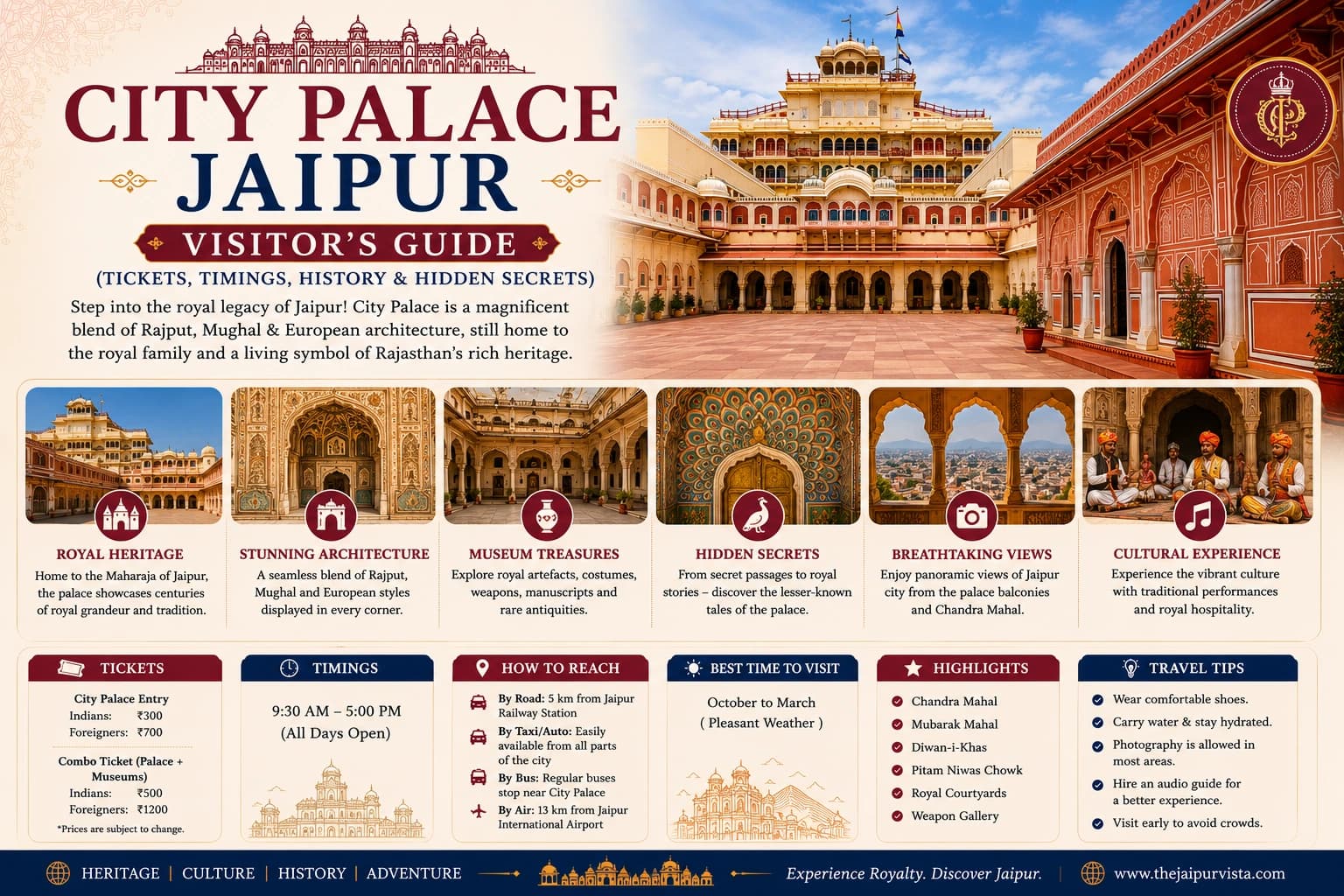
If there is one place in Jaipur that captures everything this city stands for - royalty, grandeur, art, and living heritage - it is the City Palace Jaipur. Sitting at the very heart of the walled city, this magnificent palace complex is not just a tourist attraction. It is the soul of Jaipur itself. Whether you are a first-time visitor trying to plan your trip, a history enthusiast chasing Rajput stories, or a photographer hunting for that perfect shot framed in marble arches, this guide covers everything you need to know about the City Palace before you walk through its gates. The Jaipur City Palace is a sprawling royal complex located in the old walled city (also called the Pink City) of Jaipur, Rajasthan. Covering roughly one-seventh of the old city's total area, it is one of the largest palace complexes in India. What makes the City Palace truly unique is that it is not a relic frozen in the past. The royal family of Jaipur - the descendants of Maharaja Sawai Jai Singh II - still occupies a significant portion of the complex. This makes it a rare example of a living palace where history breathes alongside the present. The complex includes courtyards, museums, galleries, temples, and ceremonial halls, all seamlessly blending Rajput, Mughal, and European architectural styles into one extraordinary ensemble. The story of City Palace Jaipur begins in 1727 when Maharaja Sawai Jai Singh II founded the city of Jaipur. Jai Singh II was not an ordinary ruler - he was an astronomer, a mathematician, a diplomat, and a visionary urban planner. He commissioned the famous architect Vidyadhar Bhattacharya to design Jaipur on a grid system inspired by ancient Vedic principles (Vastu Shastra), making it one of the first planned cities in India. The Jaipur City Palace was conceived as the nucleus of this new city. Construction began simultaneously with the founding of Jaipur, and the complex grew organically over the next two centuries as successive rulers added their own contributions. The Kachwaha Rajput dynasty, rulers of the Amber kingdom (and later Jaipur), had a strong tradition of architectural patronage. Each maharaja who followed Jai Singh II left his architectural signature on the City Palace: Maharaja Sawai Pratap Singh built the iconic Chandra Mahal additions and refinements in the late 18th century. Maharaja Sawai Ram Singh II incorporated elements reflecting British influence during the colonial period. Maharaja Sawai Madho Singh II and Maharaja Sawai Man Singh II were responsible for significant preservation efforts and the establishment of the City Palace Museum. The result is a layered architectural narrative - walk through City Palace Jaipur and you are walking through 300 years of royal evolution. The old walled city of Jaipur, of which the City Palace is the most prominent landmark, was inscribed as a UNESCO World Heritage Site in 2019. This recognition acknowledges Jaipur's exceptional universal value as a planned city that influenced urban planning in South Asia. One of the most rewarding aspects of visiting Jaipur City Palace is studying its architecture, which is a stunning synthesis of three distinct traditions: Rajput Architecture brings the bold use of red and pink sandstone, ornate jharokhas (overhanging enclosed balconies), intricate jaali (lattice screen) work, and dramatic gateways. Mughal Architecture contributes the formal garden layouts (the Char Bagh style), the use of white marble, arched colonnades, and the overall sense of geometric order. European (Colonial) Influence appears in the later additions - neoclassical columns, symmetrical facades, and the integration of European decorative motifs. This architectural dialogue between cultures reflects Jaipur's historical role as a diplomatic crossroads. The Kachwaha rulers maintained strong alliances with the Mughal emperors (Amber's princes served as Mughal commanders) while also adapting to British influence in the 19th century. The City Palace Jaipur complex is large enough to take 3–4 hours to explore properly. Here is a section-by-section breakdown of the key attractions: The first major structure you encounter after entering the City Palace is the Mubarak Mahal, built in the late 19th century by Maharaja Sawai Madho Singh II. The name means "Auspicious Palace," and it was originally designed as a guest house for visiting dignitaries. Today it houses the Maharani's Palace Textile Gallery, displaying an extraordinary collection of royal garments, including silk saris, shawls from Kashmir and Persia, and ceremonial robes. The most famous exhibit is the enormous mashroo silk robe of Maharaja Sawai Madho Singh I - wide enough to hint at legends of the king's remarkable physical stature. The architecture of Mubarak Mahal is particularly notable for its intricate honeycomb lattice screens and carved pillars that blend Islamic, Rajput, and European motifs in a single facade. Adjacent to Mubarak Mahal is the Diwan-i-Khas, or Hall of Private Audience. This is where the City Palace keeps one of its most jaw-dropping exhibits: two enormous silver urns, known as the Gangajali. These silver vessels - recorded in the Guinness Book of World Records as the largest silver objects in the world - each hold approximately 4,000 litres of water. They were commissioned by Maharaja Sawai Madho Singh II for his 1901 voyage to London to attend the coronation of King Edward VII. Being deeply religious, the Maharaja refused to drink non-sacred water abroad and transported Ganga water in these vessels. Each urn is made of 14,000 silver coins melted together. Standing beside these urns gives you a tangible sense of the extraordinary lengths to which Jaipur's maharajas went to uphold their values and traditions. The Diwan-i-Aam is the grand ceremonial hall where the maharaja once addressed his subjects and heard their petitions. Today it serves as the Art Gallery of City Palace Jaipur, housing a remarkable collection of manuscripts, miniature paintings, weapons, and decorative arts. The hall itself is architecturally stunning - a colonnaded open pavilion with rows of grey marble columns, a painted ceiling, and walls adorned with murals depicting scenes from Rajput court life. The weapon collection here includes finely crafted swords, shields, bows, guns, and daggers - many inlaid with precious stones, ivory, or gold - offering a vivid picture of the martial culture of the Rajput aristocracy. The Chandra Mahal is the crown jewel of City Palace Jaipur - a seven-storey tower that rises above the entire complex and remains the official residence of the royal family of Jaipur to this day. Each of its seven floors has a distinct name and character: Sukh Niwas (Ground Floor) - Hall of Pleasure Ratan Mandir (First Floor) - Hall of Gems, known for its glass and mirror work Vikram Mandir (Second Floor) - adorned with murals and paintings Shobha Niwas (Third Floor) - Hall of Beauty Chhavi Niwas (Fourth Floor) - Hall of Images, with blue and white tiles Shri Niwas (Fifth Floor) - adorned with intricate floral motifs Mukut Mandir (Sixth Floor/Top) - The Crown Temple, visible from much of Jaipur General visitors can view the exterior of Chandra Mahal and enter the ground floor area. However, a special Chandra Mahal VIP Tour allows access to higher floors - more on this in the tickets section below. From the upper floors, the views over the walled city of Jaipur - the terracotta rooftops, the distant Nahargarh Fort on the ridge, and the minaret of the mosques punctuating the skyline - are extraordinary. This inner courtyard is one of the most photographed spots in all of Jaipur City Palace. It features four ornate gateways, each representing a different season and associated with a different Hindu deity: Peacock Gate (South) - representing autumn, dedicated to Lord Vishnu. The gate is covered in intricate peacock feather motifs in vivid blue-green tiles. Lotus Gate (North) - representing summer, dedicated to Goddess Shakti. The floral designs are delicate and feminine. Green Gate / Leheriya Gate (East) - representing spring, dedicated to Lord Ganesha. Rose Gate (West) - representing winter, dedicated to Lord Shiva. The rose petal carvings are extraordinarily fine. Each gate is a masterpiece of craftwork and colour. The Peacock Gate in particular has become the iconic symbol of City Palace Jaipur - it features on countless postcards and travel guides. Plan to spend time here; the changing light at different hours of day transforms the colours dramatically. Within the City Palace complex (though technically in an adjacent compound accessible from within) is the famous Govind Dev Ji Temple, one of the most important Vaishnava temples in Rajasthan. The presiding deity - an idol of Lord Krishna as Govind Dev Ji - is considered the personal deity (Ishta Devata) of the Jaipur royal family. The temple draws thousands of devotees daily, particularly during the seven daily darshan (viewing) sessions. Attending one of these sessions - when the shrine opens to reveal the deity amid blasts of conch shells, bells, and devotional music - is a deeply moving experience regardless of your faith. Often overlooked by hurried visitors, the Baggi Khana is a fascinating collection of royal carriages, palanquins, and buggies used by the Jaipur maharajas. The vehicles range from ornate ceremonial elephant howdahs to imported European carriages - each telling a story of statecraft and ceremony. One of the most searched questions about visiting City Palace Jaipur is about ticket prices and what each ticket covers. Here is a complete breakdown: Note: Ticket prices are subject to revision. Check the official booking window or the palace website for the latest rates before visiting. Jaipur offers a composite tourist ticket that covers multiple heritage sites at a discounted price. The composite ticket typically includes: City Palace Museum, Jantar Mantar, Hawa Mahal, Nahargarh Fort, Albert Hall Museum, Amber Fort, and Sisodia Rani Garden. If you plan to visit more than two or three major sites, the composite ticket almost always works out significantly cheaper and also saves time at each entry point. For those wishing to visit the upper floors of the royal residence (Chandra Mahal), a separate VIP tour is available. This exclusive tour takes small groups through the private apartments, offering access to royal artefacts, the personal art collection, and the stunning rooftop views. The VIP tour must be booked in advance and costs significantly more than standard entry - typically in the range of ₹2,500–₹3,000 per person. Group sizes are limited (usually 2–8 people per slot) making it an intimate experience. Photography is permitted in most public areas of City Palace Jaipur. A separate camera fee may be charged at the ticket counter. Note that photography is restricted in certain galleries (particularly where original manuscripts and textiles are displayed, as flash photography damages them). Drone photography requires prior permission from the palace authorities and is generally not available to casual visitors. City Palace Jaipur tickets can be purchased: At the Gate: Tickets are available at the main ticket counter near the Virendra Pol (main entrance). In peak tourist season (October–March), queues can be long - arriving before 10 AM is advisable. Online: Tickets for the standard entry and the composite tourist ticket can be booked through the Rajasthan Tourism portal and affiliated booking platforms. Online booking saves time and sometimes offers small discounts. For the VIP Chandra Mahal Tour: Must be booked through the official palace booking desk, ideally a day in advance. Contact the palace directly or book through authorised tour operators. Opening Hours: 9:30 AM to 5:00 PM, seven days a week (including public holidays) Last Entry: 4:30 PM Museum Galleries: Same hours as the main palace Govind Dev Ji Temple Darshan Timings: The temple has seven darshan sessions throughout the day - approximately 4:30 AM, 7:30 AM, 9:30 AM, 11:30 AM, 5:30 PM, 7:30 PM, and 8:30 PM. The evening sessions (particularly the 7:30 PM aarti) are especially atmospheric. Best Time to Visit City Palace Jaipur: The ideal visiting time is early morning, around 9:30 AM when it opens. The palace complex catches beautiful golden morning light, the crowds are thinner, and the temperature (crucial in Jaipur's warm climate) is more comfortable. Best Season: October through March is Jaipur's peak tourist season and the most pleasant weather for sightseeing. The Jaipur Literature Festival (January) and various royal cultural events bring additional life to the City Palace complex during this period. Avoid visiting between 12 PM and 3 PM in summer (April–June) when temperatures can exceed 42°C. If you must visit in summer, carry water, wear light clothes, and use the shaded arcade walkways where possible. City Palace Jaipur sits in the heart of the walled city, approximately 4 kilometres from the Jaipur railway station and about 14 kilometres from Jaipur International Airport. By Auto-Rickshaw / E-Rickshaw: The most authentic and economical way to reach the palace from anywhere in central Jaipur. Ask for "City Palace" or "Tripolia Bazaar" - every auto driver in Jaipur knows the route. From the main bus stand (Sindhi Camp), the ride takes approximately 15–20 minutes. By Cab / Taxi: Available through Ola, Uber, and local operators. Recommended if you are travelling with luggage or in a group. By Local Bus: Several RSRTC routes pass through or near the old city. For first-time visitors unfamiliar with local bus routes, auto-rickshaws are easier. Parking: Limited vehicle parking is available near Tripolia Gate and Atish Market. The lanes around the palace are narrow and congested - if you are driving your own vehicle, park at Ajmeri Gate or Sanganeri Gate and take an auto or walk the remaining distance. Walking from Hawa Mahal: If you are coming from Hawa Mahal (which is close by), the City Palace is a 10–15 minute walk through the bustling lanes of the old city, passing through the vibrant Johari Bazaar. This walk is an experience in itself. Hire an Authorised Guide: The stories behind every arch, every painting, and every artefact are extraordinary - but you will miss most of them without a guide. The palace employs trained and accredited guides available at the entrance. A guided tour typically takes 2–2.5 hours and transforms the experience from a visual walkthrough to a living history lesson. Dress Code: There is no strict formal dress code, but modest dressing is recommended and appreciated. Avoid beachwear or very short clothing out of respect for the palace's cultural and religious significance. Comfortable shoes are essential - the complex involves a fair amount of walking on stone surfaces. Beat the Crowds: Despite opening at 9:30 AM, most tour groups arrive between 10 AM and 11:30 AM. Arriving at opening time gives you a quieter, more personal experience - especially in Pitam Niwas Chowk and the galleries. Stay for Longer Than You Think: Most visitors allot one to two hours. For a thorough experience - including the temples, all galleries, the courtyards, and the VIP sections if booked - plan for at least 3.5 to 4 hours. Combine With Jantar Mantar: The world-famous astronomical observatory Jantar Mantar (also a UNESCO World Heritage Site) is just a 5-minute walk from City Palace Jaipur. Built by the same founder, Maharaja Sawai Jai Singh II, combining both visits in one day is both logical and deeply rewarding. Evening at the Palace: While the museum closes at 5 PM, the outer courtyards and Govind Dev Ji Temple draw beautiful crowds in the early evening. Combine a visit to the temple's evening aarti with dinner at one of the rooftop restaurants overlooking the old city for an unforgettable Jaipur evening. Watch Out for Tourist Traps: In the lanes near the palace, visitors are frequently approached by touts offering "free" guided tours into nearby shops. These almost always end with high-pressure sales for jewellery, textiles, or handicrafts. Politely decline and stick to authorised guides hired at the palace itself. Many visitors to Jaipur wonder about the order and relative importance of City Palace Jaipur versus Amber Fort (Amer Fort), the earlier Kachwaha capital located 11 km from the city. City Palace Jaipur tells the story of Jaipur's urban, courtly, and diplomatic life from 1727 onwards - it is the story of the Pink City. Amber Fort tells the earlier story of the Kachwaha dynasty's mountain stronghold and the transition from Amber to Jaipur. If your time is limited, visit City Palace first. It contextualises the history of Jaipur and provides a foundation for understanding Amber Fort's significance. Ideally, Visit Amber Fort in the morning (it is best in early light and can be physically demanding), and then City Palace Jaipur in the afternoon. The City Palace is not merely a museum - it is an active royal establishment that hosts several significant annual events: Gangaur Festival (March–April): One of Rajasthan's most beloved festivals, celebrating Goddess Parvati. The Gangaur procession originates from the City Palace and winds through the old city in a spectacular display of traditional costumes, palanquins, and royal elephants. Teej Festival (July–August): Another significant festival for women in Rajasthan, celebrated with a procession from the palace carrying the idol of Goddess Teej. Polo Matches: The Royal family of Jaipur has a long association with polo. Jaipur polo grounds (near the palace complex) host matches during the season (October–March), and the maharaja's family remains actively involved. Jaipur Literature Festival (January): While held primarily at Diggi Palace, the JLF often features events and discussions connected to the cultural heritage of City Palace Jaipur and the Jaipur royal family. Attending any of these festivals transforms a standard heritage visit into an immersive cultural experience - and The Jaipur Vista publishes detailed event guides for each festival season. One of the most fascinating dimensions of City Palace Jaipur is the continued presence of the royal family. Maharaja Sawai Padmanabh Singh - born in 1998 and educated at some of India's finest institutions - is the current titular head of the Jaipur royal family. His grandmother, the late Maharani Gayatri Devi, was one of the most celebrated women of 20th century India - a politician, socialite, and conservationist who appeared on multiple international lists of the world's most beautiful people. The family's engagement with heritage preservation is genuine and ongoing. The Maharaja Sawai Man Singh II Museum Trust manages the City Palace Museum with a professional team dedicated to conservation, cataloguing, and interpretation of the royal collection. Visitors occasionally encounter family members or royal staff during visits - a reminder that unlike most historical monuments, Jaipur City Palace is a home as much as a heritage site. City Palace Jaipur is surrounded by several must-visit attractions within walking distance: Jantar Mantar (5 minutes' walk): Jai Singh II's extraordinary astronomical observatory with 19 geometric instruments, many still accurate today. An absolute must-see. Hawa Mahal (10 minutes' walk): The iconic five-storey "Palace of Winds" with its 953 small windows. Best photographed from the street. Johari Bazaar and Bapu Bazaar (5–10 minutes' walk): The old city's famous jewellery and textile markets. Whether you are buying or just exploring, these bazaars are a sensory feast. Albert Hall Museum (20 minutes by auto): Rajasthan's oldest museum in a magnificent Indo-Saracenic building. Excellent Egyptian mummy exhibit and decorative arts collection. Nahargarh Fort (25 minutes by auto): The fort on the Aravalli ridge overlooking Jaipur, offering panoramic views of the city. Particularly stunning at sunset. In a city full of extraordinary heritage - forts, temples, bazaars, havelis - City Palace Jaipur stands apart because it is complete. It is history and living culture in one place. It is royal ambition expressed in marble and sandstone. It is Rajput pride, Mughal aesthetics, and the cosmopolitan spirit of Jaipur all under one arched gateway. To visit the City Palace is not merely to tick a box on a tourist checklist. It is to understand why Jaipur is called the Gem of India - why UNESCO recognised this city, why travellers from every corner of the world find something here that moves them. Walk slowly. Look up at the painted ceilings. Watch how the light falls through the lattice screens. Listen to the bells of Govind Dev Ji Temple carry across the rooftops. Stand in Pitam Niwas Chowk and let the Peacock Gate take your breath away. City Palace Jaipur rewards those who give it time and attention with memories that last a lifetime. Q: How long does it take to visit City Palace Jaipur? Q: Is City Palace Jaipur open on all days? Q: Can I buy City Palace Jaipur tickets online? Q: Is photography allowed inside City Palace Jaipur? Q: What is the best time to visit City Palace Jaipur? Q: Is City Palace Jaipur and Amber Fort the same? Q: Are there restaurants inside City Palace Jaipur? What Is the City Palace Jaipur?
Learn more: Jai Mahal Palace Jaipur: Complete Guide to Jaipur's Most Royal Stay
History of City Palace Jaipur: A Royal Legacy Built Over Centuries
The Founder: Maharaja Sawai Jai Singh II
Growth Under the Kachwaha Dynasty
UNESCO World Heritage Connection
Read Also: History of Jaipur: The Royal Legacy of India’s Pink City
Architecture of the City Palace: Where Three Worlds Meet
What to See Inside City Palace Jaipur: A Section-by-Section Guide
1. Mubarak Mahal (Welcome Palace)
2. Sarvato Bhadra (Diwan-i-Khas / Hall of Private Audience)
3. Diwan-i-Aam (Hall of Public Audience)
4. Chandra Mahal (Moon Palace) - The Royal Residence
5. Pitam Niwas Chowk (Peacock Courtyard)
6. Govind Dev Ji Temple
7. Baggi Khana (Royal Carriage Museum)
City Palace Jaipur Tickets: Complete Price Guide (2024)
Standard Entry Tickets
Composite Ticket (Best Value Option)
Chandra Mahal VIP Tour Tickets
Photography Charges
How to Book City Palace Jaipur Tickets
City Palace Jaipur Timings
How to Reach City Palace Jaipur
Insider Tips for Visiting City Palace Jaipur
City Palace Jaipur vs. Amber Fort: Which Should You Visit First?
Special Events and Royal Functions at City Palace Jaipur
The Royal Family of Jaipur: Living History
Nearby Attractions: Making the Most of Your Time in the Old City
Plan Your Visit: Quick Reference Card
Why City Palace Jaipur Belongs on Every Traveller's List
Frequently Asked Questions About City Palace Jaipur
A minimum of 2 hours is needed for a basic visit. For a thorough experience including all galleries and sections, plan 3.5 to 4 hours. Add another hour if you include Govind Dev Ji Temple and Jantar Mantar.
Yes, Jaipur City Palace is open seven days a week, including Sundays and public holidays, from 9:30 AM to 5:00 PM.
Yes, tickets are available online through Rajasthan Tourism and affiliated platforms, as well as at the gate. Online booking is recommended during peak season (October–March) to avoid queues.
Photography is permitted in most areas. Some specific galleries have restrictions to protect fragile artworks. A separate camera fee may apply. Tripods and drones require special permission.
Early morning (opening time, around 9:30 AM) for thinner crowds and beautiful light. October to March for the most comfortable weather.
No. City Palace Jaipur is located in the heart of the old city of Jaipur and was built from 1727 onwards. Amber Fort (Amer Fort) is located 11 km away in the hills and was the earlier capital. Both are distinct and worth visiting.
There is a café/refreshment area within the complex. For full meals, there are several heritage restaurants in the surrounding lanes and nearby Narain Niwas area serving traditional Rajasthani thali.
Accessibility has improved in recent years, but the complex involves significant stone paving and some steps. Ground-floor areas of most sections are accessible. Visitors with mobility concerns should contact the palace administration in advance.