Nahargarh Fort Jaipur: Complete Visitor's Guide 2026 (Tickets, Timings, History & Best Photos)
Author:Nidhi
Published:May 31, 2026
Views:2583
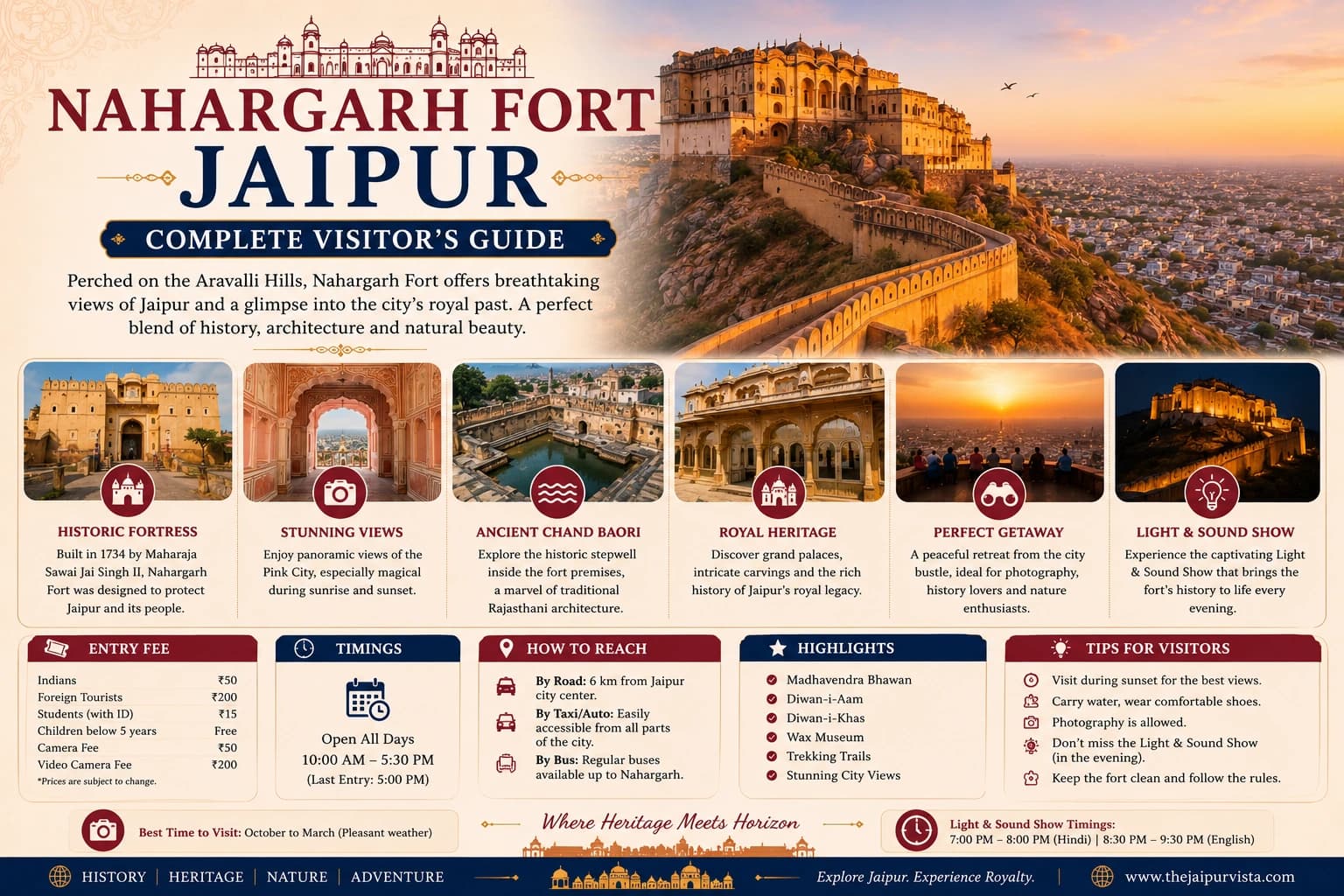
There is a place in Jaipur where the city does not simply surround you - it unfolds beneath you. Standing on the ramparts of Nahargarh Fort, with the entire pink sprawl of Jaipur glittering in every direction and the ancient Aravalli hills rising at your back, you feel something that no monument inside the city can quite replicate: a sense of commanding perspective. Not just of the landscape, but of time itself. Nahargarh Fort - whose name translates as the "Abode of Tigers" - has stood sentinel over Jaipur since 1734, watching the city grow from a planned royal capital into the thriving, vibrant metropolis it is today. It has sheltered kings and sheltered refugees. It has never once been conquered. And today, it offers visitors one of the most spectacular panoramic views in all of Rajasthan, a remarkably preserved royal palace complex, a world-class wax museum, and - after dark - the most dramatic nighttime skyline view in the Pink City. At The Jaipur Vista, we know Nahargarh Fort the way only locals do. This complete guide covers everything you need: Nahargarh Fort ticket prices, timings, the complete history and architecture, the best photography spots for stunning Nahargarh Fort photos, all the things to do inside, where to eat, how to reach, and the insider tips that most visitors never discover. Getting the Nahargarh Fort ticket is straightforward - tickets are purchased at the main entrance gate. Here is the complete, updated pricing structure: The main Nahargarh Fort ticket gives you access to the fort premises and Madhavendra Bhawan. Certain specific attractions within the fort complex require additional tickets: Note: Prices for the Wax Museum and Sheesh Mahal are updated periodically. Always confirm current pricing at the ticket counter on the day of your visit. Personal photography within the fort premises is generally permitted at no additional charge for mobile phones and standard cameras. The Madhavendra Bhawan royal suites may have specific photography guidelines - follow the signage within. Value Assessment: At ₹50 per Indian adult, the Nahargarh Fort ticket price represents extraordinary value - this is a 700-foot hilltop fort with a complete royal palace, multiple museums, a sculpture park, two on-site restaurants, and the finest panoramic view in Jaipur, all for the price of a cup of chai. It is one of the best-value experiences in all of Rajasthan. Nahargarh Fort is one of the very few major forts in Rajasthan that remains open until 10:00 PM - making it exceptional among Jaipur's heritage sites and one of the best places in the city for a magical sunset and evening experience. Early Morning (10:00–11:30 AM): The Aravalli hills glow in the first light of day, the air is cool and fragrant with forest scent, and the crowds are at their thinnest. Ideal for exploring the interior halls and frescoes of Madhavendra Bhawan in peace. Late Afternoon and Sunset (4:00–7:00 PM - Highly Recommended): This is the single best window to visit Nahargarh Fort. As the sun descends toward the western horizon, the light turns warm and golden, painting the fort's sandstone walls in deep saffron tones. The panoramic views of Jaipur at this hour are breathtaking, and the sunset from the fort's ramparts is considered one of the finest sunset experiences in all of Rajasthan. Do not miss this. Evening and Night (7:00–10:00 PM): After dark, Nahargarh Fort offers something truly unique - a view of Jaipur illuminated at night, its streets and landmarks glittering with thousands of lights across the valley. The fort itself is softly lit, and the restaurants operate until closing time. An evening visit combined with dinner at Padao or Once Upon a Time at Nahargarh is one of Jaipur's most memorable experiences. Noon Hours (12:00–3:00 PM): The least recommended time, especially in summer, as Rajasthan's midday heat can be brutal at this exposed hilltop location. If you must visit midday in summer, carry plenty of water and protect yourself from direct sun. When Maharaja Sawai Jai Singh II founded the planned city of Jaipur in 1727, he was thinking centuries ahead. His new capital needed three lines of defence: a city wall, a strategic fort overlooking the plains, and a high citadel commanding the Aravalli ridge above. Nahargarh Fort, built in 1734 - just seven years after Jaipur was founded - fulfilled that third and highest role. The fort was originally christened "Sudarshangarh" - a name honouring Lord Vishnu's divine discus (sudarshana chakra), symbolising divine protection over the new city below. Perched at approximately 700 feet above the city on the Aravalli ridge, it commanded a 360-degree view over every approach to Jaipur and was essentially impregnable for any attacking force of the era. The story of how Sudarshangarh became Nahargarh is one of Jaipur's most captivating legends, told in every corner of the city. According to legend, the construction of the fort was repeatedly obstructed by mysterious disturbances - walls that collapsed inexplicably, work that undid itself overnight, and strange occurrences that no earthly explanation could account for. The royal priests and astrologers were consulted, and they concluded that the spirit responsible for these disturbances was that of a Rathore Rajput prince named Nahar Singh Bhomia, whose soul was restless because it felt its territory was being encroached upon. To appease the spirit of Nahar Singh, Maharaja Jai Singh II agreed to the spirit's requests: the fort would be renamed in Nahar Singh's honour, and a temple dedicated to Nahar Singh Bhomia would be built and permanently maintained within the fort premises. Once these conditions were met, the legend holds, the construction proceeded without further obstacles. To this day, the Nahar Singh Bhomia temple stands within the fort, and local devotees regularly offer prayers there. The story reveals the sophisticated way in which Rajput rulers navigated local spiritual traditions and folk beliefs as they built their kingdoms. Nahargarh Fort's most dramatic historical role came not in military battle but in humanitarian protection. During the Indian Rebellion of 1857, as violence swept across North India and the positions of British colonial officials and European civilians became perilous, the Maharaja of Jaipur offered Nahargarh Fort as a place of refuge. The British Residents, their wives, and other European civilians based in the Jaipur region were sheltered within the fort's fortified walls throughout the most dangerous period of the uprising. The fort's strategic position, its stockpiled provisions, and its near-impregnability made it an ideal safe haven. Not a single life was lost under its protection. Nahargarh Fort also played a significant diplomatic role during the turbulent period of Maratha expansion in Rajputana. When the Maratha Confederacy repeatedly threatened Rajput kingdoms, the Jaipur state used Nahargarh as a site for critical negotiations and treaty discussions. The fort's impregnable position gave the Jaipur ruler the confidence to negotiate from strength - a classic example of defensive architecture serving diplomatic purpose. The fort was significantly extended in 1868 by Maharaja Ram Singh II, and again between 1883 and 1892 by Maharaja Sawai Madho Singh I, who commissioned the magnificent Madhavendra Bhawan - the royal palace complex visitors explore today. Until April 1944, Nahargarh Fort served an unexpected scientific function: a gunshot was fired each day from the fort at precisely the solar noon reading from the Samrat Yantra at Jantar Mantar observatory below, synchronising the city's clocks. For over two centuries, Nahargarh literally kept Jaipur on time. The most immediately striking feature of Nahargarh Fort is its massive battlemented perimeter wall, stretching for several kilometres along the Aravalli ridge and connecting to Jaigarh Fort to the east. Built from the distinctive buff-coloured Aravalli stone, the walls are thick enough to resist cannon fire and punctuated by bastions at regular intervals, each providing commanding field coverage over the approaches below. The main gateway - the Tadigate - features an entrance archway and a small temple dedicated to the deity of the Jaipur monarchs. This placement of a sacred space at the threshold is characteristic of Rajput fortress design, symbolically placing the fort under divine protection before military defence even begins. The architectural jewel of Nahargarh Fort is the Madhavendra Bhawan - a remarkable two-storey royal palace that represents a fascinating exercise in domestic royal architecture, designed to accommodate the Maharaja's twelve queens in conditions of both comfort and deliberate separation. The palace is arranged as a series of nine nearly identical suites, each allocated to one of the principal queens. Each suite is fully self-contained - its own entrance vestibule, bedchamber, kitchen, bathroom, and storage room - a complete, private domestic world within the larger palace. What makes this architecturally extraordinary is the ingeniously designed corridor system: the Maharaja could access any queen's suite from his central private corridor without passing through any other queen's space - ensuring complete privacy and the discretion of royal visits. No queen could know which suite the Maharaja was visiting on any given night. This architectural solution to the complex social dynamics of royal polygamy is a masterpiece of functional design. The connecting corridors of Nahargarh Fort are lined with exquisite frescoes executed in the Indo-European style. These paintings draw freely from both Rajput and Victorian European traditions, creating a cultural fusion that is uniquely Jaipur. The frescoes depict processions of elephants and horses in royal regalia, hunting scenes, delicate floral patterns inspired by Victorian wallpaper designs, and scenes from Hindu mythology. The meenakari work (enamel inlay) alongside the painted surfaces adds colour and texture that has survived remarkably well over more than a century. The Victorian floral paintings - large, botanically accurate renderings of European garden flowers - appear almost incongruously beside traditional Rajput motifs. This is not contradiction; it is a confident cultural statement by a ruler who embraced both his Rajput heritage and the global artistic currents of his time. High on the Aravalli ridge, water supply was a fundamental challenge. The builders solved this brilliantly with a sophisticated rainwater harvesting system - a large stone-lined tank collects rainwater channelled from the fort's extensive rooftops and courtyards through carved stone channels. The tank is deep, covered, and capacious enough to sustain the fort's population through extended dry seasons. The engineering, executed without modern tools or cement, demonstrates extraordinary practical ingenuity. The primary heritage experience within the fort, Madhavendra Bhawan deserves at least an hour of careful exploration. Walk through the identical queen suites, decipher the corridor logic, admire the frescoes, and stand on the upper terrace for your first preview of the extraordinary views that await. Look for the subtle architectural details: the slight variations in each queen's suite, the placement of windows to maximise natural light, and the thick walls that keep interiors cool even in summer. Housed in the former Vishram Grah (soldiers' rest house) and Shastragarh (artillery house) on the left side of the fort entrance, the Jaipur Wax Museum surprises most visitors with its quality. The museum houses more than 35 ultra-realistic silicon and wax figures representing Bollywood stars, national sports champions, freedom fighters, social reformers, and the Maharajas and Maharanis of Jaipur. Developed in partnership with the Department of Archaeology and Museums, Rajasthan, it has official cultural credibility alongside strong entertainment value. Budget approximately 45–60 minutes for a complete tour. One of the most spectacular additions to Nahargarh Fort is the Sheesh Mahal - a breathtaking hall constructed using 25 million individual pieces of glass, combined with traditional Thikri mirror work, gold polish inlay, and conventional mirror panels. The effect inside is nothing short of overwhelming - every light source multiplies infinitely in every direction, creating a total immersion of light and reflection. It is simultaneously an ancient craft tradition (Sheesh Mahals appear in Rajput palaces across Rajasthan) and a bold contemporary interpretation at extraordinary scale. The Sheesh Mahal creates genuinely surreal photographs and is among the most shared Nahargarh Fort photos on social media. The Nahargarh Sculpture Park occupies chambers and open courtyards within Madhavendra Palace, housing curated contemporary sculptures by significant Indian artists. The juxtaposition of modern art within a 19th-century royal palace is deliberate and provocative - the sculptures dialogue with the architectural context in productive tension. The park has been an important platform for contemporary Indian sculpture within a heritage context. The fort's perimeter walls and ramparts offer the finest panoramic view of Jaipur available from any public viewpoint in the city. On a clear day - particularly common between October and March - the view extends for 50 kilometres in every direction: To the south and east, the entire Pink City unfolds - terracotta-pink rooftops, white temple domes, and towers stretching to the horizon. To the northeast, the golden battlements of Jaigarh Fort rise from the same ridge. Below and east, the dramatic profile of Amer Fort is visible above the Maota Lake. To the north and west, the Aravalli hills roll away in successive forested ridges. After dark, the view of Jaipur illuminated at night from these ramparts is one of the most spectacular cityscapes in India - an ocean of golden light beneath a sky full of stars. No photograph fully captures it. You must see it for yourself. Just below Nahargarh, nestled in a natural cove between the Aravalli foothills, lie the Royal Gaitor Tombs (Gatore Ki Chhatriyan) - the cenotaphs of the Jaipur royal family, including Maharaja Sawai Jai Singh II himself. These elaborately carved white marble and sandstone cenotaphs are among the most refined examples of Rajput funerary architecture in India, and they are deeply moving in their quiet, beautiful solemnity. Approximately 1 kilometre from the fort, easily combined with a Nahargarh visit. The sunset from Nahargarh Fort's ramparts is not merely a photo opportunity - it is a Jaipur institution. Locals bring picnics. Young couples share the view quietly. Travellers from across the world stand in shared, wordless appreciation as the sky transforms from gold to amber to deep rose and finally to the purple-grey of twilight over the Pink City. This is one of those experiences that requires no explanation and leaves no one indifferent. The Nahargarh Fort photos that stop the scroll on Instagram and Pinterest share something in common: they capture either the sheer scale of the fort against its landscape, the intimate detail of the frescoed interiors, the dreamlike infinity of the Sheesh Mahal, or the golden-hour panorama of Jaipur from the ramparts. The Rampart Panorama - Golden Hour (5:00–6:30 PM): The definitive Nahargarh Fort photo. Position yourself on the western-facing rampart about an hour before sunset. As the sun drops toward the Aravalli ridgeline, the light turns cinematic - warm, directional, rich with colour. The Pink City spreads below, and the fort's crenellated walls create a natural foreground frame. A wide-angle lens capturing both wall and city is the classic composition. The Approach Road - Morning (9:30–10:30 AM): The winding road climbing from Jaipur through the Aravalli forest offers several magnificent pull-out spots where the fort's battlemented walls rise dramatically above the tree canopy. The morning light on warm stone is beautiful and the forest context adds scale. Madhavendra Bhawan Courtyard - Soft Morning Light: The inner courtyard, with its symmetrical arches and painted walls, photographs beautifully in the soft, diffused morning light before direct sunlight enters. Frescoes are richly coloured and architectural detail rewards close-up shots. Inside the Sheesh Mahal - Any Time: The mirror interior creates dramatic images regardless of time of day. Position a person centrally and shoot toward the ceiling for infinity-reflection compositions. Long-exposure shots create a stunning blur effect of moving visitors against the static mirrors. The Fort Wall Silhouette - Sunset: Walking along the base of the fort wall at sunset, with jagged battlements silhouetted against an orange and purple sky, creates one of the most iconic Rajasthan landscape compositions. Night View of Jaipur - After 7:30 PM: After dark, the view from the ramparts showing Jaipur's illuminated skyline is extraordinary. Use a tripod or stabiliser for long-exposure shots. The combination of fort stone walls in the foreground and the glittering city stretching to the horizon creates genuinely arresting images. Golden hour (5:00–6:30 PM) is non-negotiable for the best rampart panorama shots. The fort is open until 10 PM, so night photography on a tripod is possible and rewarding. Avoid flash photography in the frescoed interior rooms - it causes colour casts and glare on the delicate painted surfaces. Drone photography requires advance permission from the Archaeological Survey of India and Rajasthan Civil Aviation Authority. Do not fly without this clearance. A polarising filter (or polarising mode on smartphones) enriches blue skies and reduces glare off the pale stone surfaces dramatically. The approach road viewpoints are best in the morning - afternoon light comes from the wrong direction for these shots. Located within the palace premises, Once Upon a Time is the most atmospheric dining option in the complex. The restaurant occupies a heritage space with royal-inspired decor - carved furniture, traditional Rajasthani fabrics, antique accessories - and both indoor and outdoor seating. The outdoor terrace offers an outstanding view of Jaipur below, making it one of the most romantic dining settings in the entire city. The menu spans traditional Rajasthani dishes (dal baati churma, laal maas, gatte ki sabzi) and North Indian and international options. Ideal for a leisurely lunch or a sunset dinner. Padao is probably the most famous restaurant associated with Nahargarh Fort - beloved by Jaipur locals and travellers alike for its simple, irresistible proposition: great food, cold drinks, and the best sunset view in the city at surprisingly reasonable prices. Located just a short distance from the fort, Padao's rooftop seating offers a panoramic view of Jaipur that rivals anything from the fort's ramparts. On busy evenings, every table fills before sunset - come early, stake out a good table, and settle in for one of Jaipur's classic experiences. The menu covers Rajasthani thalis, kebabs, North Indian mains, and a solid selection of beverages. Operating within the fort precincts, this venue offers a more formal dining environment with a curated menu spanning Rajasthani and international cuisine. Ideal for visitors seeking a complete dining experience in an exclusive royal setting, or for those considering an overnight stay at the fort itself. October to March (Best Season): Unambiguously the ideal time. Rajasthan winters are mild and pleasant - daytime temperatures of 15°C to 25°C make the hill walk comfortable and the open-air rampart experience enjoyable. Clear winter skies give the sharpest, most far-reaching panoramic views of Jaipur. April to June (Hot and Dry): Rajasthan summers can be ferocious, regularly exceeding 42°C in May. At 700 feet, Nahargarh does benefit from some breeze, but the exposed hilltop offers little shade. If visiting in summer, choose the evening window (6:00–9:00 PM). July to September (Monsoon): The monsoon transforms the Aravalli hills into unexpected, startling green - the parched scrub becomes lush canopy almost overnight. Nahargarh in monsoon light has dramatic, moody beauty that photographers find irresistible. Be aware that the road can become slippery after heavy rain. Weekday mornings and afternoons (Monday–Thursday) offer quieter, more peaceful exploration of the interiors. Weekends and national holidays are busier, particularly at sunset viewing times, though the experience remains wonderful. Full Address: Krishna Nagar, Brahampuri, Jaipur, Rajasthan – 302001 By Private Taxi / App Cab (Ola/Uber): Most comfortable. Drive from central Jaipur takes 20–30 minutes. Cabs are abundantly available via app throughout Jaipur. By Auto-Rickshaw: Autos can reach the fort but the climb is steep - agree on a round-trip fare with waiting time in advance. Expect ₹200–350 for the round trip with 2–3 hours waiting. By Private Bike/Scooter: An exciting option for the adventurous - the road is well-surfaced and the ride through the Aravalli forest is beautiful. Approximately 40–50 minutes by road. Take an Ola/Uber or pre-arrange a local taxi. Approximately 50–60 minutes via NH-248. Taxis from the airport are available through app-based services and airport taxi operators. Nahargarh and Amer Fort are on the same Aravalli ridge. The drive between the two forts takes approximately 15 minutes on the ridge road - combining both in a single day is the standard Jaipur fort itinerary. The two forts are directly connected by the historic perimeter wall and also linked by the hilltop road. Most visitors combine both in a single half-day circuit. 1. Never conquered. Despite 290 years of strategic importance, Nahargarh Fort has never been attacked or conquered - a remarkable distinction for a major Rajput fortification. 2. It was Jaipur's public clock. Until 1944, a daily noon gunshot from Nahargarh synchronised with the Samrat Yantra at Jantar Mantar below, giving the entire city its official time signal. 3. The queens' suites were engineered for the Maharaja's privacy. The corridor system of Madhavendra Bhawan was specifically designed so no queen could know which suite the Maharaja was visiting. 4. Bats inhabit the upper floors. Several upper-level rooms of the fort are home to large bat colonies - an atmospheric if startling discovery for unprepared visitors. Look upward in the darker rooms. 5. The Sheesh Mahal used 25 million pieces of glass. This is not an exaggeration - every surface of the hall is covered in individually placed mirror fragments, gold inlay, and Thikri work. 6. Bollywood has filmed here extensively. Several major productions have used Nahargarh Fort's atmospheric interiors and dramatic exterior as locations, including major period films and music videos. 7. The fort wall connects to Jaigarh Fort. The perimeter wall extends east to connect with Jaigarh Fort, creating a single unified defensive system along the Aravalli ridge - one of the longest continuous fortification walls in Rajputana. 8. The Wax Museum was a soldiers' billet. Before its transformation into a museum, the Wax Museum space served as the Vishram Grah (rest house) for soldiers and the Shastragarh (weapons store) of the garrison. 9. Leopards are found nearby. The Nahargarh Wildlife Sanctuary surrounding the fort is one of the few places in India where leopards exist within a major city's boundaries. Night sightings on the road to the fort are not unheard of. 10. The fort spirit has its own temple. The Nahar Singh Bhomia temple within the fort - built to appease the spirit whose name the fort bears - is actively worshipped to this day, making it one of the few legends in Jaipur that has a living, practised religious tradition behind it. Jaigarh Fort (~1 km): Famous for the Jaivana - the world's largest cannon on wheels - and excellent museum of armaments. A natural companion to Nahargarh on the same ridge. Amer Fort (~6 km): The UNESCO World Heritage crown jewel of Jaipur's fort circuit. Its Sheesh Mahal, Diwan-i-Khas, and Ganesh Pol gateway are extraordinary. Combine Amer in the morning with Nahargarh in the late afternoon. Royal Gaitor Tombs (~1 km below): Beautifully carved cenotaphs of the Jaipur royal family, including founder Maharaja Sawai Jai Singh II. Deeply moving, often overlooked. Jal Mahal (~8 km): The ethereal palace seemingly floating in Man Sagar Lake - a natural and photogenic stop on the route between city and fort. Nahargarh Biological Park (~12 km): Tigers, lions, leopards, and impressive birdlife in the Aravalli foothills. A morning at the biological park followed by an afternoon and sunset at the fort is a wonderful full-day combination. 9:00 AM - Start at Amer Fort. Explore the palace, Sheesh Mahal, and ramparts (2.5 hours). 11:30 AM - Drive to Jaigarh Fort (15 minutes). See the Jaivana cannon and fort museum (1 hour). 1:00 PM - Lunch near Amer or en route to Nahargarh. 3:00 PM - Arrive at Nahargarh Fort. Explore Madhavendra Bhawan, Wax Museum, Sheesh Mahal (2 hours). 5:00 PM - Take position on the ramparts for the sunset panorama of Jaipur. 7:00 PM - Dinner at Padao Restaurant or Once Upon a Time at Nahargarh. 9:00 PM - Final night views of the illuminated city before departing. 3:30 PM - Arrive. Explore Madhavendra Bhawan and Wax Museum. 5:00 PM - Ramparts for golden hour and sunset. 6:30 PM - Dinner at Padao. 8:00–9:00 PM - Night views, then depart. Every city has a place where it reveals itself most completely - where the noise and busyness fall away and something essential and timeless becomes visible. In Jaipur, that place is Nahargarh Fort. From these Aravalli ramparts, you see Jaipur not as a series of disconnected tourist stops but as a living whole - its pink rooftops and glittering temples, its busy bazaars and wide boulevards, its history and its present, all laid out in one breathtaking canvas. You see the city the way Maharaja Sawai Jai Singh II must have seen it from here: as a vision brought magnificently to life. Whether you come for the architectural wonder of Madhavendra Bhawan's queens' palace, the dazzling reflections of the Sheesh Mahal, the irreverent fun of the Wax Museum, the quiet devotion at the Nahar Singh temple, or simply to stand on a 290-year-old wall and watch the sun set over a city that has been watching sunsets for three centuries - Nahargarh Fort will give it to you, fully and unforgettably. At The Jaipur Vista, we have watched this fort at every hour and in every season. Our honest advice: come at 3:30 PM, stay for sunset, have dinner at Padao, and linger for the night view. It is one of the finest evenings any city in India can offer. Q1. What is the Nahargarh Fort ticket price? Q2. What are the Nahargarh Fort timings? Q3. Why is Nahargarh Fort famous? Q4. What does "Nahargarh" mean? Q5. Is Nahargarh Fort open at night? Q6. How long does it take to visit Nahargarh Fort? Q7. What is the best time of day to visit Nahargarh Fort? Q8. How do I reach Nahargarh Fort? Q9. Can I see Amer Fort and Nahargarh Fort on the same day? Yes, absolutely. The "Jaipur Fort Triangle" combining Amer Fort, Jaigarh Fort, and Nahargarh Fort in a single day is the classic heritage itinerary. Start at Amer (morning), visit Jaigarh (midday), and end at Nahargarh for the sunset (afternoon–evening). Q10. Are there restaurants inside Nahargarh Fort? Q11. Is Nahargarh Fort good for photography? Nahargarh Fort Jaipur: Quick Reference Guide
Nahargarh Fort Ticket Price 2026
General Entry Tickets
Additional Attractions Inside (Separate Tickets)
Photography
Nahargarh Fort Timings 2026
Best Time of Day to Visit
The History of Nahargarh Fort: The Fort That Was Never Conquered
Foundation: A City Needs a Guardian
The Legend of Nahar Singh Bhomia: How the Fort Got Its Name
1857: Shelter in a Storm
The Maratha Connection
Royal Extensions: Madhavendra Bhawan
Architecture of Nahargarh Fort: What Makes It Magnificent
The Fortification Walls
Madhavendra Bhawan: The Queens' Palace
The Corridors and Frescoes
The Water Tank and Engineering
Things to Do at Nahargarh Fort Jaipur
1. Explore Madhavendra Bhawan - The Queens' Palace
2. Jaipur Wax Museum - 35 Silicon and Wax Masterpieces
3. Sheesh Mahal - The Palace of a Million Mirrors
4. The Sculpture Park Inside Madhavendra Palace
5. Walk the Ramparts - The Greatest View in Jaipur
6. Royal Gaitor Tombs - Just Below the Fort
7. Sunset Watching - Jaipur's Most Beloved Experience
Best Nahargarh Fort Photos: Photography Spots & Tips
Best Photography Spots
Photography Tips
Where to Eat at Nahargarh Fort
1. Once Upon a Time at Nahargarh
2. Padao Restaurant
3. Nahargarh Palace Hotel and Restaurant
Best Time to Visit Nahargarh Fort
By Season
By Day of Week
How to Reach Nahargarh Fort Jaipur
From Jaipur City Centre (~7–9 km)
From Jaipur Railway Station (~20 km)
From Jaipur International Airport (~28 km)
From Amer Fort (~6 km)
From Jaigarh Fort (~1 km)
Nahargarh Fort: 10 Remarkable Facts
Nearby Attractions to Combine With Nahargarh Fort
Suggested Itinerary: The Perfect Nahargarh Fort Day
The Classic Jaipur Fort Triangle (Full Day)
Nahargarh Sunset Special (Half Day - Perfect for Return Visitors)
Final Thoughts: Why Nahargarh Fort is the Soul of Jaipur
Frequently Asked Questions: Nahargarh Fort Jaipur
The Nahargarh Fort ticket price is ₹50 for Indian adults, ₹20 for Indian students (with ID), ₹200 for foreign nationals, and ₹100 for foreign students. The Jaipur Wax Museum inside the fort requires a separate ticket (approximately ₹500 for Indians).
Nahargarh Fort is open every day from 10:00 AM to 10:00 PM - one of the few major forts in Rajasthan open until 10 PM, making it perfect for sunset and evening visits.
Nahargarh Fort is famous for its extraordinary panoramic views of Jaipur, the Madhavendra Bhawan royal palace with its architecturally remarkable queens' suites, the Jaipur Wax Museum, the spectacular Sheesh Mahal, the Sculpture Park, and its unbroken 290-year record of never having been conquered.
Nahargarh means "Abode of Tigers." The fort was originally named Sudarshangarh but was renamed to honour the spirit of Rathore Rajput prince Nahar Singh Bhomia, according to local legend.
Yes. Nahargarh Fort remains open until 10:00 PM every day. The view of Jaipur's illuminated skyline from the ramparts at night is one of the most spectacular experiences in the city. On-site restaurants also serve dinner.
Allow 2.5 to 4 hours for a thorough visit including Madhavendra Bhawan, the Wax Museum, the Sheesh Mahal, and the rampart views. For a sunset dinner and night view, plan for 5–6 hours total.
The golden hour before sunset (4:30–6:30 PM) followed by an evening dinner (7:00–9:00 PM) is the quintessential Nahargarh experience. The sunset panorama combined with the night city view is unmatched anywhere in Jaipur.
From central Jaipur, the fort is approximately 7–9 km by road - 20–30 minutes by taxi or auto. App-based cabs (Ola/Uber) are the most convenient option.
Yes. Two well-regarded restaurants operate within or adjacent to the fort: Once Upon a Time at Nahargarh (inside the palace premises) and Padao Restaurant (famous for sunset views and Rajasthani cuisine). Both serve until the fort's 10 PM closing time.
Nahargarh Fort is one of the best photography destinations in Jaipur. Key shots include the Jaipur panorama from the ramparts at golden hour, the Sheesh Mahal infinity mirrors, the frescoed interiors of Madhavendra Bhawan, and the night city view. The fort is open until 10 PM, making night photography possible.
Madhavendra Bhawan is a royal palace designed for the Maharaja and his 12 queens, with nine identical suites connected by a clever private corridor system that allowed the Maharaja to visit any queen without other queens knowing. The frescoes, Victorian floral paintings, and meenakari work in the corridors are remarkable.