Jantar Mantar Jaipur: Complete Visitor's Guide 2026 (Tickets, Timings, Instruments & History)
Author:Nidhi
Published:May 31, 2026
Views:3077
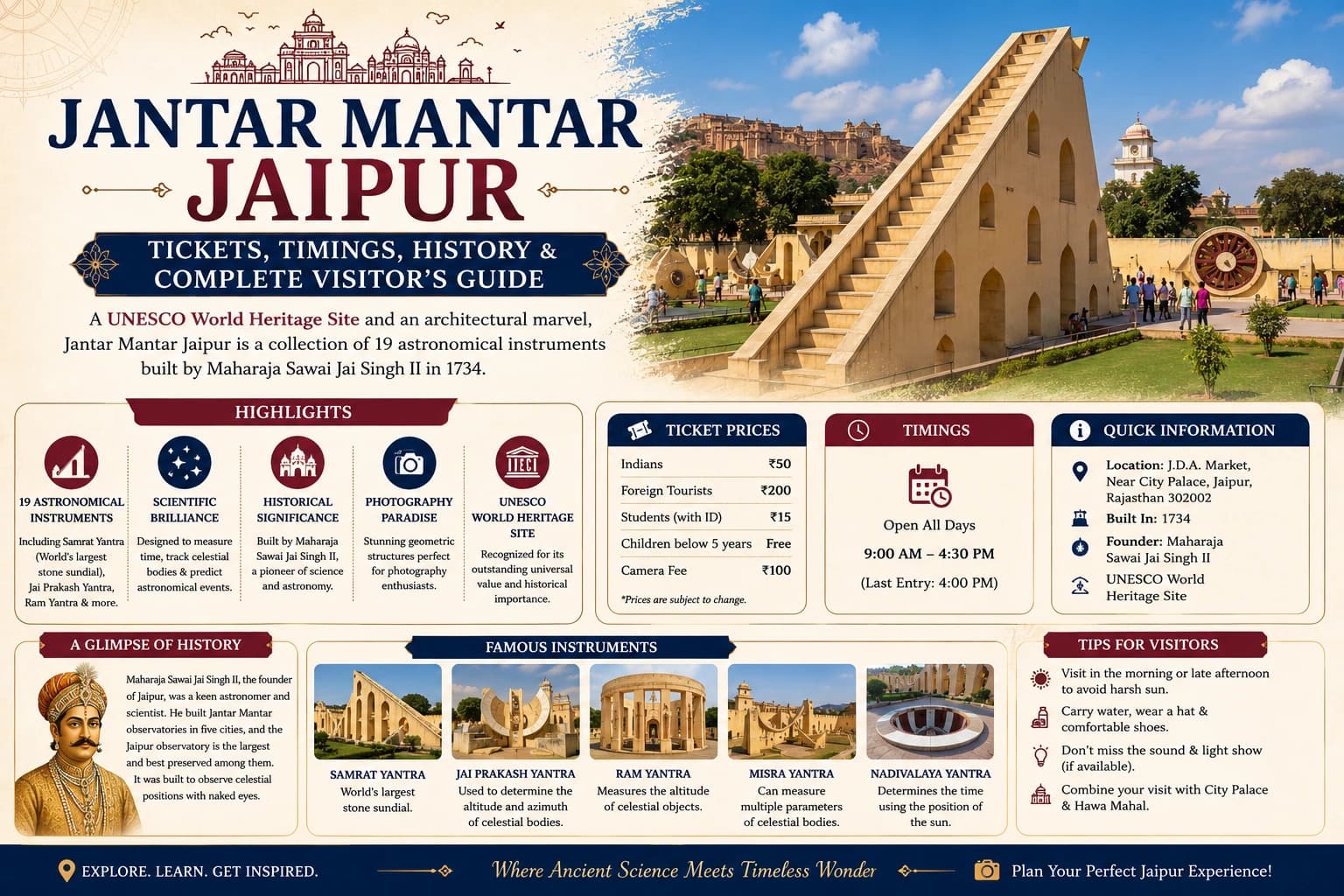
There is a moment that every visitor to Jantar Mantar Jaipur experiences - a moment of genuine, wide-eyed wonder. You walk through the entrance, you look up, and suddenly the world shifts. These are not decorative sculptures, not royal fountains, not palace arches. What stands before you is something altogether stranger and more magnificent: a collection of enormous stone machines, each one designed to read the sky with a precision that still astonishes professional astronomers today. The Jantar Mantar in Jaipur is India's largest and best-preserved astronomical observatory. Built between 1724 and 1734 by the visionary Maharaja Sawai Jai Singh II, it houses 19 monumental astronomical instruments that can measure time, track celestial bodies, predict eclipses, and calculate the positions of stars - all without a single lens, telescope, or digital component. In 2010, UNESCO inscribed Jantar Mantar Jaipur on the World Heritage List, recognising it as an outstanding universal value for science, astronomy, and human intellectual achievement. At The Jaipur Vista, we believe that Jantar Mantar is not merely a tourist attraction - it is one of the most extraordinary monuments to human curiosity ever built. This complete guide covers everything you need before your visit: Jantar Mantar Jaipur ticket prices, timings, the history behind its creation, each instrument explained clearly, insider photography tips, and how to combine it with Jaipur's other iconic landmarks. The Jantar Mantar Jaipur ticket is among the best-value entry fees at any UNESCO World Heritage Site in India. Here is the complete updated pricing structure: An audio guide is available in multiple languages - including English, Hindi, French, German, Spanish, Japanese, and several other languages - and is strongly recommended for every visitor. Without a guide or audio commentary, the function and scale of the instruments can be difficult to appreciate fully. The audio guide makes each instrument come alive with context, mathematics, and historical narrative. Insider Tip: While the Jantar Mantar ticket price is low, the true value of the visit multiplies dramatically when you invest in the audio guide or hire a licensed guide at the entrance. Visitors who explore without explanation often leave after 30 minutes; those with a guide stay for 2+ hours and leave with a profound sense of awe. Photography for personal use is generally permitted throughout the observatory. There are no additional photography charges for mobile phones and standard cameras. Professional videography and commercial photography require prior permission from the Archaeological Survey of India (ASI). The observatory is open all seven days of the week throughout the year, including weekends, national holidays, and public holidays. Best Time of Day to Visit: The Jantar Mantar is a functional observatory - many of its instruments give their most accurate readings at specific times of day when the sun is at particular angles. The following times are ideal for different purposes: Early Morning (9:00–10:30 AM): The softest light, fewest crowds, and the cool freshness of a Jaipur morning. Excellent for photography and a peaceful experience. Certain instruments like the Rashivalayas (zodiac instruments) are best observed as the sun climbs. Noon (11:30 AM–12:30 PM): The Samrat Yantra sundial shows solar noon with remarkable precision. If you want to see the instruments at their most "live" and functional, visiting around noon is rewarding - you can actually read the time from the Samrat Yantra to within two seconds. Late Afternoon (3:00–4:30 PM): Pleasant light for photography, though the observatory closes at 4:30 PM for last entry. The warm golden light on the pink sandstone and lime plaster of the instruments is photogenic. Least Crowded Days: Tuesday through Thursday on weekday mornings are the quietest times to visit. To understand why Jantar Mantar Jaipur is extraordinary, you must first understand the man who built it: Maharaja Sawai Jai Singh II (1688–1743), ruler of the Kachwaha Rajput kingdom. Jai Singh was not merely a king - he was a polymath of rare genius. Deeply interested in mathematics, astronomy, city planning, and governance, he received his education from some of the finest scholars of his era. From an early age, he observed that the existing astronomical tables available to him - both Islamic and Hindu - were producing inaccurate calculations for celestial events, eclipses, and planetary positions. These inaccuracies had real consequences: auspicious dates for royal events were miscalculated, agricultural calendars were unreliable, and navigational data was imprecise. Determined to correct this, Jai Singh embarked on one of history's most ambitious scientific projects: he would build a series of giant stone observatories - the Jantar Mantars - so large that their scale alone would eliminate the measurement errors that plagued smaller instruments. Between 1724 and 1734, Jai Singh constructed five Jantar Mantars across India - in Jaipur, Delhi, Ujjain, Mathura, and Varanasi. The Jaipur Jantar Mantar, completed as part of his new planned city, is the largest, most complete, and best preserved of all five. Jai Singh was not working in isolation. He studied ancient Sanskrit astronomical texts including the Siddhantas, sent a team of scholars to Europe to study the latest Western astronomical knowledge, corresponded with Jesuit priests, and synthesised insights from Islamic, Hindu, Greek, and European astronomical traditions into a unified observational framework. The result was a monument that bridged the ancient and the early modern - a stone computer that could perform calculations previously requiring complex mathematics. The word Jantar Mantar is a colloquial corruption of the Sanskrit Yantra Mantra - meaning "instruments and formulas." The observatory's official ancient name is Yantrasala - the hall of instruments. In 2010, the United Nations Educational, Scientific and Cultural Organisation (UNESCO) inscribed Jantar Mantar Jaipur on the World Heritage List under Criterion (i) and Criterion (iv): Criterion (i): "It represents a masterpiece of human creative genius" - as an architectural and scientific achievement that combines creative vision, structural engineering, and mathematical precision at a monumental scale. Criterion (iv): "It is an outstanding example of a type of building, architectural or technological ensemble or landscape which illustrates significant stages in human history" - specifically illustrating the remarkable flowering of astronomical observation and scientific synthesis in early 18th-century India. UNESCO also noted that Jantar Mantar demonstrates the "cosmological concepts and astronomical knowledge of a specific culture at a particular time in history" - making it not just a scientific monument but a cultural document of immense historical importance. This UNESCO recognition places Jantar Mantar Jaipur alongside the Taj Mahal, Amer Fort, Qutub Minar, and Hampi as some of India's greatest contributions to world cultural heritage. This is the heart of any visit to Jantar Mantar. Understanding what you are looking at transforms these massive stone-and-marble structures from mysterious sculptures into breathtaking examples of pre-telescopic astronomical engineering. Here are the key instruments, explained clearly: The Samrat Yantra is the most iconic instrument at Jantar Mantar Jaipur and the one that most strikingly communicates the observatory's ambition. At 27 metres tall, it is the world's largest gnomon (the part of a sundial that casts a shadow) - a giant triangular structure whose sloping hypotenuse is precisely aligned with the Earth's axis, pointing directly toward the North Star. On either side of the gnomon are two enormous quadrant arcs - curved ramps marked with carefully calibrated scales. The shadow of the gnomon falls on these arcs, and the position of the shadow's tip gives the local solar time to an accuracy of within two seconds. This is not approximate - this is extraordinary precision for any instrument, let alone one built without modern tools in the 18th century. The Samrat Yantra can also be used to determine the sun's declination (its angle above or below the celestial equator) and, by extension, the time of the year with great accuracy. What to observe: Stand at the base and watch the shadow move. In two minutes, you can see it shift visibly - a dramatic illustration of the Earth's rotation made tangible. The Jai Prakash Yantra - "Jai Prakash" meaning "victory of light" - is one of Maharaja Jai Singh's own inventions and is unique to the Jaipur observatory. It consists of two hemispherical bowls sunk into the ground, each representing the inverted image of the sky above. The bowls are engraved with a precisely calibrated grid of coordinates - the celestial equator, the ecliptic (the sun's apparent path through the year), and the hours of right ascension. A small ring suspended over the centre of each bowl casts a shadow onto the interior surface, allowing the observer to read the sun's position in the sky against the celestial coordinate grid. Because it would be impossible to read the complete bowl from one side while the sun is overhead, the two bowls are complementary - together, they cover the complete celestial hemisphere. The Jai Prakash Yantra can determine the sun's celestial coordinates, track the movement of planets, and identify the position of stars. Jai Singh considered this instrument his finest invention and used it to calibrate all the other instruments in the observatory. The Ram Yantra consists of two large cylindrical structures, each open to the sky, with a vertical pillar rising from the centre. The walls and floors of these cylinders are engraved with a precise angular scale. When combined, the two Ram Yantra structures allow the observer to read both the altitude (height above the horizon) and azimuth (compass bearing) of the sun or any celestial body visible from within the structure. The pillars, walls, and floor are carefully proportioned so that the scales complement each other, covering all angular positions without blind spots. The Ram Yantra is used particularly for determining the altitude and azimuth of celestial bodies at the moment of their transit (highest point in the sky). One of the most visually striking sections of the observatory is the Rashivalaya Yantras - a series of 12 smaller sundials, one for each sign of the zodiac (Aries through Pisces). Each instrument is inclined at a different angle, matching the exact declination of the sun when it enters the corresponding zodiac sign, and each is oriented to produce the most accurate readings during that particular time of year. These 12 instruments together allow the observer to determine the sun's precise position within its zodiacal sign, enabling extremely accurate astrological and astronomical calculations. They are particularly useful for determining the moment when the sun transitions from one zodiac sign to the next - an important calculation in both Indian astrology and the Hindu calendar. The Nadi Valaya Yantra consists of two circular dial faces mounted back-to-back on a flat surface aligned parallel to the Earth's equatorial plane. One face is tilted toward the north (facing the Northern Hemisphere) and one toward the south (facing the Southern Hemisphere). Together, they measure solar time as the sun crosses the observer's meridian. This instrument is among the most elegant in the observatory - its twin circular faces are engraved with hour markings, and the shadow of the central pointer falls on the correct face depending on the season, shifting from north face to south face at the equinoxes. The Disha Yantra (direction instrument) and Dakshino Bhitti Yantra (south wall instrument) are used to determine the exact local noon and the sun's altitude at noon on any given day. The Dakshino Bhitti Yantra is essentially a wall built precisely on the north-south meridian line, with a graduated arc engraved on its surface. As the sun crosses the meridian at noon, its shadow falls on the arc, and the reading gives both the time of local noon and the sun's current declination. These instruments were critical for calibrating all the other instruments in the observatory, and for the fundamental astronomical calculation of determining the precise length of a solar year. Similar in concept to the Jai Prakash Yantra but simpler in design, the Kapali Yantra consists of hemispherical bowls whose concave surfaces are graduated with a coordinate system. The instrument tracks the sun's position as it moves through the sky and can be used to convert between different celestial coordinate systems - converting positions measured in altitude and azimuth to right ascension and declination, or vice versa. A large metal ring mounted on a fixed axis, the Unnathamsa Yantra is designed to measure the altitude (the angle above the horizon) of celestial bodies - not just the sun, but also the moon, planets, and bright stars. Its circular graduated scale allows an observer to sight along the ring and read the altitude of any body in the sky. The Yantra Raj - literally "king of instruments" - is a large bronze astrolabe, a traditional astronomical instrument with ancient roots in Greek and Islamic astronomical tradition. Unlike the stone instruments, which are permanent and fixed, the Yantra Raj is a portable device capable of solving a wide range of astronomical problems: finding latitude, determining the time of sunrise and sunset, calculating the positions of stars, and solving spherical trigonometry problems graphically. The Yantra Raj at Jaipur is one of the largest astrolabes ever made, with inscriptions in Sanskrit - a rare example of the fusion between the Islamic instrument-making tradition and the Hindu astronomical tradition that Jai Singh worked to synthesise. Maharaja Sawai Jai Singh II built five Jantar Mantars across India. Here is how Jaipur's compares: The Jaipur Jantar Mantar is the only one to receive UNESCO World Heritage recognition, and it is by far the most complete, scientifically significant, and visitor-accessible of all five observatories. Full Address: Near City Palace, Gangori Bazaar, J.D.A. Market, Pink City, Jaipur, Rajasthan – 302002 Jantar Mantar is located in the heart of Jaipur's walled old city (Pink City), making it one of the most centrally accessible major attractions in Jaipur. A 10–15 minute auto-rickshaw or taxi ride from Jaipur Junction (JP station). Taxis and auto-rickshaws are abundantly available outside the station. The fare is approximately ₹60–100 by auto. Approximately 30–45 minutes by taxi or cab (Ola/Uber). Cabs from the airport to the old city area typically cost ₹300–400. Several city bus routes run through the old city near the Jantar Mantar. Ask for the City Palace or Hawa Mahal stop - the observatory is a 2–3 minute walk from City Palace. Jantar Mantar is just 400 metres from Hawa Mahal - an easy 5-minute walk through the colourful lanes of the old bazaar. Most visitors combine these two landmarks in one morning. Private vehicles can be parked in the designated parking areas near the City Palace complex. The old city lanes are narrow and congested, so hiring an auto-rickshaw for the old city circuit is strongly recommended over bringing a private car. October to March (Highly Recommended): This is the absolute best time to visit Jantar Mantar in Jaipur. The weather is delightfully pleasant - cool mornings, warm afternoons, and crystal-clear skies that maximise the accuracy of the instruments (and your photography). The observatory is most rewarding when the sun is bright and unobscured, as many instruments rely on shadows and sunlight to function. April to June (Summer): Rajasthan's summer is extreme, with temperatures regularly exceeding 42°C by May. The instruments themselves are still fascinating, but the experience of exploring the open-air observatory in intense heat is significantly less comfortable. Visit very early (9:00–10:30 AM) if you must visit in summer, and carry adequate water. July to September (Monsoon): The monsoon brings dramatic skies, but overcast conditions mean many of the sun-dependent instruments cannot be fully demonstrated. The observatory remains open and is less crowded during monsoon, which has its appeal for those who prefer quieter visits. Weekday mornings (Monday to Thursday, 9:00–11:00 AM) offer the quietest, most peaceful experience. Weekend mornings can be quite busy, especially on Sundays when both domestic tourists and local families visit in large numbers. The Jantar Mantar is one of the most photogenic sites in all of India - its massive geometric forms, the interplay of light and shadow, and the surreal quality of giant stone instruments against a blue Rajasthan sky create images of extraordinary visual power. The Samrat Yantra at Solar Noon: The dramatic shadow falling precisely across the graduated arc of the world's largest sundial is a photograph that perfectly captures the monument's essence. Visit at or just before 12:00 PM solar time (approximately 12:30 PM Indian Standard Time in winter) for this shot. The Jai Prakash Yantra from Inside the Bowl: Stand at the edge of one of the hemispherical bowls and look across to the other side - the curved interior, the engraved coordinate lines, and the ring suspended at the centre create a remarkably abstract, otherworldly image. The Rashivalaya Yantras from Above: If you can find a slightly elevated viewpoint, the row of 12 zodiac instruments at different angles creates a compelling rhythmic composition. Wide Angles of the Full Observatory: A wide-angle lens (or the wide mode on your smartphone) captures the sheer scale and density of the instruments within the compact observatory space - multiple structures visible simultaneously, each different in form and orientation. Detail Shots: The carved scale markings, the worn lime plaster surfaces, the mathematically precise curves of the arcs - these close-up details tell the story of craftsmanship and scientific dedication. Morning light (9:00–10:30 AM) is the softest and most flattering. Harsh midday light creates strong shadows, which are actually valuable for instrument demonstrations but can be challenging for portraits. A polarising filter (or polarising mode on phone cameras) makes the blue sky richer and reduces glare off the pale plaster surfaces. Entrance and Ticket Counter: A well-organised ticket counter is located at the main gate. Audio guides are also issued here. Audio Guide Facility: Available in English, Hindi, and several other languages. Strongly recommended - it is the single investment that most dramatically improves the visit experience. Licensed Guides: Government-approved licensed guides are available at the entrance for those who prefer a personal guided tour. Ensure your guide displays their official ASI/RTDC license badge. Restrooms: Clean restrooms are available within the premises. Accessibility: The main pathways within the observatory are paved and relatively level, making it accessible for wheelchairs and visitors with mobility challenges on the ground level. Some instrument platforms involve steps. No Large Bags/Trolleys: Large luggage is not permitted inside - most hotels and guest houses in the area offer luggage storage. Drinking Water: A small kiosk near the entrance sells bottled water. Carrying your own water is advisable, especially in warmer months. No Food Inside: Eating within the observatory premises is not permitted. Numerous restaurants and cafes are available in the streets immediately surrounding the Jantar Mantar and City Palace area. Jantar Mantar Jaipur sits within one of the most historically rich areas in India - the old walled city of Jaipur. Within a short walking or auto-rickshaw distance, several of Jaipur's most iconic landmarks await: The magnificent City Palace - still the residence of the Jaipur royal family - is essentially next door to Jantar Mantar. The palace complex houses a superb museum of royal artefacts, textiles, weapons, and art. The two sites share a common historical and spatial relationship: Jai Singh built both the City Palace and Jantar Mantar as part of his planned city. Visiting both on the same morning is highly recommended and a combined ticket may be available. The iconic Hawa Mahal (Palace of Winds) - Jaipur's most photographed facade, with its 953 intricately carved windows - is a 5-minute walk from Jantar Mantar. This five-storey honeycomb structure was built in 1799 by Maharaja Sawai Pratap Singh, grandson of Jai Singh II, and is one of the most distinctive architectural achievements in Rajasthan. Within the City Palace complex is the Govind Dev Ji Temple, the most revered Krishna temple in Jaipur and an important pilgrimage site. The aarti timings here draw thousands of devotees daily. Just steps away from Jantar Mantar lies Johari Bazaar - Jaipur's legendary gem and jewellery market. Browse Jaipur's famous precious stones (emeralds, rubies, sapphires), handcrafted silver jewellery, and traditional Rajasthani handicrafts. This is also the best place in India to find Jaipur's distinctive blue pottery. The stunning Indo-Saracenic Albert Hall Museum in Ram Niwas Garden is Jaipur's oldest museum and houses a superb collection of ancient artefacts, paintings, carpets, ivory work, and the famous Egyptian mummy. A beautiful building in its own right. No Jaipur itinerary is complete without the magnificent Amber Fort - a UNESCO World Heritage Site and one of the finest examples of Rajput architecture in India. From Jantar Mantar, it is approximately a 25-minute drive. A perfect morning in the Pink City's heritage heart: 9:00 AM - Enter Jantar Mantar at opening time. Take the audio guide. Spend 90–120 minutes exploring the instruments thoroughly. 10:30–11:00 AM - Walk to City Palace (5 minutes). Explore the palace museum and the exquisite Mubarak Mahal courtyard. 12:00–12:30 PM - Walk to Hawa Mahal for photographs of its extraordinary facade (best photographed from the street in the morning light). 12:30–1:30 PM - Lunch at one of the rooftop restaurants near Johari Bazaar with views over the Pink City. 1:30–3:00 PM - Browse Johari Bazaar and the lanes around City Palace for gems, jewellery, blue pottery, and traditional Rajasthani crafts. 9:00 AM - Jantar Mantar (90 minutes) → City Palace (45 minutes) → Hawa Mahal (30 minutes, photography) 12:30 PM - Lunch in the old city 2:00 PM - Drive to Amer Fort (25 minutes). Explore the fort, Sheesh Mahal, and the views from the ramparts. 5:30 PM - Sunset at Nahargarh Fort (20 minutes from Amer) with panoramic views over Jaipur These remarkable facts deepen appreciation for what you are looking at when you visit: 1. The Samrat Yantra measures time to within 2 seconds - a precision that many modern sundials cannot match. 2. Jai Singh read Greek, Sanskrit, Arabic, and Persian astronomy texts simultaneously as he designed the observatory, making it one of the first truly cross-cultural scientific institutions. 3. The observatory was built without the use of any telescopes - all measurements are made with the naked eye and extraordinarily precise geometric construction. 4. Jantar Mantar is Sanskrit for "Yantra Mantra" - instruments and formulas. It is a poetic name for what is, in essence, a giant stone computing device. 5. The Samrat Yantra is 27 metres tall - taller than a seven-storey building - because Jai Singh understood that scale directly reduces percentage error in measurement. 6. The instruments can predict eclipses - lunar and solar - through mathematical extrapolation of the measurements they produce. 7. Jai Singh sent scholars to Portugal and France before designing the observatory, to bring back the latest European astronomical knowledge and compare it with Hindu and Islamic traditions. 8. The Jai Prakash Yantra was Jai Singh's personal invention - an original contribution to astronomical instrumentation not found anywhere else in the ancient world. 9. The observatory was actively used for astronomical observations until at least the early 20th century - it is not merely a historical monument but a functional scientific facility. 10. UNESCO chose Jantar Mantar Jaipur ahead of the Delhi, Ujjain, and Varanasi Jantar Mantars for World Heritage inscription because of its exceptional state of preservation and scientific completeness. Jaipur has many magnificent attractions - the golden corridors of Amber Fort, the rosy facades of Hawa Mahal, the regal grandeur of City Palace. Each of these deserves its place in every visitor's itinerary. But Jantar Mantar occupies a unique category among them: it is the only attraction in Jaipur - arguably in all of India - that makes you feel the astonishing intellectual ambition of a single human mind reaching for the stars. Standing beside the Samrat Yantra as it silently reads the sun's position to within two seconds of accuracy, you are not just looking at a historic monument. You are witnessing an 18th-century king's refusal to accept imprecision - his insistence on building something large enough, precise enough, and durable enough to outlast all the political and physical upheavals of the centuries that followed. And it has. It still works. It still tells the time. At The Jaipur Vista, we consider Jantar Mantar not just a place to visit but a place to think - about science, about ambition, about the astonishing capabilities of human curiosity before the age of electricity, computers, or telescopes. Plan your visit, take the audio guide, arrive at opening time, and give this extraordinary place the 2 hours it deserves. Q1. What is Jantar Mantar Jaipur? Q2. What are the Jantar Mantar Jaipur ticket prices? Q3. What are the Jantar Mantar timings? Q4. How long does it take to visit Jantar Mantar Jaipur? Q5. Is Jantar Mantar Jaipur a UNESCO World Heritage Site? Q6. Who built Jantar Mantar Jaipur? Q7. What is the most famous instrument at Jantar Mantar Jaipur? Q8. Is photography allowed at Jantar Mantar Jaipur? Q9. How do I reach Jantar Mantar Jaipur? Q10. Is an audio guide necessary at Jantar Mantar Jaipur? Q11. What is the best time of year to visit Jantar Mantar Jaipur?Quick Reference: Jantar Mantar Jaipur Essential Information
Jantar Mantar Jaipur Ticket Price 2026
General Entry Tickets
Audio Guide
Photography
Jantar Mantar Jaipur Timings 2026
The Story Behind Jantar Mantar: History of a Royal Astronomer's Dream
UNESCO World Heritage Status: Why Jantar Mantar Matters Globally
The 9 Astronomical Instruments of Jantar Mantar Jaipur - Explained
1. Samrat Yantra - The World's Largest Sundial
2. Jai Prakash Yantra - The Inverted Celestial Hemisphere
3. Ram Yantra - Reading the Sky's Coordinates
4. Rashivalaya Yantras - The Zodiac Instruments
5. Nadi Valaya Yantra - The Equatorial Dial
6. Disha Yantra & Dakshino Bhitti Yantra - Meridian Instruments
7. Kapali Yantra - The Hemispherical Bowl
8. Unnathamsa Yantra - The Altitude Measurer
9. Yantra Raj - The Astrolabe
Jantar Mantar Jaipur vs. Other Jantar Mantars in India
How to Reach Jantar Mantar Jaipur
From Jaipur Railway Station (~3.5 km)
From Jaipur International Airport (~15 km)
By Public Transport
On Foot from Hawa Mahal
Parking
Best Time to Visit Jantar Mantar Jaipur
By Season
By Day of Week
Jantar Mantar Jaipur Photography Guide
Best Shots to Capture
Photography Tips
Visitor Facilities at Jantar Mantar Jaipur
Nearby Attractions: Combining Jantar Mantar With the Best of Old Jaipur
City Palace (~200 metres)
Hawa Mahal (~400 metres)
Govind Dev Ji Temple (~400 metres)
Johari Bazaar (~500 metres)
Albert Hall Museum (~2 km)
Amber Fort (~11 km)
Read Also: Top Tourist Places in Jaipur
Suggested Itineraries Including Jantar Mantar Jaipur
Half-Day Heritage Walk (4–5 Hours)
Full Jaipur Heritage Day (With Amer Fort)
10 Fascinating Facts About Jantar Mantar Jaipur
Final Thoughts: Why Jantar Mantar Jaipur Belongs on Every Itinerary
Frequently Asked Questions: Jantar Mantar Jaipur
Jantar Mantar Jaipur is a UNESCO World Heritage Site astronomical observatory built by Maharaja Sawai Jai Singh II between 1724 and 1734. It houses 19 monumental stone instruments designed to measure time, track celestial bodies, and perform astronomical calculations with extraordinary precision.
The Jantar Mantar Jaipur ticket price is ₹50 for Indian adults, ₹200 for foreign nationals, and ₹15 for Indian students (with valid ID). Children below 7 years enter free. An audio guide is available at an additional charge and is strongly recommended.
Jantar Mantar Jaipur is open daily from 9:00 AM to 4:30 PM (last entry), with the site closing at 5:00 PM. It is open all seven days of the week throughout the year.
Allow 1.5 to 2.5 hours for a thorough visit. Visitors with a guide or audio commentary typically spend around 2 hours; those exploring independently often spend less time but gain less understanding of what they are seeing.
Yes. Jantar Mantar Jaipur was inscribed on the UNESCO World Heritage List in 2010, recognised as a masterpiece of human creative genius and an outstanding example of early 18th-century astronomical science.
Jantar Mantar Jaipur was built by Maharaja Sawai Jai Singh II, the founder of Jaipur city, between 1724 and 1734. Jai Singh was a brilliant astronomer and mathematician who also built four other Jantar Mantars across India (in Delhi, Ujjain, Mathura, and Varanasi).
The Samrat Yantra - the world's largest sundial at 27 metres tall - is the most famous and visually dramatic instrument at Jantar Mantar Jaipur. It can measure local solar time to within two seconds of accuracy.
Yes, personal photography is permitted throughout the observatory at no extra charge. Commercial photography and professional videography require prior permission from the Archaeological Survey of India.
Jantar Mantar is located in the heart of Jaipur's old city, adjacent to City Palace and 400 metres from Hawa Mahal. It is approximately 3.5 km from Jaipur Railway Station (10–15 minutes by auto) and 15 km from Jaipur International Airport (30–45 minutes by taxi).
Yes, an audio guide is very strongly recommended. The instruments are complex and without context or explanation, most visitors walk through without understanding what makes the observatory so extraordinary. The audio guide in multiple languages dramatically enriches the experience.
October to March is the best time to visit - pleasant weather, clear skies, and the bright sunshine needed to make the sun-dependent instruments fully functional and demonstrable.
The City Palace (200 metres), Hawa Mahal (400 metres), Johari Bazaar (500 metres), and Govind Dev Ji Temple are all within easy walking distance. Amber Fort is a 25-minute drive and makes for a perfect full-day itinerary.