Albert Hall Museum Jaipur - Entry Fee, Timings, History & Visitor Guide 2026
Author:Nidhi
Published:May 31, 2026
Views:1687
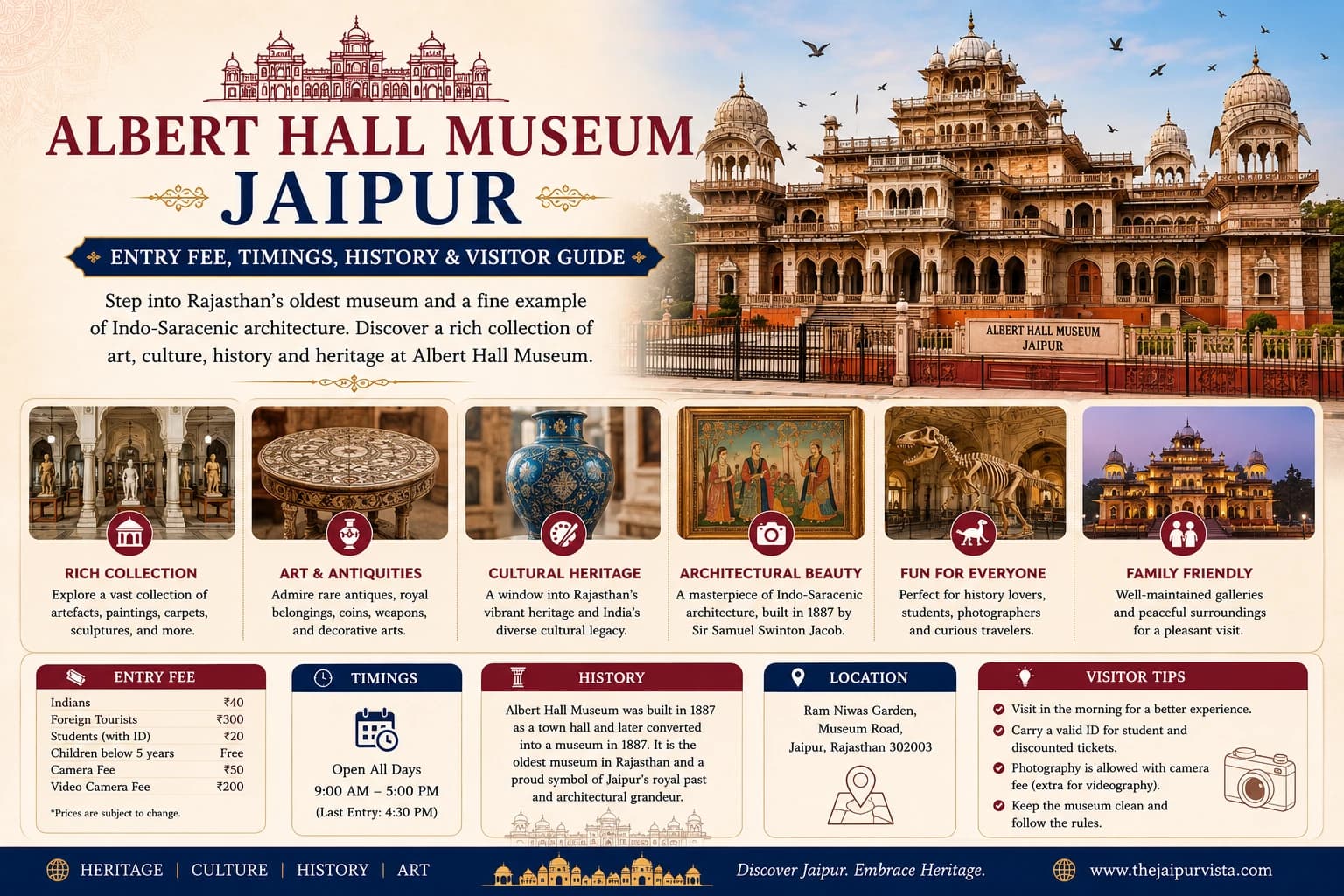
If you've ever stood before a building and felt the weight of history pressing gently against your chest, the Albert Hall Museum in Jaipur will do exactly that. Rising majestically at the southern entrance of the walled city, this sandstone-and-marble structure isn't just Rajasthan's oldest museum - it is one of the most beautifully designed public buildings in all of India, a place where royal patronage, colonial-era craftsmanship, and the timeless artistic traditions of Rajasthan converge under one magnificent roof.
Whether you are visiting Jaipur for the first time or returning for the tenth, the Albert Hall Museum, Jaipur deserves far more than a hurried half-hour. It deserves your curiosity, your time, and your full attention. This complete guide from The Jaipur Vista - written by people who live and breathe this city - gives you everything you need to plan the perfect visit.
The Albert Hall Museum - officially known as the Government Central Museum - is Rajasthan's oldest museum and one of the finest examples of Indo-Saracenic architecture in the country. Located within the sprawling Ram Niwas Garden on Ajmer Road in Jaipur, it houses a spectacular collection of over 20,000 artefacts spanning sculpture, jewellery, textiles, miniature paintings, carpets, metalwork, pottery, and natural history exhibits.
The Albert Museum Jaipur is far more than a repository of ancient objects. It is a living cultural institution that tells the story of Rajasthan - its royal courts, its artisan communities, its trade routes, its faith traditions, and its extraordinary creative legacy - across more than a thousand years of history.
And yet, for all its grandeur, the Albert Hall Jaipur remains surprisingly accessible. It is affordable to visit, centrally located, and consistently rewarding - whether you spend an hour or an entire afternoon within its galleries.
The story of the Albert Hall Museum begins in 1868, when Maharaja Sawai Ram Singh II of Jaipur - one of the most progressive and far-sighted rulers the Pink City has ever known - commissioned the construction of a new civic building for his capital. The vision was grand: a public hall that would serve as a centre for arts, crafts, and cultural exchange.
The building's name and its moment of formal consecration are inseparably linked to a single royal visit. In 1876, Albert Edward - the Prince of Wales and future King Edward VII of England - visited Jaipur as part of his grand tour of India. As a mark of respect, the foundation stone of the new civic hall was laid in his honour during this visit, and the building was subsequently named after him: Albert Hall.
This act was not merely ceremonial flattery. It reflected the pragmatic diplomatic relationship between Jaipur's royal family and the British Crown - a relationship that brought considerable benefits to the state while preserving its cultural autonomy.
The man responsible for translating Maharaja Ram Singh II's vision into stone was Samuel Swinton Jacob, a British engineer and architect of extraordinary talent who would go on to become one of the most influential figures in the development of what is now called Indo-Saracenic architecture.
Jacob drew masterfully from multiple architectural traditions - Mughal, Rajput, Gothic, and Islamic - weaving them into a coherent and stunning whole that feels simultaneously Indian and international. His design for the Albert Hall Museum is widely regarded as his masterpiece, a building that manages to look both ancient and timeless, both formal and welcoming.
Jacob's approach was deeply respectful of local craft traditions. He worked closely with Jaipur's master artisans to ensure that the building's ornamentation - its carved friezes, its decorative brackets, its arched galleries - reflected the living traditions of Rajasthani craftsmanship rather than simply importing foreign aesthetic conventions.
After Maharaja Sawai Ram Singh II passed away in 1880, it was his successor, Maharaja Sawai Madho Singh II, who completed the building and determined its purpose. In 1887, he opened the completed structure to the public as a museum - a decision that transformed what might have been a ceremonial hall into one of India's great public cultural institutions.
Since that opening day, the Albert Hall Museum, Jaipur has welcomed millions of visitors from across India and around the world. It has survived two world wars, independence, and the transformation of Jaipur from a royal capital to a modern metropolis - and it remains as relevant and as magnificent as ever.
From the moment you approach the Albert Hall Museum, its architecture commands your full attention. The building is constructed primarily in warm pink and golden sandstone - the same material that gives Jaipur its famous "Pink City" character - accented with white marble detailing that catches the light at different times of day.
The Albert Hall is the most celebrated example of Indo-Saracenic architecture in Rajasthan. This style - developed primarily during the British colonial period in India - blended Gothic and Renaissance elements from European architecture with the Mughal and Rajput traditions of the Indian subcontinent. The result is a vocabulary of design that feels neither purely Eastern nor purely Western, but genuinely and beautifully both.
At the Albert Hall Jaipur, this synthesis is visible in every detail: the graceful pointed arches and vaulted corridors recall Mughal palace architecture, while the decorative battlements and corner towers have a Gothic quality; the carved stone brackets and jharokha-style windows are unmistakably Rajput; and the overall symmetry and classical proportions reflect a European sensibility for civic grandeur.
The building's facade is one of the most photographed in all of Jaipur. Guarding the main entrance are two imposing stone elephants - a classic Rajasthani welcome - flanking a grand arched gateway that leads into a spacious forecourt. The central tower rises proudly above the surrounding gardens, visible from a considerable distance and orientated to face the Jaipur city axis with ceremonial precision.
Running along the exterior are elaborately carved friezes depicting scenes from Hindu mythology, Rajasthani court life, flora and fauna, and geometric patterns of Islamic inspiration. These carvings were executed by master craftsmen from Jaipur's famous stone-carving ateliers, and their quality - even after more than 135 years of exposure to the elements - remains exceptional.
Inside, the Albert Hall Museum is arranged across two main floors connected by a grand central staircase. The interior spaces are characterised by high ceilings, arched galleries, and large windows that flood the halls with natural light. The floors are laid with geometric-patterned tiles, and the walls carry murals, inscriptions, and architectural detailing that reward close inspection.
Sixteen principal galleries branch off from the central axis, each devoted to a different aspect of Rajasthan's material and artistic heritage. The building's spatial organisation reflects the Victorian museum tradition of systematic classification - exhibits arranged in logical sequences to create a narrative journey through knowledge - while the decorative treatment of the interior maintains the distinctly Indian character established by the exterior.
Perhaps the most visually spectacular aspect of the Albert Hall Museum today is its after-dark transformation. Every evening, the building is bathed in vibrant, constantly changing coloured lights that illuminate its architectural details with dramatic effect, turning the already-magnificent facade into something genuinely theatrical. The evening session - from 7:00 PM to 9:30 PM - offers a completely different experience from the daytime visit, and is especially popular with families and photographers. If your itinerary allows for only one visit, consider doing the evening session to experience this magical lighting display.
The Albert Museum Jaipur houses over 20,000 artefacts across 16 galleries. Here is a detailed guide to what you can expect in the most significant sections:
The undisputed star attraction of the Albert Hall Museum is the rare Persian Garden Carpet, displayed in a specially dedicated space on the ground floor. Dating to the 17th century and measuring approximately 8 by 4 metres, this extraordinary textile is considered one of the finest Persian carpets in existence. Its intricate design depicts a formal Persian garden in meticulous detail - the garden of paradise as imagined by Safavid court artisans - and its colours, despite centuries of age, retain a remarkable vibrancy. Art historians and textile scholars travel from around the world specifically to study this piece.
One of the Albert Hall's most unexpected and fascinating exhibits is a genuine Egyptian mummy - one of very few in India - accompanied by a range of Egyptian artefacts including canopic jars, amulets, and funerary objects. The mummy is believed to date to approximately 332 BC and was brought to Jaipur in the 19th century. It remains a perennially popular exhibit, particularly with younger visitors, and serves as a reminder of the global reach of the Jaipur royal family's collecting interests.
The Jaipur School of Art Gallery showcases an exceptional collection of miniature paintings spanning the 16th to 19th centuries. The Jaipur or Dhundhar school of miniature painting is renowned for its vivid colour palette, its delicate brushwork, and its distinctive interpretation of traditional Rajput themes - royal hunting scenes, courtly romance, religious narratives, and intricate portraits of rulers and nobles. This gallery also includes works from the Mughal, Mewar, Bundi, and Kishangarh schools, offering a broader survey of Rajasthani miniature painting traditions.
The sculpture collection covers a vast chronological range, from early medieval Jain and Hindu stone sculptures to finely crafted bronze and metal images. Notable pieces include depictions of Vishnu, Shiva, Durga, and various minor deities, as well as Jain Tirthankaras and Buddhist figures. Several rare terracotta pieces dating to the Gupta and post-Gupta periods are particularly significant for scholars of Indian art history.
Jaipur has been India's most celebrated centre for jewellery craftsmanship for centuries - the home of kundan (pure gold foil setting), meenakari (enamel work), and jadau (embedded stone setting) techniques that are still practised in the city's workshops today. The Jewellery Gallery at the Albert Hall Museum showcases magnificent examples of these traditions, including royal ornaments, ceremonial pieces, and everyday jewellery from different periods and communities of Rajasthan.
Rajasthan is one of India's greatest textile-producing regions, and the Albert Museum Jaipur holds an important collection of historic fabrics representing the full diversity of the state's weaving, printing, and dyeing traditions. Bandhani (tie-and-dye), leheriya (diagonal resist-dyeing), block printing, zari (gold thread) weaving, and embroidery traditions from different parts of Rajasthan are all represented here.
A substantial collection of weapons, armour, and military paraphernalia from the royal armouries of Jaipur and the broader Rajput warrior tradition. This gallery includes swords (talwars), daggers (kataars), shields, helmets, chainmail, elephant armour, and ceremonial weapons that combine lethal functionality with extraordinary artistry. The craftsmanship of the hilts and scabbards - inlaid with gold, silver, precious stones, and enamel - is particularly noteworthy.
Featuring both Indian and imported ceramics, this gallery includes examples of Jaipur's famous blue pottery - a distinctive craft tradition with Persian and Central Asian roots - alongside Chinese porcelain imported by the Jaipur royal family, European ceramics, and examples from various Indian regional pottery traditions.
A numismatic collection tracing the monetary history of the region from ancient Indian coins through medieval Islamic sultanate coinage to the distinctive coins of the Jaipur state and the British colonial period. For anyone interested in economic history or political succession, this gallery offers a fascinating material record.
The Albert Hall also houses a natural history collection that includes specimens of Rajasthan's fauna, geological samples, and botanical materials - reflecting the Victorian museum tradition of comprehensive scientific collecting. While this section has been overshadowed by the more spectacular cultural artefacts, it provides useful context for understanding the natural environment that shaped Rajasthan's human history.
A collection of traditional Rajasthani and broader Indian musical instruments - stringed, wind, and percussion - many of which are beautifully decorated as well as functional. This gallery offers an insight into the rich musical culture of the Rajput courts and the folk traditions of Rajasthan's rural communities.
Note: Entry fees are subject to revision by the Rajasthan government. It is advisable to verify current rates at the museum ticket counter or on the official Rajasthan Museums website before your visit.
Combined Ticket: Visitors can purchase a composite ticket covering multiple Jaipur heritage sites. This is excellent value if you plan to visit Amber Fort, Nahargarh Fort, Jaigarh Fort, and the Albert Hall in the same trip.
The Albert Hall Museum, Jaipur has two operational sessions daily:
Morning/Afternoon Session: 9:00 AM – 5:00 PM
Evening Session: 7:00 PM – 9:30 PM
The museum is open all seven days of the week, including public holidays and national holidays. There is no weekly closure.
Pro Tip from The Jaipur Vista: Arrive at 9:00 AM sharp on weekdays for the most peaceful experience. By 11:00 AM, tour groups begin to arrive. The evening session (7:00 PM onwards) is magical for the light-and-sound experience of the illuminated exterior, but the interior galleries are accessible during this session too.
October to March is the ideal window to visit the Albert Hall Museum and Jaipur in general. The weather during these months is pleasantly cool - daytime temperatures range from approximately 10°C to 25°C - making it comfortable to spend extended time both inside the galleries and exploring the surrounding Ram Niwas Garden.
November and December are particularly atmospheric. The post-monsoon gardens are lush, the air is crisp, and the museum's warm sandstone glows beautifully in the soft winter light.
April to June brings extreme heat (40°C+). If you must visit during summer, go as early as possible in the morning or plan the evening session instead.
July to September (Monsoon) - the museum is accessible, and the surrounding gardens are verdantly green and beautiful, but brief afternoon downpours can affect outdoor movement.
The Albert Hall Jaipur is centrally located and easy to reach from all parts of the city.
The most convenient public transport option. Board the Jaipur Metro to Civil Lines Station (Line 1) and walk approximately 10 minutes south to the museum entrance at Ram Niwas Garden. This is our top recommendation for avoiding parking hassles.
Freely available throughout the city. From:
Jaipur Railway Station: approximately 3 km, 10–15 minutes
Sindhi Camp Bus Stand: approximately 2.5 km, 10 minutes
Jaipur International Airport: approximately 13 km, 25–35 minutes
Hawa Mahal: approximately 1.5 km, 5–10 minutes
The museum is located on Ajmer Road (also accessible via Jawaharlal Nehru Marg). Parking is available near the Ram Niwas Garden entrance on both sides of the road. Be aware that parking can be tight on weekends and during peak season.
If you're exploring Jaipur's walled city - visiting Hawa Mahal, Johari Bazaar, or the City Palace - the Albert Hall is easily walkable in 15–20 minutes via Sanganeri Gate and M.I. Road. This is a lovely walk that passes through the beating heart of the old city.
The Albert Hall Museum is set within Ram Niwas Garden, a magnificent public garden spanning 76 acres that was laid out by Maharaja Sawai Ram Singh II in 1868 alongside the museum's construction. The garden is one of the most beloved public spaces in Jaipur - a green lung in the heart of the city where locals come to exercise, relax, and socialise at all hours of the day.
Within Ram Niwas Garden, alongside the Albert Hall, you will also find:
Jaipur Zoo - One of Rajasthan's largest zoological parks, home to a wide variety of Indian fauna including tigers, leopards, crocodiles, and numerous bird species.
Ravindra Rang Manch - Jaipur's premier cultural performance venue, hosting theatre, classical music, and dance performances throughout the year.
Bird Park - A dedicated aviary section featuring various Indian and exotic bird species.
Horticulture Gardens - Beautifully maintained flower gardens that are particularly spectacular between October and February when seasonal blooms are at their peak.
Combine your visit to the Albert Museum Jaipur with a leisurely walk through Ram Niwas Garden for a complete afternoon experience that balances cultural exploration with open-air relaxation.
Since the Albert Hall Museum sits near the southern edge of Jaipur's walled city, it pairs wonderfully with several major attractions:
Hawa Mahal (1.5 km) - The iconic Palace of Winds and Jaipur's most photographed landmark. Best viewed from outside or from the café across the street for the full facade effect.
City Palace (2 km) - The grand royal complex at the heart of the old city, still partly inhabited by the royal family of Jaipur. The museum within the City Palace complex is exceptional.
Jantar Mantar (2 km) - The UNESCO World Heritage astronomical observatory built by Maharaja Sawai Jai Singh II, featuring the world's largest stone sundial.
Birla Mandir / Laxmi Narayan Temple (1 km) - A stunning white marble temple dedicated to Lord Vishnu and Goddess Lakshmi, beautifully illuminated at night and just a short walk from the Albert Hall.
Moti Doongri Fort (1 km) - A small hilltop fort and private Ganesh temple associated with the royal family, visible on the hill behind Birla Mandir.
Nahargarh Fort (7 km) - For sunset views over the Pink City, Nahargarh on the Aravalli ridge is unmissable and pairs well with a morning at the Albert Hall Museum.
Read Also: Top Tourist Places in Jaipur
The Albert Hall Museum is one of the most photogenic buildings in Jaipur, and the right approach will dramatically improve your photographs. Exterior - Best Shots: The most iconic view of the Albert Hall Jaipur is a straight-on shot from the main entrance gate of Ram Niwas Garden looking north. This captures the full symmetry of the facade with the central tower. Early morning (9:00–10:00 AM) offers the best soft light on the sandstone. The reflecting pool in front of the museum, when still, offers beautiful mirror reflections. Evening Illumination: The lighting display that transforms the Albert Hall every evening is extraordinary. Bring a tripod if you have one, as longer exposures at dusk will capture the building in transition from daylight to full illumination. The best position is from the main garden path, far enough back to capture the entire facade. Interior: Natural light fills the galleries beautifully. Avoid using flash - it's not permitted near fragile artefacts and will produce flat, overexposed images. Instead, raise your ISO and use the available light for more atmospheric shots of the galleries and exhibits. Camera Fees: A still camera requires a ₹50 ticket purchased at the entrance. Mobile phone photography is free. Plan at least 2–3 hours. The 16 galleries contain thousands of artefacts, and rushing through will mean missing the finest pieces. The Persian carpet alone deserves 20 minutes of your time. Hire a guide. The museum's official guides are knowledgeable and affordable, and their contextual storytelling transforms an anonymous collection of objects into a vivid narrative. Ask for a guide at the ticket counter. Wear comfortable footwear. You'll be walking on stone and tile floors for an extended period. The interiors are cool, but the garden pathways can get warm in the afternoon. Visit the garden too. Many visitors head straight to the museum and back out again without exploring Ram Niwas Garden. Set aside 30–45 minutes for the garden, especially in the morning when it is most peaceful. Combine sessions. If time allows, visit once in the day (for the interior galleries) and return in the evening (for the illumination). The two experiences are genuinely complementary. Carry water and a light snack. There are food vendors within the garden, but they are limited. If you plan an extended visit, bring your own refreshments. Avoid school-trip hours. Large school groups typically arrive between 10:00 AM and noon on weekdays. If you prefer a quieter experience, go at opening time (9:00 AM) or in the late afternoon. We cannot overstate how remarkable the Albert Hall Museum's evening transformation is. Every night without exception, the building is illuminated in a choreographed display of coloured lights that shifts through the spectrum - warm golds and ambers giving way to deep blues and purples, with occasional splashes of vivid pink and green. The effect on the sandstone and marble facade is genuinely spectacular. The evening session (7:00 PM – 9:30 PM) is popular with local families and couples who come to stroll through the garden and enjoy the spectacle. The atmosphere is festive but calm - one of those rare urban experiences that feels both entertaining and genuinely beautiful. For photographers, the Albert Hall Jaipur at night offers some of the most striking heritage building photographs in all of India. The combination of architectural grandeur and dramatic lighting is irresistible. Jaipur has no shortage of magnificent things to see - Amber Fort, Hawa Mahal, Nahargarh, City Palace, Jantar Mantar - each competing for your limited time. In this crowded field of heritage wonders, the Albert Hall Museum holds its own with quiet authority. It offers something that most of Jaipur's other major sites do not: the opportunity to engage slowly and intimately with the city's history on your own terms. There are no elephant rides, no light-and-sound shows with scripted narratives, no photography queues at a famous facade. Just you, 20,000 extraordinary objects, and one of the most beautiful buildings in India. The Albert Museum Jaipur is where Jaipur's past is curated and preserved with genuine care - where you can hold (metaphorically) a 17th-century Persian carpet in your gaze, study the brushwork of a Rajput miniature from 300 years ago, or contemplate an Egyptian mummy that travelled from North Africa to this Rajasthani city more than a century ago. For anyone who wants to understand Jaipur beyond its famous skyline, the Albert Hall is not optional. It is essential. We at The Jaipur Vista believe that the best travel experiences are the ones that teach you something - about the place you're visiting, about the people who built it, and about the human instinct to create beauty and meaning even in the most practical of contexts. The Albert Hall Museum, Jaipur does all of this. It is an extraordinary building, a world-class collection, and a genuinely moving experience - all for the price of a cup of coffee. Come with curiosity. Come with time. Come back in the evening for the lights. Q1. What is the entry fee for Albert Hall Museum in 2025? Q2. What are the timings for Albert Hall Museum Jaipur? Q3. Is Albert Hall Museum closed on any day? Q4. Who built Albert Hall Museum Jaipur? Q5. Why is it called Albert Hall? Q6. What is the most famous exhibit in Albert Hall Museum? Q7. Is photography allowed inside Albert Hall Museum? Q8. How much time is needed to explore Albert Hall Museum properly? Q9. Is there parking available at Albert Hall Museum? Q10. Is there a combined ticket available for multiple Jaipur heritage sites? Q11. Is Albert Hall Museum accessible for visitors with disabilities? Photography Guide for Albert Hall Museum
Practical Tips for Visiting Albert Hall Museum
The Albert Hall Museum at Night - Don't Miss This Experience
Why Albert Hall Museum Deserves a Top Spot on Your Jaipur Itinerary
Final Words from The Jaipur Vista
Frequently Asked Questions About Albert Hall Museum Jaipur
The entry fee is ₹40 for Indian adults and ₹300 for foreign nationals. Children are charged at a reduced rate. Camera fees are separate.
The museum is open from 9:00 AM to 5:00 PM and again from 7:00 PM to 9:30 PM, every day of the week.
No. The Albert Hall Museum is open all seven days a week, including public holidays and national holidays.
The Albert Hall Museum was designed by British architect Samuel Swinton Jacob. It was commissioned by Maharaja Sawai Ram Singh II and completed and opened to the public by Maharaja Sawai Madho Singh II in 1887.
The museum was named after Albert Edward, Prince of Wales (later King Edward VII of England), who laid the foundation stone during his visit to Jaipur in 1876.
The most celebrated exhibit is the rare 17th-century Persian Garden Carpet, considered one of the finest Persian carpets in existence. The Egyptian mummy is another perennially popular attraction.
Yes, photography is allowed with a paid permit (₹50 for a still camera). Mobile phone photography is free. Flash photography is not permitted in sensitive gallery areas.
Allow a minimum of 2 hours for a reasonably thorough visit. For those with a serious interest in the collections, 3–4 hours is more appropriate.
Yes, street parking is available on the roads around Ram Niwas Garden. The museum does not have a dedicated parking lot.
Yes. Composite tickets covering multiple heritage sites in Jaipur - including the Albert Hall, Amber Fort, Nahargarh Fort, and Jaigarh Fort - offer good value. Ask about composite ticketing at the entrance counter.
Partial accessibility is available. The ground floor galleries are wheelchair accessible via ramp entry. However, upper floor galleries require staircase navigation. Contact the museum administration in advance if you have specific requirements.