Amer Fort Jaipur: History, Timings, Ticket Price & Complete Travel Guide (2026)
Author:Nidhi
Published:May 22, 2026
Views:5666
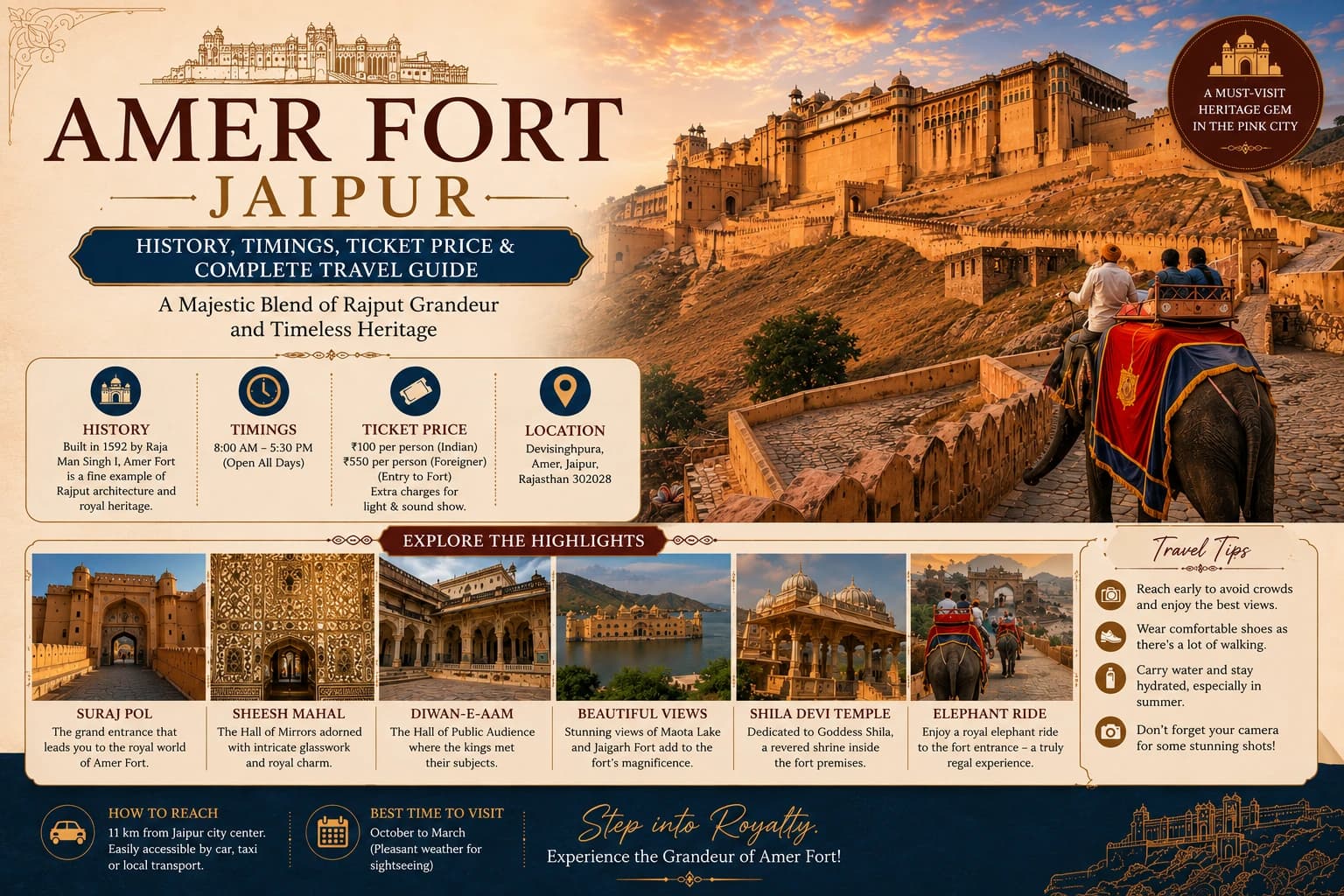
If there is one place in Jaipur that captures the true soul of Rajasthan's royal heritage, it is Amer Fort. Known locally as Amer ka Kila, this majestic hilltop fortress rises above the still waters of Maota Lake, just 11 kilometres from the heart of the Pink City. For centuries, it stood as the proud seat of the powerful Kachwaha Rajput rulers - and today, it stands as one of India's most visited and celebrated UNESCO World Heritage Sites.
Whether you are a history enthusiast, an architecture lover, a photography buff, or simply a traveller curious about Rajasthan's legendary past, Amer Fort Jaipur will leave you genuinely awestruck. In this complete travel guide by The Jaipur Vista, we cover everything you need to know before planning your visit - history, architecture, key attractions, Amer Fort timings, Amer Fort ticket price, travel tips, and much more.
Amer Fort, also spelt Amber Fort, is a grand hilltop fortification located in the historic town of Amer (or Amber), on the outskirts of Jaipur. Perched on the rugged Aravalli Hills and overlooking the serene Maota Lake, the fort stretches across a vast area and is one of the most well-preserved examples of early Rajput military and palace architecture in all of India.
The name "Amer" (or "Amber") is believed to have been derived from "Ambikeshwar," a local name for Lord Shiva, or from the Mina tribe that originally inhabited the area. Locals still affectionately call it Amer ka Kila, and if you arrive at dawn when the morning mist hangs over the lake, you'll understand why generations of Rajputs considered this place almost divine.
Amer Fort served as the primary capital of the Kachwaha clan of Rajputs for several centuries before Maharaja Sawai Jai Singh II founded the new city of Jaipur in 1727 and shifted the capital. The fort complex, however, continued to be expanded and embellished by successive rulers and today represents a brilliant layering of architectural ambition spanning nearly two centuries.
Understanding the history of Amer Fort requires going back well before 1592. The hilltop at Amer had been occupied long before the Kachwahas arrived - the Mina tribe, indigenous to the region, had built an earlier structure on the same hill. When Raja Alan Singh Kachwaha captured the town from the Minas around the 11th century, the seeds of what would become one of Rajasthan's greatest fortresses were sown.
The Amer Fort, as we know it today, was commissioned by Raja Man Singh I in 1592 AD. Man Singh was a trusted general (Navratna) in the court of Mughal Emperor Akbar and a shrewd diplomat who negotiated a celebrated alliance between the Rajput Kachwahas and the Mughals. His familiarity with Mughal art and architecture deeply influenced the design of Amer Fort, which blends Rajput grandeur with Mughal elegance in a way rarely seen elsewhere in India.
Man Singh's construction focused on the lower palace complex, including the Jaleb Chowk and the core defensive walls. He drew on the wealth generated from Mughal campaigns - notably from Bengal - to fund the fort's lavish interiors.
After Man Singh, it was Mirza Raja Jai Singh I who significantly expanded and enriched the Amer Fort complex. He added the magnificent Sheesh Mahal (Mirror Palace), one of the most celebrated rooms in all of Rajasthan. Jai Singh I also strengthened diplomatic ties with the Mughals under Emperor Shah Jahan, and the wealth flowing in from these alliances was reflected in the increasingly ornate additions to the fort.
Sawai Jai Singh II, the astronomer-king famous for building Jaipur and the Jantar Mantar observatories, continued developing Amer Fort before ultimately deciding to establish a new capital at Jaipur in 1727. After the capital shifted, Amer Fort gradually became less of a living royal palace and more of a ceremonial and strategic outpost - though it lost none of its architectural splendour.
In 2013, Amer Fort was inscribed as a UNESCO World Heritage Site as part of the collective "Hill Forts of Rajasthan," which also includes Chittorgarh, Kumbhalgarh, Ranthambore, Gagron, Jaisalmer, and Nahargarh. This recognition cemented Amer Fort's status as a globally significant cultural landmark.
Read Also: History of Jaipur
Architecture of Amer Fort: A Masterpiece in Stone
The architecture of Amer Fort is a breathtaking synthesis of Rajput and Mughal styles - what art historians often call the Indo-Islamic or Indo-Saracenic tradition. Built primarily from pale yellow and pink sandstone and white Makrana marble, the fort's visual character shifts with the time of day, glowing amber at sunrise and taking on a smoky lavender hue at dusk.
The fort complex is arranged around four main courtyards, each serving a distinct ceremonial and functional purpose. Moving from the public entrance at the base to the private royal quarters at the highest level, the architecture narrates a journey from openness and power to intimacy and luxury.
Defensive Design: The outer walls of Amer Fort stretch for kilometres and are integrated with the larger Jaigarh Fort on the hilltop above via a hidden network of passages. Crenellated battlements, watchtowers, and narrow cannon ports speak to its original function as a military stronghold.
Water System: An elaborate system of channels, tanks, and pipes carried water from Maota Lake uphill into the fort - a remarkable feat of ancient engineering that sustained a large royal household for centuries.
Natural Ventilation: The Sukh Niwas (Hall of Pleasure) features a brilliantly designed passive cooling system, with sandalwood-and-ivory latticed doors and channels of water flowing through the walls to keep the interiors cool even in Rajasthan's brutal summers.
Ornamental Craftsmanship: From intricate pietra dura marble inlay work to vibrant painted frescoes, gilded ceilings, coloured glass, and mirror mosaics - every surface inside Amer Fort rewards close inspection.
If Amer Fort has one image that defines it for the world, it is the Sheesh Mahal. This extraordinary chamber, located in the Jai Mandir, is covered floor to ceiling - and across the entire ceiling - with thousands of tiny convex mirror pieces set into ornate plaster. A single candle held inside the Sheesh Mahal is said to create the illusion of a sky full of stars. The craftsmanship is extraordinary, and even centuries after its creation, the Sheesh Mahal continues to astonish visitors from every corner of the world.
The Ganesh Pol is widely considered one of the finest gateways in all of Rajasthan. This three-storey entrance portal, named after Lord Ganesh whose idol is enshrined above it, marks the transition from the public courtyards to the private royal precincts. Every inch of its surface is covered in vibrant painted frescoes, geometric tile work, and delicate latticework screens - a visual riot of colour and craft that demands you slow down and truly look.
The Diwan-i-Aam is the large open courtyard where the Maharaja would meet and address his subjects and receive petitions. Elevated on a decorated platform, the hall features double-row colonnades of elaborately carved columns - a visual demonstration of royal authority and accessibility. The geometric and floral motifs on the columns show the clear influence of Mughal court aesthetics on Kachwaha taste.
Separate from the public hall, the Diwan-i-Khas was reserved for high-level diplomatic meetings, private royal consultations, and meetings with important dignitaries. The intimacy of the space contrasts with the grandeur of the Diwan-i-Aam, but its craftsmanship is even more refined - fine marble columns, intricate stone carvings, and the unmistakable polish of a space designed to impress the most sophisticated of guests.
The Sukh Niwas is one of the most ingenious spaces in Amer Fort. Its unique sandal-and-ivory latticed doors were designed so that the breeze passing through them would carry the fragrance of sandalwood into the hall. Water flowed in channels through the walls and floor, dramatically cooling the interior temperature. In the searing heat of a Rajasthani summer, this chamber must have felt like paradise - which, of course, was entirely the point.
Located adjacent to the Sheesh Mahal, the Jas Mandir is another stunning space in the private palace wing. Its walls are decorated with fine relief stucco work and glass inlay, creating a luminous, jewel-like effect. Intricate latticed marble screens (jalis) on the upper level allowed the royal women to observe the courtyard below without being seen - a design feature common to both Rajput and Mughal palace architecture.
Inside the fort complex lies the Sila Devi Temple, dedicated to the goddess Sila (a form of Kali or Durga). The temple was established by Raja Man Singh I after he reportedly brought the idol from Bengal following a military victory. The temple remains an active place of worship, and its inner sanctum - with its silver doors, brass bells, and the fragrance of incense - offers a deeply authentic spiritual experience inside the fort.
The Jaleb Chowk is the large entrance courtyard you first encounter when entering Amer Fort. This is where the royal army would assemble and where the spoils of war were once displayed for public viewing. Today, it serves as the primary gathering and orientation space for visitors, and it is also where elephant rides traditionally depart from (though availability and regulations around this attraction change; always check current guidelines before visiting).
The view of Maota Lake from the upper terraces of Amer Fort is genuinely one of the most beautiful panoramas in all of Jaipur. The lake's still waters mirror the fort's walls and towers, especially during the early morning hours when the light is soft and golden. If you carry a camera, you will not regret arriving early for this shot.
Every evening, Amer Fort comes alive with a spectacular Light and Sound Show that narrates the history of the Kachwaha rulers through dramatic narration, music, and stunning illumination of the fort's façade. Available in both Hindi and English, the show is a wonderful way to end a day at Amer Fort and gain a deeper sense of the human stories behind the stone walls.
Getting the Amer Fort timings right is essential for a smooth and enjoyable visit. Here is the full breakdown:
Note: The fort is open every day of the year, including national holidays. The last entry is typically 30 minutes before closing time.
Pro Tip from The Jaipur Vista: Arrive at least 20–30 minutes before your chosen show time, especially during the October–March peak season when tickets sell out fast. Book in advance online if possible.
For the most comfortable and photogenic experience, visit Amer Fort between 8:00 AM and 10:30 AM. At this time, the light is soft, the crowds are thinner, and the temperature is far more manageable - especially from April to September. Late afternoon (after 3:30 PM) is the second-best window for light and temperature.
Here is the complete Amer Fort ticket price structure for 2026:
Still cameras are generally permitted without charge inside Amer Fort. Dedicated video cameras may attract a small additional fee - check at the ticket counter for the most current rules.
Tickets for Amer Fort can be purchased:
At the ticket counter at the fort entrance (cash and UPI accepted)
Online through the Rajasthan Tourism official portal (recommended during peak season to avoid long queues)
Money-Saving Tip: If you plan to visit Amer Fort along with Jaigarh Fort and Nahargarh Fort, ask about the composite ticket options available at the counter, which can offer savings compared to buying individual tickets.
Amer Fort is located approximately 11 km from Jaipur city centre and is easily reachable by multiple modes of transport.
The most popular and convenient option for individual travellers and families. A taxi from central Jaipur (MI Road, Railway Station area) to Amer Fort typically costs ₹300–₹500 one way. Auto-rickshaws are cheaper but the journey on the highway can feel bumpy. Always agree on the fare before boarding or use an app-based cab.
The Rajasthan State Road Transport Corporation (RSRTC) operates regular buses from the Sindhi Camp bus stand in Jaipur to Amer. This is the most budget-friendly option (fare: ₹15–₹30), though buses can be crowded during peak hours.
If you are driving yourself or have hired a car for the day, there is a dedicated parking area at the base of the fort. Electric vehicles (golf carts) and jeeps shuttle visitors from the parking lot up the hill to the fort entrance for a small additional fee.
The fort is approximately 30 minutes from Jaipur Junction by road (about 11 km). Both taxis and auto-rickshaws are readily available outside the station.
The airport is around 22 km from Amer Fort, approximately 45–50 minutes by taxi or cab.
October to March (Best Season) This is undeniably the best time to visit Amer Fort Jaipur. Temperatures are pleasant, ranging from 8°C at night to 24°C during the day. The skies are clear, the light is beautiful, and the fort is at its most photogenic. This period also coincides with major Jaipur events like the Jaipur Literature Festival (January) and Makar Sankranti kite festival.
April to June (Summer - Challenging but Doable) Rajasthan summers are fierce, with temperatures regularly crossing 40°C. If you must visit during this period, arrive at the fort by 8:00 AM sharp and plan to leave by 11:00 AM. Carry water, wear light cotton clothing, and consider a hat or cap.
July to September (Monsoon) The monsoon brings relief from the heat and the surrounding Aravalli landscape turns a lush green - making Amer Fort look dramatically different and beautiful. However, some areas inside the fort can be slippery when wet, so exercise caution. The occasional heavy rain may also briefly disrupt the evening light show.
Weekdays are significantly less crowded than weekends at Amer Fort. If your travel schedule allows flexibility, visiting on a Tuesday, Wednesday, or Thursday will mean shorter queues and more space to explore at your own pace.
These are the tips The Jaipur Vista team has gathered from locals and experienced travellers - the kind of advice you won't find on a standard tour pamphlet:
1. Go Early, Very Early The gates open at 8:00 AM. If you are there by 8:15 AM on a weekday, you may have sections of the fort almost entirely to yourself for the first hour. The Sheesh Mahal and Ganesh Pol in the morning light are extraordinary.
2. Hire a Government-Certified Guide The fort's history is layered and complex, and many of the architectural and artistic details are easy to miss without context. Certified guides are available at the entrance for approximately ₹400–₹600 for a 2-hour tour (rates may vary; always confirm in advance). A good guide transforms Amer Fort from a beautiful ruin into a living story.
3. Wear Comfortable Footwear The pathways inside Amer ka Kila include steep ramps, uneven flagstones, and narrow staircases. Avoid heels or slippery soles entirely. Sturdy walking shoes or sandals with grip are ideal.
4. Stay for the Light Show The evening Light and Sound Show at Amer Fort is genuinely spectacular and not to be missed if your schedule allows. The narration is engaging, the lighting is dramatic, and the experience of being at the fort after dark carries a magical quality that the daytime visit simply cannot replicate.
5. Visit Panna Meena ka Kund on the Way Just a few minutes' walk from the fort entrance is the Panna Meena ka Kund - a striking 16th-century step-well with an intricate geometric staircase. It is a favourite among photographers and is almost always less crowded than the fort itself. Do not miss it.
6. Carry Cash and Water While UPI payments are accepted at the ticket counter, smaller vendors, guide fees, and the jeep/shuttle from the parking lot are often cash-only. Carry small-denomination notes. Also, water is available inside the fort but buy a bottle before entering to stay hydrated.
7. Respect the Active Temple The Sila Devi Temple inside the fort is an active place of Hindu worship. Remove your footwear before entering, dress modestly (no sleeveless tops or shorts), and maintain a respectful, quiet demeanour inside the temple premises.
8. Photography - Best Spots
The view of the fort from the Maota Lake road (arrive early for misty reflections)
The Jaleb Chowk from the upper walkway looking down
The Sheesh Mahal (bring a small torch for dramatic mirror effects)
Ganesh Pol from directly below
The hilltop view of Maota Lake from the royal palace terrace
One of the most fascinating and lesser-known aspects of Amer Fort is its intimate relationship with Jaigarh Fort, the military stronghold that sits directly above it on the higher ridge of the Aravalli Hills. The two forts are connected by a network of covered passages - including a secret tunnel - that allowed the royal family to escape from Amer Fort to the more defensible Jaigarh in times of attack.
Jaigarh Fort houses the Jaivana Cannon, the largest cannon on wheels ever made. Visitors who purchase a composite ticket can walk (or drive) between both forts on the same day, experiencing the full spectrum of Kachwaha military and palatial architecture. The view of Amer Fort from the walls of Jaigarh Fort is one of the most dramatic in Rajasthan.
Amer Fort sits in one of the most heritage-rich corridors in all of Jaipur. Here are the top nearby attractions to include in your itinerary:
The military companion to Amer Fort, Jaigarh is known for its well-preserved ramparts, water storage tanks, and the Jaivana Cannon. The views from Jaigarh are breathtaking and it takes about 1.5–2 hours to explore properly.
Perched on the Aravalli ridge, Nahargarh ("Tiger's Lair") offers the best panoramic views of Jaipur city. It is an excellent sunset destination and houses a fascinating wax museum. The drive up to Nahargarh through narrow winding roads is itself an adventure.
On the road back from Amer Fort to Jaipur lies the enchanting Jal Mahal - the Water Palace - rising from the centre of Man Sagar Lake. Though the palace interior is not open to visitors, the lakeside promenade (evening hours) offers stunning views and is a popular spot for photography and a relaxed evening stroll.
A short walk from the fort entrance, this photogenic 16th-century step-well is a gem of vernacular architecture. Its symmetrical zigzag staircases descend to the water level from all four sides, creating extraordinary geometric reflections and shadow play. One of the most Instagrammed spots in Jaipur.
For those interested in Jaipur's celebrated textile traditions, the Anokhi Museum offers a beautifully curated introduction to block-printing techniques, heritage fabrics, and the artisans who keep this ancient craft alive. A wonderful complement to the fort's architectural focus.
8:00 AM – Arrive at Amer Fort (beat the crowd)
8:00 AM – 11:00 AM – Explore Amer Fort (with guide recommended)
11:15 AM – Visit Panna Meena ka Kund (15–20 minutes)
12:00 PM – Drive up to Jaigarh Fort
12:00 PM – 1:30 PM – Explore Jaigarh Fort
1:30 PM – Lunch at a restaurant near Amer or head back towards Jaipur
3:30 PM – Drive past Jal Mahal for photos (no entry required)
7:00 PM – Return to Amer Fort for the Light & Sound Show
Amer Fort has appeared in several Bollywood films and international productions over the decades, serving as a stand-in for various royal and historical settings. Its dramatic architecture and photogenic qualities make it one of the most filmed locations in Rajasthan. If you have watched films set in Mughal or Rajput courts, there is a reasonable chance Amer Fort's corridors and courtyards have appeared on your screen.
The fort also features prominently in the UNESCO documentation of Rajasthan's intangible cultural heritage and is regularly cited in academic studies of Indo-Islamic architectural synthesis.
This is a question The Jaipur Vista hears frequently. The simple answer: Amer Fort and Amber Fort are the same place. The two spellings are simply different romanisations of the same Hindi/Rajasthani name - आमेर. In official government and tourism documents, both spellings appear interchangeably. When searching online for Amer Fort timings or Amber Fort ticket price, you will find information about the same monument.
In a city overflowing with magnificent heritage - the Hawa Mahal, City Palace, Jantar Mantar, Nahargarh - Amer Fort still manages to stand apart. It is not just its scale or its UNESCO status or even the dazzling Sheesh Mahal that sets it apart. It is the feeling you get walking through those courtyards and corridors, the sense that every stone has a story, every fresco holds a secret.
Amer Fort Jaipur is a place that rewards patience. It rewards early mornings. It rewards those who slow down, look carefully, and listen - to a guide, to the wind through the jali screens, to the echo of footsteps on 400-year-old marble.
If you only visit one site in Jaipur, let it be Amer Fort. And if you visit Jaipur more than once - and you will want to - Amer ka Kila will always have something new to show you.
Q1. What are the Amer Fort timings?
Amer Fort is open from 8:00 AM to 5:30 PM every day of the week. The Light and Sound Show begins at 6:30 PM (November–February) or 7:00 PM (March–October), depending on the season.
Q2. What is the Amer Fort ticket price in 2026?
The entry fee is ₹100 for Indian adults, ₹20 for Indian students, ₹500 for foreign tourists, and ₹150 for foreign students. The Light and Sound Show has a separate ticket: ₹200 (English) and ₹100 (Hindi).
Q3. Who built Amer Fort and when?
Amer Fort was built by Raja Man Singh I in 1592 AD. It was later expanded significantly by Mirza Raja Jai Singh I and Sawai Jai Singh II.
Q4. Is Amer Fort a UNESCO World Heritage Site?
Yes. Amer Fort was designated a UNESCO World Heritage Site in 2013 as part of the Hill Forts of Rajasthan.
Q5. How do I reach Amer Fort from Jaipur?
Amer Fort is 11 km from central Jaipur. You can reach it by taxi (₹300–₹500), auto-rickshaw, RSRTC bus from Sindhi Camp, or private vehicle. The journey takes approximately 25–35 minutes depending on traffic.
Q6. What is the best time to visit Amer Fort?
The best time to visit Amer Fort is from October to March, when the weather is pleasant and the skies are clear. Within the day, early morning (8:00–10:30 AM) offers the best light and fewest crowds.
Q7. Is Amer Fort connected to Jaigarh Fort?
Yes. Amer Fort and Jaigarh Fort are connected by a network of passages and a historic secret tunnel that the royal family used as an escape route during military sieges.
Q8. Can we go inside Amer Fort?
Yes, the fort is fully open to visitors. You can explore all the major courtyards, palaces, and temples, though some innermost rooms may have restricted access. Hiring a guide is strongly recommended for a richer experience.
Q9. How much time is needed to visit Amer Fort?
Plan for at least 2–3 hours for a thorough visit of the fort. If you are attending the evening Light and Sound Show as well, budget the full day for the Amer Fort experience.
Q10. What is Amer ka Kila?
Amer ka Kila is the Hindi/Rajasthani name for Amer Fort. "Kila" means fort in Hindi and Urdu. It is the same monument known in English as Amer Fort or Amber Fort.