History of Jaipur: The Royal Legacy of India’s Pink City
Author:Nidhi
Published:May 12, 2026
Views:515
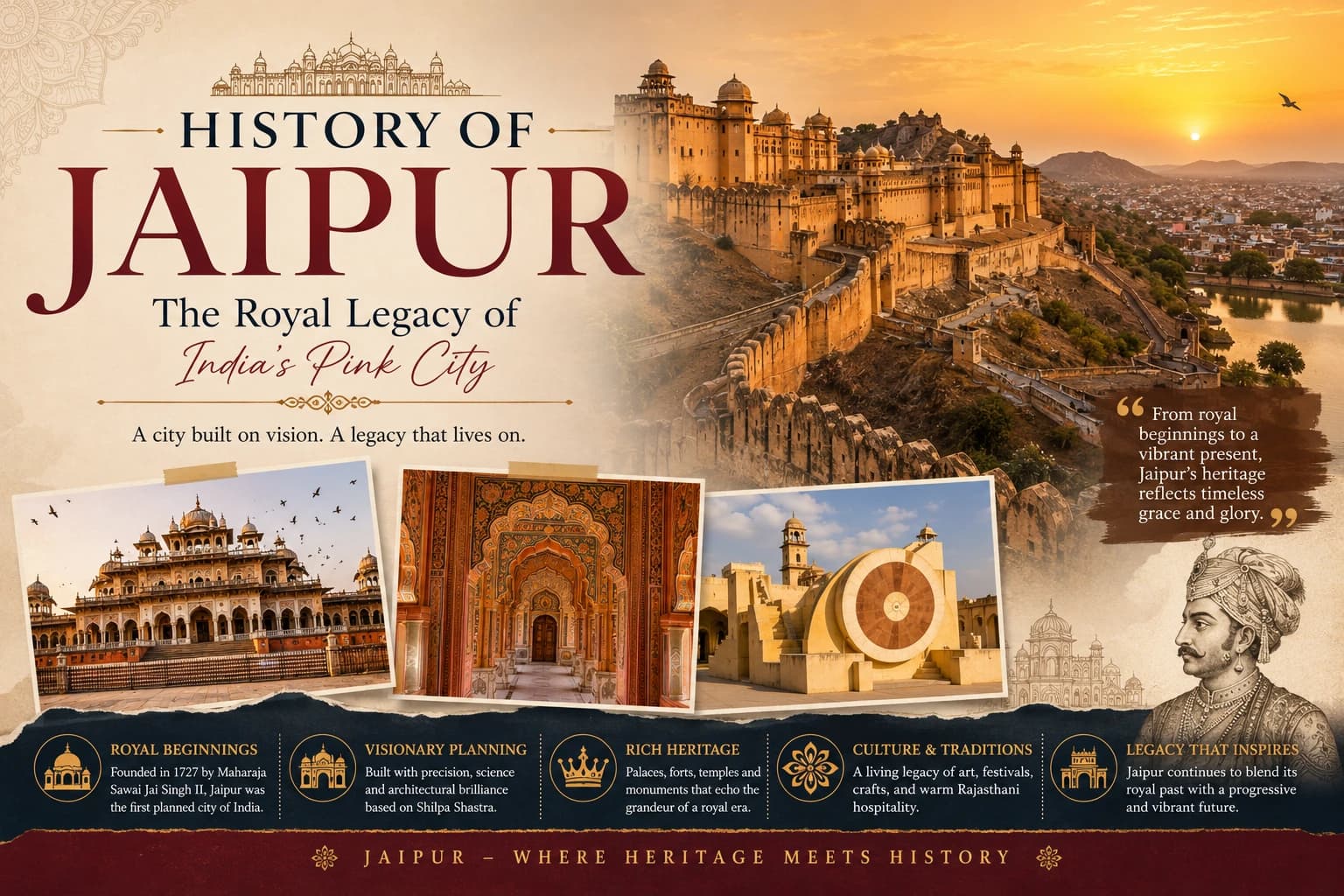
History of Jaipur
Jaipur, famously known as the Pink City of India, is one of the most historically rich and culturally vibrant cities in Rajasthan. From magnificent palaces and royal forts to scientific innovations and urban planning far ahead of its time, the history of Jaipur reflects the grandeur of Rajputana heritage.
Founded in 1727 by Maharaja Sawai Jai Singh II, Jaipur became India’s first planned city and continues to attract millions of travellers, historians, and architecture lovers from around the world. Today, Jaipur is not only the capital of Rajasthan but also a UNESCO World Heritage City admired for its unique blend of tradition and modernity.
In this complete guide, we explore the origin, royal legacy, architecture, cultural evolution, and historical importance of Jaipur in detail.
Before Jaipur was established, the Kachwaha Rajputs ruled from Amer (Amber), located around 11 km from present-day Jaipur. However, due to increasing population and water scarcity in Amer, Maharaja Sawai Jai Singh II decided to shift the capital.
In 1727, he founded Jaipur with the vision of creating a scientifically planned city based on principles of Vastu Shastra and astronomy.
Several factors contributed to the establishment of Jaipur:
Water shortage in Amer
Growing population
Need for better trade routes
Military and strategic planning
Desire to create a modern administrative capital
The city was carefully designed with wide roads, organized markets, security walls, and residential zones — something highly advanced for the 18th century.
The history of Jaipur cannot be discussed without mentioning Maharaja Sawai Jai Singh II, one of the most intelligent and progressive rulers of India.
Born in 1688, Jai Singh II was not only a warrior king but also an astronomer, mathematician, and urban planner. The Mughal Emperor Aurangzeb awarded him the title “Sawai,” meaning “one and a quarter times superior to an average person.”
He created India’s first systematically planned city with nine rectangular sectors called “Chowkris.”
He built the famous Jantar Mantar, an astronomical observatory that became a scientific marvel.
Jaipur soon emerged as a center for gems, jewellery, textiles, handicrafts, and art.
Under his rule, Jaipur became politically strong and culturally influential.
One of the most fascinating aspects of Jaipur’s history is its urban planning. The city was designed by Vidyadhar Bhattacharya, a Bengali architect and scholar.
Grid-based road network
Broad streets and intersections
Markets organized by trade
Defensive walls and gates
Proper drainage systems
Public squares and temples
The city was divided into nine sections symbolizing the nine divisions of the universe according to Hindu architecture principles.
Even today, Jaipur’s old city layout remains one of the best examples of ancient Indian town planning.
Jaipur became known as the Pink City in 1876 when Maharaja Sawai Ram Singh II ordered the entire city to be painted terracotta pink to welcome the Prince of Wales (later King Edward VII).
Pink was considered the color of hospitality. The tradition continued, and today the old city still maintains its iconic pink appearance, making Jaipur globally famous.
Jaipur’s history is deeply connected with its majestic forts and royal palaces. These architectural wonders showcase Rajput bravery, luxury, and craftsmanship.
Located on a hilltop, Amer Fort served as the original capital before Jaipur was built. It combines Rajput and Mughal architecture beautifully.
Sheesh Mahal
Diwan-e-Aam
Ganesh Pol
Royal courtyards
Situated in the heart of Jaipur, the City Palace remains one of the most important royal residences in Rajasthan.
Mubarak Mahal
Chandra Mahal
Museum galleries
Royal costumes and weapons
Built in 1799 by Maharaja Sawai Pratap Singh, Hawa Mahal allowed royal women to observe city life without being seen publicly.
Its 953 windows make it one of Jaipur’s most photographed landmarks.
Built for defense and later used as a retreat palace, Nahargarh Fort offers panoramic views of Jaipur city.
Famous for housing the world’s largest cannon on wheels, Jaigarh Fort protected Amer and Jaipur from invasions.
Read more: Top Historical Places in Jaipur
The Kachwaha rulers of Jaipur maintained strong relations with the Mughal Empire. Raja Man Singh, one of Jaipur’s earlier rulers, was a trusted general of Emperor Akbar.
This alliance brought political stability, wealth, and cultural influence to Jaipur and Amer.
Rajput-Mughal architectural fusion became visible in forts, palaces, gardens, and decorative arts during this period.
During British colonial rule, Jaipur became a princely state under indirect British administration.
Unlike many regions, Jaipur retained significant autonomy while modernizing its infrastructure.
Railways introduced
Educational institutions established
Administrative reforms implemented
Public buildings and roads developed
The city also became an important center for tourism and royal diplomacy.
Jaipur’s history is not limited to rulers and wars. The city became one of India’s biggest cultural centers.
Jaipur is globally famous for:
Blue pottery
Block printing
Meenakari jewellery
Kundan work
Marble carving
Miniature paintings
Jaipur celebrates festivals with grandeur:
Teej Festival
Gangaur Festival
Diwali
Kite Festival
Holi
These celebrations preserve the city’s royal traditions and cultural identity.
One of Jaipur’s greatest historical achievements is Jantar Mantar, built by Sawai Jai Singh II.
This UNESCO World Heritage Site contains massive astronomical instruments used to study celestial movements and time calculation.
The observatory reflects the scientific advancement of Jaipur during the 18th century.
In 2019, Jaipur was officially declared a UNESCO World Heritage City due to its:
Historic architecture
Urban planning
Cultural significance
Preservation of heritage
This recognition strengthened Jaipur’s position as one of India’s top historical destinations.
Jaipur’s markets have been important trade centers since the city’s foundation.
Known for gemstones and traditional jewellery.
Popular for textiles, handicrafts, and mojari footwear.
Famous for lac bangles and brassware.
These markets continue the centuries-old trading traditions established by Jaipur’s rulers.
After India gained independence in 1947, Jaipur merged into the Indian Union and later became the capital of Rajasthan.
Today, Jaipur is:
A major tourist destination
An educational hub
A center for handicrafts and gems
Part of India’s Golden Triangle tourism circuit
Despite modernization, the city has preserved its historical identity remarkably well.
Jaipur was India’s first planned city.
The city was designed according to Vastu principles.
Jaipur’s old city has seven historic gates.
Jantar Mantar is the world’s largest stone observatory.
Jaipur was painted pink in 1876 and has remained pink ever since.
The city is home to several UNESCO-recognized monuments.
The ideal time to visit Jaipur is between October and March when the weather remains pleasant for sightseeing.
Winter months are perfect for exploring forts, palaces, markets, and heritage walks.
Start early to avoid crowds at forts
Hire a local guide for historical insights
Wear comfortable shoes for fort visits
Visit during festivals for cultural experiences
Explore local food and traditional bazaars
The history of Jaipur is a remarkable journey of vision, royalty, science, architecture, and culture. From the strategic brilliance of Maharaja Sawai Jai Singh II to the stunning pink streets admired worldwide today, Jaipur stands as a living symbol of Rajasthan’s royal heritage.
Every fort, palace, market, and monument in Jaipur tells a story of courage, creativity, and timeless elegance. Whether you are a history enthusiast, traveller, or culture lover, exploring Jaipur is like stepping into a royal chapter of India’s glorious past.
If you are planning a Rajasthan trip, Jaipur deserves a top spot on your travel list for its unmatched historical charm and cultural richness.
Jaipur was founded by Maharaja Sawai Jai Singh II in 1727.
The city was painted pink in 1876 to welcome the Prince of Wales.
Amer (Amber) was the original capital before Jaipur was established.
Yes, Jaipur was declared a UNESCO World Heritage City in 2019.
Amer Fort is among the oldest and most historically important forts connected to Jaipur’s history.