Patrika Gate Jaipur - History, Photos, Timings & Complete Visitor Guide 2026
Author:Nidhi
Published:June 4, 2026
Views:1815
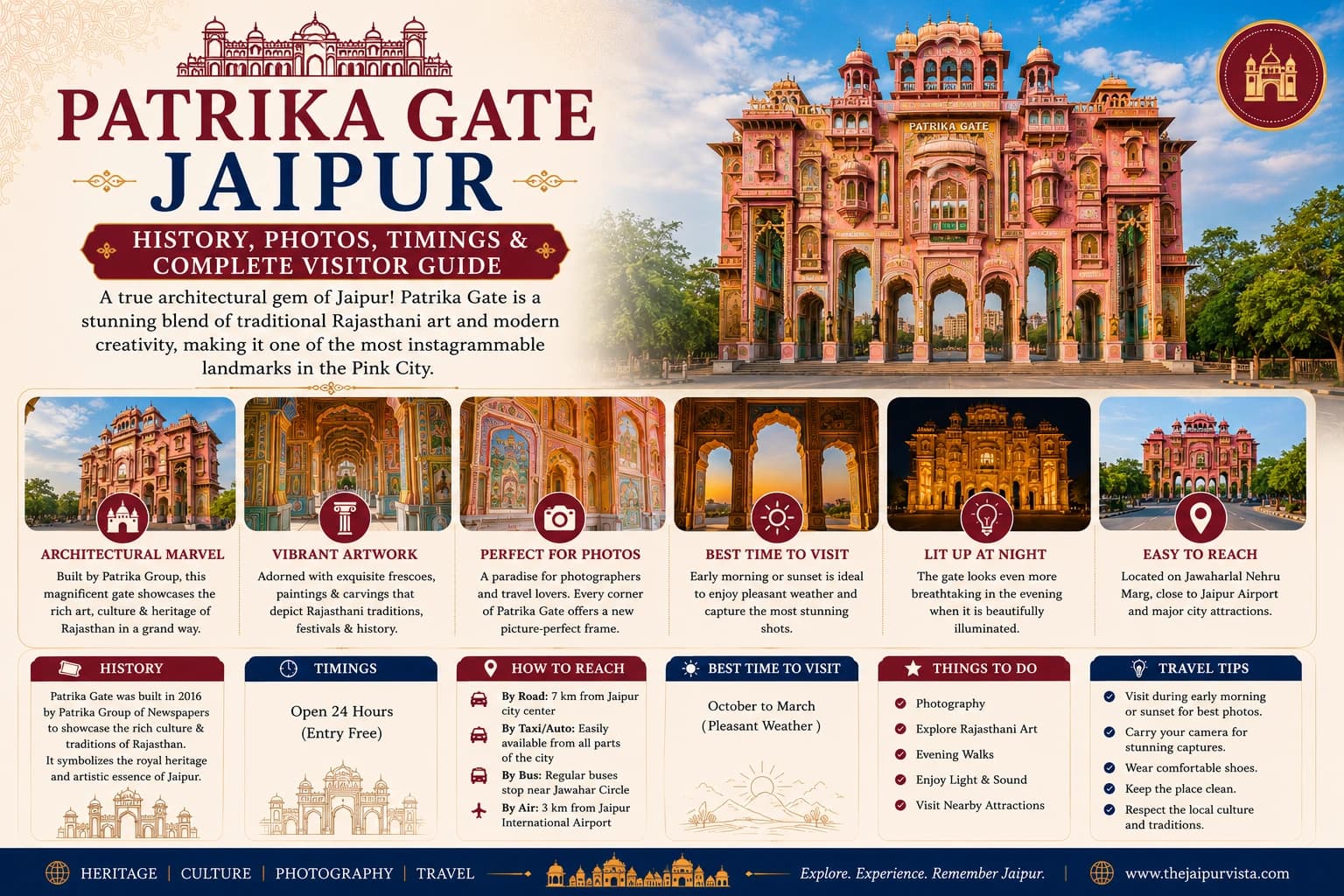
You have seen the images. Bold arches painted in deep saffron, vivid cobalt, and warm ochre, rising above a circular garden in a riot of fresco art that tells the entire story of Rajasthan in a single glance. You have watched them flood Instagram feeds, travel blogs, and architecture galleries around the world. And now, standing at the edge of Jawahar Circle on Tonk Road in Jaipur, you realise that no photograph - however carefully composed, however lovingly filtered - has ever truly done Patrika Gate justice.
This is one of those rare places where the lived experience exceeds the photograph. Where the scale surprises you, the colour overwhelms you, and the craft stops you completely in your tracks.
At The Jaipur Vista, we know this gate intimately - we have watched it glow gold in the early morning light, seen it ablaze in the colours of Holi, and stood before it in the deep silence of a winter midnight when it is entirely yours. In this complete guide, we bring you everything you need to know about Patrika Gate, Jaipur - its fascinating history, the remarkable story of its creation, a detailed look at its architecture and frescoes, the best times to visit, expert photography tips, and everything you need to plan the perfect visit.
Patrika Gate is a monumental ceremonial gate located at Jawahar Circle, Tonk Road, Jaipur, Rajasthan - one of the most distinctive and visually extraordinary landmarks in a city already famous for extraordinary landmarks. Completed in 2016, it stands as Jaipur's ninth and newest city gate, added to honour the spirit of the original eight gates that Maharaja Sawai Jai Singh II built when he founded the Pink City in 1727.
The gate was commissioned by the Patrika Group - one of India's most widely read Hindi-language newspaper publishing houses, headquartered in Jaipur - as a cultural contribution to the city the company has called home since its founding in 1956. The word patrika itself means "newspaper" or "publication" in Sanskrit and Hindi, and the Patrika Group's investment in this remarkable structure was, at its heart, a love letter to the culture, art, history, and spirit of Rajasthan.
What makes Patrika Gate Jaipur genuinely unique among India's many magnificent gates is not just its scale or its visual grandeur - it is the extraordinarily detailed narrative painted on virtually every surface in vivid fresco artwork. The gate is, in the most literal sense, an open-air museum of Rajasthani history and culture, compressed into nine painted pavilions and rendered in colours that seem to defy the passage of time.
To understand the full significance of Patrika Gate, you need to understand what came before it - and what Maharaja Sawai Jai Singh II built nearly three centuries ago.
When Maharaja Sawai Jai Singh II laid the foundations of Jaipur in 1727, he was designing something unprecedented in the history of Indian city-building: a completely planned city, constructed from the ground up according to the ancient principles of town planning codified in the Shilpa Shastra and Vastu Shastra.
The city plan was executed in close collaboration with the brilliant architect and scholar Vidyadhar Bhattacharya, and it divided Jaipur into nine rectangular sectors (chowkris) - a layout derived from the Hindu cosmological principle of navagraha, the nine planets of Vedic astrology. The number nine was not incidental; it was the philosophical spine of the entire city.
The fortified boundary wall that enclosed the city had seven principal gates (some accounts record eight, including the Ghat Darwaza near Galta), each strategically positioned in relation to the city's main boulevards and the cardinal directions. These included Chandpol Gate (facing west), Surajpol Gate (facing east), Sanganeri Gate, Ajmeri Gate, New Gate, Zorawar Gate, and Chand Pole Gate - each a functional defensive structure and a statement of the city's regal grandeur.
For nearly three centuries, this was Jaipur's gate heritage - a fixed, historical patrimony.
In 2016, the Patrika Group proposed and funded the construction of a ninth gate for Jaipur - not a defensive structure, not a governmental project, but a cultural monument: a gate that would serve as a living celebration of Rajasthani art, history, and identity.
The project was designed by architect Anoop Bartaria, who approached the commission with a vision that was deeply rooted in the architectural language of Jaipur's original gates while simultaneously creating something entirely new. The result - Patrika Gate - was inaugurated in 2016 and immediately became one of the most talked-about new architectural landmarks in India.
The choice of Jawahar Circle as the location for the new gate was significant. Jawahar Circle is located on Tonk Road, one of Jaipur's major southern arterial roads, near the Jaipur International Airport. It is home to what is commonly described as Asia's largest circular park developed on a highway roundabout - a claim that immediately signals the ambition with which Jaipur's civic planners have approached this part of the city's urban landscape. Placing the ninth gate here was both a civic statement and a tourist invitation - a spectacular arrival landmark for the millions of visitors who enter Jaipur from this direction.
The Patrika Gate is not a single gate but a connected complex of nine pavilions - each exactly nine feet wide - arranged in a grand curved formation that frames the entrance to Jawahar Circle. The number nine is, of course, deeply intentional: nine pavilions, nine feet each, honouring the nine-sectored plan of the original city and the nine planets of Vedic cosmology.
Each of the nine pavilions is a self-contained architectural unit, built in the traditional Rajput style that defines Jaipur's finest historic buildings. The pavilions feature:
Intricately carved arches in the classic Rajasthani mehrab form, with layered stone detailing that creates depth and shadow play throughout the day
Chattris (elevated dome-shaped pavilions on pillars) crowning the tops of the larger sections - a hallmark of Rajput palace architecture visible across Jaipur, Jodhpur, and Udaipur
Jaalis (perforated stone lattice screens) in traditional geometric and floral patterns, through which filtered light creates moving patterns on the ground below
Shikhara-inspired finials at the highest points, drawing from the vocabulary of Rajasthani temple architecture
Locally sourced sandstone in the characteristic warm pink and cream tones that define Jaipur's built environment, with painted surfaces adding the extraordinary explosion of colour that makes the gate globally recognisable
If the architecture of Patrika Gate Jaipur is the body, the frescoes are the soul. Every surface of the gate - arches, columns, ceilings, interior walls, and connecting passages - is covered in hand-painted frescoes executed in the traditional Rajasthani fresco technique, using mineral pigments and natural colours that have been the hallmark of Shekhawati and Jaipur school painting for centuries.
The fresco programme at Patrika Gate is one of the most ambitious narrative painting projects undertaken in Rajasthan in the modern era. The paintings tell the story of Rajasthan across multiple registers and themes:
Historical Narratives: Scenes from the battles and alliances of the Rajput kingdoms, the founding of Jaipur by Maharaja Sawai Jai Singh II, and the royal court life of the Kachhwaha dynasty are painted across several sections of the gate.
Mythological Scenes: Stories from the Ramayana, Mahabharata, and the exploits of Hindu deities - Krishna's Raas Leela, the divine court of Lord Ganesha, Durga in battle - rendered in vivid narrative sequence.
Folk Life and Cultural Traditions: Wedding processions (barat) with camel and elephant-mounted grooms, women carrying water pots on their heads, folk musicians playing the sarangi and dholak, craftspeople at work - the daily life of Rajasthan immortalised in colour.
Architectural Heritage: Detailed painted representations of Rajasthan's most iconic monuments - Amer Fort, Hawa Mahal, Nahargarh Fort, Jantar Mantar, and the City Palace - creating a painted map of the state's heritage within the gate complex.
Festivals and Celebrations: The colours of Holi, the lamps of Diwali, the processions of Gangaur - Rajasthan's festival calendar rendered in the joyful saturated palette that the state is famous for.
The palette of the frescoes at Patrika Gate is deliberately, almost aggressively vivid - deep pinks and saffrons, rich cobalts, warm ochres, bright whites, and leaf greens - colours that look painted yesterday but are executed in time-tested mineral pigments designed to last generations. Against the warm sandstone of the arches, this palette creates the visual effect that has made Patrika Gate photos some of the most shared images of India on social media worldwide.
The full width of the Patrika Gate complex spans approximately 90 metres across the entrance to Jawahar Circle. The central pavilion stands at the highest point, with flanking pavilions stepping down symmetrically on either side, creating a composition that is balanced, classical, and visually satisfying from any distance.
The gate is designed to be experienced at multiple distances: from the road, it reads as a grand ceremonial monument; approaching on foot, the scale and detail of the frescoes begin to emerge; and standing directly beneath the arches, the overwhelming richness of colour and carving becomes fully apparent.
Patrika Gate Jaipur is among the top five most photographed locations in Rajasthan, and for very good reason. Here is The Jaipur Vista's definitive guide to photographing this extraordinary landmark.
Golden Hour (Sunrise): 6:00 AM – 7:30 AM The single best time to photograph Patrika Gate. In the early morning, the eastern sun bathes the warm sandstone and vivid frescoes in a golden light that makes the colours literally glow. The crowds are minimal or absent - particularly on weekday mornings - which means you can frame your shots without tourists in the foreground. The quality of light at this time is simply unmatched.
Blue Hour (Pre-Dawn): 5:15 AM – 5:45 AM If you are an experienced photographer willing to arrive very early, the brief blue hour before sunrise creates an extraordinary atmospheric effect - the deep blue pre-dawn sky behind the illuminated gate (which has floodlighting) creates a contrast that produces some of the most dramatic Patrika Gate photos available.
Golden Hour (Sunset): One hour before sunset The western light at sunset illuminates different sections of the gate than morning light, creating different shadow patterns and highlighting different fresco panels. The warm orange tones of a Rajasthani sunset against the already warm tones of the sandstone and frescoes produce a deeply saturated, almost hyperreal colour palette. This is when the largest number of visitors arrive for photos, so patience and timing are required to get clean shots.
Night Photography: 8:00 PM – 10:00 PM After dark, Patrika Gate is beautifully illuminated by coloured floodlights that pick out the architectural details and give the frescoes a completely different, more theatrical character. Long-exposure night photography here produces striking results. The park is also active and pleasant in the evening, with local families strolling and children playing in the fountains - which adds life and human scale to night photographs.
What to Avoid: The harsh overhead light of midday (11:00 AM – 3:00 PM) flattens the frescoes and creates strong shadows inside the arches. It is also the hottest part of the day in Jaipur for most of the year.
The Symmetry Shot (Most Iconic): Stand on the central axis of Tonk Road, approximately 30-50 metres back from the gate, and frame the full width of the Patrika Gate complex. This shot captures the perfect bilateral symmetry of the nine pavilions, with the tallest central pavilion balanced by the stepping pavilions on each side. This is the classic Patrika Gate Jaipur photograph.
The Arch Detail Shot: Walk directly to one of the arches and look up into the ceiling - the fresco paintings inside each arch create a domed ceiling of colour and imagery that makes for an extraordinary close-up shot. This is the photograph that tends to go viral on Instagram.
The Through-the-Arch Shot: Stand in the central archway and frame the interior of Jawahar Circle's garden beyond - the fountains and rose gardens of the circular park, framed by the vivid frescoes of the arch, create a layered depth composition that works beautifully.
The Human Scale Shot: Including a person (with their permission) in the foreground of a wide shot dramatically conveys the sheer scale of the gate in a way that solo architectural shots cannot.
Fresco Close-Ups: The narrative detail in the painted panels rewards macro and close-up photography. Look for painted elephant processions, detailed architectural landscapes, and facial expressions in the figurative scenes.
Wide-angle lens (16-24mm full frame equivalent): Essential for capturing the full width of the gate without extreme perspective distortion.
Smartphone: Modern flagship smartphones with their wide-angle modes capture the gate very well and are easy to manage for the overhead arch shots.
Tripod: Necessary for blue hour, golden hour, and night photography. The garden ground is flat and stable.
Polarising filter: Useful in the middle of the day to reduce glare on the painted surfaces.
Patrika Gate and Jawahar Circle Garden Timings:
Entry Fee: The Patrika Gate structure itself is free to view at any time. Entry to the Jawahar Circle garden park may involve a nominal fee (₹10-20 per person as of last update - confirm locally as fees can change).
Best Time to Visit Patrika Gate Jaipur: Early morning on a weekday (6:00 AM – 8:00 AM) for the best photography conditions and minimal crowds. Evenings are excellent for a leisurely visit with the family and for the garden atmosphere.
Estimated Visit Duration: 30-60 minutes for a casual visit; 1.5-2 hours for photographers or those who want to explore the full fresco programme in detail.
Illumination: The gate is illuminated in the evenings and is beautiful after dark, typically from 7:00 PM until 10:00 PM or later.
Location: Jawahar Circle, Tonk Road (NH-58 / NH-148B), Jaipur, Rajasthan - approximately 6 km from the Jaipur city centre (City Palace / Hawa Mahal area) and approximately 4 km from Jaipur International Airport.
Coordinates: 26.8416222, 75.8013497 The most convenient way to reach Patrika Gate Jaipur. From the old city (City Palace, Hawa Mahal), take MI Road south to Tonk Road and continue approximately 4-5 km to Jawahar Circle. The drive takes 15-25 minutes depending on traffic. Ola and Uber are both widely available in Jaipur and can drop you directly at Jawahar Circle. Auto-rickshaws are abundant throughout Jaipur. Ask for "Patrika Gate" or "Jawahar Circle" - both names are well-known to every driver. From the old city, the fare is typically ₹80-150. Several RSRTC (Rajasthan State Road Transport Corporation) city bus routes pass Jawahar Circle on Tonk Road. However, given Jaipur's traffic and the typically cumbersome city bus experience, taxis and autos are recommended for visitor convenience. Patrika Gate is one of the first major landmarks you will pass after leaving Jaipur International Airport on Tonk Road - making it an easy and highly recommended first stop for visitors arriving by air. The drive from the airport terminal takes approximately 8-12 minutes. Take an auto-rickshaw or taxi from the station via MI Road to Tonk Road. The journey takes approximately 20-30 minutes. Patrika Gate does not stand alone - it is the entrance to Jawahar Circle, one of Jaipur's most beloved urban parks and, by some measures, one of the largest circular gardens in Asia. The park extends in a full circle around the central island of the roundabout, and within it you will find: Rose Gardens and Themed Plantings: The park is beautifully landscaped with extensive rose gardens (at their magnificent best from November to February), manicured lawns, seasonal flowering plants, and mature trees that provide shade in the warmer months. Horticulture enthusiasts will find much to admire here. Fountains and Water Features: Multiple fountain installations are located within the circular park. The central fountain is illuminated at night, creating a beautiful display. Children are invariably drawn to the fountains, making this one of Jaipur's best family-friendly outdoor spaces. Walking Paths: Well-paved circular walking paths run through the garden, making this a popular spot for early morning walkers and joggers from the surrounding residential neighbourhoods. The 4,658-foot circumference of the park creates an excellent morning walking circuit. Outdoor Gym Equipment: Several sections of the park are fitted with outdoor exercise equipment - a popular attraction for the health-conscious residents of the surrounding area. Cultural Programmes: On occasion, the amphitheatre area of Jawahar Circle hosts cultural performances, folk music events, and public celebrations, particularly around Rajasthan Day (March 30) and other state festivals. Food and Snack Vendors: In the evenings especially, small food vendors and snack stalls set up near the park entrance, offering local favourites including kachori, samosa, chai, and corn. The evening food scene here is low-key but authentically local. One of the most rewarding ways to experience Patrika Gate is to walk slowly through each of the nine pavilions and take time to read the narrative paintings. Here is a thematic guide to what you will find in the different sections: The tallest and most architecturally dominant section, the central pavilion features paintings focused on the founding and royal history of Jaipur - Maharaja Sawai Jai Singh II's vision for the city, the astronomical instruments of Jantar Mantar, and scenes from the Kachhwaha court. This is the most photographed individual section of the gate. Flanking the central pavilion, these two sections are dominated by painted representations of Rajasthan's most iconic architectural heritage - detailed fresco renditions of Amer Fort, Nahargarh Fort, Jaigarh Fort, the Hawa Mahal, and the City Palace, alongside smaller depictions of palaces and temples from across the state. These sections are rich with mythological narrative painting - scenes from the Ramayana and Mahabharata, the divine exploits of Lord Krishna and Radha, the battles of the Goddess Durga, and the peaceful abundance of Lord Ganesha's court. The ceiling paintings in these pavilions are particularly detailed and worth spending time with. These outer pavilions celebrate the daily life, craft traditions, and folk culture of Rajasthan - painted scenes of potters at the wheel, weavers at the loom, block printers working their wooden blocks, camel farmers, water-carriers, village fairs, and the extraordinary variety of traditional dress from different regions of the state. The outermost pavilions on each end are dedicated to Rajasthan's festival calendar - the colours of Holi, the lamps of Diwali and Diwali processions, the swing festivals of Teej, the camel festival of Pushkar, the desert festival of Jaisalmer, and the kite festival of Makar Sankranti. These sections are the most vivid and celebratory in the entire gate complex. A truly enriching way to experience Patrika Gate Jaipur is to place it in the context of the city's original eight historic gates - and to explore the complete Nine Gates of Jaipur heritage circuit as a half-day or full-day cultural itinerary. The eight original gates of Jaipur's fortified city wall include: Chandpol Gate (Moon Gate): On the western side of the old city, Chandpol - or Moon Gate - is named for its alignment with the moon in the city's astronomical plan. It is one of the grandest of the original gates, with a wide roadway and imposing double-towered structure. Surajpol Gate (Sun Gate): On the eastern side, aligned with the rising sun. Surajpol is another of the well-preserved original gates and marks one of the main entry points to the old walled city. Ajmeri Gate: On the southwestern side, this gate faces in the direction of Ajmer and is one of the most historically significant of the city's original entrance points. Sanganeri Gate: Named for the road that leads to Sanganer (a town renowned for its block-printed textiles), this gate is located on the southern side of the old city. New Gate (Naya Darwaza): Added slightly later than the original gates, this gate was constructed to accommodate the growing commercial activity of the city. Dhruv Pol (Zorawar Gate): One of the less well-known of the original gates, located on the northern side. Ghat Darwaza (near Galta): Associated with the road leading to the Galtaji temple complex, this gate connected the city to one of its most important pilgrimage routes. Adding Patrika Gate as the ninth gate of this heritage circuit creates a wonderful cross-city itinerary that connects the ancient planned city of Jai Singh II with modern Jaipur's cultural ambition. The area around Jawahar Circle is well-positioned for a broader southern Jaipur itinerary. Here are the best places to visit near Patrika Gate: One of Rajasthan's most modern and architecturally striking shopping and entertainment complexes, World Trade Park is located very close to Jawahar Circle on Tonk Road. A visit here pairs well with a Patrika Gate sunrise trip - you can photograph the gate in the early morning and then have breakfast at one of the WTP restaurants. One of the world's most celebrated heritage hotels - the former royal residence of the Maharaja of Jaipur, now a Taj Hotels property - Rambagh Palace is located approximately 4 km north of Patrika Gate on Bhawani Singh Road. Even non-guests can visit for afternoon tea or a meal, and the beautifully maintained Mughal gardens are worth seeing. The white marble Birla Mandir Jaipur, dedicated to Lord Vishnu and Goddess Lakshmi, is one of Jaipur's most beautiful modern temples and is particularly stunning when illuminated at night. Located at the foot of Moti Doongri hill, approximately 5 km from Patrika Gate. One of Jaipur's most beloved Ganesha temples, situated on a small rocky outcrop near Birla Temple. Particularly busy on Wednesdays and during Ganesh Chaturthi. Jaipur's most expansive urban park, home to India's tallest flag mast and stretching for over 1.5 km along the Jai Mahal Road. Ideal for a morning walk or evening stroll. Home to a famous statue of Maharaja Sawai Jai Singh II at the centre of one of Jaipur's main traffic circles, Statue Circle is surrounded by government buildings in classical Rajasthani architectural style and is a good photography stop. If you are visiting Patrika Gate as your final Jaipur stop before a departure flight, the proximity to the airport makes this particularly convenient - the gate is the last great Jaipur landmark you will see before leaving the city. Read Also: Top Tourist Places in Jaipur With so many spectacular landmarks to see in Jaipur - Amer Fort, Nahargarh, the City Palace, Jantar Mantar, the Hawa Mahal - you might wonder whether Patrika Gate earns its place on your itinerary. The answer, from The Jaipur Vista team who knows this city intimately: absolutely yes, and for reasons that go beyond the Instagram photograph. For photographers and visual travellers: The Patrika Gate is one of the most extraordinary photography subjects in India - the combination of architectural grandeur, the richness of the fresco programme, and the quality of light on the warm sandstone creates photographic conditions that are almost unreasonably generous. For those interested in craft and art: The fresco paintings represent some of the finest traditional Rajasthani mural painting produced in the 21st century. For anyone interested in Indian visual arts, spending an hour reading the paintings at Patrika Gate Jaipur is genuinely rewarding. For cultural travellers: The gate tells the story of Jaipur's founding mythology and Rajasthan's cultural identity in a single extended visual narrative. It is a compressed museum of Rajasthani civilisation, accessible for free, open to all. For families: The Jawahar Circle garden is one of the most pleasant family spaces in the city - children enjoy the fountains, the gardens, and the evening food vendors while parents photograph the gate. For first-time Jaipur visitors: If you are arriving at Jaipur Airport, stopping at Patrika Gate before heading to your hotel is one of the best possible introductions to the Pink City - it sets up the visual language of Rajasthani art and architecture that you will see across the rest of your trip. What to Wear: The Patrika Gate is a public civic monument with no dress code. That said, if you plan to visit early in the morning, Jaipur can be chilly from November to February - carry a light jacket. In summer (April to June), light, breathable cotton clothing and sun protection are essential. Footwear: The Jawahar Circle garden has paved paths and is easy to navigate in any footwear. Good walking shoes are recommended if you plan to walk the full circular path of the park. Crowds and Timing: The gate is busiest on weekends, public holidays, and evenings. For the most peaceful visit and the best Patrika Gate photos, arrive on a weekday morning between 6:00 AM and 8:00 AM. Sun Protection: For daytime visits, carry sunscreen, sunglasses, and a hat - Jawahar Circle is an open, sun-exposed space with limited shade in the inner areas near the gate. Refreshments: There are no permanent cafes or restaurants inside the park, but vendors operate in the evenings. Carry water for morning visits. Duration: Budget at least 45-60 minutes for a comfortable visit that includes walking through all nine pavilions of the gate and exploring the immediate garden area. Jaipur has been called many things - the Pink City, the Gem of Rajputana, a living heritage museum, an astronomer-king's geometric dream made real in sandstone. But Patrika Gate reminds you that Jaipur is also a city that continues to invest in its own cultural identity, to take pride in its history, and to create new landmarks worthy of standing alongside the magnificent structures of the 18th century. The Patrika Gate is brand new by the standards of this ancient city. But it is already, unmistakably, one of Jaipur's own. Walk through its painted arches in the early morning light, take your time reading the frescoes, watch the fountains of Jawahar Circle catch the light, and you will understand why - of all the photographs that people take home from Jaipur - the images of Patrika Gate are the ones that most often surprise them. Because no matter how many times they have seen the pictures, they were not prepared for the real thing. Welcome to Jaipur's ninth gate. The Pink City has never looked more colourful. Q. Who built Patrika Gate in Jaipur? Q. Why is it called Patrika Gate? Q. What is the history of Patrika Gate? Q. What are the timings of Patrika Gate? Q. Is there an entry fee for Patrika Gate Jaipur? Q. What is the best time to visit Patrika Gate for photography? Q. How many pavilions does Patrika Gate have? Q. How far is Patrika Gate from Jaipur city centre? Q. What is the significance of the frescoes at Patrika Gate? Q. Can I visit Patrika Gate at night?By Car or Taxi
By Auto-Rickshaw
By Bus
From Jaipur Airport (4 km)
From Jaipur Railway Station (7 km)
Jawahar Circle: The Garden Around Patrika Gate
The Nine Pavilions: A Section-by-Section Fresco Guide
The Central Pavilion (Gate No. 5)
The Heritage Pavilions (Gates No. 4 and 6)
The Mythology and Religion Pavilions (Gates No. 3 and 7)
The Folk Life and Craft Pavilions (Gates No. 2 and 8)
The Festival Pavilions (Gates No. 1 and 9)
Patrika Gate and the Nine Gates of Jaipur: A Heritage Circuit
Places to Visit Near Patrika Gate Jaipur
1. World Trade Park (1.5 km)
2. Rambagh Palace (4 km)
3. Birla Mandir / Laxmi Narayan Temple (5 km)
4. Moti Doongri Ganesh Temple (5 km)
5. Central Park Jaipur (4 km)
6. Statue Circle (5 km)
7. Jaipur International Airport (4 km)
Is Patrika Gate Worth Visiting? Honest Assessment
Visitor Tips for Patrika Gate, Jaipur
Final Word: Patrika Gate and the Soul of Jaipur
Frequently Asked Questions: Patrika Gate Jaipur
Patrika Gate was commissioned and funded by the Patrika Group, one of India's leading Hindi-language newspaper publishing companies headquartered in Jaipur. It was designed by architect Anoop Bartaria and completed in 2016.
The gate takes its name from the Patrika Group, the newspaper company that funded its construction as a cultural gift to Jaipur. Patrika means "newspaper" or "publication" in Sanskrit and Hindi.
Patrika Gate was built in 2016 to serve as Jaipur's ninth city gate, honouring the legacy of the eight gates built by Maharaja Sawai Jai Singh II when he founded Jaipur in 1727. It is located at Jawahar Circle on Tonk Road and features nine pavilions (each nine feet wide) referencing the nine planets of Vedic astrology - the same cosmological number that shaped the original city plan.
The Patrika Gate structure is visible and freely accessible at all times. The Jawahar Circle garden is generally open from 6:00 AM to 10:00 PM. The gate is beautifully illuminated in the evenings.
Entry to the Patrika Gate structure itself is free. A nominal fee (₹10-20) may apply for entry to the Jawahar Circle garden park.
The best time for Patrika Gate photos is at sunrise (6:00 AM – 7:30 AM) for golden morning light with minimal crowds, or at sunset for warm evening tones. Night photography from 8:00 PM – 10:00 PM (when the gate is floodlit) also produces spectacular results.
Patrika Gate has nine pavilions, each nine feet wide - a deliberate reference to the number nine that underpinned Maharaja Sawai Jai Singh II's original nine-sector plan for Jaipur city.
Patrika Gate at Jawahar Circle is approximately 5-6 km from the old city centre (Hawa Mahal / City Palace area), a drive of around 15-20 minutes.
The frescoes at Patrika Gate Jaipur depict the history, mythology, architecture, folk life, craft traditions, and festival culture of Rajasthan, executed in traditional mineral pigment fresco painting technique. They represent one of the most ambitious narrative mural projects in modern Rajasthan and are comparable in scope to a complete museum of Rajasthani civilisation.
Yes - Patrika Gate is illuminated by coloured floodlights in the evening and is a very popular spot for evening visits and night photography. The garden and fountains are also active and well-populated in the evening.