Top Tourist Places in Jaipur 2026: Forts, Palaces, Markets & Hidden Gems
Author:Niharika
Published:May 8, 2026
Views:573
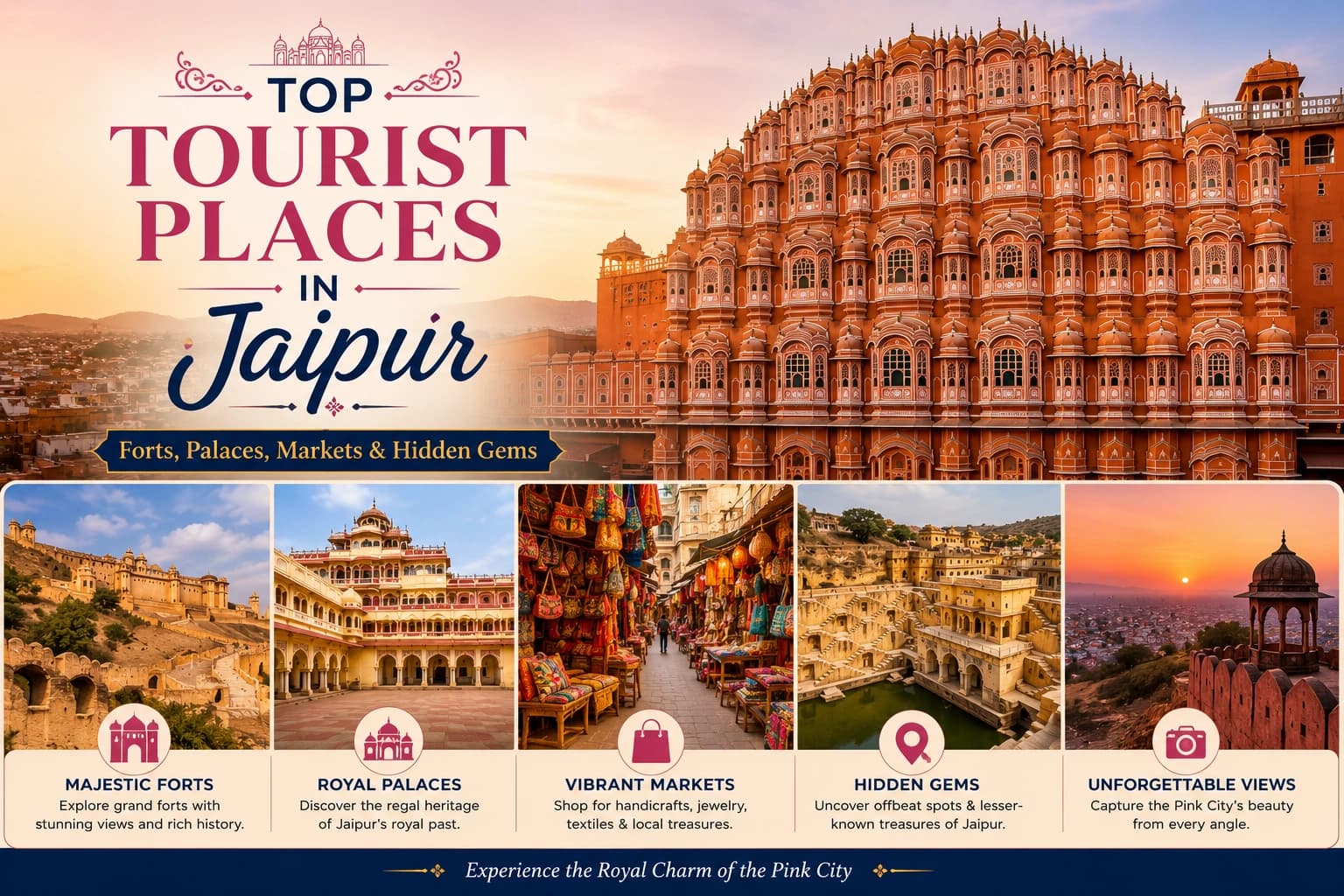
Jaipur. Say the name to any seasoned traveller and watch their eyes light up. The Pink City of Rajasthan is one of those rare destinations that simultaneously delivers everything — grand architecture, spiritual depth, market frenzy, street food ecstasy, and sunsets that look hand-painted. Whether you are planning your first visit or your fifth, knowing the best tourist places in Jaipur — beyond the postcard photos — makes all the difference between a good trip and a transformative one.
We are The Jaipur Vista, a travel and culture platform built by Jaipur locals. We walk these streets, celebrate these festivals, and eat in these bylanes every day. This guide to Jaipur tourist places is not assembled from Wikipedia descriptions — it is lived experience, honest opinion, and practical knowledge you can actually use.
“Jaipur was not built by accident. Maharaja Sawai Jai Singh II designed it in 1727 as a grid city when no other city in India had been planned from scratch. That intentionality — in architecture, culture, and craft — still defines Jaipur today.”
In this guide, you will find the top 10 tourist places in Jaipur with detailed write-ups, offbeat discoveries, a day-by-day itinerary, market-by-market shopping breakdowns, and genuinely useful travel tips. Let us explore the Pink City, the right way.
India has hundreds of historic cities, but very few possess Jaipur's particular combination of attributes. The city offers forts that rival anything in Europe, palaces still inhabited by royalty, markets that have traded in gems and textiles for three centuries, and a street food culture so distinct it has its own vocabulary.
Jaipur is also extremely well connected — it has an international airport, sits on the Golden Triangle tourist circuit (Delhi–Agra–Jaipur), and has enough accommodation for every budget.
The real reason Jaipur captivates travellers is its texture. The rose-pink colour that covers the old city — mandated by Maharaja Ram Singh II in 1876 to welcome Prince Albert — creates a visual coherence unlike anywhere else in India.
The places to visit in Jaipur span multiple centuries and sensibilities, meaning a single city can satisfy the history enthusiast, the architecture buff, the foodie, the photographer, and the spiritual seeker simultaneously.
If you have limited time or are planning your first trip, this is your essential list. These are the best places to visit in Jaipur, ranked by cultural significance, architectural grandeur, visitor experience, and uniqueness.
Must Visit • UNESCO Heritage • Photography • History
The undisputed crown jewel of Jaipur tourist places, Amber Fort is a 16th-century Rajput masterpiece perched dramatically on a ridge above Maota Lake. Built by Raja Man Singh I in 1592, the fort is a labyrinth of courtyards, elephant gates, audience halls, and the extraordinary Sheesh Mahal (Palace of Mirrors) — a chamber whose ceiling is encrusted with thousands of tiny convex mirrors that scatter candlelight like a galaxy of stars. Arrive by 8:00 AM to beat the crowds and witness the fort in golden morning light. The sound-and-light show held every evening is one of the best in Rajasthan.
Timings: 8:00 AM – 5:30 PM
Entry Fee: ₹100 (Indian) | ₹500 (Foreign)
Best Time: Early Morning
Distance: 11 km from city centre
Icon of Jaipur • Architecture • Photography
This 1799 honey-combed pink sandstone façade — designed in the shape of Lord Krishna's crown — has 953 intricately carved jharokhas stacked five stories high. Built so royal ladies could observe street life without being seen. Go inside: the top floor offers a commanding panorama of the old city. Early in the morning, the east-facing façade glows orange-gold in the rising sun — the best time for photographs.
Royal Heritage • Museum • Architecture
The City Palace is a magnificent blend of Rajput, Mughal, and European architectural styles covering one-seventh of the old city. The Mubarak Mahal houses royal garments including Maharaja Sawai Madho Singh I's enormous robe. The Diwan-i-Khas houses two giant silver vessels listed in the Guinness World Records as the world's largest sterling silver objects. The seven-storey Chandra Mahal is still a royal residence — accessible via premium guided tour.
Timings: 9:30 AM – 5:00 PM
Entry Fee: ₹200 (Indian) | ₹700 (Foreign)
Tip: Buy the Composite Ticket for all major monuments
UNESCO Heritage • Science & Astronomy
A UNESCO World Heritage Site since 2010, Jantar Mantar contains 19 astronomical instruments of extraordinary precision built entirely of masonry and marble. The Samrat Yantra, the world's largest sundial, stands 27 metres tall and calculates time accurate to 2 seconds. Built in 1734, these instruments were more than a century ahead of modern astronomy equipment and still work perfectly. Hire a certified guide — essential for understanding what you're seeing.
Timings: 9:00 AM – 4:30 PM
Entry Fee: ₹50 (Indian) | ₹200 (Foreign)
Time Needed: 45–90 minutes
Best Sunset • Panoramic Views • Hidden Gem
Perched on the Aravalli ridge overlooking Jaipur, Nahargarh Fort offers what many consider the finest panoramic view of the entire Pink City. Built in 1734, the fort is less visited than Amber but arguably more rewarding for sunset-chasers and photographers. The Madhavendra Bhawan — a suite of rooms for the maharaja's nine queens, each with identical layouts so none could claim precedence — is a fascinating study in diplomatic architecture.
Timings: 10:00 AM – 5:30 PM
Entry Fee: ₹50 (Indian) | ₹200 (Foreign)
Best Time: 4:00–6:00 PM for sunset
Bonus: Padao restaurant inside with city views
Military History • World's Largest Cannon
The primary military stronghold of Jaipur, Jaigarh houses the Jaivana cannon — the world's largest wheeled cannon on a single carriage. Cast in 1720, its barrel measures over 6 metres and it has been fired only once in history. The projectile landed 35 km away and created a crater that became a lake. Connected to Amber Fort by a long covered passage, the two forts formed an almost impregnable defensive complex.
Timings: 9:00 AM – 4:30 PM
Entry Fee: ₹70 (Indian) | ₹200 (Foreign)
Tip: Combine with Amber Fort visit (same hill)
Most Romantic • Photography • Evening Visit
Jal Mahal appears to float in the middle of Man Sagar Lake with the Aravalli hills as backdrop. Four of the five storeys are submerged — only the rooftop terrace is visible above the waterline. Built as a duck-hunting lodge, it was restored in the early 2000s and the lake has since been ecologically revived to support flocks of migratory birds. The lakeside promenade with evening views and reflections of the palace at dusk makes this one of the most beautiful places to visit in Jaipur.
Access: Lakeside viewing (no entry to palace)
Entry Fee: Free (lakeside)
Best Time: Evening — golden hour reflections
Museum • Architecture • Family
Jaipur's oldest museum, housed in a stunning Indo-Saracenic building inaugurated in 1887. Houses over 16,000 artefacts spanning Egyptian mummies, Rajasthani miniature paintings, carpets, metalwork, pottery, and jewellery. The Egyptian mummy is the most-photographed exhibit; the Persian garden carpet from the 17th century is among India's finest.
Timings: 10:00 AM – 5:00 PM, 7:00–10:00 PM
Entry Fee: ₹40 (Indian) | ₹300 (Foreign)
Don't Miss: Night lighting (illuminated after dark)
Instagram Famous • Photography
Built in 2016, Patrika Gate is Jaipur's newest and most photogenic landmark. The 35-metre entrance arch to Jawahar Circle Garden has interior columns and ceilings covered in vibrant, hand-painted frescoes depicting the 12 districts of Rajasthan, folk art scenes, and architectural motifs. No two panels are identical. Visit after sunset when the fresco-covered interior is dramatically illuminated.
Timings: Open 24 hours
Entry Fee: Free
Best Time: Evening (illuminated)
Spiritual Heart • Culture • Aarti
Located within the City Palace complex, Govind Dev Ji Temple houses an idol of Lord Krishna venerated by the Jaipur royal family since 1714. The temple holds seven daily darshan sessions, each accompanied by music, bells, and incense. The early morning aarti at 4:30 AM attracts thousands of devotees and is a profound spectacle even for non-religious visitors. Dress modestly and arrive early for the best views.
Darshan Timings: 4:30 AM – 9:30 PM (7 sessions daily)
Entry Fee: Free
Dress Code: Modest attire required
Read More: Top Historical Places in Jaipur
Jaipur is surrounded by a network of forts built over several centuries. Each served a different strategic and ceremonial purpose — together forming one of the most impressive defensive systems in Rajasthan. For travellers interested in military history, architecture, or extraordinary views, the forts near Jaipur are unmatched.
The scale of Amber Fort — its rampart walls snaking across the ridgeline like a miniature Great Wall of China, its four successive courtyards each more ornate than the last — is genuinely jaw-dropping. The Sheesh Mahal is frequently described as one of the most beautiful rooms in all of India. Allow minimum three hours; the audio guide is thorough and well-produced. Elephant rides to the fort entrance have become controversial for animal welfare reasons — opt for the jeep or walk the path instead.
If Amber is the tourist's fort, Nahargarh is the Jaipurite's fort. On weekends, locals drive up for picnics, sunset views, and the excellent Padao restaurant inside the fort. From the upper battlements at dusk — when the entire pink city shifts through shades of amber, rose, and violet — this is one of those moments that confirms why travel matters. A sculpture park and art installation have been added in recent years.
Less visited and less polished than Amber, Jaigarh rewards those who make the extra effort. The fort contains a cannon foundry, armoury, granary, open-air theatre, and watchtowers. For decades after Indian independence, rumours persisted that the fort contained a buried treasury — dramatic enough that Prime Minister Indira Gandhi ordered a search in 1976. Nothing was found. Superb views of Amber Fort below make this well worth visiting.
The City Palace complex encompasses the Chandra Mahal, Mubarak Mahal, Diwan-i-Khas, Diwan-i-Aam, and numerous courtyards. The Textile Gallery in Mubarak Mahal is outstanding — royal garments, embroidered saddles, ceremonial robes, and palanquins. Book the Royal Grandeur Tour for access to the private sections of the Chandra Mahal (approx. ₹2,500 per person) including tea with a family representative and rooms tourists never normally see.
Even if you are not staying here, Rambagh Palace — the former official residence of Maharaja Sawai Man Singh II, now a Taj Hotels luxury property — deserves a visit. The gardens, heritage galleries, and Suvarna Mahal restaurant (for a truly royal dining experience) are accessible to day visitors. One of the finest heritage hotels in Asia.
About 45 km north of Jaipur, Samode Palace is a 475-year-old palace with an extraordinary durbar hall painted floor-to-ceiling in mirrors and frescoes. Less commercialised than city attractions, it gives a more intimate sense of what Rajasthani royal life felt like. Well worth the day trip.
Built in 1728, this terraced Mughal-style garden with fountains, water channels, and murals of the Krishna-Radha legend sits 10 km east of the city. Largely crowd-free on weekday mornings, perfect for a contemplative walk.
One of Jaipur's best-kept secrets: the city has a functioning leopard safari park almost entirely within city limits. Jhalana Safari Park covers 23 sq km of Aravalli scrubland and is home to over 30 leopards. Safari jeeps operate twice daily (6:00–9:00 AM and 3:00–6:00 PM). Booking in advance is essential. Spotting a leopard within view of a city's apartment blocks is a genuinely surreal experience.
Book online in advance — slots sell out, especially on weekends
Wear earth tones (browns, greens, khakis) for better wildlife spotting
Morning safaris (6:00–9:00 AM) generally offer better leopard sightings
Fee: ₹750 (Indian) | ₹1,500 (Foreign) per person; camera fee extra
Full-day nature walks with a naturalist available for ₹2,500–₹3,500
Jaipur has been a trading city for nearly 300 years. Its markets — concentrated in the old walled city — are legendary among buyers of gems, jewellery, textiles, handicrafts, and antiques. Even if you buy nothing, walking the bazaars of Jaipur is one of the most vivid sensory experiences in India.
| Market | Best For | Local Tip |
|---|---|---|
| Johari Bazaar | Jewellery & Gems | World's largest coloured gemstone hub. Hundreds of shops for gold, Kundan, Meenakari jewellery. Get a certificate for significant purchases. |
| Bapu Bazaar | Textiles & Jootis | Best for block-printed fabrics, traditional leather jootis, and souvenirs. More tourist-friendly; prices are marked but bargaining works. |
| Tripolia Bazaar | Lac Bangles & Antiques | One of Jaipur's most atmospheric lanes. Older, less curated, more authentic than Bapu Bazaar. Great for traditional metalwork. |
| Nehru Bazaar | Blue Pottery & Handicrafts | Located along the old city's southern wall. Curated for tourist shopping with blue pottery, hand-painted boxes, and Rajasthani crafts. |
| Chandpole Bazaar | Marble Carvings & Blue Pottery | Specialist in marble statues and stone carvings. Several artisan studios welcome visitors to watch craftsmen at work. |
| MI Road / Panch Batti | Modern Shopping | Branded boutiques, upscale Rajasthani fashion designers, and the famous Rawat Mishtan Bhandar for pyaaz kachori. |
Avoid hotel-recommended shops — they often pay high commissions and inflate prices
For gems: the Gem Testing Laboratory of Rajasthan (near Johari Bazaar) offers independent certification
Fixed-price government emporiums (Rajasthali on MI Road) are excellent for quality assurance without bargaining stress
Block-printing: Visit Sanganer or Bagru village (30–40 km from Jaipur) to buy directly from artisans
Bargaining: Start at 40–50% of first quoted price. Be firm but friendly. Walking away often results in a better offer
The top tourist places in Jaipur are magnificent. But the city has a parallel layer of less-publicised gems that reward the curious traveller. Here are spots most visitors skip — and most locals quietly love.
This 16th-century stepwell in Amer village (just below Amber Fort) has geometrically perfect zigzagging steps descending to the water below — creating a hypnotic symmetry beloved by photographers. Visit early morning when light hits the stone at an angle and there are almost no other visitors. Entry is free.
About 95 km from Jaipur, the Chand Baori in Abhaneri village is one of the deepest and most visually stunning stepwells in the world. With 3,500 narrow steps arranged in perfect geometric patterns across 13 storeys descending 30 metres, it pre-dates any European Gothic cathedral. Featured in films including The Dark Knight Rises and The Fall. Well worth a day trip.
Located in a restored haveli in Amer, this superbly curated museum documents the history and practice of Jaipur's block-printing tradition. Interactive displays, working artisan demonstrations, and beautifully presented artefacts make it one of the city's finest small museums. The Anokhi cafe serves excellent lunch.
The most underrated places to visit in Jaipur may not be monuments at all. Laxmi Mishthan Bhandar in Johari Bazaar serves the finest ghewar in Jaipur. The pyaaz kachori at Rawat Mishtan Bhandar on Station Road is the city's most beloved breakfast. For a traveller serious about understanding Jaipur, eating is as important as sightseeing.
Here is a structured itinerary for visiting the major Jaipur tourist places efficiently without rushing.
Morning: Arrive at Hawa Mahal before 9:00 AM for sunrise photographs, then explore the interior. Walk to City Palace (10 min) and spend 2–3 hours.
Afternoon: Jantar Mantar (adjacent to City Palace, 1.5 hours). Lunch at Peacock Rooftop Restaurant.
Evening: Explore Johari Bazaar and Bapu Bazaar.
Dinner at Laxmi Mishtan Bhandar for traditional Rajasthani thali.
Early Morning: Depart by 7:30 AM for Amber Fort — arrive by 8:00 AM to beat the heat and crowds. Spend 3 hours.
Mid-Morning: Drive up to Jaigarh Fort (10 min from Amber) — 1.5 hours.
Afternoon: Explore Panna Meena ka Kund stepwell near Amber.
Sunset: Nahargarh Fort by 4:30 PM for the city's best sunset view.Dinner at Padao restaurant inside the fort.
Morning: Early darshan at Govind Dev Ji Temple (4:30 or 7:30 AM session). Visit Galtaji Monkey Temple (30 min drive, best before 9 AM).
Mid-Morning: Jal Mahal lakeside walk. Anokhi Museum in Amer.
Afternoon: Albert Hall Museum, then Patrika Gate.
Evening: Shopping in Chandpole or Nehru Bazaar. Birla Mandir after sunset (beautifully illuminated).
Option A: Jhalana Leopard Safari (morning, 6–9 AM) + Sisodia Rani Garden + Kanak Vrindavan.
Option B: Day trip to Abhaneri (Chand Baori stepwell) + Samode Palace.
Option C: Sanganer and Bagru village textile tours + block printing workshop.
Evening: Rambagh Palace garden visit and heritage walk in the old city laneways.
Not all travellers want the same experience. Here is a curated breakdown of the best places to visit in Jaipur based on what you are looking for:
| Traveller Type | Top Picks | Local Tip |
|---|---|---|
| First-Time Visitors | Amber Fort, Hawa Mahal, City Palace, Jantar Mantar | Buy the Composite Ticket; sunrise at Hawa Mahal is non-negotiable |
| History & Architecture | Amber Fort, Jaigarh, City Palace, Albert Hall Museum | Hire a certified heritage guide; visit Panna Meena Kund |
| Photographers | Hawa Mahal (sunrise), Patrika Gate (evening), Amber Fort | Nahargarh Fort sunset; Jal Mahal reflection at dusk |
| Couples & Romantics | Nahargarh sunset, Jal Mahal evening, Sisodia Rani Garden | Dinner at Rambagh Palace; rooftop sunset dining in old city |
| Families with Kids | Albert Hall Museum, Amber Fort, Nahargarh Wax Museum | Jhalana Leopard Safari; Galtaji Monkey Temple |
| Spiritual Seekers | Govind Dev Ji Temple, Galtaji, Birla Mandir | Early morning aarti at Govind Dev Ji is extraordinary |
| Shoppers | Johari Bazaar, Bapu Bazaar, Tripolia Bazaar | Rajasthali emporium on MI Road for fixed-price quality |
| Foodies | Old city food lanes, Rawat Mishtan Bhandar, MI Road | Rajasthani thali dinner; ghewar at Laxmi Mishtan Bhandar |
| Off-the-Beaten-Path | Panna Meena Kund, Jhalana Safari, Kanak Vrindavan | Abhaneri day trip (Chand Baori); Galtaji early morning |
| Budget Travellers | Patrika Gate (free), Jal Mahal (free lakeside), Birla Mandir | Composite ticket saves 30–40% vs individual entry fees |
Oct – Mar: Peak season. 10–25°C. Ideal for all sightseeing. Jaipur Literature Festival (Jan) and Heritage Festival (Feb).
Apr – Jun: Hot (35–45°C). Fewer tourists; good accommodation deals. Manageable with early morning starts.
Jul – Sep: Monsoon. Moderate rainfall. Hills go green; dramatic atmospheric quality. Wet fort access — wear grip shoes.
Best Pick: October–November (post-monsoon green + pleasant weather) or January for the Literature Festival.
App-based cabs (Ola / Uber): Most reliable and transparent pricing. Strongly recommended for longer trips to forts.
Auto-rickshaws: For short inner-city distances. Always agree on a price before getting in, or insist on the meter.
Cycle-rickshaws: Perfect for the old city's narrow lanes. Atmospheric and slow — which is exactly the point.
Day hire car with driver: ₹1,200–₹2,000/day. Recommended for families or groups of 3–4.
Walking: Hawa Mahal to City Palace to Jantar Mantar is a 15-minute walk. Mornings and evenings are pleasant.
Covers: Amber Fort, City Palace, Jantar Mantar, Nahargarh Fort, Albert Hall Museum, Sisodia Rani Garden
Valid for 2 days
Cost: ₹1,000 (Indian) | ₹1,500–₹2,500 (Foreign)
Savings: 30–40% vs individual ticket prices
Government-certified guides available at Amber Fort and City Palace entrances (₹500–₹1,000 for 2–3 hours)
Must-eat: Pyaaz kachori, dal baati churma, laal maas, ghewar, mawa kachori, and lassi
Best breakfast: Rawat Mishtan Bhandar (Station Road/MI Road) — the pyaaz kachori is non-negotiable
Best thali: Chokhi Dhani (ethnic village resort, 20 km from city) for full Rajasthani thali with folk performance
Veg-friendly: Jaipur is one of India's most vegetarian-friendly cities. Traditional Rajasthani diet is almost entirely vegetarian
Hydration: Carry water. Coconut water stalls are everywhere in tourist areas
The top 10 tourist places in Jaipur are: Amber Fort, Hawa Mahal, City Palace, Jantar Mantar, Nahargarh Fort, Jaigarh Fort, Jal Mahal, Albert Hall Museum, Patrika Gate, and Govind Dev Ji Temple. A Composite Ticket covers most of these at a discounted combined rate.
Three full days cover all major Jaipur tourist places comfortably. Four to five days is ideal if you want to include offbeat spots like Galtaji, Panna Meena Kund, Jhalana Safari, and a day trip to Abhaneri or Samode. If doing the Golden Triangle (Delhi–Agra–Jaipur), two days minimum is realistic for Jaipur alone.
October to March is the best time to visit Jaipur, with pleasant temperatures between 10–25°C. January and February are particularly recommended — the weather is excellent, the Jaipur Literature Festival draws an exciting crowd, and the city's heritage festivals are in full swing.
For photography, the best places to visit in Jaipur are Hawa Mahal (sunrise for the golden-lit façade), Patrika Gate (evening illumination), Panna Meena Kund stepwell (geometric patterns in morning light), Nahargarh Fort (sunset cityscape), and Jal Mahal (dusk reflections).
Jaipur is world-famous for coloured gemstones (the global centre for gem cutting), Kundan and Meenakari jewellery, block-printed textiles, blue pottery, lac bangles, embroidered leather jootis, and miniature paintings. Key markets: Johari Bazaar (jewellery), Bapu Bazaar (textiles), Tripolia Bazaar (bangles), and Nehru Bazaar (handicrafts).
Yes — Jhalana Safari Park is a remarkable leopard reserve within Jaipur city limits. About 40 km from Jaipur, Nahargarh Biological Park houses tigers and lions. Ranthambore National Park (famous for Bengal tigers) is 3.5 hours away and easily combined as a 2-day extension.
Yes, Jaipur is generally considered one of Rajasthan's safer cities for solo female travellers. Police presence is high at major tourist sites. Use app-based cabs at night, dress modestly at temples, and exercise the same caution you would in any large Indian city.