Sawai Mansingh Stadium Jaipur: The Complete Guide to the SMS Stadium (2026 Guide)
Author:Niharika
Published:June 11, 2026
Views:1147
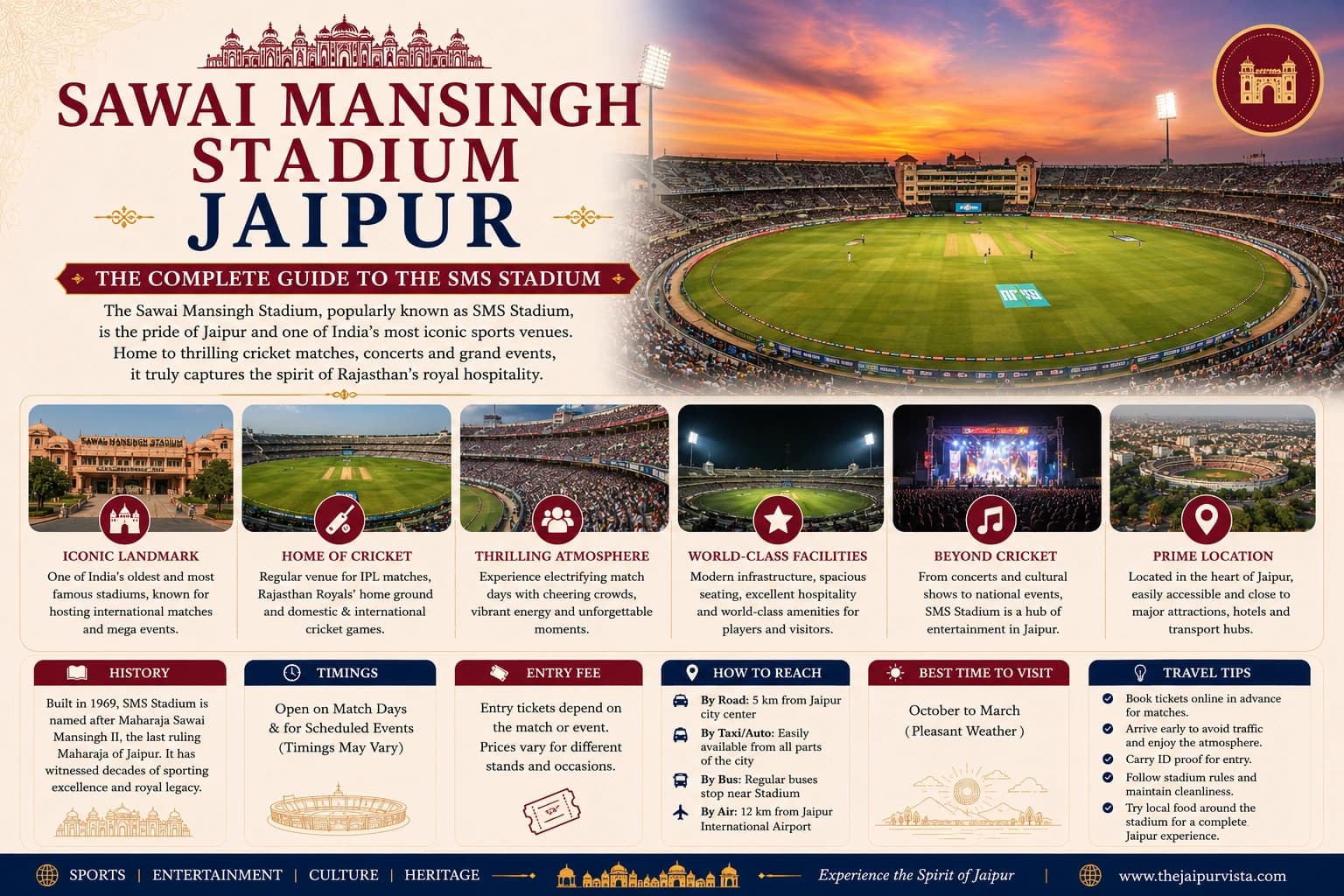
It begins in the morning, when the auto-rickshaws start appearing with Rajasthan Royals flags fluttering from their aerials. It builds through the afternoon, as the streets around Rambagh Circle begin to fill with the pink and blue of replica jerseys. By evening, as the floodlights of the Sawai Mansingh Stadium cut a column of white light into the Rajasthani sky, the entire city seems to pulse with the collective heartbeat of 30,000 cricket-mad fans heading to their seats.
The SMS Stadium Jaipur - as it is affectionately known to every cricket fan in Rajasthan - is far more than a sporting venue. It is a landmark of the Pink City, a theatre of unforgettable cricketing drama, and a place where some of the most significant moments in Indian cricket history have unfolded on the grass. From Dhoni's 183 to Virat Kohli's IPL century, from the historic first Test with Pakistan to Vaibhav Suryavanshi's blazing IPL 2026 hundred in just 35 balls - the Sawai Mansingh Stadium has been the stage for moments that live permanently in the memory of Indian cricket.
This is The Jaipur Vista definitive guide to the Sawai Mansingh Stadium, Jaipur - covering everything from its royal origins and history, to a detailed look at its facilities and capacity, a complete pitch report, the most important records set here, how to buy tickets, how to reach the stadium, and an honest, experience-based visitor guide for cricket fans planning their first (or tenth) trip to the Jaipur cricket stadium.
The Sawai Mansingh Stadium - universally known as the SMS Stadium among cricket fans - is an international cricket ground located at Janpath, Lalkothi, Jaipur, Rajasthan. Established in 1969 and named after Maharaja Sawai Man Singh II, the last ruling Maharaja of the Jaipur Princely State, the stadium is one of two international cricket grounds in Rajasthan and one of India's most storied cricket venues.
The Jaipur stadium serves as: The home ground of the Rajasthan cricket team in domestic cricket (Ranji Trophy, Vijay Hazare Trophy, Syed Mushtaq Ali Trophy) The IPL home ground of the Rajasthan Royals since the IPL's inaugural season in 2008 A host venue for international matches - ODIs, T20Is, and the stadium's only Test match (February 1987) Stadium at a Glance: The Sawai Mansingh Stadium carries the name of Maharaja Sawai Man Singh II - one of the most celebrated rulers of the Jaipur state, who served as its last ruling Maharaja before Jaipur's accession to independent India in 1949 and subsequently as Rajpramukh (Governor) of Rajasthan. Sawai Man Singh II was not merely a political figure - he was a sportsman of genuine distinction. A celebrated polo player of international repute (he captained the Indian polo team) and a passionate patron of sport in Jaipur, the Maharaja is credited with laying the foundations of modern sports infrastructure in the city. The stadium named in his honour is, in many ways, the most enduring expression of that sporting legacy. The SMS Stadium was formally established in 1969 under the aegis of the Rajasthan State Sports Council, on land located near Rambagh Circle in the southern part of the city - in a location that was then at the edge of Jaipur's urban development but is today well within the city's thriving mid-town area. In its first decade of existence, the Sawai Mansingh Stadium Jaipur served primarily as a venue for domestic cricket and state-level sports events. The Rajasthan cricket team - one of the more competitive domestic teams in India, having produced many players for the national side over the decades - made the stadium their home ground. The stadium during this period was a relatively modest facility by international standards, but it rapidly developed a devoted local cricket culture. Jaipur's fans earned a reputation for passionate, knowledgeable, and extremely vocal support - a reputation that has only grown stronger over the decades and is now a defining feature of the SMS Stadium experience. The Sawai Mansingh Stadium entered the history books on October 2, 1983 - a date that carries extraordinary significance for Indian cricket. India had just won the Cricket World Cup in England for the first time, defeating the mighty West Indies in the final at Lord's. The nation was still riding the wave of that triumph when the victorious Indian team returned to action. The very first international match at the Jaipur cricket stadium was between India and Pakistan - and India won. The match drew an enormous crowd and created the template for what the SMS Stadium would become: a venue where India regularly performed exceptionally well, fuelled by partisan home support that could be felt by players on both sides. February 1987 saw the Sawai Mansingh Stadium host its one and only Test match - and it was a contest freighted with historical and political significance that went far beyond cricket. The Test between India and Pakistan was played as part of the "Cricket for Peace" initiative - a diplomatic sporting gesture organised during a period of significant tension between the two nations. Pakistani President General Zia-ul-Haq made the historically remarkable gesture of crossing the border to attend the Test match at Jaipur personally - a visit that was simultaneously a sporting occasion and a diplomatic signal. The match itself ended in a draw after five days, but its significance as a moment of bilateral diplomacy through cricket gives it a permanent place in the history of both the SMS Stadium and South Asian cricket. The Sawai Mansingh Stadium has the distinction of having hosted World Cup matches in two separate editions of the Cricket World Cup - one of only a handful of Indian venues to have achieved this. In the 1987 Reliance World Cup - the first Cricket World Cup held outside England, co-hosted by India and Pakistan - the Jaipur stadium hosted a group stage match between West Indies and England. This was the World Cup that Pakistan's Imran Khan won, and in which India came agonisingly close to the final. Nearly a decade later, the 1996 Wills World Cup brought international cricket back to Jaipur, with the stadium hosting a league match between West Indies and Australia. This was the World Cup that Sri Lanka won under Arjuna Ranatunga. Hosting World Cup matches in both 1987 and 1996 cemented the SMS Stadium's status as one of India's established international venues. The most transformative chapter in the Sawai Mansingh Stadium's physical development came with a major renovation and redevelopment project in 2006, for which approximately ₹400 crore was invested by the Rajasthan State Sports Council. The renovation was comprehensive and ambitious, transforming the SMS Stadium Jaipur from a functional but relatively basic cricket ground into a facility with genuine world-class amenities: New stands and improved seating - increasing covered seating capacity and improving sightlines across the ground Floodlighting installation - enabling day-night matches and dramatically expanding the stadium's commercial and cricketing calendar A world-class cricket academy - including practice pitches, bowling machines, coaching facilities, and training areas that have since developed several Rajasthan cricketers to the highest levels A gymnasium - fully equipped, available to players and academy members A restaurant - providing food and beverage services within the stadium complex Two conference halls - for cricket board functions, press conferences, and events A swimming pool - adding recovery and training facilities for professional cricketers Improved media facilities - press boxes, commentary positions, and broadcast infrastructure to international standards Better dressing rooms and player facilities - meeting the requirements of international cricket This renovation positioned the Sawai Mansingh Stadium to host the 2006 ICC Champions Trophy (three matches) and the 2006 Women's Asia Cup, and set the stage for the IPL era that would begin just two years later. When the Indian Premier League was launched in 2008, the SMS Stadium Jaipur became the home ground of the Rajasthan Royals - and immediately became one of the IPL's most celebrated venues. The Rajasthan Royals' story in the first edition of the IPL is one of cricket's great underdog narratives. Under the captaincy of the legendary Australian leg-spinner Shane Warne, the Royals assembled a team of unknown young Indian players and brilliant overseas picks, and proceeded to win the inaugural IPL title against all expectations, defeating Chennai Super Kings in a final that went down to the last ball. The SMS Stadium was the nerve centre of that campaign, and the Jaipur crowd's role in creating a fortress home atmosphere was central to the Royals' success. From that first IPL season, the Sawai Mansingh Stadium has been associated in the hearts of cricket fans with the Rajasthan Royals' fearless, innovative, and entertaining brand of cricket. The Royals have made the SMS Stadium their home for every IPL season they have played, making it one of the most recognised IPL venues in India. The Sawai Mansingh Stadium capacity is approximately 30,000 spectators, making it a mid-sized international cricket venue by Indian standards - comparable in scale to venues like the JSCA Stadium in Ranchi or the Holkar Stadium in Indore, and larger than several other Test venues. The stadium has two principal ends: Van Vihar Colony End (one side of the ground) Garh Ganesh Temple End (the other end - named for the famous hilltop Ganesh temple visible from the stadium's upper tiers, a distinctly Jaipur touch) The seating at the SMS Stadium is organised across several stands offering a range of viewing experiences: General Stands: The bulk of the SMS Stadium's 30,000 capacity is accounted for by covered general admission stands that run along both sides of the ground. The view of the action from these stands is excellent - the SMS Stadium is compact enough that there are very few genuinely poor seats. VIP and Corporate Boxes: Premium viewing areas with enhanced facilities, air conditioning (in some sections), dedicated catering, and superior sightlines. These sections are bookable through the RCA and IPL franchises for corporate and VIP guests. Media Facilities: The stadium has dedicated press boxes, commentary positions, and broadcast facilities that meet international cricket board standards - a legacy of the 2006 renovation. In the 2024-25 period, the Rajasthan government announced ambitious plans to significantly expand the Sawai Mansingh Stadium's capacity, with a target of approximately 50,000 seats. The expansion plans include a modernised South Pavilion and improved spectator facilities throughout the ground. When completed, this expansion would make the Jaipur cricket stadium one of the larger international venues in India and substantially improve its case for hosting marquee international fixtures including Tests and major ODI series. Understanding the SMS Stadium pitch is essential for cricket fans attending matches here - and for those following the Rajasthan Royals' IPL campaigns. The Sawai Mansingh Stadium pitch is a dry, flat surface that sits within Jaipur's semi-arid climate. The characteristics that define batting and bowling at this ground are: For Batters: The pitch offers a true, even bounce that allows batters to play their natural game. The ball comes on to the bat well, particularly in T20 cricket, and batters who get in can score quickly. The dry conditions mean the ball does not swing appreciably, which rewards straight bat play and aggressive hitting. However - and this is the characteristic that makes the SMS Stadium unique among Indian cricket venues - the boundaries here are notably larger than at most IPL grounds. The straight boundaries measure approximately 78 metres, which is substantial, and the square boundaries are similarly generous. This means that boundaries are harder to come by than at, say, the Wankhede or the Chinnaswamy, and big hitting requires more commitment and cleaner contact. The result is a ground where a score of 160-175 is competitive, scores above 190 are excellent, and crossing 200 is a genuine achievement - only 10 teams have crossed 200 at this venue in IPL history, one of the lowest 200-plus counts among active IPL venues. For Bowlers: The SMS Stadium pitch offers genuine assistance to both pace and spin - making it one of the more balanced cricket surfaces in India for T20 cricket. Spin bowlers extract significant turn and bounce from the dry, dusty surface, especially as the match progresses. The famous Jaipur spin-friendly conditions have influenced countless IPL teams to pick extra spinners for games at this venue. Pace bowlers can extract useful movement off the surface with good length bowling, and the larger boundaries mean pace bowlers can defend totals more effectively than at smaller grounds. Winning the toss and fielding first has historically been the preferred strategy at the SMS Stadium - teams batting second have won approximately 63-64% of IPL matches at this venue, one of the higher chase-success rates in the IPL. (Note: Average scores have trended upward in recent IPL seasons with more aggressive batting.) Test Match (Only Test: India vs Pakistan, February 1987) The match was part of the "Cricket for Peace" initiative. Pakistan President General Zia-ul-Haq attended. The match ended in a draw after five days of competitive cricket. First ODI (India vs Pakistan, October 2, 1983) India won the inaugural international match at the SMS Stadium - a perfect beginning for a ground that would become famous for India's strong home record. MS Dhoni's 183* (2005 ODI vs Sri Lanka) The single most famous individual innings played at the Sawai Mansingh Stadium Jaipur came not in the IPL but in a one-day international against Sri Lanka in October 2005. A young Mahendra Singh Dhoni - at the time still establishing himself in the Indian team - walked in at number 3 and played one of the most astonishing batting displays in ODI history: 183 not out, hitting 15 fours and 10 sixes in an innings that announced to the world that Indian cricket had found a generational talent. That score remains the highest individual score by an Indian wicketkeeper-batsman in ODIs. Sachin Tendulkar & Sourav Ganguly Open Together for the First Time The Sawai Mansingh Stadium holds a special place in the story of India's most successful ODI opening partnership. It was at this ground that Sachin Tendulkar and Sourav Ganguly first opened the batting together for India - the beginning of a partnership that would go on to become the most prolific opening combination in ODI cricket history. India's Record ODI Chase (2013 vs Australia) In October 2013, India achieved one of the greatest run chases in ODI history at the SMS Stadium - successfully chasing down Australia's mammoth total of 360 runs to win by 9 wickets. Virat Kohli scored his fastest ODI century for India during that historic chase - a knock that also became a landmark moment in his journey towards becoming India's greatest ODI batsman. Only T20I (India vs New Zealand, November 17, 2021) The SMS Stadium hosted its first and only T20 International in November 2021, when India played New Zealand. The match was a part of the home series and drew a full capacity crowd to the Jaipur cricket stadium. Highest Individual Score: Virat Kohli - 113* (off 72 balls) for Royal Challengers Bengaluru vs Rajasthan Royals, IPL 2024. A masterclass innings on a typically challenging SMS Stadium surface. Fastest Century at the Ground: Vaibhav Suryavanshi - century in just 35 balls for Rajasthan Royals in IPL 2026. This extraordinary innings by the teenage Rajasthan prodigy is the fastest hundred in the history of the Sawai Mansingh Stadium in IPL cricket. Top IPL Run-Scorer at This Venue: Ajinkya Rahane - 1,115 runs in 37 matches at the SMS Stadium. A native Mumbaikar who made Jaipur his home during his long years as a Rajasthan Royals stalwart, Rahane thrived on the Jaipur stadium pitch with his classical technique. Top IPL Wicket-Taker: Siddharth Trivedi - 36 wickets in 32 matches at the SMS Stadium. The Gujarat-born medium-fast bowler used his deep understanding of the Jaipur surface to become the most successful bowler in the ground's IPL history. Best Bowling Figures: Sohail Tanvir - 6/14 for Rajasthan Royals vs Chennai Super Kings, IPL 2008. The Pakistani left-arm swing bowler produced one of the most devastating bowling performances in IPL history at the SMS Stadium in the inaugural season - a spell that became the first six-wicket haul in IPL history and remains the best bowling figures at this venue. Highest Team Total (IPL): Punjab Kings - 219/5 vs Rajasthan Royals, IPL 2026. Lowest Team Total (IPL): Rajasthan Royals - 59 all out vs Royal Challengers Bengaluru (one of the IPL's more extraordinary collapses, on a home ground). Chase Success Rate: Teams batting second have won approximately 63-64% of IPL matches at the SMS Stadium - making it one of the more chase-friendly venues in the IPL. Total IPL Matches Hosted (as of IPL 2026): 61+ matches, making the Sawai Mansingh Stadium one of the most experienced IPL venues in the country. Attending a match at the Sawai Mansingh Stadium is one of the great experiences for any cricket fan visiting Jaipur. Here is everything you need to know about tickets. Primary Official Channel - BookMyShow: IPL tickets for SMS Stadium Jaipur matches are primarily sold through BookMyShow (bookmyshow.com) - India's largest event ticketing platform and the official IPL ticketing partner. The booking portal typically opens 1-2 weeks before each match. Rajasthan Royals Official Website: The Rajasthan Royals also sell tickets through their official website (rajasthanroyals.com) and their official app. Season passes and premium packages are available here. Box Office: A limited number of tickets may be available at the stadium box office on match day, but IPL matches at the SMS Stadium routinely sell out quickly. Online booking well in advance is strongly recommended. Note: IPL ticket prices vary by match, opponent, and availability. Prices are indicative - check official channels for exact pricing for each match. International match tickets (ODIs, T20Is, Tests) are sold through the BCCI's official channels and BookMyShow. Given the limited number of international matches at the Jaipur cricket stadium, these tickets sell extremely quickly. Set up alerts on BookMyShow and follow the BCCI and Rajasthan Cricket Association on social media for booking announcements. Book early - IPL matches at SMS Stadium are very popular and sell out routinely, especially Rajasthan Royals vs Mumbai Indians, Chennai Super Kings, and Royal Challengers Bengaluru. Avoid touts - Unofficial ticket sellers operate near the stadium on match day. Their tickets carry the risk of being counterfeit or invalid. Always buy from official channels. Check the match schedule in advance - Rajasthan Royals play 5-7 home IPL games per season at the SMS Stadium; the rest are sometimes played at alternate venues. Group bookings - For groups of 10 or more, contact the Rajasthan Cricket Association directly for group pricing. The SMS Stadium is located at Janpath, Lalkothi, in the mid-southern part of Jaipur - well within the city and easily accessible from most parts of Jaipur. Address: Sawai Mansingh Stadium, Janpath, Lalkothi, Jaipur, Rajasthan 302015 The Jaipur Metro is one of the easiest ways to reach the SMS Stadium on match day, avoiding the severe traffic congestion that surrounds the stadium before big IPL matches. The nearest metro stations are: Jaipur Junction Station (Pink Line) - approximately 3 km from the stadium; autos available from the station The metro network is expanding; check the current JMRC route map for the most recent connectivity Auto-rickshaws are the most popular form of transport to the SMS Stadium for local fans. Simply tell the driver "SMS Stadium" or "Sawai Mansingh Stadium" - every auto driver in Jaipur knows it. From the old city (City Palace / Hawa Mahal area): approximately 15-25 minutes; from Jaipur Railway Station: approximately 15-20 minutes. On match days, auto-rickshaws charge premium rates for routes towards the stadium. Negotiate the fare before boarding, or use an Ola or Uber auto/cab through the app. RSRTC city buses serve several routes passing near the SMS Stadium. Useful stops: Rambagh Circle (nearest major bus stop, ~500 metres from the stadium) Nagar Nigam Lal Kothi (approximately 1 km from the stadium) App-based cabs are widely available in Jaipur and can drop you directly at the stadium entrance. Book in advance on match days as surge pricing applies and availability reduces near kickoff time. The nearest railway stations to the SMS Stadium are: Gandhinagar Railway Station (~2.5 km) Bais Godam Railway Station (~2 km) Jaipur Junction (~5 km, but very well connected to the city) From Jaipur Railway Station, take an auto or city cab to reach the stadium. Jaipur International Airport is approximately 17-20 km from the Sawai Mansingh Stadium. The journey by taxi takes approximately 35-50 minutes depending on traffic. Pre-booked airport taxis are recommended on match days as transport availability can be unpredictable. Limited parking is available near the SMS Stadium for private vehicles. On IPL match days, parking fills up very quickly. Public transport is strongly recommended on match days - it is faster, cheaper, and significantly less stressful than driving. The Sawai Mansingh Stadium offers one of the most authentic and energetic cricket atmospheres in India. Here is what your match day experience will look like. Plan to arrive at least 60-90 minutes before the match on IPL days. The streets around Rambagh Circle fill with fans, food vendors, and jersey sellers from 2-3 hours before a big game, and the queue for security screening can be substantial at the stadium gates. Carry your ticket (digital or printed), a valid photo ID (mandatory for entry), and arrive with patience. The security process at the SMS Stadium is thorough - bags are checked, metal detectors used - but generally moves reasonably efficiently once you are in the queue. Match ticket (printed or on your smartphone - screenshot recommended in case of connectivity issues) Valid Government Photo ID (Aadhaar, PAN, Passport, Driving Licence) Snacks (limited food items in sealed packaging are usually permitted - check the IPL/RCA guidelines for the specific match) Cash and/or UPI payment app (food and merchandise stalls inside the stadium) A jacket or light wrap for evening matches (Jaipur can be cold after 9 PM from October to February) Earplugs (optional but useful in the particularly loud stands near the DJ and drum sections) Outside food and beverages (glass bottles, cans, and outside food are generally not permitted) Large bags, backpacks, or suitcases (small bags or pouches only) Selfie sticks, professional cameras with detachable lenses, or video cameras Fireworks or any pyrotechnic items Banners or placards without prior approval Laser pointers The SMS Stadium has food and beverage concession stalls located throughout the stadium concourse. The menu typically includes: Hot snacks: samosas, kachoris, pav bhaji, poha, and other Indian fast food Cold beverages: bottled water, juices, soft drinks Ice cream IPL-branded merchandise at official Rajasthan Royals store inside the stadium Food prices inside the stadium are above street level - as at all sports venues - but the quality is generally reliable. The SMS Stadium crowd is among the most passionate and knowledgeable in Indian cricket. The Rajasthan Royals have built a deeply loyal fan base in Jaipur, and a home match at the Jaipur stadium creates an atmosphere that players on both sides describe as genuinely intimidating. Key features of the SMS Stadium match day atmosphere: The drum sections in the stand ends generate a constant, pulsating rhythm throughout the match The "Aao Dhoom Machao" (Come, Make Some Noise) chanting sections that the Rajasthan Royals fan community organises The distinctive Rajasthani folk-inspired musical performances before the match and during innings breaks The evening light show when the floodlights come on - a moment that always draws a roar from the crowd Restrooms: Available at multiple points around the concourse, generally well-maintained First Aid: Medical facilities and first aid stations are stationed inside the stadium ATMs: Available near the stadium entrance Merchandise: Official Rajasthan Royals merchandise available inside the stadium and at stalls near the gates The Sawai Mansingh Stadium consistently receives positive reviews from cricket fans and visitors. Here is a synthesis of the common themes in visitor feedback: What fans love most: The atmosphere - universally described as electric, passionate, and uniquely Rajasthani The sightlines - the compact size of the ground means virtually every seat offers a clear view of the action The pitch - the balanced surface that gives genuine contests between bat and ball, producing exciting matches The floodlit evening atmosphere - the stadium looks spectacular under the lights, particularly with the Aravalli Hills as a backdrop What visitors note could be improved: Traffic and parking on match days can be extremely challenging - the single strongest recommendation from experienced SMS Stadium visitors is to use public transport or app-based cabs rather than private vehicles Food prices inside the stadium are higher than street prices, as is standard for major sports venues Entry queues for big matches can be long - arriving early is essential The consensus: The Sawai Mansingh Stadium offers one of the most authentic, enjoyable cricket match experiences in India. The combination of the knowledgeable crowd, the manageable stadium size, and the beautiful Jaipur setting makes it a must-visit for any cricket fan travelling through Rajasthan. The SMS Stadium is located in a part of Jaipur that is rich with interesting places to visit - making it easy to combine a match day trip with broader Jaipur sightseeing. The former royal residence of the Jaipur Maharajas, now the world-renowned Taj Rambagh Palace hotel, is almost literally next door to the SMS Stadium. Even non-guests can visit for afternoon tea or a meal at one of the hotel's restaurants, and the beautifully maintained Mughal gardens are worth seeing. Located very close to the Sawai Mansingh Stadium, the Amar Jawan Jyoti memorial commemorates the soldiers from Jaipur who gave their lives in service to India. A moving and peaceful site to visit before or after a match. Jaipur's finest museum, housed in a magnificent Indo-Saracenic building in Ram Niwas Garden, the Albert Hall Museum contains an exceptional collection of Rajasthani and Mughal-era artefacts, miniature paintings, coins, and decorative arts. An excellent morning activity before an evening match. One of Jaipur's largest urban parks, home to India's tallest flagpole and beautifully landscaped grounds - ideal for a morning walk or pre-match relaxation. The stunning white marble temple at the foot of Moti Doongri hill is beautiful by day and spectacular when illuminated at night - a perfect stop after an evening match. If you need post-match food or shopping, World Trade Park on Tonk Road is one of Jaipur's most modern and comprehensive shopping and dining complexes, open until late evening. Walk past the Sawai Mansingh Stadium on any ordinary day - no match scheduled, gates closed, the ground quiet - and there is still something about the place that holds your attention. Perhaps it is the knowledge of what has happened here. The roar of 30,000 voices when Dhoni hit his 183rd run into the stands. The silence when Sohail Tanvir took his sixth wicket. The disbelief when a teenager named Vaibhav Suryavanshi reached his hundred in 35 balls. Or perhaps it is simply the Jaipur sky above the floodlight towers - the same sky that has watched this city for three hundred years, through palaces and wars and the founding of a new capital and the birth of a new sport in a new nation - doing what it has always done: turning a deep, impossible Rajasthani blue at dusk. The Sawai Mansingh Stadium is not the largest cricket ground in India. It does not have the oldest history. But it has something that matters more than size or age: it has character. And character, in cricket as in everything else, is what you remember. Q. Where is Sawai Mansingh Stadium located? Q. What is the capacity of Sawai Mansingh Stadium? Q. Which teams play at SMS Stadium? Q. What is SMS Stadium known for? Q. Who is the highest scorer at SMS Stadium in IPL? Q. What is the pitch like at SMS Stadium? Q. How do I buy tickets for SMS Stadium Jaipur? Q. Why is it called SMS Stadium? Q. Has India won the most matches here? Q. What is the nearest Metro station to SMS Stadium? Have you attended a match at the SMS Stadium? Share your Sawai Mansingh Stadium reviews and experience in the comments below - we love hearing from fellow cricket fans! Exploring Jaipur beyond the stadium? Read our complete guides to [Amer Fort], [Hawa Mahal], [Nahargarh Fort at sunset], and [the best things to do in Jaipur], right here on The Jaipur Vista.Sawai Mansingh Stadium History: From a Maharaja's Vision to an IPL Icon
The Royal Legacy Behind the Name
The First Steps: Domestic Cricket and Early Development (1969–1982)
The 1983 ODI: International Cricket Arrives in Jaipur
The 1987 Test: Cricket for Peace
The 1987 and 1996 World Cups
The 2006 Renovation: A World-Class Transformation
2008 Onwards: The Rajasthan Royals Era and IPL Glory
Sawai Mansingh Stadium Capacity: Stands, Seating & Expansion Plans
Current Capacity
Expansion Plans
Sawai Mansingh Stadium Pitch Report: What to Expect
Surface Character
Average Scores at SMS Stadium (IPL)
Sawai Mansingh Stadium Records: The Numbers That Define This Ground
International Cricket Records at SMS Stadium
IPL Records at Sawai Mansingh Stadium (Updated to IPL 2026)
SMS Stadium Tickets: How to Buy and What to Expect
IPL Ticket Booking for Sawai Mansingh Stadium
Typical IPL Ticket Price Categories at SMS Stadium
For International Matches
Tips for Buying SMS Stadium Tickets
How to Reach Sawai Mansingh Stadium, Jaipur
Nearest Circle/Landmark: Rambagh Circle (approximately 500 metres from the stadium)By Metro
By Auto-Rickshaw
By Bus
By Cab (Ola/Uber)
By Train
From Jaipur Airport
Parking
The SMS Stadium Match Day Experience: What to Expect as a Visitor
Getting to the Ground
What to Bring
Water bottle (sealed, factory-packaged - unsealed water bottles are typically not permitted)What NOT to Bring
Food and Beverages Inside the Stadium
The Atmosphere
Facilities at the Stadium
Sawai Mansingh Stadium Reviews: What Fans and Visitors Say
Places to Visit Near Sawai Mansingh Stadium, Jaipur
1. Rambagh Palace (500 metres)
2. Amar Jawan Jyoti and Shaheed Smarak (1 km)
3. Albert Hall Museum (3 km)
4. Central Park Jaipur (2 km)
5. Birla Mandir / Laxmi Narayan Temple (2 km)
6. World Trade Park (2 km)
Also Read: Birla Mandir Jaipur: Timings, Aarti Schedule, History & Complete Visitor Guide
Final Word: The SMS Stadium and the Spirit of Jaipur Cricket
Frequently Asked Questions: Sawai Mansingh Stadium
make a bog image use our blog templte and title and according image lgana
The Sawai Mansingh Stadium capacity is approximately 30,000 spectators. Expansion plans to increase this to 50,000 seats have been announced by the Rajasthan government.
The SMS Stadium Jaipur is the home ground of the Rajasthan Royals in the IPL and the Rajasthan cricket team in domestic cricket. The Indian national team also plays here for select international matches.
The SMS Stadium is known for being the home of the inaugural IPL champions (Rajasthan Royals, 2008), for hosting India's highest ODI chase at the time (vs Australia, 2013), for MS Dhoni's legendary 183* (2005), and for Sohail Tanvir's 6/14 - the first six-wicket haul in IPL history.
Ajinkya Rahane holds the record for most IPL runs at the SMS Stadium with 1,115 runs in 37 matches. The highest individual innings is Virat Kohli's 113* (RCB vs RR, IPL 2024).
The SMS Stadium pitch is a flat, dry surface that assists both spinners and pacers. The key characteristic is the notably large outfield (straight boundaries of ~78 metres), which makes big hitting more challenging than at most IPL venues. Chasing teams have won approximately 63-64% of matches here.
IPL tickets for Sawai Mansingh Stadium are sold primarily through BookMyShow (bookmyshow.com) and the Rajasthan Royals' official website (rajasthanroyals.com). Book well in advance as matches frequently sell out.
"SMS" stands for Sawai Man Singh - the popular abbreviation of the stadium's full name, Sawai Mansingh Stadium, named after Maharaja Sawai Man Singh II of Jaipur.
India has a strong home record at the SMS Stadium across all international formats - consistent with the general trend of strong Indian team performances at home venues in Jaipur.
The nearest Jaipur Metro connectivity point for the SMS Stadium is via the Jaipur Junction metro station (Pink Line), followed by an auto-rickshaw to the stadium. Check the current JMRC network map for updated routing