Tourist Attractions in Jaipur for Every Traveller: Handicrafts, Palaces, Markets & More
Author:Niharika
Published:May 12, 2026
Views:384
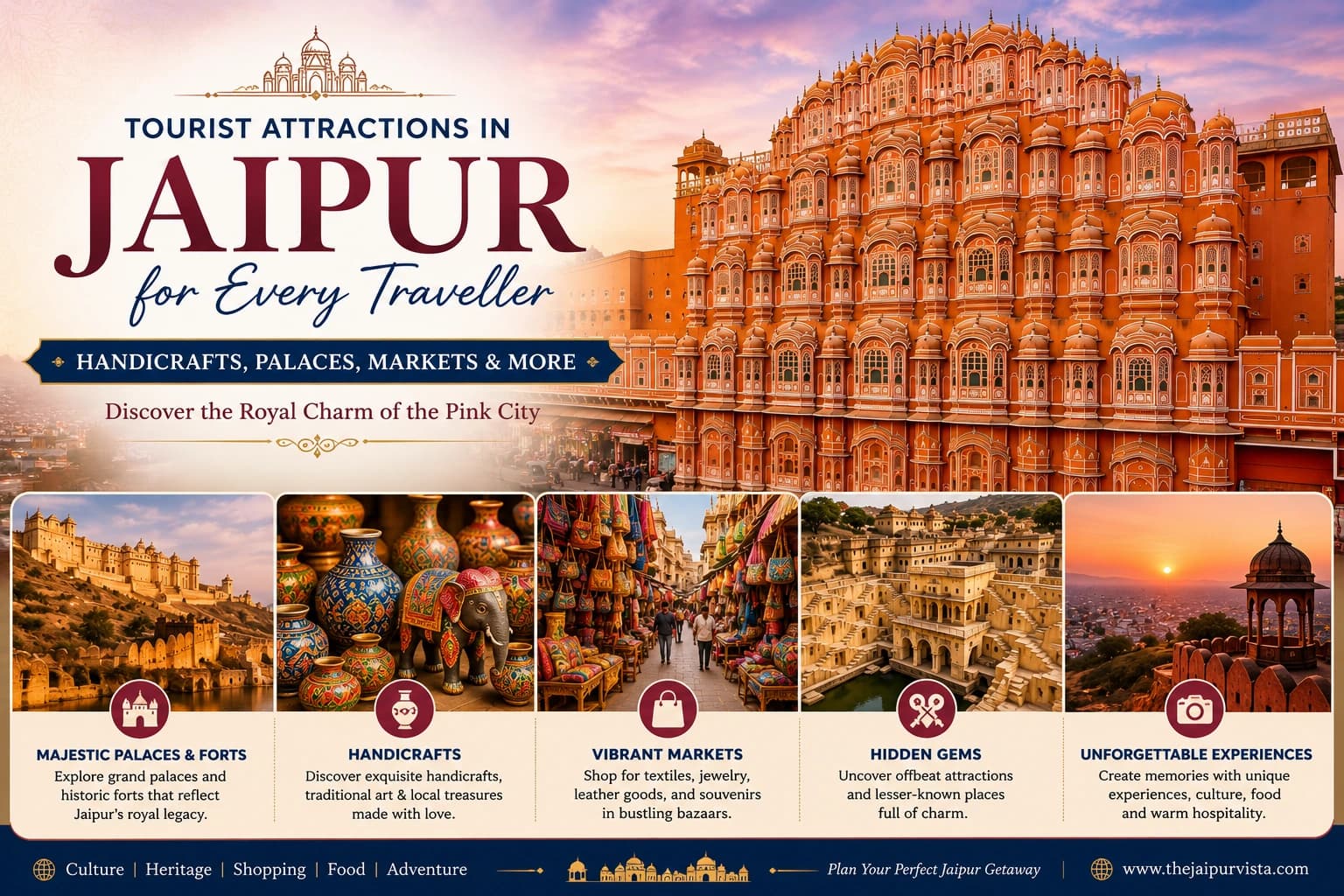
Introduction: Why Jaipur Is Every Traveller’s Dream Destination
Jaipur — the legendary Pink City of Rajasthan — is not just a city. It is a living museum, a royal canvas, and an artisan’s paradise rolled into one. Whether you are a history enthusiast marvelling at centuries-old palaces, a culture seeker exploring Rajasthani traditions, or a shopaholic hunting for the finest Jaipur handicrafts, the Pink City has something extraordinary waiting for you at every corner.
Founded in 1727 by Maharaja Sawai Jai Singh II, Jaipur was India’s first planned city — laid out according to the principles of Vastu Shastra with wide boulevards and symmetrical architecture that still stands proudly today. Its rose-pink sandstone buildings, which gave the city its beloved nickname, create an atmosphere unlike anywhere else in India.
At The Jaipur Vista, we believe that truly understanding Jaipur means going beyond the postcard images. This comprehensive guide covers the must-see tourist attractions in Jaipur — iconic palaces, UNESCO World Heritage Sites, vibrant bazaars, and the extraordinary world of traditional handicrafts of Rajasthan that make this city a shopper’s paradise and a craftsman’s legacy.
If there is one place that defines places to visit in Jaipur, it is the magnificent Amber Fort. Perched dramatically on the craggy Aravalli hills about 11 kilometres from the city, this UNESCO World Heritage Site is a breathtaking blend of Rajput and Mughal architectural styles. Construction began under Raja Man Singh I in 1592. The fort features the mesmerising Sheesh Mahal (Hall of Mirrors) where a single candle flame reflects into a thousand glittering stars across mirror-mosaic walls. The fort overlooks the serene Maota Lake, adding a picture-perfect reflection to its grandeur.
Best time to visit: Early morning (7:00 AM) to avoid crowds
Light & Sound Show: 6:30 PM (Hindi) | 7:30 PM (English)
Entry fee: ₹100 (Indians) | ₹500 (Foreigners)
No list of Jaipur famous things is complete without the iconic Hawa Mahal. Built in 1799 by poet-king Sawai Pratap Singh, this five-storey sandstone structure features 953 intricately latticed windows called jharokhas. It allowed royal ladies to observe street festivities without being seen, while the latticed windows created a natural air-conditioning effect — a remarkable feat of pre-modern engineering in the desert heat. From the outside, its facade resembles the crown of Lord Krishna.
Best angle: Photograph from the tea stall across the road for the full facade
Timings: 9:00 AM – 5:00 PM (Closed on Fridays)
Entry fee: ₹50 (Indians) | ₹200 (Foreigners)
Deep within the walled city lies the magnificent City Palace Complex, a beautiful fusion of Mughal and Rajput architectural styles still partially home to the last ruling royal family. The complex includes Mubarak Mahal (now the Maharaja Sawai Man Singh II Museum housing royal costumes and Pashmina shawls), the Maharani’s Palace (with Rajput weaponry dating to the 15th century), and the Chandra Mahal. The Palace Atelier inside sells handpicked royal souvenirs, and the Baradari restaurant offers authentic royal cuisine.
Timings: 9:30 AM – 5:00 PM (open all days)
Entry fee: ₹130 (Indians) | ₹500 (Foreigners)
A UNESCO World Heritage Site and one of the most unique tourist attractions in Jaipur, Jantar Mantar is an astronomical observatory built in the early 18th century by Maharaja Sawai Jai Singh II. The observatory houses 19 large fixed astronomical instruments — including the Samrat Yantra, the world’s largest sundial, accurate to two seconds. Located adjacent to City Palace, it stands as proof of the remarkable intellectual achievements of Rajasthan’s royal patrons.
Timings: 9:00 AM – 4:30 PM
Entry fee: ₹50 (Indians) | ₹200 (Foreigners)
An audio guide is highly recommended for understanding each instrument
Rising mysteriously from the middle of Man Sagar Lake, the hauntingly beautiful Jal Mahal (Water Palace) was built in 1750 by Maharaja Madho Singh. This five-storey red sandstone palace appears to float effortlessly on the lake’s surface — with four of its storeys submerged beneath the water. The Jal Mahal captivates travellers with the sheer magic of its silhouette against the lake, especially at golden hour when the setting sun paints the water and palace in warm amber tones.
Perched high on the Aravalli ridge, Nahargarh Fort (“Abode of Tigers”) offers the most spectacular panoramic views in Rajasthan. Built in 1734, the fort’s most intriguing feature is the Madhavendra Bhawan — a palace with nine identical suites, one for each of the Maharaja’s nine queens, connected by a maze of corridors. Nahargarh also houses a wax museum and a rooftop café with an unbeatable view. Timings: 10:00 AM – 5:30 PM.
Standing majestically at the centre of Ram Niwas Garden, the Albert Hall Museum is Rajasthan’s oldest museum and a fine example of Indo-Saracenic architecture. Built in 1887 by Sir Samuel Swinton Jacob, its 16 galleries hold paintings, carpets, musical instruments, jewellery, brassware, antique coins, local pottery, and Jaipur handicrafts — an unparalleled overview of Rajasthan’s cultural heritage in a single visit.
Read More: Top Tourist Places in Jaipur
Jaipur holds the official title of “City of Crafts.” For centuries, royal patronage encouraged master artisans to settle in the Pink City and perfect their crafts, creating a living tradition of handmade excellence that continues today. Here are the 10 traditional handicrafts of Rajasthan that every visitor must experience:
Blue Pottery is arguably the single most recognisable Jaipur handicraft in the world. Uniquely, it is made not from clay but from a special mixture of quartz stone powder, powdered glass, and raw glaze materials — resulting in a translucent, smooth finish that does not crack easily. The craft has Persian and Chinese roots and flourished under royal patronage in Jaipur during the 19th century. Common motifs include delicate floral patterns, geometric designs, and bird and animal figures — all painstakingly hand-painted in vivid cobalt-blue and gold.
Where to buy: Kripal Kumbh, Neerja International, Kuber Handicraft, Jawahar Kala Kendra, Heritage India
Meenakari involves fusing vibrant enamel colours — traditionally red, blue, and green — into the surface of gold jewellery in exquisitely detailed patterns. The word meena derives from the Persian for ‘heaven.’ The craft was brought to Jaipur in the 16th century by Raja Man Singh, who invited master artisans from Lahore, establishing Jaipur as the premier global centre for this jewellery art. Meenakari is frequently combined with Kundan work, where uncut gemstones are set into gold in a lacquer-based Mughal-era technique.
Where to buy: Johari Bazaar, MI Road jewellery shops, City Palace Museum shop
Hand block printing is one of the oldest handicraft Rajasthan traditions — and Jaipur, along with nearby Sanganer, is its global capital. The craft involves pressing intricately carved wooden blocks onto fabric to create repeating patterns. Sanganer is famous for bright floral patterns, while Bagru specialises in darker earthy tones using natural dyes. Each design is applied block by block, colour by colour — painstakingly by hand. Block-printed sarees, dupattas, kurtas, and bed linens are among the most famous shopping items in Jaipur.
Where to buy: Sanganer Village (artisan studios), Bapu Bazaar, Kishanpol Bazaar, Nehru Bazaar
Bandhani is a traditional tie-and-dye technique that creates intricate, jewel-bright patterns on fabric. Tiny knots are tied at precise intervals before dyeing; each knotted point resists the dye to create a raised dot or pattern when untied. Popular designs include chunari (fine dots), lahariya (diagonal waves), and mothra (larger dots). The resulting sarees, odhnis, turbans, and dupattas are famous for their wavy textures and vibrant festive colours, deeply embedded in Rajasthani wedding and festival culture.
Where to buy: Tripolia Bazaar, MI Road, Kishanpol Bazaar, Nehru Bazaar
Kundan jewellery is the most regal of all Jaipur handicrafts — a centuries-old tradition of setting uncut or polished gemstones into intricate gold foil frameworks using a lacquer-based technique. Necklaces, earrings, maangtikkas, and bracelets encrusted with rubies, emeralds, diamonds, sapphires, and pearls evoke the grandeur of Mughal and Rajput courts. Jaipur is also one of the world’s leading centres for gem cutting and polishing, particularly for emeralds, rubies, and sapphires.
Where to buy: Johari Bazaar (the primary jewellery market of Jaipur)
Rajasthan is rich in high-quality Makrana marble — the same marble used to build the Taj Mahal — and Jaipur’s craftsmen have developed extraordinary skill in transforming it into works of art: statues of gods and goddesses, decorative vases, tabletops, sculptures, and intricate inlay work where gemstones are set into the marble surface. The celebrated Meenakari marble work combines enamel art with marble carving to create richly coloured decorative pieces.
Where to buy: Chandpole Bazaar, Johari Bazaar, specialist marble craft shops on Amber Road
Lac bangles are brilliantly coloured bangles crafted from lac — a natural resin — and adorned with mirrors, beads, stones, and intricate gold and silver patterns. The main centre for lac bangle making is the Maniharon Ka Raasta lane in Tripolia Bazaar, where artisans mould hot lac over metal rods, shape it into perfectly circular bangles, and painstakingly decorate each one by hand. Traditionally worn by married Rajasthani women, they are an essential part of festive and bridal jewellery.
Where to buy: Tripolia Bazaar (Maniharon Ka Raasta), Johari Bazaar
Juttis (also called Mojaris) are traditional Rajasthani leather footwear originally crafted for royalty during the Mughal era. Made from camel leather and hand-decorated with intricate embroidery, beadwork, sequins, and colourful threads, they are both beautiful and practical. Each region of Rajasthan has its own distinctive embroidery style. These handmade shoes are among the most popular famous shopping items in Jaipur and make perfect, lightweight souvenirs.
Where to buy: Bapu Bazaar, Nehru Bazaar, Ramganj Bazaar, MI Road
The miniature painting tradition of Rajasthan is one of India’s most celebrated art forms. These small, exquisitely detailed paintings are executed on paper, silk, ivory, or marble using fine brushes — sometimes made from a single squirrel hair — and natural pigments derived from plants, minerals, and shells. Crushed powder of precious stones adds a sparkling luminescence. Subject matter ranges from Mughal court scenes to devotional images of Radha-Krishna and peacocks. The natural paints do not fade with time.
Where to buy: Johari Bazaar, Hawa Mahal area workshops, Rajasthali (Rajasthan Government Emporium)
Jaipur is one of India’s leading centres for hand-knotted carpets and flatweave durries — a craft tradition mirroring Persian weaving brought to Rajasthan by the Mughals. Crafted from fine wool, silk, or cotton, featuring bold floral patterns and rich colour palettes, a single carpet can take months to complete. The hand-knotted woolen carpets of Jaipur are particularly renowned, with quality measured by knots per square inch (KPSI). These are among the finest handicraft Rajasthan produces and are widely exported globally.
Where to buy: Sireh Deori Bazaar, Nehru Bazaar, specialist carpet showrooms near MI Road
Shopping in Jaipur is not merely a transaction — it is an experience that engages all your senses. The ancient bazaars of the walled city are living heritage sites where the clamour of vendors, the scent of incense, and the kaleidoscope of colour create an atmosphere unlike any modern mall.
The oldest and most famous market in Jaipur, Johari Bazaar is the definitive destination for Kundan and Meenakari jewellery, gold, silver, and gemstone pieces of extraordinary quality. In its lanes you can watch artisans delicately shaping jewellery by hand in small open workshops.
Best for: Kundan jewellery, Meenakari jewellery, gemstones, gold and silver ornaments, Blue Pottery
Jaipur’s most popular and accessible market for tourists and locals alike. Famous for colourful Bandhani sarees, block-printed fabrics, Jaipuri mojari shoes, lac bangles, brass accessories, and decorative home items. Prices are reasonable and bargaining is welcome.
Best for: Bandhani fabrics, block-printed textiles, juttis/mojaris, lac bangles, souvenirs
One of Jaipur’s oldest markets, particularly famous for lac bangles. Head to the Maniharon Ka Raasta area to watch artisans crafting bangles by hand. Also excellent for metalwork, brass and copper cookware, and ornamental iron pieces.
Best for: Lac bangles, metalwork, brass and copper items, textiles
The go-to destination for marble crafts, statues of Hindu deities, decorative vases, and inlay work pieces. Carpets, fabrics, and a wide range of Rajasthani traditional handicrafts also line the shops.
Best for: Marble crafts, statues, carpets, home décor, traditional artefacts
A favourite for Jaipuri quilts and razais, camel leather bags and shoes, unique wall hangings, and handmade home décor items. A convenient one-stop shop for a curated selection of authentic Rajasthani gifts.
Best for: Jaipuri quilts, camel leather goods, wall hangings, home décor
A favourite among locals for its wide range of traditional Jaipuri footwear, local handicrafts, quality textiles, and everyday Rajasthani items. Prices here tend to be more competitive than in tourist-heavy central bazaars.
Best for: Juttis, textiles, local handicrafts, affordable shopping
Located on the outskirts of Jaipur, Chokhi Dhani is a living cultural resort recreating a traditional Rajasthani village experience. Accredited as a 5-star resort by the Ministry of Tourism, it offers live folk dance, traditional music, puppet shows (kathputli ro nach), acrobatics, camel and horse rides, and authentic Rajasthani cuisine served on traditional pattals (leaf plates). There is also a craft bazaar where you can shop for Jaipur handicrafts and watch artisans demonstrate traditional crafts.
Built in the 18th century, Galtaji Temple is a revered Hindu pilgrimage site located about 10 kilometres from Jaipur amidst the Aravalli hills. The temple complex features pink sandstone palace-style architecture, shrines to Lord Rama, Lord Krishna, and Lord Hanuman, along with natural springs, holy kunds, and beautiful pavilions.
Held every January at Diggi Palace, the Jaipur Literature Festival (JLF) is the world’s largest free literary festival, attracting authors, thinkers, poets, and readers from across the globe. It is one of the most distinctive Jaipur famous things on the cultural calendar and draws hundreds of thousands of visitors each year.
No visit to Jaipur is complete without experiencing its legendary cuisine. Must-try Jaipur special things on the food front:
Pyaaz Kachori — Deep-fried pastry filled with spiced onions; the quintessential Jaipur breakfast
Dal Kachori — The lentil-stuffed cousin of the pyaaz kachori
Dal Baati Churma — The iconic Rajasthani meal of baked wheat balls with lentil curry and sweetened wheat
Ghewar — A ring-shaped, honey-sweet dessert made from refined flour, ghee, and sugar
Lassi — Thick, creamy yogurt drinks served traditionally in terracotta cups
The ideal time to explore tourist attractions in Jaipur is during the winter months (October to March), when the weather is cool and pleasant:
October–March: Ideal — cool weather, clear skies, festival season (10°C–25°C)
January: Best for the Jaipur Literature Festival and Kite Festival (Makar Sankranti)
Avoid May–June: Temperatures can soar beyond 40°C in the desert heat
Auto-rickshaws and cycle-rickshaws are ideal for short distances within the old city
Local taxis and app-based cabs (Ola, Uber) for longer distances and day tours
Most key attractions — Hawa Mahal, City Palace, Jantar Mantar, Johari Bazaar — are within the walled Pink City and accessible on foot or by rickshaw
Bargaining is expected in most bazaars — start at 40–50% of the quoted price
For guaranteed quality, visit Rajasthali (the Rajasthan Government Emporium on MI Road) — fixed prices and assured authenticity
Always ask to see artisans at work before buying Meenakari, Kundan, and Block Printing items
GI-tagged products (Geographically Indicated) like Jaipur Blue Pottery and Sanganeri Print carry certification guarantees
2–3 Days: Covers Amber Fort, City Palace, Hawa Mahal, Jantar Mantar, and key bazaars
4–5 Days: Adds Nahargarh Fort, Jal Mahal, Albert Hall Museum, and day trips to Sanganer/Bagru
7+ Days: Attend workshops, learn traditional crafts, and deeply absorb the city’s cultural heritage
Learn More: Top Historical Places in Jaipur
There is a reason why Jaipur consistently ranks among the most visited cities in India and features on bucket lists worldwide. It is a city that does not merely show you history — it lets you live it. Walk through the lanes of Johari Bazaar and you are following centuries of merchants and royalty. Hold a piece of Jaipur Blue Pottery and you are touching a tradition that has survived empires. Look up at the latticed windows of Hawa Mahal and you are seeing the world through the eyes of Rajput queens.
Whether you come for the magnificent places to visit in Jaipur, the extraordinary Jaipur handicrafts, the legendary famous shopping items in its ancient bazaars, or simply the warmth and colour that defines Rajasthani culture — Jaipur will leave an indelible impression on your heart. At The Jaipur Vista, our mission is to help every traveller discover the very best of this extraordinary city.
The most iconic tourist attractions in Jaipur include Amber Fort (UNESCO World Heritage Site), Hawa Mahal (Palace of Winds), City Palace, Jantar Mantar observatory, Jal Mahal (Water Palace), Nahargarh Fort, and the Albert Hall Museum.
Jaipur is famous for Blue Pottery, Kundan and Meenakari jewellery, Bandhani and block-printed textiles, lac bangles, leather juttis/mojaris, miniature paintings, marble crafts, hand-knotted carpets, and gemstones.
The 10 major traditional handicrafts of Rajasthan are: Blue Pottery, Meenakari jewellery, Block Printing (Sanganeri/Bagru), Bandhani tie-and-dye, Kundan jewellery, Marble crafts, Lac bangles, Leather Juttis/Mojaris, Miniature Paintings, and Hand-knotted Carpets.
Jaipur is most famous for its pink-hued heritage buildings, royal palaces and forts (especially Amber Fort and City Palace), the iconic Hawa Mahal, vibrant bazaars and handicraft markets, exquisite Kundan and Meenakari jewellery, Blue Pottery, block-printed textiles, and rich Rajasthani cultural traditions.
The best time to visit Jaipur is from October to March, when the weather is cool (10°C–25°C) and ideal for outdoor sightseeing. January is especially good for the Jaipur Literature Festival and Kite Festival.
For authentic Jaipur handicrafts, visit Johari Bazaar (jewellery), Bapu Bazaar (textiles and juttis), Tripolia Bazaar (lac bangles), Chandpole Bazaar (marble crafts), and Rajasthali (the Rajasthan Government Emporium on MI Road) for fixed-price, GI-certified goods.
Yes, Jaipur is one of the three cities of India’s famous Golden Triangle tourist circuit, alongside Delhi and Agra (home of the Taj Mahal). This circuit is one of the most popular travel itineraries in India