Rajmahal Palace Jaipur - The Complete Guide to Jaipur's Most Royal Heritage Hotel (2026)
Author:Namrata
Published:May 31, 2026
Views:1436
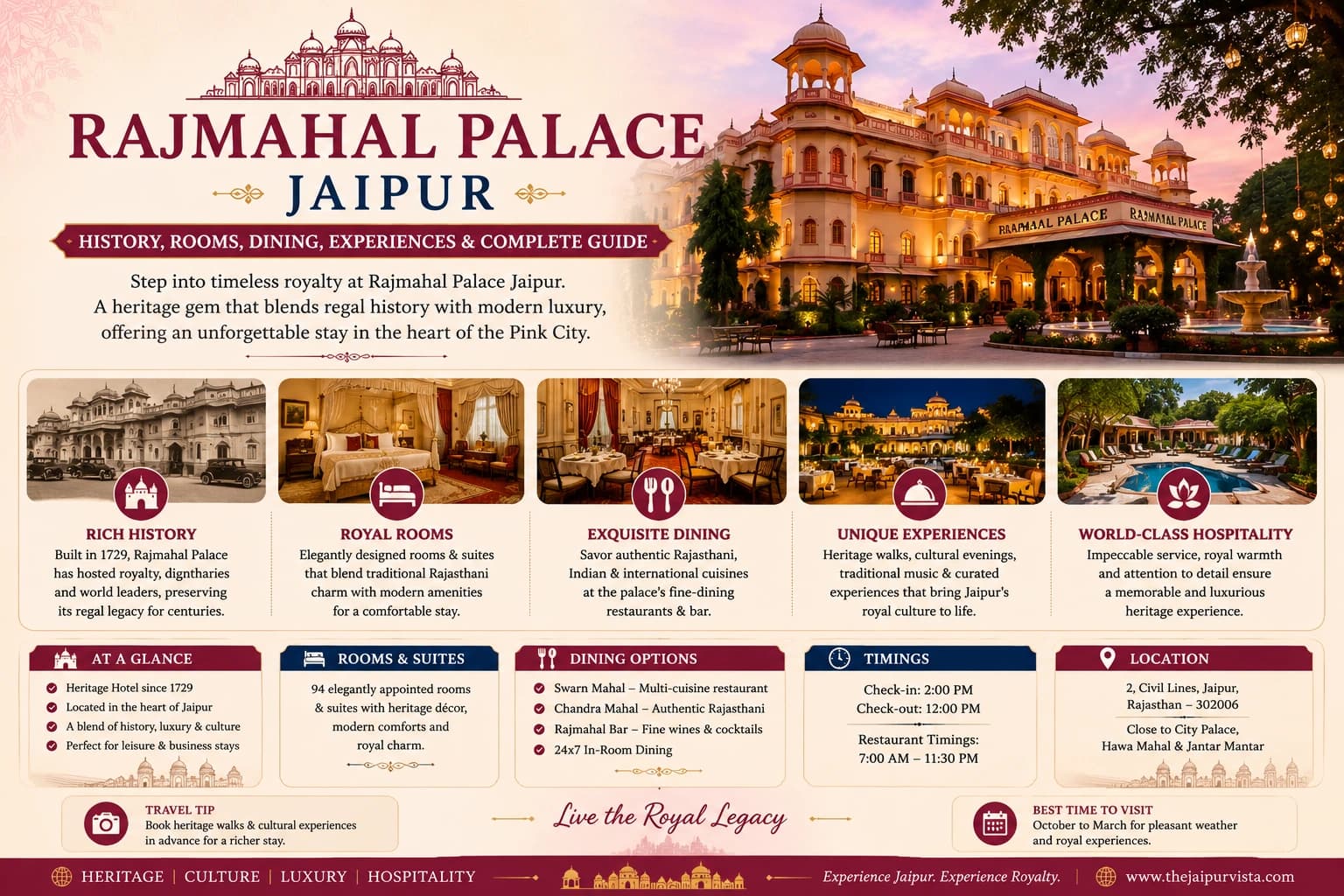
Jaipur is a city of palaces. Amber Fort commands the Aravalli skyline. Nahargarh watches over the plains. City Palace holds the ceremonial heart of the old walled city. But among the many royal residences that define this extraordinary city, one stands apart for a quality that no fort or grand monument can quite replicate: the quiet, personal intimacy of a place that was truly and deeply someone's home. That place is Rajmahal Palace, Jaipur. Built in 1729, Rajmahal Palace was not built to impress armies or receive ambassadors in formal splendour. It was built to be lived in - by royalty, yes, but by royalty who wanted a home that felt warm, characterful, and genuinely beautiful rather than simply monumental. For decades, it was exactly that: the private residence of Maharaja Sawai Man Singh II and, most famously, the beloved home of Maharani Gayatri Devi - one of the most celebrated women of 20th-century India. Today, Rajmahal Palace is a luxury heritage hotel operating under the banner of RAAS Hotels, one of India's most respected boutique heritage hospitality groups. It offers just 13 rooms and suites - an intimacy that remains entirely faithful to the private, residential character that Maharani Gayatri Devi herself described so memorably in her autobiography. This is the most complete guide to Rajmahal Palace Jaipur - its history, its architecture, its accommodations, its dining, its experiences, and everything you need to know about visiting or staying at one of India's most storied royal addresses. Rajmahal Palace - raj meaning royal, mahal meaning palace - is a 18th-century royal residence in Jaipur that has been transformed into one of India's finest luxury heritage hotels. Unlike the grand fortress-palaces that dominate Rajasthan's tourist trail, Rajmahal Palace Jaipur is distinguished by its domestic scale, its Art Deco elegance, its extraordinary personal history, and its singular atmosphere of lived-in royalty. The palace sits within expansive, beautifully maintained gardens covering over 100,000 square feet - a green sanctuary in the heart of Jaipur's affluent C-Scheme neighbourhood. The property combines the intimacy of a private country house with the grandeur appropriate to its royal origins, creating a guest experience that feels less like staying in a hotel and more like being graciously received as a personal guest of the royal family. Rajmahal Palace RAAS Jaipur is currently managed by RAAS Hotels, a boutique hospitality group renowned across India for its thoughtful, sensitively curated approach to heritage properties. Under RAAS, the Raj Mahal Palace has been meticulously restored and updated while preserving every element of its royal character - from the family photographs and polo trophies on the walls to the classic 1950s Ford Thunderbird on display at the property. The Rajmahal Palace is also notable for being part of the living heritage of the Jaipur royal family. Unlike many palace hotels that have been sold away from their original owners, this property remains the primary residence of the Jaipur royal family - meaning that staying here is as close as a visitor can come to genuinely sharing space with the continuing dynastic history of the Pink City. Rajmahal Palace was built in 1729 during a period of extraordinary creative and architectural activity in Jaipur. This was the era of Maharaja Sawai Jai Singh II - the visionary founder of Jaipur itself, who had established the planned city in 1727 and was simultaneously building Jantar Mantar, commissioning the layout of the walled city, and overseeing the creation of Jaipur's distinctive architectural identity. The palace was constructed as a residential property for the royal family - one of several palatial residences built within and around the new city to accommodate the extended royal household and the various branches of the Jaipur royal family. Its location outside the main walled city gave it a character of retreat and privacy distinct from the grand ceremonial spaces of the City Palace within the old walls. The figure most associated with Rajmahal Palace in the public imagination is Maharaja Sawai Man Singh II (1912–1970), one of the most charismatic and internationally celebrated of Jaipur's rulers. Known as much for his exceptional skill at polo as for his administrative abilities, Man Singh II was one of the last great maharajas of the princely state era - a man who embodied a particular ideal of Rajput nobility: courageous, cultured, immaculately dressed, and deeply connected to his land and his people. Man Singh II made Rajmahal Palace his primary personal residence for much of his reign, and the property reflects his personality and tastes throughout. His polo trophies - testament to a sporting career of remarkable distinction - are displayed at the palace. His photographs line the walls. His classic 1950s Ford Thunderbird stands as a beloved artefact of a mid-century maharaja's life. These are not museum exhibits - they are personal objects that tell the story of a man, his household, and his era with an intimacy that no formal historical display can quite achieve. If Maharaja Man Singh II is the historical anchor of Rajmahal Palace, it is Maharani Gayatri Devi - his third and most celebrated wife - who gave the palace its most profound and enduring identity. Born in 1919 as Princess Ayesha of Cooch Behar, Gayatri Devi married Maharaja Man Singh II and arrived at Rajmahal Palace Jaipur as its young maharani. She would spend many of the defining years of her extraordinary life here - raising her family, hosting international dignitaries, managing the transition from princely rule to democratic India, and building the personal and political legacy that would eventually see her elected to Parliament with the largest majority in Indian electoral history, earning her a place in the Guinness Book of Records. Gayatri Devi was also widely celebrated as one of the most beautiful women in the world. Vogue magazine listed her among the world's most elegant women. She was photographed by the greatest portrait photographers of the 20th century. She moved in the highest circles of international society - from the European aristocracy to American political dynasties to the royal families of Asia. And through all of this, Rajmahal Palace was her home. In her celebrated memoir, A Princess Remembers, Maharani Gayatri Devi described the Raj Mahal Palace as a place that had - in words that have become the most famous description of this property - a quality of "charm and character and a pleasantly informal atmosphere". This description remains the most accurate characterisation of Rajmahal Palace Jaipur that anyone has ever written. After nearly three centuries, the charm, the character, and the informal warmth remain intact. The guest list at Rajmahal Palace over the decades reads like a roll call of 20th-century history. Among the most celebrated visitors were: Queen Elizabeth II and the Duke of Edinburgh - The British monarch visited Jaipur and was received at Rajmahal Palace, a visit that cemented the property's status as the appropriate setting for the highest level of official and personal hospitality. Jacqueline Kennedy - The First Lady of the United States visited Jaipur during her famous India trip in 1962, and her connection to Rajmahal Palace is commemorated in a suite named in her honour. The Jackie Kennedy Suite remains one of the most sought-after accommodations at the property. Lord Mountbatten - The last Viceroy of India and a personal friend of the Jaipur royal family stayed at the palace, his visit a reminder of the complex, sometimes intimate relationships between Indian princely families and the British Crown during the transition to independence. These connections are not merely trivia. They speak to the position that Rajmahal Palace and the Jaipur royal family occupied at the very apex of 20th-century international society - a position that the palace still embodies, now as a heritage hotel, with a quiet, understated confidence. The architecture of Rajmahal Palace Jaipur is one of its most distinctive and fascinating aspects - and one of the things that sets it apart from virtually every other palace hotel in Rajasthan. Most of Rajasthan's celebrated palace hotels are defined by the visual language of Rajput or Mughal architecture: jharokha windows, carved sandstone screens, arched corridors, floral pietra dura inlay, and the kind of ornate opulence that conjures images of medieval courts and elephant processions. Rajmahal Palace offers something more unusual, more personal, and in many ways more surprising: Indian Art Deco. The Art Deco movement - which swept through European and American architecture and design in the 1920s and 1930s - found an unexpected and fertile home in the private residences of progressive Indian royalty. Maharajas who had been educated in England, who travelled to Europe and America, who followed international design trends with sophisticated attention, began commissioning Art Deco interior schemes for their personal residences while maintaining the traditional architectural shells of their palaces. At Rajmahal Palace, this synthesis produces a distinctive visual identity: the external architecture retains its 18th-century Rajasthani character, while the interiors reflect a mid-20th-century sensibility - clean geometric forms, elegant proportions, restrained ornamentation, and a colour palette of warm neutrals and rich accent tones. The result is a palace that feels simultaneously historic and stylish, traditional and modern - which is precisely the spirit of the Jaipur royal family's world view during the Man Singh–Gayatri Devi era. The Rajmahal Palace gardens are among the finest private gardens in Jaipur - and in a city that is not short of magnificent garden spaces, this is a genuine distinction. Covering over 100,000 square feet, the gardens combine formal landscape design with the relaxed, generous quality of a private residential garden that has been tended with love and continuity over many decades. The grounds include mature trees that provide deep shade during the Rajasthani summer, carefully maintained flower beds, wide lawns suitable for large outdoor events, and the famous Art Deco swimming pool - surrounded by fountains, framed by garden architecture, and set against the palace's warm sandstone facade in a composition that is genuinely beautiful. These gardens are also the venue for Rajmahal Palace's celebrated weddings and celebrations, which can accommodate between 200 and 2,500 guests - an extraordinary range that makes the palace suitable for intimate family gatherings and grand Rajasthani wedding spectacles alike. The Art Deco swimming pool at Rajmahal Palace RAAS Jaipur deserves specific mention because it is one of the most beautiful swimming pools in any hotel in India. Set within the palace gardens, surrounded by fountains and garden plantings, with the palace facade as its backdrop, this pool is the kind of place where you sit in the warm Jaipur afternoon and feel, with complete sincerity, that life does not get much better than this. Rajmahal Palace offers just 13 rooms, suites, and Royal Apartments - a deliberate intimacy that defines the entire experience of staying here. This is not a large hotel with hundreds of anonymous rooms; it is a private palace with 13 uniquely furnished spaces, each one telling a story, each one connecting you to the living history of this extraordinary building. Every room at Raj Mahal Palace has been designed around a principle of respectful modernisation - preserving the historical character of each space while providing the contemporary comforts that a discerning 21st-century traveller expects. The furniture is a thoughtful combination of genuine heirlooms from the royal collection and sensitively chosen contemporary pieces. The result is rooms that feel lived-in and personal rather than staged for photography - exactly as Maharani Gayatri Devi described the palace itself. Standard Rooms and Deluxe Rooms - The entry-level accommodations at Rajmahal Palace are still, by any conventional measure, extraordinary. Spacious, elegantly furnished, with views into the palace gardens, these rooms establish the Art Deco aesthetic character of the property with well-chosen period furniture, handpicked artworks and objects, and the kind of quality bed linen and bathroom amenity that a five-star heritage property should provide. Suites - The suites at Rajmahal Palace Jaipur step up significantly in scale and opulence. With separate sitting areas, larger garden or palace views, and furnishings that more generously reflect the royal collections, these are spaces designed for guests who want to truly settle into the palace atmosphere - to spend an evening reading in a royal armchair, to wake slowly in a suite that once hosted visiting dignitaries, to feel the full weight and pleasure of the palace's history pressing gently around them. Royal Apartments - The two Royal Apartments at Rajmahal Palace represent the absolute pinnacle of what heritage accommodation in Jaipur can offer. These are not hotel rooms in any conventional sense - they are palatial spaces of extraordinary scale and character, furnished with the finest pieces from the royal collection, offering garden views, private sitting areas, and the kind of spatial grandeur that genuinely lives up to the word royal. For a honeymoon, a significant anniversary, or a once-in-a-lifetime Jaipur experience, the Royal Apartments are the definitive choice. Among the most memorable accommodations at Rajmahal Palace are suites named for the remarkable guests who once stayed within them: The Jackie Kennedy Suite - Honouring the visit of the First Lady of the United States, this suite carries the glamour and history of one of the most photographed visits in Jaipur's modern history. Jacqueline Kennedy's 1962 India tour was a diplomatic and cultural moment of great significance, and her time at Rajmahal Palace is commemorated here with both history and genuine luxury. The Lord Mountbatten Suite - Named for the last Viceroy of India, this suite connects guests to one of the most pivotal moments in modern Indian history - the transition of power from the British Crown to an independent India - through the personal associations of a man who was simultaneously a symbol of empire and a friend to many of its princes. The Queen Elizabeth Suite - Commemorating the British monarch's visit to Rajmahal Palace, this suite is a reminder of the diplomatic significance this palace held in the post-independence decades when Jaipur's royal family navigated the complex transition from ruling sovereigns to citizens of a democratic republic while maintaining their international connections and social position. The dining offering at Rajmahal Palace RAAS Jaipur reflects the same philosophy that governs every aspect of the property: genuine quality, thoughtful curation, and a deep respect for both Indian and international culinary traditions. The Colonnade is the main dining restaurant at Rajmahal Palace, taking its name from the classical columned arcade that defines one of the palace's most architecturally striking exterior features. Serving both Indian and international cuisine, The Colonnade offers guests the opportunity to dine in a setting of genuine architectural beauty - the colonnaded space creating a dining room that is formal enough for a special occasion yet warm and characterful enough for a relaxed evening meal. The menu at The Colonnade draws on Rajasthani culinary traditions - the royal cuisine of the Pink City, including refined versions of the region's great meat and vegetarian preparations - alongside international dishes that reflect the Jaipur royal family's cosmopolitan tastes and the expectations of the palace's international guest list. Named with a knowing nod to Jaipur's famous Pink City identity, 51 Shades of Pink is a more relaxed dining venue that celebrates the colour, vitality, and playfulness of Jaipur's character. The name also reflects the extraordinary range of shades - from pale rose to deep terracotta - in which Jaipur's sandstone buildings present themselves across different seasons, times of day, and qualities of light. This venue offers a lighter, more casual dining atmosphere alongside the formal gravitas of The Colonnade - giving guests the choice between an immersive palatial dining experience and a more relaxed meal in a setting that still carries the unmistakable character of Rajmahal Palace. No aspect of Rajmahal Palace would be complete without an acknowledgement of polo - the sport that defined Maharaja Man Singh II's public identity and that remains synonymous with the Jaipur royal family. The Polo Bar at Rajmahal Palace is a tribute to this heritage: a beautifully curated space decorated with polo memorabilia, vintage photographs, and the trophies and equipment of a sporting tradition that stretches back generations. The bar serves an expertly crafted cocktail menu alongside premium wines and spirits, and its atmosphere - part club, part sporting gallery, entirely Rajasthani royal - is one of the most characterful drinking spaces in Jaipur. Orient Occident is a private dining space available for reservation for special occasions - intimate dinners, anniversary celebrations, private tastings, or any occasion that deserves its own dedicated, beautifully appointed setting. The name reflects the synthesis of Eastern and Western influences that has characterised Rajmahal Palace's aesthetic and social history - a home where Rajput tradition and international modernity have always coexisted in elegant balance. The experience offering at Rajmahal Palace goes well beyond comfortable accommodation and good food. RAAS Hotels has curated a programme of immersive experiences that connect guests to the full depth of Jaipur's royal heritage, cultural traditions, and living city character. Expert-guided tours of Jaipur's most significant royal residences - including the City Palace, Amber Fort, Jaigarh Fort, and Nahargarh Fort - conducted with the kind of contextual depth and access that comes from the palace's own connections to the living royal family and the city's heritage institutions. These tours go beyond the publicly available information to offer personal, story-rich accounts of the places and people that shaped Jaipur. Jaipur's markets - Johari Bazaar for jewellery and gemstones, Bapu Bazaar for textiles and crafts, Tripolia Bazaar for bangles and lac work - are among the most vibrant and rewarding in all of India. Rajmahal Palace's guided market experiences take guests into these spaces with the advantage of local knowledge and personal introductions that transform a shopping expedition into a genuine cultural education. Given Maharaja Man Singh II's legendary polo legacy - and Jaipur's continuing status as one of India's great polo cities - polo experiences occupy a special place in Rajmahal Palace's offering. Guests can watch matches at the Jaipur Polo Ground, learn the basics of the sport with expert tuition, or simply explore the polo heritage of the palace through its extraordinary collection of trophies, photographs, and equipment. The RAAS spa at Rajmahal Palace offers a carefully curated programme of holistic wellness treatments combining specific therapeutic techniques from Indian Ayurvedic traditions with contemporary wellness approaches and potent, natural ingredients. The spa reflects RAAS Hotels' broader philosophy of authentic, place-rooted wellness - treatments that connect you to the healing traditions of Rajasthan rather than generic spa menu offerings. Ma Earth brings an additional dimension of botanical and earth-based wellness - treatments grounded in the natural ingredients of the Aravalli region, administered in the serene, garden-surrounded setting of Rajmahal Palace's grounds. The Rajmahal Palace gardens - covering over 100,000 square feet - make this one of the most magnificent wedding venues in all of Rajasthan. The capacity range (200 to 2,500 guests) accommodates everything from an intimate family celebration to a grand Rajasthani wedding of the type that has made Jaipur one of India's premier destination wedding cities. The combination of authentic royal heritage, architectural grandeur, beautiful gardens, and the intimacy of a property that is still a living royal family home creates a wedding setting that is, quite simply, without parallel in Jaipur. Jaipur has no shortage of excellent luxury heritage hotels - the Rambagh Palace (Taj Hotels), Samode Haveli, Dera Amer, and several others all offer distinguished experiences. How does Rajmahal Palace RAAS Jaipur compare? Scale and Intimacy: At just 13 rooms, Rajmahal Palace is significantly more intimate than the Rambagh Palace (78 rooms) or other large heritage properties. This intimacy is either a strength or a limitation depending on what you are looking for. For guests who want a genuinely private, personal experience, Rajmahal Palace is incomparably superior. For those who want a large hotel's range of facilities and activities, larger properties may suit better. Authenticity of Heritage: The Rajmahal Palace is a still-inhabited royal family home - not a palace that was purchased and converted by an external hotel company. This living connection to the Jaipur royal family gives it an authenticity of heritage that is genuinely different from properties where the royal connection is primarily historical. The Gayatri Devi Factor: Maharani Gayatri Devi's personal connection to Raj Mahal Palace - documented in her own memoir and in countless international publications - gives this property a cultural significance that extends well beyond Rajasthan. For visitors who know and admire Gayatri Devi's story, staying at Rajmahal Palace is an act of genuine historical communion. The Art Deco Aesthetic: Most Jaipur palace hotels lean heavily into Rajput and Mughal aesthetic vocabulary. Rajmahal Palace's Art Deco identity is genuinely distinctive and appealing to guests who are drawn to the 20th-century royal India aesthetic - the world of safari jackets, polo ponies, Ford Thunderbirds, and the India that existed at the intersection of ancient tradition and modern internationalism. The RAAS Philosophy: RAAS Hotels has a clear and admirably consistent philosophy: thoughtful restoration, authentic heritage, genuine hospitality, and immersive local experience. This philosophy makes Rajmahal Palace a property where the quality of curation - of the rooms, the dining, the spa, the experiences - reflects genuine care and intelligence rather than generic luxury hotel standardisation. Rajmahal Palace Jaipur is a functioning luxury hotel and private family residence, not a public heritage site. Unlike the City Palace, Amber Fort, or Albert Hall Museum, it does not have a public entrance or admission ticket. However, there are several ways to experience Rajmahal Palace without being an overnight guest: Dining at The Colonnade or 51 Shades of Pink - Non-guests can make dining reservations at the palace restaurants, which provides the opportunity to experience the palace's interior, gardens, and atmosphere without the cost of an overnight stay. A dinner at Rajmahal Palace is itself a remarkable Jaipur experience. The Polo Bar - The bar at Rajmahal Palace is accessible to non-residents for drinks. An evening cocktail at the Polo Bar, surrounded by Man Singh II's trophies and polo memorabilia, is one of the most atmospherically distinctive drinks experiences in Jaipur. Special Events and Celebrations - The palace grounds host public and semi-public events at various times of year. The Jaipur Literature Festival and other cultural events occasionally use Rajmahal Palace as a venue - check local event listings when planning your visit. Spa Access - The RAAS spa and Ma Earth wellness facilities may be accessible to non-guests for treatments, subject to availability. Contact the hotel directly to enquire. Rajmahal Palace is located on Sardar Patel Marg in the C-Scheme neighbourhood - one of Jaipur's most affluent and centrally located residential areas, just south of the walled city and very close to several major landmarks. From Jaipur Railway Station: Approximately 5–6 km, 15–20 minutes by cab or auto-rickshaw. From Jaipur International Airport: Approximately 11–12 km, 25–35 minutes by cab. From Hawa Mahal / Old City: Approximately 3–4 km, 10–15 minutes. The palace is walkable from the southern end of the walled city for those who prefer to explore on foot. From Albert Hall Museum / Ram Niwas Garden: Approximately 2 km, 5–10 minutes. The palace is very close to the Albert Hall, making a combined visit (museum in the morning, lunch or dinner at the palace) a natural and satisfying pairing. GPS Address: Sardar Patel Marg, C-Scheme, Jaipur, Rajasthan 302001 October to March is the optimal window for experiencing Rajmahal Palace at its finest. The winter months bring Jaipur's most glorious weather - cool, clear days, crisp evenings, and the kind of golden afternoon light that makes the palace's sandstone facade and garden setting look as beautiful as any heritage property in the world. The Jaipur Literature Festival (typically held in late January or early February) brings the city's cultural life to a peak, and staying at Rajmahal Palace during the festival - surrounded by writers, thinkers, and cultural figures in a palace that has always valued intellectual and creative life - is one of the most Jaipur experiences imaginable. April to June is the dry, hot Rajasthani summer. Not the ideal time for outdoor garden events or extensive sightseeing, but the palace itself - with its pools, its gardens, and its cool thick-walled interiors - provides an oasis that the city's public spaces cannot. July to September (Monsoon) is increasingly appreciated as a travel season for Rajasthan. The palace gardens are at their most lush, room rates are often at their most favourable, and Jaipur in the monsoon has a romantic, atmospheric quality that the peak-season winter crowds somewhat diminish. Jaipur is called the Pink City, and most visitors come to experience that pink - the colour of the sandstone walls, the Hawa Mahal at sunset, the bazaars of the old city at dusk. But Jaipur's most compelling story is not told in stone and architecture alone. It is told in the lives of the people who built this city, ruled it, loved it, and lived out the drama of 20th-century India within its walls. Maharani Gayatri Devi lived that drama more vividly than almost anyone - a princess of extraordinary beauty and intelligence who became a democratic politician, a polo patron, a society figure of international standing, and ultimately a witness to the entire extraordinary arc of modern India. And for much of that life, Rajmahal Palace was where she came home. When you walk through the gates of Rajmahal Palace Jaipur - whether as an overnight guest in one of its 13 rooms, a diner at The Colonnade, or an evening visitor to the Polo Bar - you are entering a space where that history is not archived in a museum but alive in the walls, the furniture, the photographs, and the air itself. At The Jaipur Vista, we believe that is worth experiencing. Whatever your budget, whatever your itinerary, Rajmahal Palace deserves at minimum a meal, a drink, or an afternoon in its gardens. And if the occasion and the means allow for a night or two - even better. There are very few places in Jaipur where you feel as immediately, as physically close to the living soul of the Pink City as you do at Raj Mahal Palace. That is the best reason of all to go. Q1. What is Rajmahal Palace Jaipur? Q2. Who owned Rajmahal Palace originally? Q3. Is Rajmahal Palace the same as Sujan Rajmahal Palace? Q4. How many rooms does Rajmahal Palace have? Q5. What is the architecture style of Rajmahal Palace? Q6. Can non-guests visit Rajmahal Palace Jaipur? Q7. Who are some famous guests who have stayed at Rajmahal Palace? Q8. What is Maharani Gayatri Devi's connection to Rajmahal Palace? Q9. What dining options are available at Rajmahal Palace Jaipur? Q10. Is Rajmahal Palace good for weddings? Q11. Where is Rajmahal Palace located in Jaipur? Rajmahal Palace Jaipur - At a Glance
What Is Rajmahal Palace?
The History of Rajmahal Palace - Three Centuries of Royal Life
1729 - The Foundation
Maharaja Sawai Man Singh II - The Polo Maharaja
Maharani Gayatri Devi - The Most Beautiful Woman in the World
Royal Guests of International Distinction
Architecture of Rajmahal Palace - Indian Art Deco and Royal Elegance
Indian Art Deco - A Unique Aesthetic Identity
The Gardens
The Swimming Pool
Accommodation at Rajmahal Palace RAAS Jaipur
The Philosophy of the Rooms
Room Categories
Named Suites - Staying in History
Dining at Rajmahal Palace Jaipur
The Colonnade
51 Shades of Pink
The Polo Bar
Orient Occident
Experiences at Rajmahal Palace RAAS Jaipur
Royal Heritage Tours
The Local Market Experience
Polo Experiences
Wellness at RAAS and Ma Earth Spa
Celebrations and Weddings
Rajmahal Palace vs Other Luxury Hotels in Jaipur
Visiting Rajmahal Palace Without Staying - Is It Possible?
How to Reach Rajmahal Palace Jaipur
Best Time to Visit Rajmahal Palace Jaipur
Why Rajmahal Palace Belongs on Every Jaipur Itinerary
Frequently Asked Questions About Rajmahal Palace Jaipur
Rajmahal Palace Jaipur is a 1729 royal palace that was the personal residence of Maharaja Sawai Man Singh II and Maharani Gayatri Devi. It is now operated as a luxury heritage hotel by RAAS Hotels, offering 13 rooms, suites, and Royal Apartments. It remains the primary residence of the Jaipur royal family.
Rajmahal Palace was built in 1729 and became most associated with Maharaja Sawai Man Singh II and his celebrated wife, Maharani Gayatri Devi. It remains owned by and connected to the Jaipur royal family.
Yes. Before coming under the RAAS Hotels management, Rajmahal Palace was operated under the Sujan Rajmahal Palace name by Sujan Luxury. The property is now known as Rajmahal Palace RAAS Jaipur following its transition to RAAS Hotels management. Both names refer to the same heritage property.
Rajmahal Palace has 13 rooms and suites in total, including two Royal Apartments. The intimacy of this small room count is central to the property's character and appeal.
Rajmahal Palace is characterised by Indian Art Deco architecture - a fusion of Rajput traditional architecture with the Art Deco design sensibility of the 1920s–1950s. This gives it a distinctive aesthetic identity that sets it apart from most other Rajasthani palace hotels.
Rajmahal Palace is a private hotel and residence, not a public heritage site. Non-guests can experience it through dining reservations at The Colonnade or 51 Shades of Pink, drinks at the Polo Bar, spa treatments, and special events hosted at the property.
Notable guests include Queen Elizabeth II, the Duke of Edinburgh, Jacqueline Kennedy, and Lord Mountbatten. The palace has suites named in honour of Jackie Kennedy, Lord Mountbatten, and Queen Elizabeth II.
Maharani Gayatri Devi - one of the most celebrated women of 20th-century India - lived at Rajmahal Palace for many years as the wife of Maharaja Sawai Man Singh II. In her autobiography A Princess Remembers, she described the palace as having "charm and character and a pleasantly informal atmosphere." She is considered the most famous resident in the palace's long history.
Rajmahal Palace offers four dining venues: The Colonnade (main restaurant, Indian and international cuisine), 51 Shades of Pink (casual dining), the Polo Bar (cocktails and drinks), and Orient Occident (private dining for special occasions).
Yes - the palace gardens (over 100,000 square feet) accommodate between 200 and 2,500 guests, making Rajmahal Palace one of Jaipur's most spectacular wedding venues. The combination of authentic royal heritage, beautiful gardens, and outstanding hospitality makes it a premier destination wedding choice.
Rajmahal Palace is located at Sardar Patel Marg, C-Scheme, Jaipur - a central, affluent neighbourhood close to the walled city, approximately 5–6 km from Jaipur Railway Station and 11–12 km from the international airport.
The key differences are scale (13 rooms vs 78), ownership (royal family-connected vs Taj Hotels group), aesthetic (Art Deco vs Mughal-Rajput), and atmosphere (intimate private residence vs grand hotel). Both are outstanding; Rajmahal Palace is more intimate, personal, and historically connected to the living royal family.