Garh Ganesh Temple Jaipur: The Complete Visitor's Guide (History, Timings, Darshan & Travel Tips)
Author:Niharika
Published:June 1, 2026
Views:1001
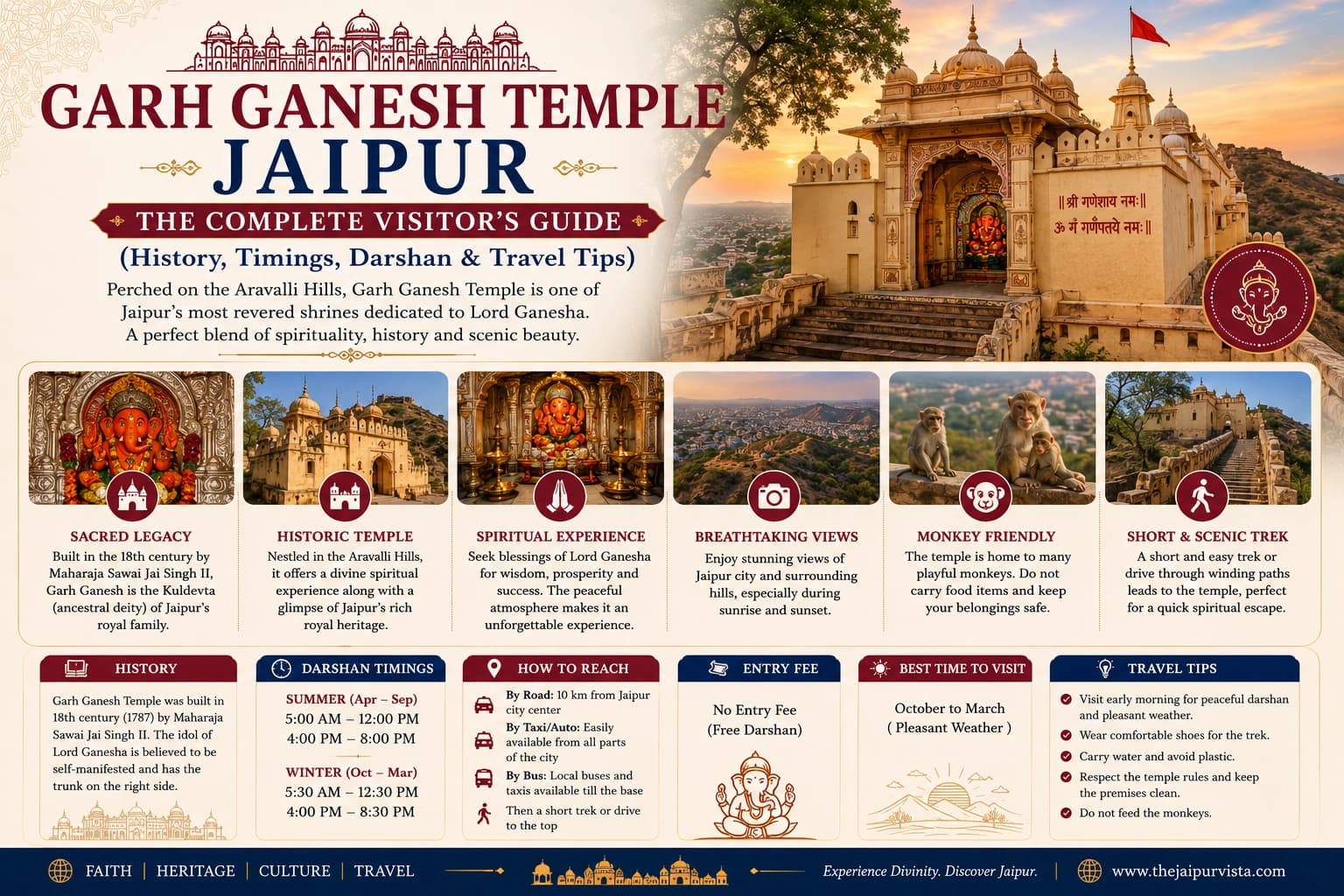
There is a stillness on the Aravalli Hills above Jaipur that is unlike anything you will find in the busy lanes of the Pink City below. At the summit of one of these ancient ridges, overlooking the entire planned city of Jaipur with its rose-tinted boulevards and royal monuments, stands the Garh Ganesh Temple - one of the most sacred, historically significant, and architecturally distinctive Ganesh temples in all of Rajasthan.
Every morning, even before the city fully awakens, a steady stream of devotees begins the ascent - climbing the 365 stone steps that lead to the hilltop shrine, each step representing a day of the year, each footfall an act of devotion. At the top, they are rewarded not just with the divine darshan of Gad Ganesh Ji Jaipur - the presiding deity of the city - but with a breathtaking panoramic view of Jaipur that stretches to the horizon in every direction.
This is The Jaipur Vista's definitive guide to the Garh Ganesh Temple, Jaipur - covering everything from its extraordinary origin story and historical significance to its unique iconography, architecture, darshan timings, and practical travel information for visitors in 2026.
Garh Ganesh (also spelled Gad Ganesh or Garh Ganesh Ji) is an ancient hilltop temple in Jaipur dedicated to Lord Ganesha - the elephant-headed deity of wisdom, prosperity, new beginnings, and the removal of obstacles. The temple is situated on the Aravalli Hills, in the northern part of the old walled city, and commands a magnificent elevated position above the Jaipur skyline.
The name "Garh Ganesh" literally means "Ganesh of the Fort" or "Ganesh of the Elevated Place" - garh in Rajasthani meaning a fort, a hill fort, or an elevated stronghold. The temple's position on the hilltop, above the city it is believed to protect and bless, perfectly embodies this meaning.
The Jaipur Ganesh Mandir is not just a place of worship - it is the spiritual cornerstone of the city of Jaipur itself. According to centuries-old tradition, it was the very first temple established when Jaipur was founded, and it continues to be the temple that newly-wed couples, business owners, students appearing for examinations, and travellers setting out on long journeys visit first, to seek Ganesha's blessings before embarking on any important new beginning.
The history of the Garh Ganesh Temple Jaipur is inseparable from the founding history of Jaipur city itself - and it begins with a divine dream.
In the early 18th century, Maharaja Sawai Jai Singh II - the visionary astronomer-king of the Kachhwaha Rajput dynasty - was in the process of planning an entirely new city to replace Amber as his capital. This was an unprecedented undertaking in the history of Rajputana: a city designed from the ground up according to the ancient Hindu principles of town planning laid out in the Shilpa Shastra and Vastu Shastra.
Before laying the foundation stone, Maharaja Jai Singh II sought divine guidance. According to the most revered tradition associated with this Jaipur Ganesh Mandir, the Maharaja received a divine vision in which Lord Ganesha himself appeared and instructed him to establish a temple in his honour on the hilltop that overlooked the site of the new city, before breaking ground on any other structure. In the dream, Lord Ganesha directed the king to bring his self-manifested idol - a swayambhu murti - from the hill and enshrine it in a proper temple.
Following the divine instruction with complete devotion, Maharaja Jai Singh II ordered the construction of the Garh Ganesh Temple as the first act of founding Jaipur. The temple was established around 1730 CE - before the city walls, before the palaces, before the markets. Lord Ganesha was thus installed as the presiding deity and guardian of Jaipur, Ganpati Ji Maharaj of the entire city.
This is why, to this day, Jaipur residents and pilgrims from across Rajasthan consider Gad Ganesh Ji Jaipur to be the most important Ganesh temple in the region - and why a visit here is considered the auspicious starting point of any significant journey or life event.
One of the most remarkable aspects of the Garh Ganesh Temple is the nature of the deity worshipped here. The idol of Lord Ganesha enshrined in the sanctum is considered a swayambhu murti - a self-manifested form that was not carved by human hands but appeared naturally in the stone of the Aravalli Hills.
In Hindu religious tradition, a swayambhu idol carries extraordinary sanctity. It is believed to be imbued with divine energy that is direct, unmediated, and primordial - not channelled through the ritual consecration of a man-made image but present naturally in the stone itself. Devotees believe that the blessings obtained from a swayambhu form of a deity are among the most powerful available to human seekers.
The idol at Garh Ganesh Jaipur has an additional distinctive feature that makes it especially unique and auspicious: the trunk of Lord Ganesha turns to the right (dakshinavarta), rather than to the left as in most Ganesha idols. A right-turning trunk is considered the rarest and most powerful form of Ganesha in Hindu iconography - associated with extraordinary strength, divine power, and the fulfillment of the most difficult wishes. Such idols are exceedingly rare, which adds immensely to the sacred significance of this Jaipur Ganesh Mandir.
The Garh Ganesh Temple stands as a magnificent example of Rajput and traditional Rajasthani temple architecture, perfectly harmonised with its dramatic natural setting on the Aravalli hillside.
The primary building material of the temple is the warm pink sandstone (Dholpur stone and local Aravalli sandstone) that is the architectural signature of Jaipur - the same material used for the Hawa Mahal, the City Palace, and Jantar Mantar. The use of this stone gives the Garh Ganesh Temple a visual continuity with the city it presides over, creating a visual harmony between the hilltop shrine and the pink cityscape below.
The main temple structure follows a traditional Rajasthani shikhara (spire) design, with a tapering tower above the sanctum sanctorum (garbhagriha) that is visible from a considerable distance below. The temple complex also includes:
The Sanctum Sanctorum (Garbhagriha): The inner shrine where the swayambhu Ganesha idol is enshrined. The sanctum is small and intimate, creating a sense of closeness with the deity.
The Mandapa (Assembly Hall): The pillared hall in front of the sanctum where devotees gather for prayers, bhajans, and the viewing of the deity.
Intricate Stone Carvings: The facade, pillars, and outer walls of the temple feature detailed carvings depicting mythological scenes, floral motifs, celestial beings (apsaras), and geometric patterns - all executed in the refined tradition of Rajput stone carving.
The Pradakshina Path: The circumambulation passage around the main shrine, used by devotees for performing the ritual of parikrama (clockwise circumambulation) as an act of devotion.
One of the most iconic features of the Garh Ganesh Jaipur experience is the climb itself. The ascent to the temple requires climbing approximately 365 stone steps - one for each day of the year. This design is deeply intentional: the climb is itself considered an act of devotion, a daily renewal of the devotee's relationship with the deity. The steps are wide, well-maintained, and manageable for most visitors, though the climb does require a moderate level of fitness, particularly in the summer months.
Along the ascent, small shrines, resting points, and vendors selling flowers, coconuts, and religious offerings are scattered at intervals. The climb typically takes 15 to 25 minutes at a comfortable pace.
The most spectacular non-religious aspect of visiting the Garh Ganesh Temple is the extraordinary panoramic view of Jaipur that greets you at the top. From the hilltop temple, the entire city spreads out below in all directions - the pink-hued old city, the modern extensions, the dark silhouette of Nahargarh Fort and Jaigarh Fort along the ridge to the northwest, the glittering spires of numerous temples, and the vast Aravalli landscape beyond. At sunrise and sunset especially, the view from Garh Ganesh Jaipur is among the most beautiful in all of Rajasthan.
This is one of the main reasons the Garh Ganesh Temple photos taken from this location are so widely shared - the combination of the ancient temple, the pink cityscape below, and the Rajasthani sky creates images of rare beauty.
When you enter the sanctum of the Garh Ganesh Temple Jaipur, understanding what you are seeing will deepen your experience significantly.
The idol of Ganesha at Gad Ganesh Ji Jaipur is particularly revered because it represents Ganesha in his Bal Swaroop - his form as a divine child, before he received his elephant head. In this form, Ganesha is depicted as a young child with a human face - a form that is extremely rare in Ganesha iconography and carries a unique spiritual significance.
The Bal Swaroop of Ganesha is associated with pure, childlike devotion - the most innocent and direct form of relationship between a devotee and the divine. Many devotees feel a special emotional connection with this form, approaching the deity with the love and tenderness one would show to a beloved child.
As mentioned earlier, the trunk of the Ganesha idol at Garh Ganesh turns to the right - a dakshinavarta trunk. In Hindu religious symbolism:
A left-turning trunk (most common) is associated with the moon energy, easily accessible blessings, and is considered suitable for household worship.
A right-turning trunk is associated with solar energy, supreme power, and the fulfillment of exceptional desires. Such forms require very specific and rigorous worship protocols to approach safely, and are generally found in larger, more formally maintained temple settings.
The dakshinavarta Ganesha at Garh Ganesh Jaipur is thus an exceptionally rare and potent form - one that devotees travel from across Rajasthan and neighbouring states to seek blessings from, particularly for major life events, business ventures, and examinations.
Opening Hours for Garh Ganesh Temple, Jaipur: Aarti Timings: Morning Aarti (Mangla Aarti): Approximately 5:30 AM – 6:00 AM (before regular darshan hours; check locally for current schedule) Shringar Aarti: 7:30 AM (at the opening of regular darshan) Sandhya Aarti (Evening Aarti): 7:00 PM – 7:30 PM (the most atmospheric aarti, when the entire city is visible as a glittering sea of lights below) Shayan Aarti: 8:00 PM – 8:30 PM Entry Fee: No entry fee. Garh Ganesh Temple is open to all visitors free of charge. Photography: Photography is generally permitted in the outer areas of the temple and on the steps. Respect any signage regarding photography near the main idol. Important Note on Festivals: On Ganesh Chaturthi, the two Navratri periods, Sankashti Chaturthi, and Wednesdays (considered especially auspicious for Ganesha worship), the temple attracts very large crowds. On these days, the temple may open earlier and close later than the standard timings above. Confirming current timings locally before your visit is always advisable. Location: Garh Ganesh Temple is situated on the Aravalli Hills, in the area above Brahmpuri, in the northern part of Jaipur's old walled city. The temple's base (from where the steps begin) is approximately 3 km from the Jaipur City Palace and approximately 5 km from Jaipur Railway Station. Address: Garh Ganesh Ji Temple, Brahmpuri Road, Near Nahargarh, Jaipur, Rajasthan – 302001. The most convenient way to reach Garh Ganesh Jaipur is by car, taxi, or auto-rickshaw. From the Jaipur city centre (City Palace / Hawa Mahal area), the drive takes approximately 15-20 minutes. Taxis and auto-rickshaws from anywhere in Jaipur can take you directly to the base of the temple steps. From Jaipur Railway Station: approximately 20 minutes by auto or taxi. Parking is available near the base of the temple steps. Auto-rickshaws are readily available throughout Jaipur and are the most common mode of transport for visiting the Garh Ganesh Temple. Negotiate the fare before boarding; the journey from the old city area should cost approximately ₹50-100. The Garh Ganesh Temple is also accessible on foot from the Nahargarh Fort road and from Brahmpuri. Walkers and trekking enthusiasts can approach from the Nahargarh direction for a more scenic route through the Aravalli landscape. If you are using Google Maps or asking for directions locally, the Gad Ganesh Ji Jaipur temple is located near: Nahargarh Fort (approximately 2 km by road) Brahmpuri locality Kanak Vrindavan Garden (approximately 2 km) Jal Mahal (approximately 4 km) A visit to the Garh Ganesh Temple Jaipur is more than just a darshan stop - here's how to make the most of your time here: The 365 steps are not merely a physical climb - approach them as the first act of your worship. Many devoted pilgrims recite the names of Lord Ganesha (Ganapati Bappa Morya, Om Gam Ganapataye Namaha) or simply walk in contemplative silence. The climb itself, traditionally understood, is your first offering. At the foot of the steps, several vendors sell traditional puja materials: fresh marigold and jasmine garlands, coconuts, modak (Ganesha's favourite sweet), ladoos, flowers, sindoor (vermillion), and incense. Purchasing an offering before you climb adds meaning to your darshan. The aarti ceremony - particularly the Sandhya (evening) aarti - is the most powerful and atmospheric experience at Garh Ganesh Temple. The sight of camphor flames illuminating the rare right-trunked Ganesha idol while devotional songs echo off the ancient stone walls, with the entire twinkling cityscape of Jaipur visible through the open doors behind you, is something that stays with you for a long time. If you time your visit to arrive about 30-45 minutes before sunset, you will be rewarded with one of the most dramatic views in all of Jaipur. The warm orange light of the Rajasthani sunset washing over the pink city below, with the temple spire in the foreground, is the definitive Garh Ganesh Temple photo that most visitors take home with them. Unlike some of Jaipur's more tourist-heavy temples, Garh Ganesh Ji retains a genuine atmosphere of personal devotion. Take time to sit quietly in the mandapa, watch the devotees, and absorb the spiritual atmosphere. From the temple, a walking path continues along the Aravalli ridge towards Nahargarh Fort. The path offers spectacular views and a peaceful walk through scrubland where wild peacocks and other birds are frequently spotted. By Season: October to March (Best): The weather is cool and pleasant - ideal for the 365-step climb and for spending time on the hilltop. Clear winter air also makes the panoramic views of Jaipur particularly spectacular. April to June (Manageable but Hot): Early morning visits (before 8:30 AM) are recommended in summer to avoid the heat on the exposed stone steps. The views in summer can be hazy. July to September (Monsoon): The Aravalli Hills turn dramatically green during the monsoon, and the temple surrounded by lush vegetation is genuinely beautiful. However, the steps can be slippery - proceed with care and wear good footwear. By Day of the Week: Wednesday is considered the most auspicious day for worshipping Lord Ganesha (associated with Mercury, the planet of intellect - Ganesha's domain). The temple is noticeably busier on Wednesdays. Weekday mornings offer the most peaceful darshan experience. By Time of Day: Sunrise (around 6:00-7:00 AM): The most serene time, with soft morning light on the city below. The Mangla Aarti is held at this time. Sunset (around 6:00-7:00 PM, seasonal): The most dramatic time for photography and for the evening aarti atmosphere. Special Occasions: Ganesh Chaturthi (August-September): The grandest celebration of the year at Garh Ganesh Temple Jaipur. The entire hill is decorated with lights, bhajan programmes run through the night, and tens of thousands of devotees make the pilgrimage on this day. A once-in-a-lifetime experience if you can be in Jaipur during this festival. Sankashti Chaturthi (monthly, on the fourth day after the full moon): A monthly Ganesha observance day when the temple is especially busy. Navratri (twice yearly): The surrounding area is festive, and many devotees combine the Garh Ganesh visit with the Moti Doongri Ganesh Temple darshan. The Garh Ganesh Temple photos that circulate most widely across Instagram and travel websites typically fall into a few distinct categories: The Sunrise Cityscape Shot: Standing at the temple terrace and facing east as the sun rises over Jaipur - the pink city gradually illuminated in golden light, with the temple pillars framing the scene. Best between 6:15 and 7:00 AM. The Temple Spire Against the Sky: The pink sandstone shikhara against a deep blue Rajasthani sky (especially sharp in winter mornings) makes for a striking architectural photograph. Best from the step approach below the final landing. The 365 Steps Shot: Looking down from the top of the steps, the long diagonal line of the staircase with devotees ascending creates a powerful compositional element - especially at golden hour. The Aarti Glow: During aarti, the warm light of oil lamps and camphor flames creates a beautiful, atmospheric image. Note that photography during active aarti should be done with sensitivity and respect. The Monsoon Green: The Aravalli Hills around the temple turn an almost impossibly vivid green during the monsoon - creating a striking contrast with the pink sandstone of the temple. The most lush and dramatic landscape photographs come from July to September. Practical Photography Tip: A wide-angle lens (or the standard wide mode on a modern smartphone) is ideal for capturing both the temple structure and the cityscape below in the same frame. The best vantage points are from the final landing at the top of the steps and from the temple terrace on the western side of the main shrine. The Garh Ganesh Temple is situated in a cluster of some of Jaipur's most interesting attractions, all within a short distance: The dramatic hilltop fort that stretches along the Aravalli ridge above Jaipur offers spectacular views of the city, well-preserved palace rooms inside, and a popular sunset spot. Nahargarh and Garh Ganesh are ideally combined in a single morning or afternoon outing. Nestled in a narrow valley between the Aravalli Hills at the foot of Nahargarh, Kanak Vrindavan is a beautifully maintained garden complex with an ancient Krishna temple, a small dam, and serene surroundings. Particularly lovely in the early morning hours. The famous "Water Palace" that appears to float in the middle of Man Sagar Lake on the Amer Road is one of Jaipur's most iconic images. The short drive from Garh Ganesh passes through scenic Aravalli landscape. Jaipur's grandest heritage attraction - the UNESCO-listed Amer Fort with its magnificent Sheesh Mahal (Hall of Mirrors), Diwan-e-Aam, and Ganesh Gate is an essential part of any Jaipur visit. Easily combined with Garh Ganesh Jaipur on the same day. Another of Jaipur's most beloved Ganesh temples, situated on a small rocky hill in the south of the city, Moti Doongri Ganesh Temple attracts especially large crowds on Wednesdays and during Ganesh Chaturthi. Visiting both the Garh Ganesh Temple and Moti Doongri on the same day creates a meaningful Ganesh darshan circuit in Jaipur. The ancient temple complex at Galtaji Temple, with its natural spring-fed kunds and numerous temples, is one of Jaipur's most atmospheric religious sites and is easily reachable from Garh Ganesh by car or taxi. The magnificent royal palace complex at the heart of the old city houses the Maharaja Sawai Man Singh II Museum, the still-occupied royal residence of the Jaipur royal family, and some of the finest examples of Rajput and Mughal architecture in India. Read more: Top Tourist Places in Jaipur Dress Code: Modest clothing is appropriate. Avoid sleeveless tops, shorts, and revealing attire. Carry a stole or dupatta to use as a head covering when inside the sanctum. There is no strict dress code enforcement, but dressing respectfully is appreciated. Footwear: Shoes and sandals must be removed before ascending the final steps to the temple. Shoe storage racks are available near the top of the staircase. Many visitors prefer to carry their shoes in a bag. Fitness Note: The 365 steps are a moderate physical challenge. The climb is entirely manageable for most healthy adults but may be challenging for the elderly or those with knee or joint issues. Take the climb at your own comfortable pace - there are several resting platforms along the way. Best Footwear for the Climb: Comfortable closed-toe shoes or sturdy sandals with good grip are recommended, especially during or after rain when the steps can be wet. Cleanliness: Eating and drinking on the steps is generally discouraged. Do not litter on the approach to the temple. Mobile Phones: Silence your phone before entering the sanctum. Be mindful of noise levels. Prasad: You can bring your own puja offerings (flowers, coconuts, modak, ladoos) or purchase them from vendors at the base. The temple distributes prasad after the aarti. Before you head up the hill, make sure you have: Comfortable footwear with good grip (for 365 steps) A stole or dupatta for head covering in the sanctum Puja offerings (or plan to buy at the base: flowers, coconut, modak, ladoos) Water bottle (especially important in warm months) Camera or charged phone for the views Small cash for offerings, prasad, and vendors Arrival planned for either early morning or late afternoon for the best experience Learn more: Jaipur Itinerary 2 Days In a city as rich with palaces, forts, and monuments as Jaipur, it can be easy to overlook the spiritual heart of the Pink City. But the Garh Ganesh Temple - watching over the city from the Aravalli ridgeline since before Jaipur was even founded - offers something that no palace or museum can: a direct, living connection to the devotional soul of Rajasthan. Whether you are a pilgrim seeking the blessings of the rare dakshinavarta Ganesha, a traveller chasing the most beautiful sunrise views in Jaipur, a history lover tracing the foundation story of one of India's greatest planned cities, or simply someone who wants to experience the quiet power of an ancient hilltop temple, the Garh Ganesh Temple Jaipur will leave you enriched. The 365 steps are a small investment for what awaits at the top. Ganpati Bappa Morya! 🙏 Q. What is the significance of Garh Ganesh Temple? Q. What are the timings of Garh Ganesh Temple, Jaipur? Q. How many steps are there to reach Garh Ganesh Temple? Q. Is there an entry fee for Garh Ganesh Temple? Q. What makes the idol at Garh Ganesh Temple unique? Q. What is the best time to visit Garh Ganesh Temple? Q. How do I reach Garh Ganesh Temple from Jaipur Railway Station? Q. Can I visit Garh Ganesh Temple and Nahargarh Fort on the same day? Q. Why is Wednesday special for Garh Ganesh Temple?How to Reach Garh Ganesh Temple, Jaipur
By Car or Taxi
By Auto-Rickshaw
On Foot (from Nahargarh / Brahmpuri area)
Read Also: Birla Mandir Jaipur
Nearby Landmarks for Navigation
What to Do at Garh Ganesh Temple: A Complete Experience Guide
1. Begin the Climb with Intention
2. Buy Offerings at the Temple Base
3. Attend the Aarti
4. Photograph the Jaipur Skyline at Sunset
5. Take Time for Personal Prayer
6. Explore the Hilltop Surroundings
Best Time to Visit Garh Ganesh Temple
Garh Ganesh Temple Photos: What to Photograph and When
Places to Visit Near Garh Ganesh Temple, Jaipur
1. Nahargarh Fort (2 km)
2. Kanak Vrindavan Garden and Temple (2 km)
3. Jal Mahal (3.5 km)
4. Amer Fort (8 km)
5. Moti Doongri Ganesh Temple (5 km)
6. Galtaji (Monkey Temple) (10 km)
7. City Palace (3 km)
Things to Know Before You Visit Garh Ganesh Temple
Visitor Checklist for Garh Ganesh Temple, Jaipur
Final Thoughts: Why Garh Ganesh Temple Deserves a Place at the Top of Your Jaipur List
Frequently Asked Questions About Garh Ganesh Temple, Jaipur
The Garh Ganesh Temple is considered the presiding Ganesh temple of Jaipur - believed to have been established before the city was founded, on the instruction of Lord Ganesha himself in a divine vision to Maharaja Sawai Jai Singh II. The self-manifested (swayambhu) idol with a rare right-turned trunk makes it one of the most spiritually powerful Ganesha shrines in Rajasthan.
The temple is open from 7:30 AM to 12:00 PM in the morning and 4:00 PM to 8:30 PM in the evening. Timings may extend on festival days and special occasions.
There are approximately 365 steps to climb from the base to the temple - one for each day of the year, symbolising the continuous, year-round nature of devotion to Lord Ganesha.
No. Entry to the Garh Ganesh Temple Jaipur, is completely free of charge.
The Ganesha idol at Gad Ganesh Ji Jaipur is unique for two reasons: it is a swayambhu (self-manifested) form found naturally in the hillside, and its trunk turns to the right - a dakshinavarta trunk that is considered extremely rare and supremely auspicious in Hindu iconography.
October to March is the best season. For daily timing, early morning (around sunrise) and evening (around sunset) are the most spiritually and visually rewarding times to visit.
The temple is approximately 5 km from Jaipur Railway Station. Take an auto-rickshaw or taxi from the station - the journey takes about 20 minutes. Ask for "Garh Ganesh Ji Mandir" or "Brahmpuri Ganesh Temple."
Absolutely - and this is one of the most recommended combinations for visitors to Jaipur. Both sites are on the same Aravalli ridge. Visit Garh Ganesh first in the morning, then walk or drive the short distance to Nahargarh Fort for an afternoon exploration with sunset views.
Wednesday (Budhwar) is traditionally dedicated to Lord Ganesha in Hindu religious practice, as the day is associated with Mercury (Budha), the planet of intellect and wisdom - which is Ganesha's domain. The Garh Ganesh Jaipur temple sees significantly larger crowds on Wednesdays.
Both temples are among the most revered Jaipur Ganesh Mandirs and have their own distinct character. Garh Ganesh is considered historically more significant (as the first temple of Jaipur), while Moti Doongri Ganesh is better known for its large crowds and festive atmosphere, particularly on Ganesh Chaturthi. Many devotees visit both on the same trip.