Galtaji Temple Jaipur: Complete Guide to the Sacred Monkey Temple
Author:Niharika
Published:May 24, 2026
Views:1600
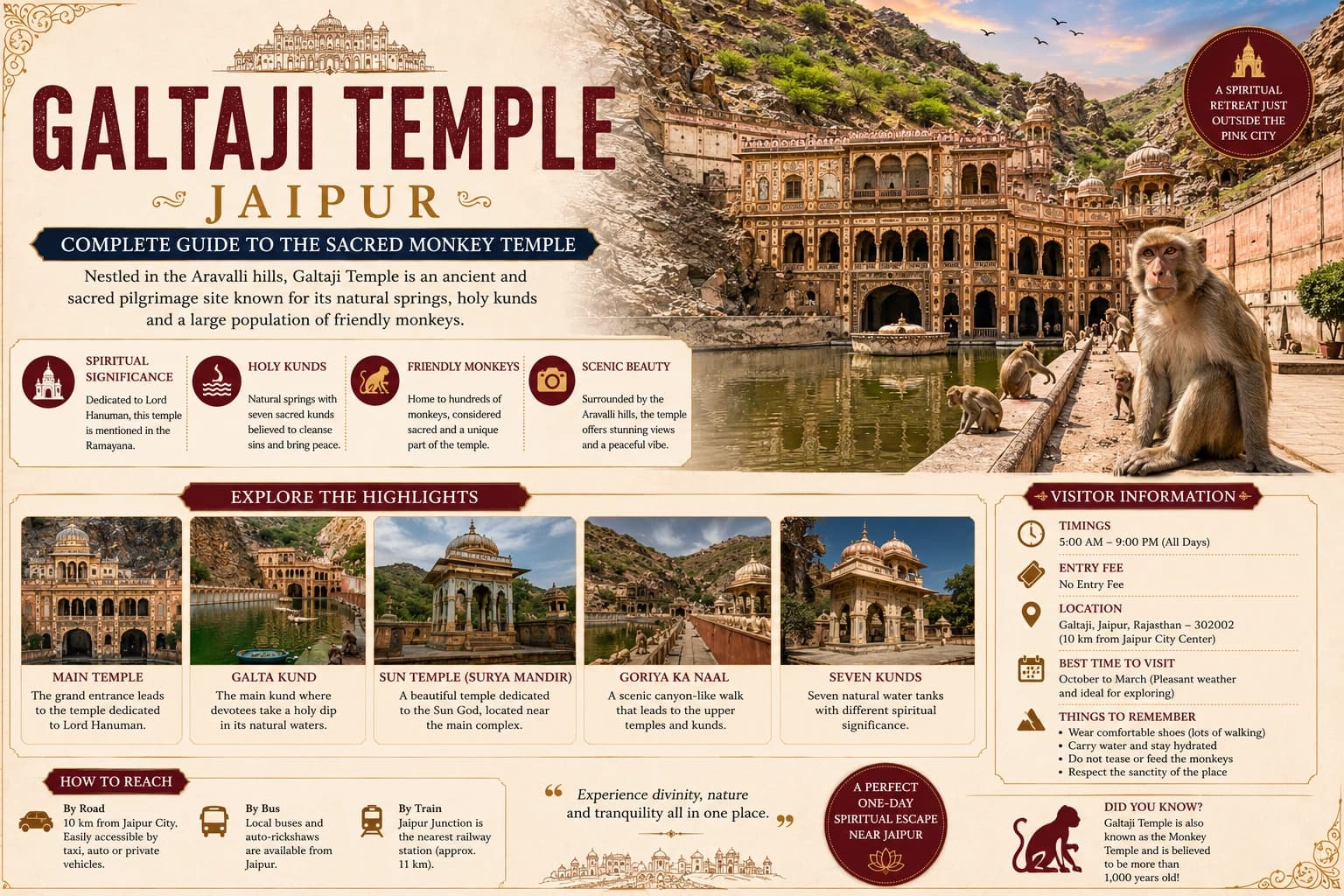
Nestled in the folds of the ancient Aravalli hills, just 10 kilometres east of the Pink City, Galtaji Temple in Jaipur is one of Rajasthan's most extraordinary and spiritually charged destinations. Whether you call it the Galta Ji Monkey Temple, the sacred Galwar Bagh, or simply Galta Ji, this ancient pilgrimage site blends myth, history, natural beauty, and raw spiritual energy into an experience unlike any other in Jaipur.
If you are planning a trip to the Galtaji Temple Jaipur and want to know everything - from Galtaji Temple Jaipur timings and entry fees to its centuries-old legends and pro travel tips - you have landed on exactly the right guide. Welcome to The Jaipur Vista definitive resource on Galta Ji Temple Jaipur.
Galtaji Temple is not a single shrine - it is a sprawling temple complex of multiple interconnected temples, sacred water tanks (called kunds), natural springs, ghats, ashrams, and pavilions built into a narrow mountain gorge. The centrepiece and the most revered site within the complex is the Galta Ji Temple itself, dedicated to the Sun God and Vaishnavite deities.
The Galta Ji Temple Jaipur holds immense significance for Hindu pilgrims, particularly for the Vaishnavite Ramanandi sect. It is one of the few temple complexes in Rajasthan where a natural perennial spring feeds a series of sacred bathing kunds - making it a living, breathing tirtha (pilgrimage site) that has drawn devotees for centuries.
The entire complex sits within a hidden valley of the Aravalli range, sheltered by rocky hillsides and dense greenery. As you enter through the grand Galwar Bagh Gate, you are immediately transported from the bustling city of Jaipur into a world of pink-tinged sandstone temples, chattering monkeys, chanting pilgrims, and the soothing sound of cascading spring water.
Galta Ji Temple remains open every day of the year - there are no weekly holidays, no seasonal closures. The Galtaji Temple Jaipur timings are as follows:
Aarti Timings at Galtaji Temple: Morning aarti takes place at sunrise (approximately 6:00 AM) and the evening aarti is conducted at sunset (approximately 7:00–7:30 PM). The evening aarti, held at dusk when lamps are lit and the entire complex glows in a warm light, is a truly magical experience and should not be missed.
Pro Tip from The Jaipur Vista: Visit Galta Ji Temple Jaipur early in the morning between 6:00 AM and 8:00 AM to experience the sunrise aarti in peace, or arrive by 4:30 PM to explore the complex and end your visit with the breathtaking sunset from the Sun Temple.
There is absolutely no entry fee to visit Galta Ji Temple Jaipur. Entry is free for everyone - Indian nationals and foreign tourists alike, regardless of religion or faith.
Beware of Touts: You may encounter individuals near the temple gates who attempt to collect entry fees from tourists. These are unauthorised touts and should be firmly ignored. No legitimate entry fee is charged at any point within the Galtaji Temple complex.
The history of Galta Ji is as layered and ancient as the hills themselves. To truly appreciate what you see at the temple, you need to understand the centuries of devotion, power, and legend that built it.
The oldest and most sacred legend associated with Galtaji Temple Jaipur takes us back to the Satyuga - the age of truth in Hindu cosmology. The hermitage is named after the great sage Galav Rishi (also written as Galava), who is believed to have meditated at this very site for thousands of years in search of divine truth.
According to ancient scriptures, especially the Galvashram Mahatmaya, the Gods were so moved by Sage Galav's intense penance that they blessed the site with an eternal gift - they brought the sacred waters of the Ganga directly to this place through a natural spring that flows from the mouth of a cow-shaped rock (Gau Mukh). This is why the spring at Galta Ji is revered almost as much as the Ganga itself by devout pilgrims.
The ashram established here by Sage Galav is called the Galva Ashram, and the name Galtaji itself is a tribute to this ancient sage.
Many centuries later, long before the current temple complex was constructed, the site at Galta Ji was inhabited by various yogis and ascetics. According to historical accounts, these practitioners were gradually displaced by the arrival of a powerful Ramanandi sadhu named Krishnadas Payo Hari - a saint whose name literally means "one who consumes only milk."
Krishnadas Payo Hari's influence transformed Galta Ji into a premier centre of Vaishnavism in northern India, particularly for the Ramanandi sect - followers of Saint Ramananda, who was himself a disciple of the Ramanujacharya tradition of Vaishnava Hinduism. The Ramanandis trace their spiritual lineage to Luv and Kush, the sons of Lord Rama.
The magnificent temple complex that visitors see today was built in the 18th century under the patronage of Diwan Rao Kriparam, a trusted minister in the royal court of the legendary Maharaja Sawai Jai Singh II - the very king who founded the city of Jaipur in 1727.
The construction of Galtaji Temple was part of Maharaja Sawai Jai Singh II's grand vision of establishing Jaipur as both a political capital and a spiritual centre. The Diwan commissioned the entire complex - the temples, the kunds, the ghats, and the pavilions - all built from Jaipur's signature pink-hued sandstone.
One of the most celebrated literary-spiritual connections of Galta Ji is its association with the great Hindi poet Tulsidas, the author of the Ramcharitmanas. According to tradition, Tulsidas spent approximately three years at Galta Ji, during which he composed several sections of the Sundar Kand - the fifth and most beloved book of the Ramcharitmanas, which recounts Hanuman's journey to Lanka.
Another literary gem born at Galtaji Temple Jaipur is the Bhaktamal, a celebrated collection of devotional poetry composed by Guru Nabha Dass Ji while residing at the ashram. The Bhaktamal documents the lives and teachings of Bhakti saints across sectarian lines, making it an invaluable historical and literary record of devotion in northern India. It is considered one of the most significant texts for understanding the Bhakti movement.
In a remarkable historical thread that connects Galtaji Temple Jaipur to a global religious movement, the philosophical foundation of the International Society for Krishna Consciousness (ISKCON), established by Swami Prabhupada, draws from the Govind Bhashya - a landmark commentary on the Vedanta Sutra written by Swami Baldeo Vidyabhushan at Galta Ji in 1718 AD. This single scholarly work, composed within these very walls, would go on to influence millions of devotees across the world.
The Mughal Emperor Akbar, known for his syncretic approach to religion, is said to have visited Galta Ji to seek blessings from the saints here. So pleased was he with the divine energy of the place that he donated 2,592 bighas of land to the head of Galta Peeth - a royal grant whose historical document is still preserved at the Galta Peeth to this day.
In 1981, severe floods submerged parts of the Galtaji Temple complex. However, restoration work was carried out swiftly and thoroughly, and the temples were returned to their original glory without significant long-term damage.
Beyond being a temple and pilgrimage site, Galtaji is also the headquarters of the Galta Peeth - one of the most important Vaishnavite religious seats in Rajasthan. The Peeth functions on a system of appointed Acharyas (spiritual heads).
The first Acharya was none other than Payo Hari (Krishnadas) himself. Since then, 17 Acharyas have led the institution. The current head is Shri Sampatkumaracharya (Avadheshacharya) Ji, the 17th Acharya.
An interesting piece of history: the earlier Acharyas practised celibacy. However, when the Peeth reached its eighth Acharya, Maharaja Sawai Jai Singh II requested the Acharya to marry - because the king was performing the Ashwamedha Yagna, a Vedic ritual that required the officiating priest to sit alongside his wife. Since then, all Acharyas of the Galta Peeth have been married.
The architecture of Galtaji Temple is a stunning blend of Indian classical forms and the distinct regional vocabulary of Rajasthani design. Built entirely from pink sandstone, the complex echoes the rose-coloured identity of Jaipur itself.
Chhatris and Pavilions: The rooftops of the temples are adorned with elegant curvilinear chhatris (domed canopies) supported on intricately carved columns - a quintessential element of Rajput architecture that gives the skyline of Galtaji its distinctive silhouette.
Painted Ceilings and Walls: The interiors of the temples feature elaborate frescoes and murals depicting scenes from Hindu mythology - episodes from the Ramayana, the Mahabharata, the life of Lord Krishna, and legends of the Vaishnavite saints. These paintings are a visual delight and an important record of 18th-century Rajasthani artistic traditions.
Haveli-style Temples: Two of the temples within the Galta Ji complex - the Shri Gyan Gopal Ji Temple and the Shri Sitaram Ji Temple - are built in the classical haveli (mansion) style, with enclosed courtyards, ornate gateways, and elaborate façades.
Rajasthani Windows: The jharokhas (projecting windows with carved frames) throughout the complex are distinctly Rajasthani in character, designed to allow light and air while providing shade.
The Galwar Bagh Gate: The main entrance to the Galtaji complex is the imposing Galwar Bagh Gate - a towering structure in pink sandstone that sets the tone for everything within. Painted in the soft rose of Jaipur stone, it is both a practical gateway and an architectural statement.
The sacred kunds (water tanks) of Galta Ji are the spiritual heart of the entire complex. Fed by a natural spring that flows from high on the Aravalli hills, these tanks have been in continuous use for centuries.
The natural spring at Galta Ji fills seven sacred kunds as it descends the hillside, each considered more blessed than the one above it:
Galta Kund is the most sacred of all seven kunds and holds a uniquely powerful place in Hindu pilgrimage geography. According to legend and the belief of thousands of devotees, the Galta Kund has never dried up, even during the most severe droughts. This alone makes it extraordinary.
The waters of the Galta Kund are believed to carry the sanctity of the Ganga itself - a tradition rooted in the legend of Sage Galav, whose meditation drew the Ganga's waters to this place. Bathing in the Galta Kund on Kartik Poornima (the full moon night in the Hindu month of Kartik) is considered equivalent in merit to completing the entire Char Dham and Sapt Puris pilgrimages.
Indeed, there is a belief that for a devotee who has completed the Char Dham Yatra, their pilgrimage remains incomplete until they have taken a holy dip in the Galta Kund. This makes Galtaji Temple Jaipur not just a local pilgrimage site, but a pan-Hindu sacred geography landmark.
The largest and most prominent temple within the Galtaji complex, the Sitaram Ji Temple is dedicated to Lord Rama. A fascinating legend surrounds the presiding deity here - the idol of Shri Ram Gopal Ji is said to bear a striking resemblance to both Lord Rama and Lord Krishna simultaneously. This is explained through the story of Tulsidas, who saw Lord Krishna appear before him in the form of Lord Rama. When he described what he saw, the idol was made to capture this dual divine vision.
Built in haveli style, this temple houses a beautiful idol of Lord Krishna. The temple compound also runs a school for students and disciples, reflecting the Galta Peeth's ongoing commitment to spiritual education.
The Hanuman temple within the complex is renowned for its Akhand Jyoti - an eternal lamp that, according to devotional tradition, has been burning continuously since the idol of Lord Hanuman was consecrated. Whether one accepts this literally or symbolically, the presence of this eternal flame gives the Hanuman temple a profoundly moving atmosphere.
Both the Brahma and Vishnu temples are important shrines within the Galtaji Temple complex, completing the representation of the Hindu Trinity at this sacred site.
Perched at the highest point of the complex, on a rocky outcrop above the seventh kund, the Sun Temple is the most dramatically situated shrine at Galta Ji. It is lesser visited but offers the finest panoramic views of Jaipur and the surrounding Aravalli landscape. This is also the best spot from which to watch the sunset over Jaipur - a sight that, on a clear day, will stay with you forever.
No guide to Galtaji Temple Jaipur would be complete without a thorough discussion of its most visible inhabitants - the monkeys. Galtaji is home to hundreds of rhesus macaques and grey langurs, which is why it is popularly known as Galwar Bagh (literally, the "monkey garden") and the Monkey Temple Jaipur.
The monkeys here are comfortable around humans - perhaps too comfortable. They have a well-earned reputation for snatching food, bags, sunglasses, and water bottles from unsuspecting visitors. They are remarkably bold and organised in this activity. One particularly fascinating (and comical) sight is watching the monkeys themselves take a dip in the sacred kunds, especially during the cooler months.
All food must be kept inside a zipped bag or backpack - never carry it in open hands or plastic bags. Avoid eating anything openly within the complex. Do not attempt to tease or provoke the monkeys, and avoid direct eye contact, which they can interpret as a threat. Never flash your camera directly at them without giving them time to get used to your presence. If a monkey grabs something from you, do not attempt to snatch it back - this can provoke an aggressive response.
One of the most rewarding ways to reach Galtaji Temple Jaipur is on foot via the hiking trail that begins at the western edge of Jaipur city, specifically at the far end of Suraj Pol Bazar Road. This trail takes you through a large and striking pink stone archway as it winds eastward through the Aravalli foothills.
The entire hike can be completed comfortably in 30 to 45 minutes and offers what many locals consider the best panoramic views of Jaipur city - particularly from the elevated section near the archway. The trail also passes by the Sun Temple, giving hikers a chance to explore it as part of their journey down to the main Galtaji complex.
The hike is best undertaken in the early morning or late afternoon to avoid the harsh midday sun, especially between April and October. Wear good walking shoes, carry water, and be prepared to encounter monkeys along the trail.
Galta Ji Temple Jaipur is one of the oldest and most sacred pilgrimage sites in Rajasthan. Nestled in the Aravalli hills, this temple complex is located around 10 kilometers east of Jaipur city. It is home to seven holy water tanks (kunds) that are naturally filled by a spring. Among them, the Galta Kund is considered the most sacred, and it is believed that this tank has never dried up.
The visiting timings of Galta Ji Temple Jaipur are from 5:00 AM to 9:00 PM daily, and entry is free of charge. During Makar Sankranti and Kartik Purnima, thousands of devotees visit the temple to take a holy dip in the sacred waters. This place is also an important center of the Ramanandi Vaishnav sect, known as Galta Peeth.
Makar Sankranti, typically celebrated in mid-January, draws the largest crowds of the year to Galtaji Temple Jaipur. Thousands of devotees from across Rajasthan converge here to take a holy dip in the sacred kunds. The air fills with the sound of devotional chanting, the colours of festival attire, and the energy of collective faith. Even the monkeys seem to sense the occasion.
The full moon night in the Hindu month of Kartik is considered supremely auspicious at Galta Ji. As per the ancient text Galvashram Mahatmaya, it is believed that the Hindu Trinity - Brahma, Vishnu, and Mahesh (Shiva) - personally visit the Galtaji Temple on this day. Taking a dip in the Galta Kund on Kartik Poornima is said to bestow blessings equivalent to completing all major pilgrimages in the Hindu tradition.
One of Jaipur's most romantic and beautifully landscaped gardens, Sisodia Rani Ka Bagh was built by Maharaja Sawai Jai Singh II for his queen from the Sisodia clan of Udaipur. The gardens are adorned with fountains, murals depicting scenes of Radha-Krishna's love, and shaded walkways. An ideal stop before or after visiting Galtaji Temple.
The Surya Mandir, perched at the highest accessible point of the Galtaji complex, is technically part of the Galtaji site but deserves special mention for its unmatched sunset views. This is one of the most underrated viewpoints in all of Jaipur.
The iconic Palace of Winds, Hawa Mahal is Jaipur's most photographed monument and a must-visit for any traveller. Its stunning five-storey façade with 953 small windows is only 15 km from Galtaji.
The magnificent Amer Fort - a UNESCO World Heritage Site - is one of Rajasthan's greatest architectural achievements. Plan a combined visit with Galtaji for a full day of Jaipur exploration.
Named after the chief architect of Jaipur city, Vidyadhar Garden is a peaceful Mughal-style stepped garden that makes for a serene stopover near Galtaji.
The best seasons to visit Galta Ji Temple Jaipur are:
October to March (Highly Recommended): The weather during these months is pleasant and ideal for both sightseeing and the hike to the temple. Winter mornings are especially beautiful here.
February to March: The mild temperatures, occasional wildflowers on the Aravalli hillsides, and the comfortable midday sun make this the most pleasant time to visit.
April to June (Not Recommended): Rajasthan summers are brutal - temperatures regularly exceed 42°C in Jaipur. Visiting Galtaji in peak summer can be uncomfortable and potentially unsafe if you plan to hike.
July to September (Monsoon): The complex is lush and green during the monsoon, and the kunds fill to capacity. However, the hike can be slippery and the humidity is high. Visiting during this season requires extra caution.
The most convenient way to reach Galtaji Temple is by road. The temple is approximately 10 km from central Jaipur and well connected by road.
By Cab/Taxi: Book a cab through Ola, Uber, or local taxi services from any point in Jaipur city. This is the most comfortable and recommended option.
By Auto-Rickshaw or E-Rickshaw: Auto-rickshaws are available from most areas in Jaipur and are an economical way to reach Galtaji. E-rickshaws are increasingly popular and eco-friendly.
By Local Bus: State Transport buses and private deluxe buses operate on routes passing near Galtaji. Ask for the Khaina Balaji stop.
The nearest railway station to Galtaji Temple Jaipur is Bais Godam Railway Station, located approximately 1 km from the temple complex.
Jaipur International Airport (Sanganer Airport) is the nearest airport, located approximately 18 km from Galtaji. Prepaid taxis and app-based cabs are available from the airport.
Footwear: The temple complex requires removing footwear before entering sacred areas. Wear slip-on sandals or shoes that are easy to remove. Avoid wearing expensive footwear that you cannot keep a close eye on.
Clothing: Galtaji is a deeply religious site. Dress modestly - avoid shorts, sleeveless tops, or revealing clothing. A light dupatta or scarf is recommended for women.
Photography: Photography is generally permitted in the open areas of the complex. Be respectful inside temple sanctuaries. When photographing the monkeys, maintain distance and avoid sudden movements or direct flash.
Food and Belongings: Keep all food sealed inside zipped bags. Do not snack in open areas. Valuables (phones, sunglasses, loose items) should be kept securely in closed bags or pockets. The monkeys are skilful and fast.
Touts: You may be approached by individuals asking for entry fees or offering "guide" services near the gate. Entry is completely free. Engage local guides only if you have verified them through your hotel or a trusted source.
Water: Carry sufficient drinking water, especially if you plan to hike or visit the Sun Temple. The complex does not always have readily available drinking water stalls.
Respect for Pilgrims: Galtaji is a living pilgrimage site, not just a tourist attraction. Many devout pilgrims come here for daily worship and holy bathing. Be mindful of their space and rituals.
Galtaji Temple Jaipur - the sacred Galta Ji, the historic Galwar Bagh, the legendary Monkey Temple - is the kind of place that defies simple categorisation. It is simultaneously a living temple, a working pilgrimage site, a natural wonder, a wildlife habitat, an architectural treasure, and a window into thousands of years of Indian devotional history.
Unlike the more polished tourist attractions of Jaipur, Galta Ji feels genuinely alive. The smell of incense mingles with the sound of spring water. Pilgrims chant beside tourists who photograph monkeys. A young sadhu reads scriptures in the same courtyard where children play. The sacred and the everyday coexist here with remarkable harmony.
At The Jaipur Vista, we believe that no visit to Jaipur is complete without a morning or evening spent at Galtaji Temple. It is the soul of the Pink City - ancient, vibrant, and deeply, unmistakably Jaipur.
Q. What is the distance from Jaipur Railway Station to Galtaji Temple?
A. The Jaipur Railway Station to Galtaji Temple distance is approximately 11–13 km, depending on the route taken. By car or taxi, the journey usually takes 25–35 minutes, while local buses and auto-rickshaws are also available for convenient travel.
Q: What are the Galtaji Temple Jaipur timings?
A: Galtaji Temple is open every day from 5:00 AM to 9:00 PM, including all public holidays and festivals.
Q: Is there an entry fee for Galtaji Temple?
A: No. Entry to Galtaji Temple Jaipur is completely free for all visitors regardless of nationality or religion.
Q: Why is Galtaji Temple called the Monkey Temple?
A: Galtaji is home to large troops of rhesus macaque monkeys and grey langurs. Their abundant and bold presence throughout the complex has earned Galtaji the popular nickname "Monkey Temple" or "Galwar Bagh."
Q: When is the best time to visit Galtaji Temple Jaipur?
A: The best time to visit Galta Ji is between October and March. The ideal times of day are early morning (6–9 AM) for the sunrise aarti and late afternoon (4–6 PM) for the sunset views from the Sun Temple.
Q: Can I swim in the kunds at Galtaji Temple? A: The kunds are used for ritual bathing (holy dipping) by pilgrims, particularly at major festivals like Makar Sankranti and Kartik Poornima. Casual swimming is not encouraged out of respect for the religious nature of the kunds.
Q: How far is Galtaji Temple from the city centre of Jaipur?
A: Galtaji Temple is approximately 10 km east of the central areas of Jaipur.
Q: Is there a hiking trail to Galtaji Temple?
A: Yes. A popular hiking trail starts from the end of Suraj Pol Bazar Road and takes approximately 30–45 minutes to complete. The trail passes through a pink stone archway and offers excellent views of Jaipur.
Q: Is Galtaji Temple safe to visit?
A: Yes, Galtaji Temple is safe to visit. Exercise normal precautions - keep belongings secure, be aware of the monkeys, avoid walking alone on the hiking trail after dark, and dress appropriately.