Jaipur Itinerary 2 Days: Best Places to Visit in Jaipur (2026 Guide)
Author:Niharika
Published:May 27, 2026
Views:356
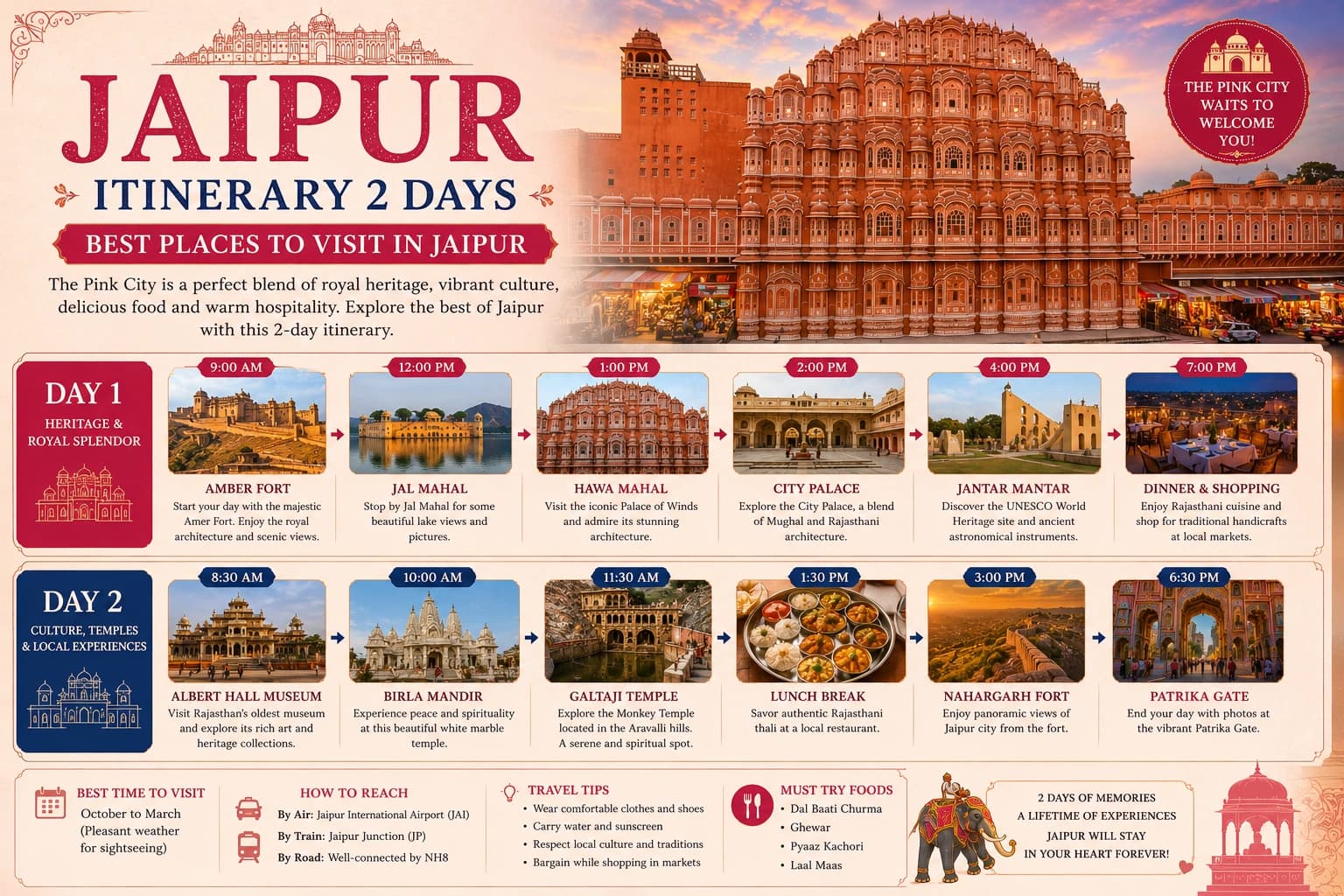
Jaipur - India’s first planned city and the crown jewel of Rajasthan - is a destination that lives up to every expectation. Known as the Pink City, its rose-hued walls and sandstone forts have drawn travellers from across the world for centuries. Whether you are a history enthusiast, a culture lover, a foodie, or simply someone craving a royal escape, Jaipur delivers on all fronts.
The best news? You don’t need weeks to experience the magic. A well-planned Jaipur itinerary for 2 days is enough to visit the most iconic Jaipur tourist places - from UNESCO World Heritage Sites and magnificent Rajput forts to vibrant bazaars and soulful cultural evenings.
In this guide by The Jaipur Vista - a local Jaipur travel resource - we share a practical, insider-crafted Jaipur itinerary 2 days covering the very best places to visit in Jaipur. Every recommendation includes opening hours, entry fees, distances, and local tips so you can travel smart and slow.
Jaipur is compact, well-connected, and incredibly rewarding. Most of the top Jaipur places to visit are within 20–25 km of the city centre, and the roads are wide and tourist-friendly. You can cover heritage forts in the morning, royal palaces by afternoon, and vibrant night bazaars in the evening - all in a single day.
Here’s what makes Jaipur ideal for short trips: the city has three UNESCO World Heritage Sites (Amber Fort, Jantar Mantar, and the Walled City of Jaipur), an extraordinary food culture rooted in Rajasthani tradition, and an artisan market scene unlike anywhere else in India. Two days here feel full, unhurried, and deeply memorable.
Here is a quick overview of the complete Jaipur itinerary for 2 days before we dive into each attraction in detail:
No Jaipur itinerary is complete without Amber Fort - arguably the most spectacular of all Jaipur tourist places. A UNESCO World Heritage Site, this 16th-century Rajput masterpiece rises dramatically over Maota Lake, its yellow and pink sandstone walls glowing magnificently in the morning light.
Built by Raja Man Singh I and expanded over generations, Amber Fort is a breathtaking blend of Rajput and Mughal architecture. The scale is extraordinary - its grand courtyards, ornate palaces, and towering gateways feel like stepping directly into Rajasthan’s royal past.
DON’T MISS INSIDE AMBER FORT
Sheesh Mahal (Mirror Palace): Thousands of tiny mirrors that reflect a single candle flame into a galaxy of light
Ganesh Pol: The most elaborately painted gateway in Jaipur, dedicated to Lord Ganesha
Diwan-i-Aam: The Hall of Public Audience with a stunning colonnaded hall
Underground Tunnels: Secret passages connecting Amber Fort to Jaigarh Fort on the hill above
Evening Sound & Light Show: A 50-minute narrated history of Jaipur projected onto the fort walls
VISITOR INFORMATION
Perched atop the Cheel ka Teela (Hill of Eagles), Jaigarh Fort sits just 800 metres above Amber Fort and is best visited immediately after. Built in 1726 by Sawai Jai Singh II, this massive military fort served as the primary defence structure for the Amber Palace complex below.
Jaigarh Fort is famous for housing the Jaivana Cannon - the world’s largest wheeled cannon ever built, weighing over 50 tonnes. The cannon is said to have been fired only once in its entire history. Beyond the cannon, the fort offers sweeping panoramic views of Amber Fort, Maota Lake, and the surrounding Aravalli Hills.
VISITOR INFORMATION
After lunch, head to City Palace Jaipur - one of the most culturally rich places to visit in Jaipur. Located in the heart of the walled city, this magnificent palace complex was built by Maharaja Sawai Jai Singh II in the early 18th century and is still home to the royal family of Jaipur.
The palace seamlessly blends Rajput, Mughal, and European architectural styles. The museum within the palace houses rare royal artefacts, weapons, and the world-famous pair of enormous silver urns - at 340 kg each, listed in the Guinness Book of World Records as the world’s largest silver objects.
HIGHLIGHTS INSIDE CITY PALACE
Mubarak Mahal: Royal textile museum displaying exquisite Pashmina, Sanganeri, and Mughal court costumes
Diwan-i-Khas: Hall of Private Audience, home to the two enormous solid silver water urns
Pritam Niwas Chowk: Four ornate gates representing each season, covered in peacock motifs
Chandra Mahal: Still a royal residence; lower floors open to visitors as a museum
Evening Light & Sound Show: Theatrical narration of Jaipur’s history projected onto the palace (₹200–₹500 per person)
VISITOR INFORMATION
Just steps from City Palace, Jantar Mantar is one of the most intellectually fascinating Jaipur tourist places - and another UNESCO World Heritage Site. Built between 1724 and 1730 by Maharaja Sawai Jai Singh II, this outdoor observatory features 19 massive stone instruments designed to measure time, predict eclipses, and track stars with the naked eye.
The most impressive instrument is the Samrat Yantra - a 27-metre-tall sundial that can tell the time to an accuracy of two seconds. Standing before these ancient stone structures, it’s astonishing to contemplate the level of scientific precision achieved over 300 years ago.
VISITOR INFORMATION
The Hawa Mahal is unquestionably the most photographed of all places to visit in Jaipur. Its extraordinary five-storey pink sandstone facade, with 953 intricately carved jharokhas (latticed windows), is the defining image of the Pink City.
Built in 1799 by Maharaja Sawai Pratap Singh, the palace was designed to allow royal women to observe street life and royal processions while remaining unseen from the street. The honeycombed lattice also creates a natural air-conditioning effect - the name literally means “Palace of Winds.”
Most people photograph Hawa Mahal from the street outside, but do enter and climb to the upper floors - the views over the old city through the delicate lattice windows are magical, and the interior honeycomb is just as photogenic as the famous exterior.
VISITOR INFORMATION
End Day 1 with an immersive evening in the bazaars of the walled city. As the sun begins to set, the old city’s lanes fill with the glow of shop lights, the scent of street food, and the hum of traders and tourists alike. This is Jaipur at its most vibrant.
Johari Bazaar (literally “jeweller’s market”) is the finest destination in India for traditional Rajasthani jewellery. Look for Kundan jewellery (gemstones set in gold foil), Meenakari work (coloured enamel on silver or gold), and polki diamond sets.
Bapu Bazaar is the place for textiles and souvenirs - Bandhani (tie-dye) and Leheriya (wave-patterned) sarees, hand-block-printed fabrics, camel leather mojris, and fragrant essential oils. Don’t forget to bargain; it’s expected and half the fun.
Begin Day 2 of your Jaipur itinerary for 2 days early, at the ethereal Jal Mahal. Rising like a mirage from the still waters of Man Sagar Lake, this five-storey Rajput palace - with only one storey visible above the water line - is one of the most strikingly beautiful Jaipur places to visit.
Built originally in 1699 and later renovated by Maharaja Jai Singh II, the palace served as a royal duck-hunting retreat. Today, while entry into the palace itself is not permitted, the lakeside promenade offers some of the most breathtaking photography in all of Jaipur - especially at sunrise when the palace reflects perfectly in the calm water against a backdrop of the Aravalli Hills.
VISITOR INFORMATION
Head next to the Albert Hall Museum in Ram Niwas Garden - the oldest museum in Rajasthan and one of the most underrated Jaipur tourist places. The building itself is a masterpiece: designed in the Indo-Saracenic architectural style and inaugurated in 1887, it blends Mughal, Gothic, and Hindu elements into a grand, ornate structure.
The museum collection spans from the Gupta period to the colonial era and includes miniature paintings, weapons, pottery, carpets, ivory works, and metal art. Its most talked-about exhibit is a genuine 2,300-year-old Egyptian mummy - a fascinating and unexpected treasure in the heart of Jaipur.
VISITOR INFORMATION
No Jaipur places to visit list is complete without Nahargarh Fort - a hilltop fortress that offers the finest panoramic views of the entire Pink City. Perched on the Aravalli Hills at an elevation of 700 metres, Nahargarh (“Abode of Tigers”) was built in 1734 by Maharaja Sawai Jai Singh II.
Nahargarh Fort also houses the Jaipur Wax Museum (India’s first wax museum) and the famous Padao rooftop café with arguably the best view in the city. The café is the perfect spot for a long lunch break before heading down for the afternoon.
VISITOR INFORMATION
As the afternoon cools into evening, visit Birla Mandir - also known as the Lakshmi Narayan Temple - for a peaceful, spiritually restorative pause. Built in 1988 by the B.M. Birla Foundation, this stunning white marble temple sits at the foot of Moti Doongri Hill and is one of the most beautiful modern temples in Rajasthan.
The temple is dedicated to Goddess Lakshmi and Lord Vishnu, and its pristine white marble structure is intricately carved with scenes from Hindu scriptures. In the evening, when the temple is lit up against the darkening sky, it achieves an almost otherworldly beauty.
VISITOR INFORMATION
End your 2-day Jaipur itinerary on the most spectacular note possible at Chokhi Dhani - a sprawling traditional Rajasthani village resort on the outskirts of Jaipur. The name translates to “Special Village,” and it truly earns that title.
What awaits is a full sensory immersion into Rajasthani culture: live folk music and Kalbelia dance performances, puppet shows, camel and elephant rides, mehndi (henna) artists, traditional games, and open-air cooking demonstrations.
The evening culminates with a traditional Rajasthani thali dinner served on clay plates and leaf bowls - an extraordinary spread of dal baati churma, gatte ki sabzi, ker sangri, bajre ki roti, and an array of chutneys and sweets. It’s one of the best meals you’ll have in Rajasthan.
VISITOR INFORMATION
A Jaipur itinerary without food is incomplete. The city’s culinary tradition is as royal and layered as its architecture. Here are the dishes that truly represent the taste of Jaipur:
October to March is ideal - cool, dry weather perfect for fort-hopping. Monsoon (July–September) is green and scenic. Avoid April–June: temperatures can hit 45°C+.
Hire an auto-rickshaw for the old city (negotiate rates upfront), use app-based cabs (Ola/Uber) for longer distances, or rent a bicycle for the walled city lanes.
Rajasthan Tourism offers a Composite Ticket covering Amber Fort, City Palace, Jantar Mantar, Hawa Mahal, Nahargarh Fort, and Albert Hall - it offers significant savings over buying individual tickets.
Comfortable, modest clothing is recommended - especially for temple visits. Wear walking shoes; fort surfaces are uneven. A light scarf is useful for sun protection and temple entry.
Carry water at all times, especially during fort visits. Use sunscreen generously. Eat at established restaurants to avoid stomach issues. Keep small change for entry fees and tips.
Yes, 2 days are sufficient to cover the major Jaipur tourist places if you follow a well-structured itinerary. You can comfortably visit Amber Fort, Jaigarh Fort, City Palace, Jantar Mantar, Hawa Mahal, the bazaars, Jal Mahal, Albert Hall Museum, Nahargarh Fort, Birla Mandir, and Chokhi Dhani over two days.
The must-see Jaipur tourist places are: Amber Fort, Hawa Mahal, City Palace Jaipur, Jantar Mantar (all UNESCO World Heritage Sites), Jal Mahal, Nahargarh Fort, Albert Hall Museum, and the bazaars of the old city. For cultural experience, Chokhi Dhani is unmissable.
October to March is the best time to visit Jaipur. The weather is cool and pleasant (15–28°C), ideal for sightseeing. Monsoon (July–September) is lush with fewer tourists. Summer (April–June) is very hot and best avoided.
Jaipur is approximately 270 km from Delhi. The most popular option is by train - the Shatabdi Express takes about 4.5 hours and is highly recommended. You can also travel by road via the Delhi-Jaipur Expressway (4–5 hours) or by air (Jaipur International Airport, approximately 1 hour from Delhi).
Jaipur is known as the “Pink City” because in 1876, Maharaja Sawai Ram Singh II ordered all buildings in the old city to be painted pink - the traditional colour of hospitality in Rajputana - to welcome the Prince of Wales, the future King Edward VII. The pink colour was later made mandatory for all buildings in the walled city, a tradition that continues to this day.