Famous Historical Monuments of India: Complete 2026 Guide (Entry Fees & History)
Author:Niharika
Published:June 19, 2026
Views:852
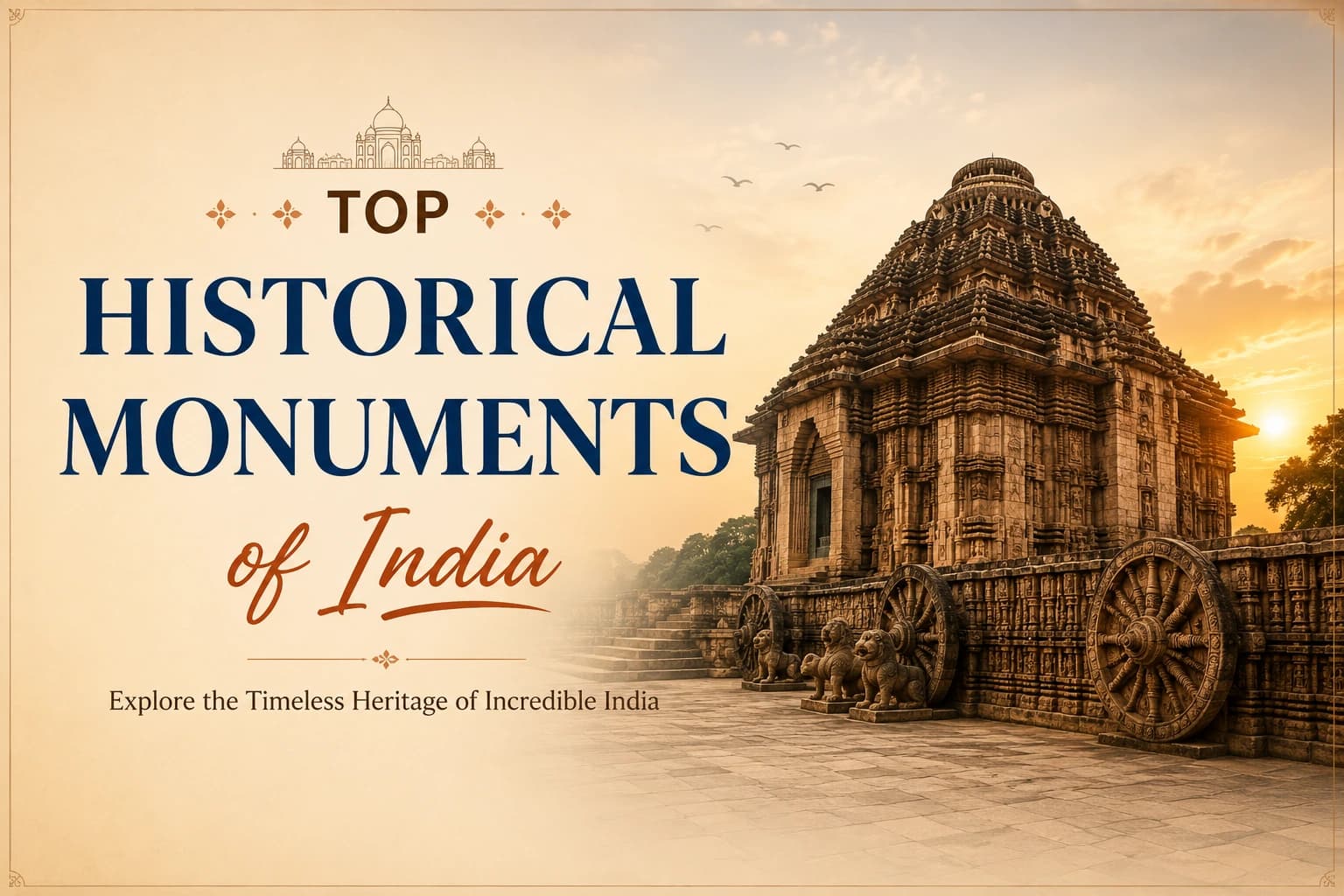
India isn't just a country - it's a 5,000-year-old open-air museum. Every state, almost every district, holds a piece of stone that has watched empires rise and fall. From the marble dome of the Taj Mahal to the rugged ramparts of Amber Fort right here in our own Rajasthan, the historical monuments of India tell a story that no textbook can fully capture.
If you're planning a heritage trip across the country - or simply trying to shortlist the famous monuments of India worth your time - this guide brings together everything in one place: history, architecture, entry fees, timings, and the practical details you'll actually need before you go.
We've organised this list region by region, the way a real itinerary would flow, so you can use it to plan an actual trip rather than just scroll past pretty pictures.
India is home to 43 UNESCO World Heritage Sites, and a majority of them are monuments - forts, tombs, temples, and palaces built by dynasties as varied as the Mughals, the Rajputs, the Cholas, and the British. These aren't just tourist attractions; they're physical records of how art, religion, science, and politics shaped the subcontinent over centuries.
What makes the monuments in India genuinely special is the sheer diversity of craftsmanship on display in one country - Indo-Islamic minarets in Delhi, Dravidian temple towers in Tamil Nadu, erotic stone carvings in Khajuraho, and pink sandstone havelis in Jaipur. Few countries can offer this range of architectural history within a single border.
Below, we've broken the list down region-wise so you can match monuments to your travel route.
North India holds the country's most internationally recognised monuments, largely thanks to the Mughal Empire's building spree across Delhi and Agra.
No list of famous monuments of India can begin anywhere else. The Taj Mahal was commissioned by Mughal Emperor Shah Jahan in 1632 as a mausoleum for his wife, Mumtaz Mahal, who died during childbirth. Built entirely of white marble inlaid with semi-precious stones, it took an estimated 20,000 artisans over two decades to complete.
The Taj is a UNESCO World Heritage Site and consistently ranks among the most visited monuments on Earth. Its perfectly symmetrical Charbagh garden, reflecting pool, and four minarets make it one of the finest examples of Mughal architecture anywhere in the world.
Location: Agra, Uttar Pradesh
Entry Fee: ₹50 for Indian citizens, ₹1,100 for foreign tourists, with an additional ₹200 for entry into the main mausoleum chamber; children below 15 enter free
Timings: Open 6:00 AM to 7:00 PM, closed on Fridays
Best Time to Visit: October to March, ideally at sunrise
A massive red sandstone fortress built by Shah Jahan in 1648, the Red Fort (Lal Qila) served as the main residence of Mughal emperors for nearly 200 years. It's also where the Indian Prime Minister hoists the national flag and addresses the nation every Independence Day.
The fort's Diwan-i-Am (Hall of Public Audience) and Diwan-i-Khas (Hall of Private Audience) still showcase the intricate inlay work and marble lattice screens that once dazzled visiting dignitaries.
Location: Old Delhi
Entry Fee: Approx. ₹35 for Indians, ₹550 for foreign nationals
Timings: 9:30 AM to 4:30 PM, closed on Mondays
Architecture Style: Mughal, red sandstone
Standing at 72.5 metres, Qutub Minar is the tallest brick minaret in the world, built by Qutb-ud-din Aibak in 1199 AD and completed by his successors. It's one of the oldest and most iconic ancient monuments in India, marking the beginning of the Delhi Sultanate's architectural legacy.
The complex also houses the mysterious Iron Pillar, which has resisted rust for over 1,600 years, and the Quwwat-ul-Islam Mosque, one of the earliest mosques built in India.
Location: Mehrauli, Delhi
Entry Fee: ₹35–₹40 for Indians, ₹550 for foreigners; free for children under 15
Timings: 7:00 AM to 5:00 PM, open daily
Commissioned in 1565 by Humayun's widow, Hamida Banu Begum, this UNESCO World Heritage Site is widely considered the architectural blueprint for the Taj Mahal. Set within a Persian-style Charbagh garden, the tomb's red sandstone façade and high central dome influenced Mughal funerary architecture for the next 150 years.
Location: Nizamuddin East, Delhi
Entry Fee: Approx. ₹35 for Indians, ₹550 for foreigners
Originally a brick fort dating back to the 11th century, Agra Fort was rebuilt in red sandstone by Emperor Akbar starting in 1565. It served as the main residence of Mughal emperors until 1638, and it was here that Shah Jahan was imprisoned by his own son Aurangzeb, reportedly spending his final years gazing at the Taj Mahal from a marble balcony.
Location: Agra, Uttar Pradesh
Entry Fee: Approx. ₹40 for Indians, ₹650 for foreigners
Built by Akbar in 1571 as a tribute to Sufi saint Salim Chishti, Fatehpur Sikri served as the Mughal capital for about a decade before being abandoned, largely due to water shortages. Today, it stands remarkably preserved - a ghost capital of red sandstone palaces, courtyards, and the stunning Buland Darwaza, one of the tallest gateways in the world.
Location: Near Agra, Uttar Pradesh
Entry Fee: Approx. ₹40 for Indians, ₹600 for foreigners
The holiest shrine of Sikhism, the Golden Temple sits at the centre of the Amrit Sarovar (Pool of Nectar) and is covered in gold-plated copper sheets. Built in the late 16th century under the guidance of Guru Arjan, it remains one of the most visited religious monuments in the world, serving free meals (langar) to over 100,000 visitors daily regardless of faith.
Location: Amritsar, Punjab
Entry Fee: Free for all visitors
Commissioned by Shah Jahan and completed in 1656, Jama Masjid is one of the largest mosques in India, with a courtyard that can hold over 25,000 worshippers. Its red sandstone and white marble façade, along with the three massive domes, make it a defining landmark of Old Delhi.
Location: Old Delhi
Entry Fee: Free; camera fee applicable
No guide on monuments in India from a Jaipur-based publication would be complete without giving Rajasthan's forts and palaces the space they deserve. This is the land of the Rajputs, and its monuments reflect centuries of warfare, royal patronage, and some of the most ornate architecture on the subcontinent.
Built in 1592 by Raja Man Singh I on the Kachhwaha dynasty's old capital, Amber Fort sits on a hill overlooking Maota Lake, about 11 km from Jaipur's city centre. The primary attractions inside the fort complex include the Diwan-e-Aam, Diwan-e-Khas, Ganesh Pol, Jaleb Chowk, Sheesh Mahal, and the Sila Devi Temple, the last housing a goddess idol believed to have been brought from Bengal.
The Sheesh Mahal (Mirror Palace) is the undisputed highlight - its walls and ceilings are covered with thousands of convex mirror fragments that, legend has it, could illuminate an entire room with the light of a single candle.
Location: Amer, about 11 km from Jaipur
Entry Fee: Approx. ₹100 for Indians, ₹500 for foreign tourists; light & sound show tickets sold separately
Timings: 8:00 AM to 5:30 PM daily, with the last entry 30 minutes before closing
Pro Tip: Visit at opening time to avoid both the heat and the tour-bus crowds that arrive by mid-morning
The "Palace of Winds" is Jaipur's most photographed monument - a five-storey pink sandstone façade with 953 intricately carved jharokha windows. Built in 1799 by Maharaja Sawai Pratap Singh, the palace was designed in the shape of a crown to honour Lord Krishna, and its perforated screens were originally built so royal women could observe street life and festivals without being seen themselves.
Location: Badi Choupad, Pink City, Jaipur
Entry Fee: Approx. ₹50 for Indians, ₹200 for foreigners
Timings: 9:00 AM to 5:00 PM
A sprawling complex of courtyards, gardens, and buildings that blends Rajput, Mughal, and European architectural styles, the City Palace was built by Maharaja Sawai Jai Singh II, the founder of Jaipur, starting in 1727. Part of the palace is still home to the former royal family, while the rest functions as a museum housing royal costumes, weaponry, and manuscripts.
Location: Pink City, Jaipur
Entry Fee: Varies by ticket category (Indian/foreigner/composite)
Built by Sawai Jai Singh II in the 1730s, this astronomical observatory houses the world's largest stone sundial along with a collection of nineteen instruments used to track celestial bodies, predict eclipses, and measure time with astonishing accuracy for the period. It's a UNESCO World Heritage Site and one of five such observatories Jai Singh built across India.
Location: Near City Palace, Jaipur
Entry Fee: Included in the Jaipur composite ticket
Perched on the Aravalli hills overlooking Jaipur, Nahargarh Fort was built in 1734 primarily as a defence structure and later expanded into a retreat for the royal family. Today, it's best known for its sunset views over the Pink City and its quirky Madhavendra Bhawan, with identical suites built for each of the king's queens.
Location: Aravalli Hills, Jaipur
Entry Fee: Approx. ₹50 for Indians, ₹200 for foreigners
Built in 1726 by Sawai Jai Singh II, Jaigarh Fort sits above Amber Fort and once served as the treasury and weapons store of the Jaipur royals. It's home to the Jaivana cannon - believed to be the largest cannon on wheels in the world - and offers sweeping views of the Aravalli range.
Location: Above Amber Fort, Jaipur
Entry Fee: Approx. ₹50 for Indians, ₹200 for foreigners
Money-saving tip: If you're visiting multiple monuments in Jaipur, the Jaipur Composite Ticket covers Amber Fort, Jantar Mantar, Hawa Mahal, Albert Hall Museum, Nahargarh Fort, and Isarlat over two consecutive days - usually working out cheaper than buying individual tickets at each gate.
Built in the 13th century by King Narasimhadeva I, the Konark Sun Temple is designed in the shape of a colossal stone chariot, complete with 24 intricately carved wheels and seven horses representing the days of the week. Often called the Black Pagoda, it's one of the finest examples of Odisha's temple architecture and a UNESCO World Heritage Site.
Location: Konark, Odisha
Entry Fee: Approx. ₹40 for Indians, ₹600 for foreigners
Built between 950 and 1050 AD by the Chandela dynasty, the Khajuraho temples are renowned worldwide for their sandstone carvings, which range from deeply spiritual iconography to the famous erotic sculptures inspired by Tantric philosophy. Of the original 85 temples, only around 25 survive today, but they remain among the most studied ancient monuments in India.
Location: Khajuraho, Madhya Pradesh
Entry Fee: Approx. ₹40 for Indians, ₹600 for foreigners
Commissioned by Emperor Ashoka in the 3rd century BC, the Sanchi Stupa is among the oldest stone structures in India and a key Buddhist pilgrimage site. The Great Stupa, with its carved gateways (toranas) depicting scenes from Buddha's life, is the centrepiece of this UNESCO-listed complex.
Location: Sanchi, Madhya Pradesh
Entry Fee: Approx. ₹40 for Indians, ₹600 for foreigners
Built between 1906 and 1921 to commemorate Queen Victoria's reign, the Victoria Memorial is a white marble building combining British and Mughal architectural elements. The 16-foot bronze Angel of Victory statue atop the dome and the memorial's illuminated night-time appearance make it one of Kolkata's most recognisable landmarks.
Location: Kolkata, West Bengal
Entry Fee: Approx. ₹30 for Indians, ₹500 for foreigners
Built by the British in 1924 to commemorate the visit of King George V and Queen Mary, the Gateway of India combines Indo-Saracenic architecture with Islamic and Hindu design elements. Overlooking the Arabian Sea at Apollo Bunder, it's now Mumbai's most photographed monument and a popular departure point for boats to Elephanta Island.
Location: Apollo Bunder, Mumbai
Entry Fee: Free
Often called the "Mini Taj Mahal," Bibi Ka Maqbara was built by Aurangzeb's son, Prince Azam Khan, as a mausoleum for his mother, Rabia-ud-Daurani. While it deliberately echoes the Taj Mahal's design, the structure uses far less marble and far more plaster, reflecting the declining Mughal treasury of the late 17th century.
Location: Aurangabad, Maharashtra
Entry Fee: Approx. ₹25 for Indians, ₹300 for foreigners
At 182 metres, the Statue of Unity is the tallest statue in the world, built to honour Sardar Vallabhbhai Patel, India's first Deputy Prime Minister and the architect of India's political unification. While modern, it has quickly become one of the most-visited monuments in the country.
Location: Kevadia, Gujarat
Entry Fee: Approx. ₹150 for Indians (viewing gallery extra)
Built in 1591 by Muhammad Quli Qutb Shah, Charminar ("Four Minarets") marks the centre of Hyderabad and is surrounded by bustling bazaars famous for pearls and bangles. Constructed from granite and lime mortar, it remains the city's most enduring symbol.
Location: Hyderabad, Telangana
Entry Fee: Approx. ₹25 for Indians, ₹300 for foreigners
Completed in the 17th century, Golconda Fort was once the stronghold of the Qutub Shahi dynasty and is famous for an acoustic system so precise that a clap at the entrance gate can be heard at the highest pavilion nearly a kilometre away. The fort was also historically associated with the diamond trade, including stones believed to be the source of the Koh-i-Noor.
Location: Hyderabad, Telangana
Entry Fee: Approx. ₹25 for Indians, ₹300 for foreigners
Once the capital of the wealthy Vijayanagara Empire, Hampi is now a UNESCO World Heritage Site scattered with temple ruins, royal enclosures, and boulder-strewn landscapes. The Virupaksha Temple and the iconic stone chariot at Vittala Temple are among the most photographed ancient monuments in India, and most of the major ruins can be covered in a single, if long, day.
Location: Hampi, Karnataka
Entry Fee: Approx. ₹40 for Indians, ₹600 for foreigners (Vittala Temple complex)
Completed in 1605, the Basilica of Bom Jesus is the most significant Roman Catholic structure in India and holds the mortal remains of St. Francis Xavier, Goa's patron saint. Built in Baroque style, it's the only church in Goa whose exterior was never plastered, giving it a distinctly raw, historic façade.
Location: Old Goa
Entry Fee: Free
Also read: Top Historical Places in Jaipur
Entry fees are approximate and subject to revision by the Archaeological Survey of India (ASI) and respective state tourism boards. Always confirm current rates on the official ASI ticketing portal before your visit.
Most of India's iconic monuments - the Taj Mahal, Amber Fort, Hawa Mahal, Qutub Minar - are outdoor or semi-outdoor sites, which makes weather a real factor in trip planning.
October to March: The ideal window for almost the entire country. Daytime temperatures are comfortable across North and West India, making it the best season for fort-hopping in Rajasthan, walking through Hampi's ruins, or exploring Delhi's monuments on foot.
April to June: Punishingly hot across Rajasthan and North India, with Agra and Jaipur regularly crossing 40°C. If you must travel in summer, plan visits for early morning or just before sunset.
July to September: Monsoon season. Monuments in Goa, Kerala, and parts of Central India look stunning against the greenery, though humidity and rain can disrupt outdoor sightseeing in the north.
For most monuments, arriving right at opening time isn't just about beating the heat - it's also when you'll get the best light for photographs and the smallest crowds before tour groups arrive.
Tips for Visiting Historical Monuments in India
Book tickets online where possible. ASI-protected monuments like the Taj Mahal, Qutub Minar, and Red Fort all offer online ticketing, which saves significant time at the gate.
Carry a valid photo ID. Most ticket counters and security checks ask for identification, especially at high-security monuments like the Taj Mahal.
Dress modestly at religious sites. The Golden Temple, Jama Masjid, and various temples expect visitors to cover their heads or remove footwear.
Check the weekly closure day. Many ASI monuments close on specific weekdays - the Taj Mahal on Fridays, the Red Fort on Mondays - so confirm before you plan your route.
Hire a local guide for context. A good guide can turn a fort visit from "nice architecture" into a genuinely memorable history lesson - particularly useful at sprawling sites like Amber Fort or Fatehpur Sikri.
Use composite tickets in Jaipur. If you're covering multiple Jaipur monuments, the composite ticket bundling Amber Fort, Jantar Mantar, Hawa Mahal, Nahargarh Fort, and Albert Hall Museum is usually the most economical option.
Avoid peak midday hours. Between 11 AM and 3 PM, both heat and crowds peak at most outdoor monuments - plan your visit around this window wherever the itinerary allows.
The historical monuments of India are not a checklist to rush through - they're chapters of a much larger story that stretches from the Mauryan Empire to British colonial rule. Whether you're tracing Mughal history through Delhi and Agra, exploring Rajput forts around Jaipur, or wandering through the temple ruins of Hampi, each monument adds a different layer to how India's past comes together.
If your trip starts or passes through Rajasthan, The Jaipur Vista will keep bringing you detailed, on-ground guides to the Pink City's forts, palaces, and hidden heritage corners - so check back as we keep this list updated through 2026 and beyond.
Planning a Jaipur heritage trip? Explore our complete guides to Amber Fort, Hawa Mahal, and Jaipur's best monuments for detailed visitor information.
Which is the most famous historical monument in India?
The Taj Mahal in Agra is widely regarded as India's most famous historical monument and is one of the most recognised landmarks in the world, drawing millions of visitors annually.
How many UNESCO World Heritage monuments are there in India?
India has 43 UNESCO World Heritage Sites as of the latest count, a significant number of which are historical monuments such as the Taj Mahal, Qutub Minar, Humayun's Tomb, and the Hampi monuments.
What are the top 5 famous monuments of India?
While rankings vary, the Taj Mahal, Red Fort, Qutub Minar, Amber Fort, and Hampi's monuments are consistently cited among the most visited and historically significant monuments in India.
Which city in India has the most historical monuments?
Delhi is often considered India's monument capital, home to the Red Fort, Qutub Minar, Humayun's Tomb, Jama Masjid, Purana Qila, and several other ASI-protected sites within city limits.
Is Jaipur known for its historical monuments?
Yes. Jaipur, the "Pink City," is home to some of India's most visited monuments, including Amber Fort, Hawa Mahal, City Palace, Jantar Mantar, and Nahargarh Fort, most built during the reign of Sawai Jai Singh II in the 18th century.
Are entry fees different for Indians and foreign tourists?
Yes. Nearly all ASI-protected and state-run monuments in India charge a lower entry fee for Indian and SAARC/BIMSTEC nationals compared to other foreign tourists. Children, typically under 15, often enter free at most sites.
Can I take photographs inside Indian monuments?
Standard photography is usually permitted at most monuments without an extra charge, though commercial photography (such as pre-wedding shoots) typically requires prior written permission from the ASI or relevant state authority, often for an additional fee.