Top 10 Historical Places in Jaipur – A Complete Travel Guide 2026
Author:Niharika
Published:May 5, 2026
Views:933
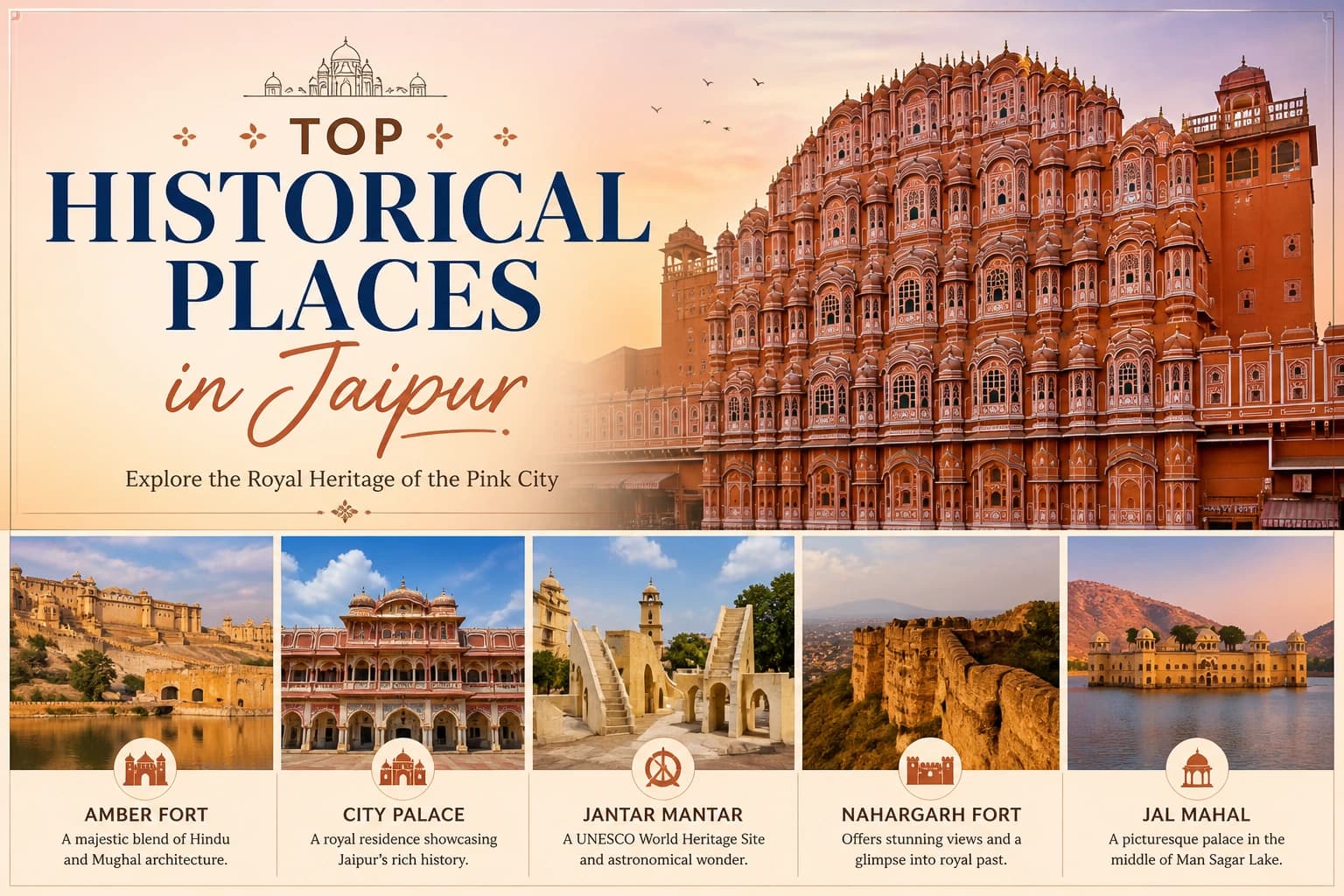
Jaipur, the Pink City of India, is one of the most magnificent destinations in all of South Asia. Capital of Rajasthan, this royal city was founded in 1727 by Maharaja Sawai Jai Singh II — and every corner of it tells a story centuries in the making. Whether you're a history buff, a photography enthusiast, or simply a curious traveller, the historical places in Jaipur will leave you breathless.
From UNESCO-listed walled city lanes to towering hill forts and shimmering lake palaces, the famous monuments of Jaipur represent an unmatched blend of Rajput bravery, Mughal elegance, and artistic brilliance. This Jaipur historical places list covers all the iconic forts, palaces, and lesser-known heritage gems — everything you need for the perfect Jaipur travel guide 2026.
If you're specifically looking for forts in Jaipur, three stand out as the most historically significant and easiest to combine in a single day:
Amber Fort (Amer Fort): The primary Rajput stronghold and most-visited Jaipur fort, known for the Sheesh Mahal.
Jaigarh Fort: The military fort connected to Amber via an underground passage, home to the world's largest cannon on wheels.
Nahargarh Fort: The hilltop retreat fort famous for sunset views over the city.
Together, these three Jaipur forts can be covered in one day using the Jaipur Composite Tourist Ticket (details below).
No Jaipur tourist places list is complete without Hawa Mahal. Built in 1799 by Maharaja Sawai Pratap Singh, this iconic five-storey façade is one of the most photographed structures in all of India. Its 953 small windows — called jharokhas — were designed to allow royal women to observe street life and festivals below without being seen, in keeping with the purdah tradition.
Constructed in red and pink sandstone in the shape of Lord Krishna's crown, Hawa Mahal is a masterpiece of Rajput architecture and one of the most recognisable historical monuments of Jaipur. The latticed screens allow cool breezes to flow through even in peak summer — earning it the name "Palace of Winds." A small museum inside the palace houses miniature paintings, armour, and ceremonial objects.
Perched dramatically on the Aravalli hills overlooking Maota Lake, Amber Fort (also spelled Amer Fort) is arguably the finest example of Jaipur heritage sites. A UNESCO World Heritage Site since 2013 as part of the Hill Forts of Rajasthan, Amber Fort was the primary residence of the Rajput Maharajas for nearly 150 years.
The fort is a stunning amalgamation of Hindu Rajput and Islamic Mughal architectural styles. Its highlight, the Sheesh Mahal (Mirror Palace), is adorned with thousands of tiny mirrors that illuminate like a sky full of stars when a single candle is lit. The Ganesh Pol gateway, richly painted with murals and mosaics, is another showstopper.
A traditional elephant ride to the fort gates remains one of the most iconic Jaipur sightseeing experiences, though jeep rides are also available. Don't miss the evening light-and-sound show that brings the fort's history to life.
Right in the heart of the old walled city lies the magnificent City Palace, a sprawling complex of courtyards, gardens, and palatial buildings. Built between 1729 and 1732 by Maharaja Sawai Jai Singh II, it remains a living palace — the royal family of Jaipur still resides in a portion of it.
The palace complex includes the Mubarak Mahal (Welcome Palace), Chandra Mahal, Diwan-i-Khas (Hall of Private Audience), and Diwan-i-Aam (Hall of Public Audience). The City Palace Museum houses one of the finest royal collections in Rajasthan, including ceremonial costumes, weapons, manuscripts, and the world's largest sterling silver vessels — the Gangajali urns — which once carried sacred Ganga water to England.
As one of the most visited Jaipur tourist attractions, the City Palace is a must for understanding how Rajput royalty lived, ruled, and celebrated art.
If you think UNESCO sites in Jaipur are limited to forts and palaces, Jantar Mantar will surprise you. Built between 1724 and 1735 by Maharaja Sawai Jai Singh II, this open-air astronomical observatory is one of the most extraordinary historical places in Jaipur Rajasthan.
Inscribed as a UNESCO World Heritage Site in 2010, Jantar Mantar houses 19 architectural astronomical instruments, including the world's largest sundial — the Samrat Yantra — which can measure local time accurate to within two seconds. The instruments were designed to observe astronomical positions with the naked eye and are still functional today.
Standing among these massive geometric structures is a surreal experience that connects you to the scientific genius of 18th-century India. It is a top-rated stop on any Jaipur sightseeing itinerary.
Overlooking the city from the rugged Aravalli ridge, Nahargarh Fort ("Abode of Tigers") was built in 1734 as a defensive retreat for Maharaja Sawai Jai Singh II. Unlike Amber and Jaigarh, Nahargarh was never attacked — it served primarily as a retreat and watch post.
What makes Nahargarh unique among forts and palaces in Jaipur is its extraordinary Madhavendra Bhawan — a complex of 12 identical royal suites, each designed for one of the Maharaja's queens, interconnected by a single corridor. The architectural symmetry and attention to royal comfort is remarkable.
Today, Nahargarh is equally famous for its panoramic views of Jaipur city — especially at sunset, when the city turns gold. It's a favourite spot for both tourists and locals and has also been a film shooting location for several Bollywood productions.
Connected to Amber Fort by an underground passage and sitting 400 metres above sea level, Jaigarh Fort is one of the most strategically significant Jaipur heritage sites. Built in 1726, the fort served primarily as a military stronghold and housed the royal cannon foundry.
Its biggest claim to fame is the Jaivana cannon — the world's largest cannon on wheels, with a barrel spanning 6.15 metres. Fired only once in history as a test, it reportedly shot a cannonball 35 km away. The fort also features a museum displaying artillery, armour, royal stamps, and old photographs of Jaipur's royal family.
Jaigarh is an essential stop on any Jaipur travel guide 2026 for those fascinated by military history and Rajput warfare strategy.
Rising serenely from the middle of Man Sagar Lake on the outskirts of Jaipur, Jal Mahal ("Water Palace") is one of the most visually stunning Jaipur tourist attractions. Built in the 18th century by Maharaja Madho Singh I in the Rajput style, the five-storey palace has four floors submerged underwater — only the top floor is visible above the lake surface.
While the palace interiors are currently not open to the public, the view from the lakeside promenade is absolutely mesmerising — especially during sunrise and sunset, when the palace reflects on the calm waters. The surrounding Nahargarh Wildlife Sanctuary adds to the peaceful atmosphere, making this one of the most photographed spots among all historical places in Jaipur.
The lake is also home to a variety of migratory birds, making it a hidden birdwatching gem.
Inaugurated in 1887 and named after King Edward VII (then Prince of Wales, Albert Edward), the Albert Hall Museum is the oldest museum in Rajasthan and one of the finest examples of Indo-Saracenic architecture. Located in Ram Niwas Garden at the heart of Jaipur, it was designed by Sir Samuel Swinton Jacob.
The museum's stunning exterior — with arched corridors, carved pillars, and intricate jali screens — is as much an attraction as its contents. Inside, the collection spans Egyptian mummies, Persian carpets, Rajasthani miniature paintings, ancient pottery, ivory artefacts, natural history exhibits, and elaborate musical instruments.
For history and art lovers, Albert Hall is an unmissable entry on any Jaipur tourist places list. The museum is also dramatically illuminated at night, drawing visitors for an evening stroll through its gardens.
Tucked away near Nahargarh Fort, Gaitore Ki Chhatriyan is one of Jaipur's most serene and underrated historical places in Jaipur Rajasthan. This is the royal cremation ground — and resting place — of Jaipur's Kachhwaha rulers, marked by ornate marble and sandstone chhatris (cenotaphs).
The most magnificent of these is the cenotaph of Maharaja Sawai Jai Singh II, the city's founder, featuring intricately carved peacocks, celestial figures, and floral motifs on white marble. Each chhatri is a monument of mourning and memory, representing the life and reign of a different ruler.
Despite being one of the most architecturally rich famous monuments in Jaipur, Gaitore remains blissfully uncrowded — making it a peaceful alternative to Jaipur's busier attractions.
Built in 1728 by Maharaja Sawai Jai Singh II for his Sisodia queen from Udaipur, Sisodia Rani Garden is Jaipur's most romantic and lushly decorated royal garden. Located 8 km from the city centre on the Agra road, it features terraced gardens, cascading fountains, painted pavilions, and murals depicting the eternal love story of Radha and Krishna.
The garden is laid out on multiple levels with symmetrical flowerbeds, water channels, and carved arches — creating a beautiful fusion of Rajput and Mughal garden design. The wall paintings are extraordinarily vivid, telling mythological tales through detailed brushwork that has survived centuries.
Located on Moti Dungari Hill, Birla Mandir is one of the famous monuments of Jaipur — though primarily a temple rather than a historic fort or palace, it draws massive visitor footfall and is often included on every Jaipur tourist places list. Built entirely in white marble, the temple is dedicated to Lord Vishnu (Narayan) and Goddess Lakshmi, and is known for its modern yet elegant architecture and stained-glass depictions of mythological scenes.
Just a kilometre from Amber Fort, Panna Meena Ka Kund is a 16th-century stepwell that most visitors zip past on their way to the fort — but it's one of the most photogenic and lesser-known historical places in Jaipur. The symmetrical geometric staircases descending into the well create a stunning visual pattern, especially in soft morning or evening light. While you cannot walk down the steps, the surrounding viewing platforms offer excellent photo opportunities.
Around 10 km east of the city, Galtaji is a revered Hindu pilgrimage site built around a series of natural springs and ancient temples nestled in a narrow gorge of the Aravalli hills. Known popularly as the "Monkey Temple" for its resident troops of macaques, Galtaji combines spirituality, nature, and history in one of Jaipur's most atmospheric historical places.
Originally built in 1835 and later transformed into one of India's most luxurious heritage hotels, Rambagh Palace was once the residence of the Maharaja of Jaipur. While primarily a functioning 5-star hotel today, its manicured gardens, royal architecture, and museum-like interiors make it one of the most treasured historical places in Jaipur that doubles as a luxury experience — perfect for a heritage high tea or fine-dining visit even if you're not staying overnight.
Before you set out to explore these incredible Jaipur tourist attractions, keep these practical tips in mind:
Best Time to Visit Jaipur: October to March offers the most pleasant weather for sightseeing.
Composite Ticket: Purchase the Jaipur Composite Tourist Ticket (valid 1 or 2 days) — it covers Amber Fort, Nahargarh, Jaigarh, Jantar Mantar, Albert Hall, and more at a discounted bundled price.
Getting Around: Auto-rickshaws, cycle-rickshaws, and app-based cabs are easily available. Hire a local guide for enriched historical sites context.
Dress Code: Dress modestly, especially when visiting temples and religious monuments within fort and palace complexes.
Photography: Most monuments allow photography but check for restricted zones — particularly in private palace sections and museum galleries.
The historical places in Jaipur represent centuries of ambition, artistry, and royal grandeur. From the astronomical genius of Jantar Mantar to the military might of Jaigarh Fort, and from the fairy-tale charm of Jal Mahal to the devotional beauty of Sisodia Rani Garden, every site on this Jaipur historical places list offers a unique window into one of India's greatest kingdoms.
Whether this is your first visit or your fifth, Jaipur's heritage never ceases to amaze. Start planning your trip today — the Pink City is waiting to write its next chapter with you.
Jaipur has dozens of historical sites, but the most visited include 10-14 major monuments — covering forts (Amber, Jaigarh, Nahargarh), palaces (City Palace, Jal Mahal, Rambagh), and landmarks (Hawa Mahal, Jantar Mantar, Albert Hall). Amber Fort is the oldest major monument, with construction beginning in the late 16th century — well before Jaipur city itself was founded in 1727. Amber Fort (Amer Fort) is the most famous and most-visited fort in Jaipur, followed by Nahargarh Fort and Jaigarh Fort. October to March offers pleasant weather. Early mornings (8-10 AM) are best for forts and palaces to avoid crowds and heat. Amber Fort, Jaigarh Fort, and Nahargarh Fort can realistically be covered in one day. City Palace, Jantar Mantar, and Hawa Mahal (all close together) can be combined into a second day. Most monuments charge a nominal entry fee (₹30-₹200 for Indians, higher for foreign nationals). Jal Mahal, Panna Meena Ka Kund, and Galtaji are free to visit.1. How many historical places are there in Jaipur?
2. Which is the oldest historical monument in Jaipur?
3. What is the most famous fort in Jaipur?
4. What is the best time to visit historical places in Jaipur?
5. Can I cover all major Jaipur monuments in one day?
6. Is there an entry fee for Jaipur's historical places?