Hathni Kund Waterfall Jaipur – The Complete Guide to Jaipur's Best Hidden Waterfall (2026)
Author:Niharika
Published:June 1, 2026
Views:1551
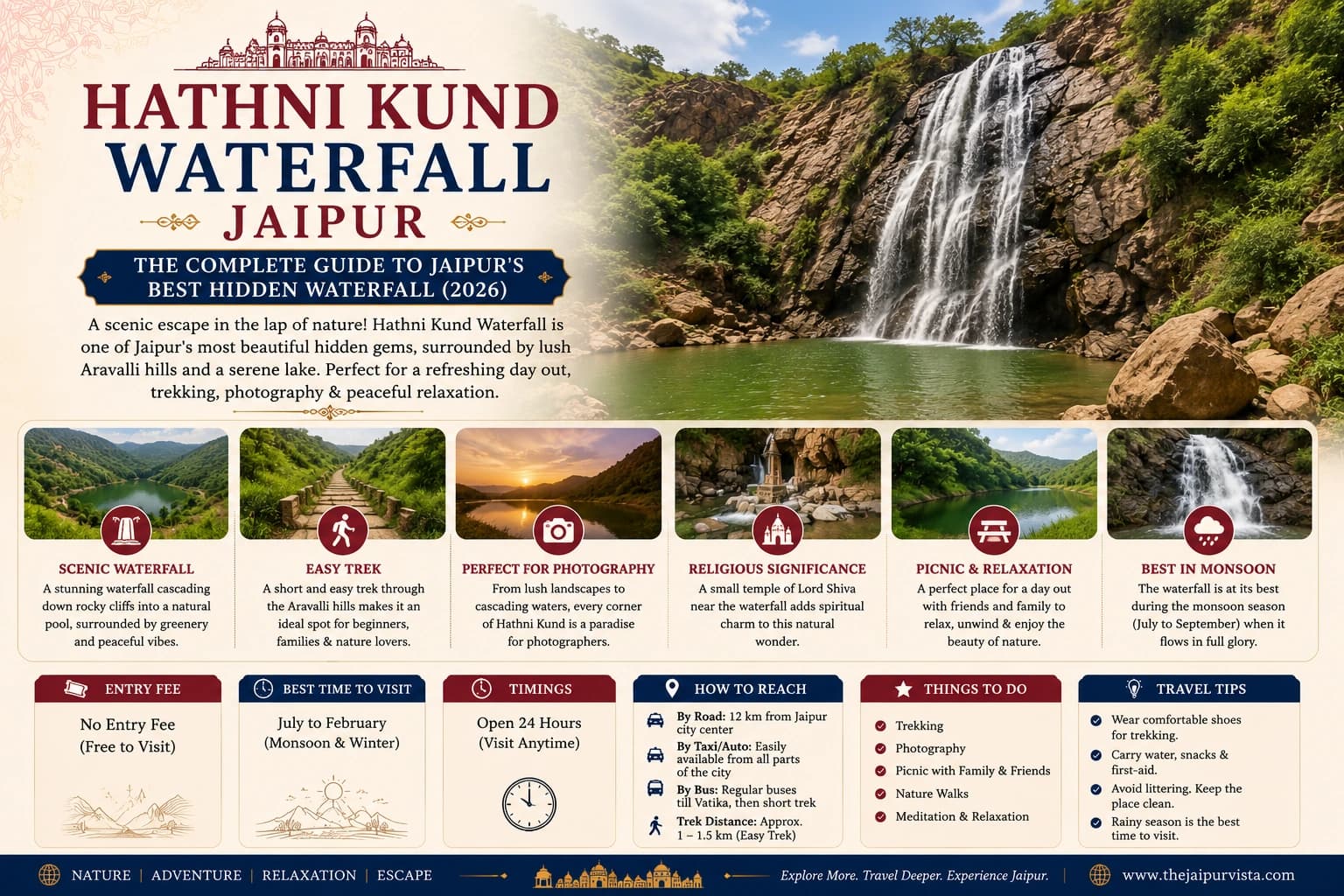
Most visitors come to Jaipur for its forts and palaces. They photograph Hawa Mahal, climb Nahargarh, walk through the bazaars of the old walled city - and they leave having seen a beautiful, historic city. But there is another Jaipur, one that very few tourists ever discover: a Jaipur of forested Aravalli ridges, ancient stream beds, hidden temples, and yes - a genuinely spectacular waterfall. That waterfall is Hathni Kund. Tucked into the Aravalli hills approximately 17 kilometres from Jaipur's city centre, Hathni Kund is the most rewarding natural escape in the entire Pink City region. Every monsoon season, thousands of Jaipurites make the trek to this elephant pond and its cascading waterfall - yet it remains almost entirely unknown to tourists. If you are in Jaipur between July and October, Hathnikund Jaipur belongs at the very top of your itinerary. This is the most complete, most detailed guide to Hathni Kund Jaipur that exists anywhere on the internet - written by locals who have made this trek many times and know every detail worth knowing. Hathni Kund is a natural water pond and seasonal waterfall situated in the Aravalli mountain range on the northern outskirts of Jaipur, Rajasthan. The name Hathni Kund translates directly from Hindi as elephant pond - hathni meaning female elephant, kund meaning pond or reservoir. The name is believed to refer to the size and depth of the natural pool that forms at the base of the waterfall during the monsoon season, said to be large and deep enough to bathe an elephant. Hathni Kund is also locally referred to as Hathuni Kund, and both spellings are in common use across Jaipur. The waterfall in Jaipur that forms here during the monsoon season is considered the most beautiful natural waterfall within the city's immediate vicinity, making it the go-to destination for adventure lovers, nature seekers, families, and photography enthusiasts from across Rajasthan every year between July and October. Beyond its natural beauty, Hathni Kund holds deep significance as the believed source of the Dravyawati River - the ancient river that flows through the heart of Jaipur. This connection to the city's own river gives the kund a mythological and geographical importance that transcends its statu Adjacent to the kund are two temples - the Hathuneshwar Mahadev Temple dedicated to Lord Shiva, and a Hanuman Temple - making this a site of both natural and spiritual pilgrimage for local devotees. Local tradition and geographical surveys both support the belief that Hathni Kund is the primary source of the Dravyawati River, one of the oldest rivers associated with the city of Jaipur. The Dravyawati - also known historically as Amanishah Nala - originates in the Aravalli hills and once flowed freely through Jaipur before urbanisation confined it to an increasingly channelised course. Today, a major river rejuvenation project along the Dravyawati has sought to restore this waterway to its former importance in the city's ecological and urban landscape. The spring that feeds Hathni Kund and, by extension, the Dravyawati, is fed by the Aravalli hill catchment area - one of the oldest mountain ranges on earth, predating even the Himalayas. The aquifer system of these ancient hills collects monsoon rainfall and releases it slowly through the year, which is why Hathni Kund holds water even after the rains have passed, though the waterfall itself is a purely seasonal monsoon feature. The Hathni Kund as it exists today is partly shaped by a historical catastrophe. Local accounts record that Raja Sawai Madho Singh II had a dam constructed in the Aravalli foothills near this location - a water management structure designed to capture and store monsoon rainfall for the benefit of the surrounding communities. In 1982, an exceptionally severe monsoon caused catastrophic flooding in Rajasthan, and this dam was breached and ultimately destroyed by floodwaters of extraordinary volume. The destruction of the dam dramatically altered the local topography. The natural bowl and catchment area that had been reinforced by the dam's structure was reshaped by the floods, and over the following years, the landscape settled into the natural configuration that visitors experience today - the rocky gorge, the cascading waterfall, and the deep natural pool at its base. This historical dimension makes Hathni Kund not just a natural destination but a place where the complex relationship between Jaipur's rulers, its people, and the monsoon's unpredictable power is written into the landscape itself. The Hathuneshwar Mahadev Temple at Hathni Kund is a Shiva temple of considerable local significance. In Hindu tradition, shiva lingas and Shiva temples located near natural water sources - springs, rivers, waterfalls, and tanks - are particularly sacred, as water and Shiva are intimately connected in religious symbolism. The natural spring and waterfall at Hathni Kund make it an especially appropriate location for a Shiva temple, and local devotees visit throughout the year, not just during the monsoon season. The Hanuman temple at the site is associated with the Charan Mandir - a historic temple complex at the base of the trail - which is believed to be 400 to 500 years old, making it one of the oldest religious sites in this part of the Jaipur region. The name Charan Mandir refers to the sacred footprint (charan) of the deity, and such temples are traditionally associated with locations where divine presence was believed to have been physically manifested. For roughly eight months of the year, Hathni Kund is a serene, relatively dry rocky gorge with a natural pool fed by the hillside spring. Beautiful, peaceful, and worth visiting for the trekking experience and the temples - but not extraordinary. Then the monsoon arrives. From late June through September, the Aravalli hills receive the rainfall carried in from the Bay of Bengal by the southwest monsoon. As the hills absorb this water and the rocky catchment fills, streams begin to flow, the spring at Hathni Kund swells dramatically, and the waterfall in Jaipur comes spectacularly to life. Water cascades down the rocky face of the gorge, filling the natural kund below with clear, fresh monsoon water. The surrounding hillsides, typically dry and dust-coloured, transform into vivid green. Wildflowers appear along the trail. Birds call from the dense scrub. The air smells of wet earth, rain, and stone. This transformation is precisely why Hathni Kund Jaipur draws such large numbers of visitors during the monsoon. In a city - and a state - defined by its aridity, the sight and sound of flowing water in the middle of the Aravalli hills is genuinely extraordinary. Jaipur residents who have grown up visiting this place every monsoon will tell you that the emotional impact of the waterfall - the sound, the mist, the cold water on hot skin after a sweaty trek - never diminishes with familiarity. The natural pool (kund) at the base of the waterfall is the destination. During a good monsoon, it is deep enough for swimming - and local young men do swim and even dive here, though we would encourage visitors to exercise caution given the rocky underwater terrain and variable depth depending on rainfall. The water is cold and refreshing, and many trekkers cool their feet in the shallower areas around the edges even if they don't swim. The pool is surrounded on multiple sides by large rocks and boulders, many of which are smoothed by centuries of water flow. These rocks serve as natural seating areas for picnickers and provide excellent vantage points for photography of the waterfall. Hathni Kund distance from key Jaipur landmarks: The Hathni Kund distance by road takes you through the northern part of Jaipur city towards the Aravalli foothills. The final stretch beyond Vidhyadhar Nagar transitions from urban roads to narrower lanes leading to the Charan Mandir trailhead. The most practical way to reach Hathni Kund is by private vehicle - your own car, a hired taxi, or a cab booked through Ola or Uber. The route is straightforward: From central Jaipur, take the Sikar Road or Ajmer Road towards Vidhyadhar Nagar. From Vidhyadhar Nagar, navigate towards the Aravalli foothills following local signs or GPS directions to Charan Mandir. Parking is available in the open areas near Charan Mandir, from where the trek to Hathni Kund begins. GPS Coordinates for Charan Mandir (Trek Starting Point): 26.9523° N, 75.8219° E (Use "Charan Mandir Jaipur" on Google Maps for directions.) From central Jaipur or Vidhyadhar Nagar, auto-rickshaws can take you to the Charan Mandir area, though drivers may not know the specific trailhead. Show them "Hathni Kund Jaipur" on Google Maps to confirm the drop-off point. RSRTC and city buses run along the Sikar Road corridor towards Vidhyadhar Nagar. From there, local transport (auto-rickshaw) covers the remaining distance to Charan Mandir. Public bus is feasible but adds complexity; a direct cab is significantly easier. Many Jaipur locals visit Hathnikund Jaipur on motorcycles or scooters, especially for quick monsoon day trips. The road is manageable for two-wheelers until Charan Mandir. This is a popular and perfectly viable option for young travellers. Once you reach Charan Mandir, the real adventure begins. There are two trekking routes to Hathni Kund: Distance: Approximately 1.5 km from Charan Mandir to the kund Difficulty: Easy to Moderate Time: 45 minutes to 1 hour (one way) Terrain: Rocky hill path with some steep sections; manageable for most fitness levels This is the shorter, more popular, and significantly safer of the two routes to Hathni Kund. The trail begins at the Charan Mandir complex - the 400-year-old Hanuman temple at the base of the Aravallis - and follows a rocky hillside path up through the scrub forest towards the gorge. The trail is well-trodden and well-marked during the monsoon season when it is most frequently used. During peak monsoon weekends, you will share this trail with dozens - sometimes hundreds - of other Jaipur residents, making it a festive, community atmosphere as much as a wilderness experience. On weekdays during the monsoon, the trail is significantly quieter and more intimate. Key features along this route include excellent views of the Jaipur plain below as you gain altitude, patches of dense scrub forest, seasonal wildflowers, and the Charan Mandir itself, which is worth spending 15–20 minutes at before beginning the trek. Important: The path can be very slippery on wet rocks after recent rainfall. Proper footwear is essential. More on this in our safety section below. Distance: Significantly longer (exact distance varies; allow 2–3 hours one way) Difficulty: Moderate to Challenging Time: 2–3 hours (one way) Terrain: Dense forest, less-marked trail, wildlife presence The second route to Hathni Kund passes through the Vidhyadhar Nagar Jungle - a stretch of relatively intact Aravalli scrub forest on the outskirts of Jaipur. This route is significantly less frequented, substantially longer, passes through denser vegetation, and involves genuine wilderness walking rather than a well-defined hillside path. This route is home to wildlife, including leopards and black panthers - the Aravalli hills around Jaipur are well-documented leopard habitat, and sightings, while not common, are not unheard of. If you plan to use this route, hiring a local guide is strongly recommended. Do not attempt this trail alone, in the early morning, or in the late afternoon. For most visitors - families, casual trekkers, monsoon day-trippers - Route 1 via Charan Mandir is the right choice. Route 2 is for experienced trekkers who want a more challenging and genuinely wild experience. The timing of your visit to Hathni Kund Jaipur is not just important - it is everything. This is when Hathni Kund is at its absolute best. The monsoon fills the kund, brings the waterfall to life, turns the hillsides green, and creates the magical landscape that makes this place legendary among Jaipur residents. If you can only visit at one time, this is it. Within the monsoon window, our specific recommendations: August is typically the prime month. By August, the Aravallis are fully green, the waterfall is at maximum flow from accumulated rainfall, the kund is deep and clear, and the surrounding landscape is at its most photogenic. August weekdays are the sweet spot - the atmosphere of the full monsoon without the weekend crowds. Late July is excellent if the monsoon arrives on time (which it usually does in Jaipur around late June to early July). Early monsoon visits have the excitement of the first rains and are less crowded. September remains wonderful - the rains are tapering off but the kund still holds good water, the greenery persists, and the weather is marginally more predictable. By late September, the waterfall flow decreases but the kund and the landscape remain beautiful. The waterfall is gone by October, but Hathni Kund remains a lovely trekking destination in the post-monsoon months. The kund retains some water from the monsoon, the green is still visible on the hillsides, and the weather becomes progressively more pleasant as Rajasthan's brutal summer heat gives way to the cool north Indian winter. October–November visits are uncrowded and relaxing. Winter at Hathni Kund is peaceful and cool. The kund has significantly less water, the landscape is drier, and there is no waterfall. However, winter mornings in the Aravallis are crisp and beautiful, the hiking is comfortable, and the temples are worth visiting year-round. If you are a serious trekker or birdwatcher, winter provides excellent conditions. Avoid visiting Hathni Kund in summer if at all possible. Jaipur's summer temperatures regularly exceed 40°C, and the exposed rocky hillside trail becomes genuinely uncomfortable and potentially dangerous in the heat. The kund is dry, the waterfall is absent, the vegetation is parched, and the experience is a fraction of what the monsoon version offers. Swimming and Wading: The kund at its monsoon peak is deep enough for swimming, and many visitors do swim here. The water is cold, fresh, and invigorating after the trek. Exercise caution - the underwater terrain is rocky and depth can vary. Children should not enter the deeper sections without supervision. Photography: The combination of waterfall, rocky gorge, lush green hillsides, and clear monsoon water creates extraordinary photographic opportunities. The best shots are taken from the large boulders around the kund looking back at the waterfall, or from the trail looking down into the gorge. Golden hour (6:30–7:30 AM) provides the most beautiful light, but this requires arriving very early. Trekking and Nature Walking: The journey to Hathni Kund is as rewarding as the destination. The Aravalli trail passes through genuine scrub forest with good birdwatching opportunities - look for Indian rollers, bee-eaters, bulbuls, and various raptors. Butterflies are abundant on the trail in the monsoon. Temple Visits: The Hathuneshwar Mahadev Temple at the kund and the ancient Charan Mandir at the trailhead are both worth spending time at. The Hathuneshwar temple is particularly atmospheric with the waterfall rushing past nearby. Picnicking: The rocks around the kund are popular with families for picnics. The flat-topped boulders provide natural tables and the sound of the waterfall makes for an unforgettable lunch setting. Bring your own food as there are no food stalls at the kund itself. Birdwatching: The Aravalli scrub forest along the Hathni Kund trail is excellent birding territory, particularly in the early morning. Species commonly encountered include painted sandgrouse, Indian grey hornbill, rufous treepie, white-throated kingfisher, and various warblers during the monsoon season. The honest truth: Hathni Kund can be dangerous if visited carelessly, particularly during peak monsoon. We at The Jaipur Vista care about your safety, so please read these tips seriously. Wear the Right Footwear - This Is Not Optional Wet rocks on a hillside trail are among the most treacherous surfaces you will ever walk on. Flip-flops, sandals, and smooth-soled shoes are genuinely dangerous here. Wear sports shoes or trekking shoes with good grip. This is the single most important safety precaution you can take. Do Not Visit Immediately After Heavy Rainfall If Jaipur has experienced heavy or continuous rainfall in the 24 hours before your planned visit, postpone. Flash floods and rapidly rising water levels in the kund are real risks during exceptional rainfall events. Wait 24–48 hours after heavy rain for water levels to stabilise before visiting. Keep Children Under Close Supervision The rocky terrain, slippery surfaces, and deep sections of the kund make this destination unsuitable for unattended young children. Keep them within arm's reach throughout, particularly near the water. Do Not Enter the Water if You Cannot Swim The kund looks approachable but can be significantly deeper than it appears. Non-swimmers should wade only in the very shallow peripheral areas and should not enter the main pool. Go in Groups, Not Alone Always visit Hathni Kund with at least one other person. If the Route 2 jungle trail is your choice, go in a group of at least 4–5 people, and ideally hire a local guide. Solo trekking in the Aravallis is inadvisable. Tell Someone Where You Are Going Before heading to Hathni Kund, let someone know your plans - where you are going, which route you are taking, and when you expect to return. Do Not Carry Valuables The trail involves scrambling over rocks and the waterfall area gets wet and misty. Leave laptops, expensive cameras without waterproof bags, and unnecessary valuables in your vehicle. Carry Drinking Water The 1.5 km trek in monsoon humidity can be surprisingly exhausting. Carry at least 1 litre of water per person. The water in the kund, while it looks clean, is not safe for drinking. Start Early For the best experience and the safest conditions, start your trek by 7:00–8:00 AM. This gives you the coolest part of the day, the best light for photography, and avoids the weekend crowds that build from mid-morning onwards. Respect the Wildlife The Aravalli hills around Jaipur are home to leopards, hyenas, jackals, wild boars, and various snake species. Do not stray from the marked trail, do not disturb undergrowth carelessly, and be aware of your surroundings - particularly if you visit at dawn or dusk. A well-packed day bag makes the Hathni Kund experience significantly more comfortable and safe. Here is our recommended packing list: Essentials: Trekking shoes or sports shoes with good grip (non-negotiable) 1.5–2 litres of drinking water per person Snacks and packed food (no food available at the kund) Fully charged mobile phone with offline maps downloaded Basic first aid (band-aids, antiseptic cream) Rain poncho or lightweight raincoat (for monsoon visits) Recommended: Extra set of clothes and a dry bag (you will get wet) Sunscreen (for non-monsoon visits) Insect repellent (for monsoon trail) Trekking poles (for those with knee issues) Waterproof phone case or ziplock bag Nice to Have: Camera or GoPro with waterproof housing Binoculars (for birdwatching) A small towel Since Hathni Kund is located in the northern Aravalli area of Jaipur, it pairs well with several other attractions in the same direction: Charan Mandir - The ancient Hanuman temple at the base of the Hathni Kund trail. A 400–500 year old temple that is spiritually significant and architecturally interesting. Visit before beginning your trek. Vidhyadhar Garden - A beautifully maintained Mughal-style garden near Vidhyadhar Nagar, designed in the tradition of the great chahar bagh gardens. A serene space for a morning stroll, conveniently located en route to Hathni Kund. Nahargarh Fort - The imposing 18th-century fort on the Aravalli ridge, approximately 20 km from Hathni Kund by road. Famous for its panoramic views over Jaipur, Nahargarh Fort makes a natural morning-afternoon combination with a Hathnikund Jaipur trek - visit the fort in the morning when it opens, then head to the kund for the trek. Amber Fort (Amer Fort) - Jaipur's most celebrated historical site is approximately 25 km from Hathni Kund, making it feasible to combine both in a day for energetic travellers. Visit Amer Fort in the morning, Hathni Kund in the afternoon (or vice versa). Jhalana Leopard Safari Park - An urban leopard reserve on the southeastern edge of Jaipur that offers guided safari experiences for spotting leopards, hyenas, and other wildlife in a relatively compact Aravalli habitat. For nature lovers who visit Hathni Kund for the Aravalli experience, Jhalana Safari is a wonderful complement. Galtaji Temple (Monkey Temple) - An ancient Hindu pilgrimage complex built into a dramatic Aravalli gorge, featuring natural freshwater springs, carved temples, and large troops of monkeys. Located approximately 20 km from Hathni Kund, it shares the same Aravalli character and can be combined into an extended nature-and-heritage day trip. Visit Galtaji Temple. Hathni Kund is one of the most photographically rewarding locations in the entire Jaipur region during the monsoon season. Here is what works best: The Waterfall Shot: Position yourself on the large flat boulders at the kund's edge, facing the waterfall. A wide-angle lens (16–24mm equivalent) captures the full gorge and waterfall in context. Use a slow shutter speed (1/4 to 1/2 second) with a tripod to show water movement and silkiness. For handheld shots, a faster shutter (1/500 second or faster) freezes the water into crisp detail. The Landscape Shot: Climb to the higher sections of the trail before descending to the kund and look back down across the gorge. This elevated angle reveals the relationship between the waterfall, the kund, and the surrounding green Aravalli hillscape - the most comprehensive view of the entire setting. The Human Element: The presence of trekkers, swimmers, and devotees at the kund on a busy monsoon weekend creates wonderful opportunities for candid people photography. Ask permission before photographing individuals closely. Best Light: Early morning (7:00–9:00 AM) provides the softest, most flattering light with the least harsh shadows in the rocky gorge. Overcast monsoon days actually produce excellent photography conditions - the diffused light eliminates harsh shadows and makes the green vegetation glow. Protect Your Equipment: Waterfall mist and monsoon rain will affect your camera. Use a waterproof bag or housing, and carry a soft cloth to wipe lens elements regularly. Be especially careful on the wet rocks near the kund. At The Jaipur Vista, we have been going to Hathni Kund for years - on monsoon mornings when the clouds are so low they brush the Aravalli ridges, on post-monsoon afternoons when the kund is still and the air smells of wet stone and wild jasmine, and even on dry winter days when the trek is simply a beautiful walk through ancient hills. Every visit is different. Every season reveals a different face of this place. But the monsoon visits are the ones that stay with you - the sound of the waterfall carrying up the trail before you even see it, the sudden cold when the mist reaches you, the shock of colour after Jaipur's brown summer, the simple happiness of sitting on a warm boulder in the middle of the Aravallis with your feet in a mountain pool. Hathni Kund is not a famous place. You will not find it on most Jaipur travel itineraries, and most tourists will leave the city without hearing its name. But Jaipur's own people - the ones who grew up here, who have been coming to this spot since childhood - know exactly how special it is. We think you should know too. Come during the monsoon. Wear proper shoes. Start early. Carry water and food. Go in a group. Leave no rubbish behind. And when you finally stand at the edge of the kund, with the waterfall roaring in front of you and the green Aravallis rising on all sides - take a moment before reaching for your camera. The view of Jaipur's most beautiful waterfall deserves to be seen first with your eyes, before anything else. Q1. What is Hathni Kund? Q2. How far is Hathni Kund from Jaipur? Q3. Is there an entry fee for Hathni Kund? Q4. What are the timings for Hathni Kund? Q5. When is the best time to visit Hathni Kund Jaipur? Q6. Is Hathni Kund safe to visit? Q7. Can you swim at Hathni Kund? Q8. How difficult is the trek to Hathni Kund? Q9. Is a guide necessary for Hathni Kund? Q10. Are there food and drink stalls at Hathni Kund? Q11. What wildlife might I see near Hathni Kund? Hathni Kund Jaipur - Quick Reference
What Is Hathni Kund?
The Story of Hathni Kund - History, Legend & the Dravyawati River
The Source of Jaipur's Ancient River
The Dam That Was Lost to the Floods of 1982
The Temples at Hathni Kund
The Waterfall at Hathni Kund - What to Expect
The Monsoon Transformation
The Kund Itself
Hathni Kund Distance from Jaipur - How Far Is It?
How to Reach Hathni Kund Jaipur
By Private Vehicle (Recommended)
By Auto-Rickshaw
By Public Bus
On Two-Wheeler
Trekking to Hathni Kund - The Two Routes
Route 1 - Via Charan Mandir (Recommended)
Route 2 - Via Vidhyadhar Nagar Jungle
Best Time to Visit Hathni Kund
July to September - The Waterfall Season (Best Time)
October to November - Post-Monsoon (Good)
December to February - Winter Trekking (Peaceful)
March to June - Summer (Not Recommended)
What to Do at Hathni Kund
Safety Tips for Visiting Hathni Kund
What to Carry to Hathni Kund
Nearby Places to Visit Alongside Hathni Kund
Read Also: Birla Mandir Jaipur: Timings, Aarti Schedule, History
Hathni Kund Jaipur - Photographer's Guide
Hathni Kund - The Local's Perspective
Read more: Top Tourist Places in Jaipur: Forts, Palaces, Markets & Hidden Gems
Final Tips Before You Go
Frequently Asked Questions About Hathni Kund Jaipur
Hathni Kund is a natural pond and seasonal waterfall located in the Aravalli hills approximately 17 km from central Jaipur, Rajasthan. It is the most popular trekking and nature destination near Jaipur, particularly during the monsoon season when the waterfall is active. The name means "elephant pond" in Hindi.
Hathni Kund is approximately 17 km from Jaipur Railway Station by road. From the Charan Mandir trailhead, the trek to the kund is a further 1.5 km on foot. Total travel time from central Jaipur is typically 45–60 minutes including the trek.
No. Hathni Kund is completely free to visit. There is no entry ticket or admission charge.
The site is generally accessible from 6:00 AM to 6:00 PM. We strongly recommend avoiding visits after 5:00 PM as the trail becomes dark quickly after sunset and there is no formal lighting.
July to September - the monsoon season - is definitively the best time. The waterfall is only active during this period, and the landscape is at its most beautiful. August is typically the peak month for waterfall flow and green scenery. Outside the monsoon, the waterfall does not exist, though the trek and temples are still worthwhile.
Hathni Kund is safe when visited sensibly. Wear proper non-slip footwear, go in a group, do not visit immediately after very heavy rainfall, supervise children closely near the water, and do not attempt the jungle route (Route 2) without a guide. Exercise normal caution and you will have a completely safe, wonderful visit.
Yes, swimming in the kund during monsoon when water levels are adequate is possible and commonly done by locals. Exercise caution - the bottom is rocky, depth varies, and the water is cold. Non-swimmers should stay in the shallow peripheral areas only. Children should be supervised at all times.
The main Route 1 trek (via Charan Mandir) is rated easy to moderate. It is 1.5 km in length and takes 45–60 minutes at a comfortable pace. The terrain is rocky and can be steep in sections, but is manageable for most people of average fitness. Wear good shoes. The Route 2 jungle trail is significantly more challenging and longer.
For the Route 1 Charan Mandir trail, a guide is not strictly necessary as the path is well-trodden and clearly defined during monsoon season. For Route 2 through the Vidhyadhar Nagar jungle, a local guide is strongly recommended due to the more complex terrain and wildlife presence.
There are no formal food stalls or restaurants at the kund itself. Some basic snack vendors may be present near the Charan Mandir trailhead on busy monsoon weekends, but do not rely on this. Always carry your own food and adequate drinking water.
The Aravalli hills around Hathni Kund are home to leopards, jackals, hyenas, wild boars, various species of snakes, and rich birdlife. Large mammal sightings during the day are rare but possible, especially on the less-frequented Route 2. Birdwatching is rewarding on both routes.
Yes, the Route 1 trek is family-friendly with appropriate precautions. Children must wear proper shoes and must be supervised closely near the water. The trek itself is short enough for children of 8 years and above. The temples add an educational and cultural dimension that families appreciate. Avoid bringing very young children (under 5) during peak monsoon when the trail is at its most challenging.