Gatore Ki Chhatriyan Jaipur – History, Ticket Price, Timings & Travel Guide 2026
Author:Nidhi
Published:May 30, 2026
Views:924
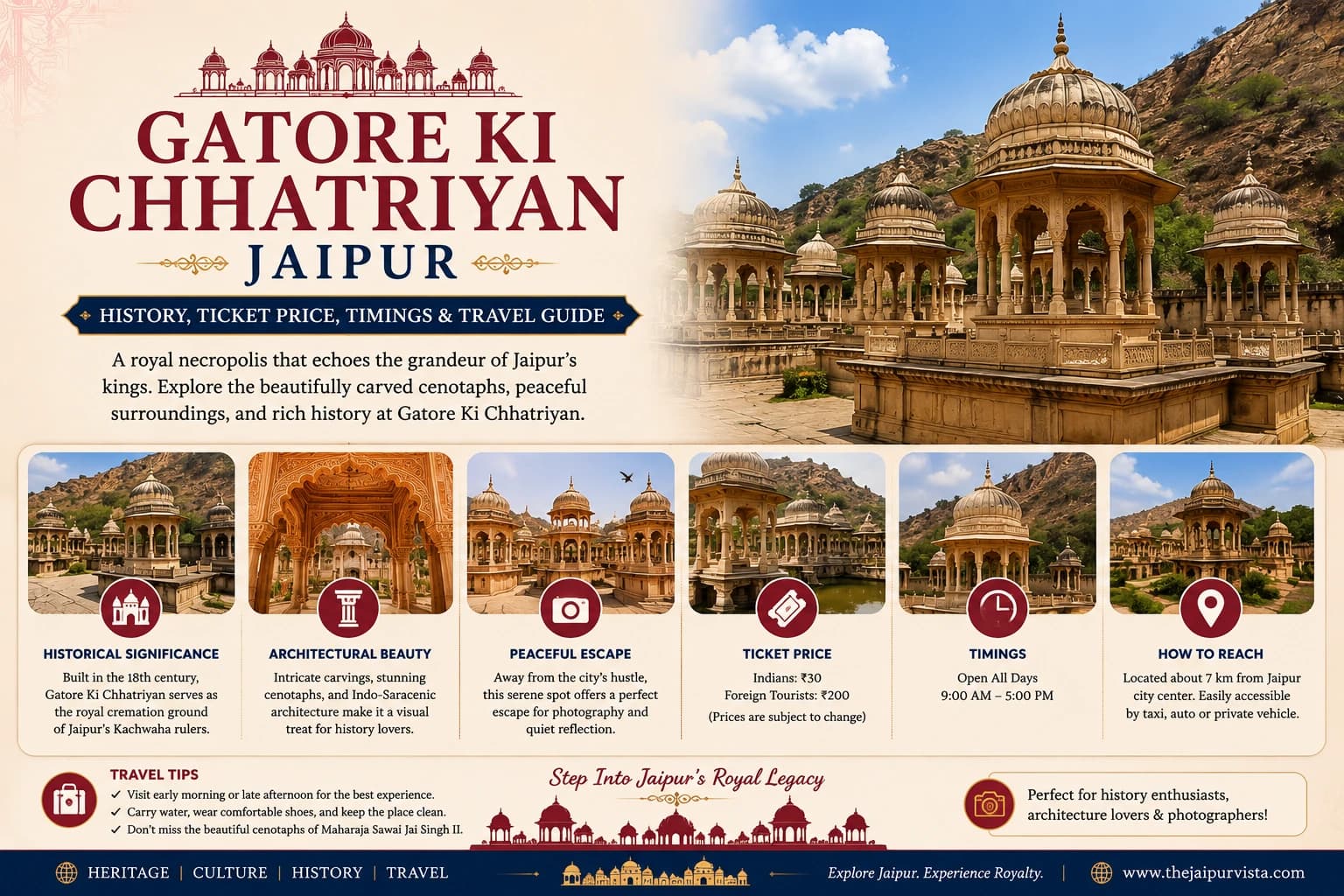
Tucked quietly in the foothills of Nahargarh, Gatore Ki Chhatriyan is one of Jaipur's most hauntingly beautiful and underrated heritage sites. Known interchangeably as Gaitor Ki Chhatriyan, this royal cremation ground served as the final resting place of the Kachhwaha Rajput kings who built and ruled Jaipur for generations. The word 'Chhatri' refers to an umbrella-shaped elevated dome structure, traditionally used in Indian and Rajput architecture as a decorative canopy or memorial monument. The complex at Gatore ki Chhatriyan Jaipur is essentially a collection of these magnificent cenotaphs – each one a tribute to a departed king, built with extraordinary craftsmanship in marble, sandstone, and rare stone quarried from nearby Rajasthan regions. Unlike the crowded tourist corridors of Hawa Mahal or Amber Fort, Gatore ki Chhatriyan remains blissfully peaceful, offering visitors an intimate encounter with Jaipur's royal past, intricate Rajput-Mughal architecture, and centuries of history carved literally in stone. The story of Gatore ki Chhatriyan begins in the early 18th century, when Maharaja Sawai Jai Singh II – the visionary founder of Jaipur city – selected this site as the designated royal cremation ground for the Kachhwaha Rajput dynasty. The year was 1733, and ever since, the site has witnessed the ceremonial last rites of nearly every successive ruler of the Jaipur state. The Kachhwaha clan, a prominent Rajput dynasty, had their seat of power first at Amber and later at Jaipur – the planned Pink City that Jai Singh II laid out with remarkable geometric precision. The decision to locate the royal cremation ground in the valley between Nahargarh Fort and Garh Ganesh Temple was deeply rooted in Vedic principles – the sacred texts that prescribe the ideal conditions for a cremation ground: proximity to water, a north-facing open space, and seclusion away from the main city. Almost all Kachhwaha kings from 1733 onward have been cremated at Gatore ki Chhatriyan. The only notable exception is Maharaja Sawai Ishwari Singh, whose cenotaph was built within the City Palace complex in Jaipur – a deviation from tradition that has made his absence here all the more historically noteworthy. Over the centuries, as each new king was cremated here, a chhatri – a beautifully decorated memorial cenotaph – was constructed on the site. These cenotaphs grew progressively more elaborate, reflecting both the wealth of the dynasty and the evolving artistic sensibilities of Rajput architecture across different eras. Today, the complex stands as a living timeline of royal Jaipur history spanning nearly three centuries. The architecture of Gatore ki Chhatriyan is a mesmerizing synthesis of Vedic principles, Rajput craftsmanship, and Indo-Persian stylistic influences. The entire complex follows the directional mandates laid down in ancient Vedic texts: the cremation ground faces north, slopes gently to the south, and is positioned near a water body – the Mansarovar Lake is within visible distance. Walking through the complex, you will notice that the cenotaphs are distributed across a tiered courtyard, with the oldest memorials positioned farthest from the entrance. The overall spatial effect is that of a miniature open-air palace – elegant, hushed, and filled with centuries of silent grandeur. Each cenotaph here is topped by the iconic chhatri – an octagonal or circular elevated pavilion with a characteristic umbrella dome. The chhatri form is distinctly Rajput in origin and represents royal dignity. In the context of memorial architecture, the chhatri symbolises the departed king's eternal protection over his kingdom, even in death. The number of pillars supporting each chhatri dome varies: smaller cenotaphs may have eight pillars, while the grandest – like the memorial of Sawai Madho Singh – feature twelve or more pillars arranged in a multi-tiered octagonal pattern. The choice of building materials at Gatore ki Chhatriyan speaks volumes about the status and wealth of each king being commemorated: White Makrana Marble – Used in the chhatri of Sawai Jai Singh II, widely regarded as the same quality marble used in the Taj Mahal. The pristine white marble glows golden at sunrise, making it one of the most photographed structures on the site. Italian Marble – Present in the memorial of Sawai Ram Singh, reflecting the cosmopolitan influences of the 19th century Jaipur court and its connections with European craftsmanship. Red Karauli Sandstone – The rare red sandstone used in the spectacular chhatri of Sawai Madho Singh was sourced from Karauli and from a quarry called 'Raay wale ki khan' near Ramgarh. This warm-toned sandstone gives the memorial a dramatic, fortress-like appearance. Combination Stone and Marble Work – Several cenotaphs use a deliberate combination of stone and marble, creating visual contrast that was both aesthetically purposeful and structurally significant. Standing in the center of the innermost courtyard, the memorial of Sawai Jai Singh II – the founder of Jaipur – is the most revered cenotaph in the entire complex. Built in white Makrana marble of the highest purity, it is supported by twenty intricately carved pillars. The dome features exquisite sculptures of Hindu deities, celestial maidens (apsaras), musicians, attendants, and scenes from royal court life. This chhatri is not merely a memorial – it is a masterpiece that validates the legacy of Jaipur's greatest ruler. The delicacy of the marble carving rivals the finest Mughal inlay work, and the entire structure radiates a serene majesty that makes it impossible to rush past. Located just behind the cenotaph of Sawai Jai Singh II, the memorial of Sawai Ram Singh was designed to echo and honour his predecessor's architectural vision. Built in Italian marble, it features detailed carvings depicting scenes of royal army processions, war manoeuvres, and courtly life – an apt tribute to a king who was also known as a progressive administrator and patron of the arts during Jaipur's 19th-century golden era. Without question, the most architecturally spectacular memorial at Gaitor ki Chhatriyan is the chhatri commissioned for Maharaja Sawai Madho Singh by his successor Sawai Pratap Singh. This extraordinary structure has drawn comparisons to the Taj Mahal in its spatial conception – a central domed pavilion surrounded by symmetrical walkways and open verandas. Key architectural features of this chhatri include: An octagonal pillar arrangement supporting the main dome, with twelve chhatris in the surrounding composition – four large ones at the corners and eight smaller ones positioned between them. Intricately vented octagonal windows that allow filtered light to play across the marble interior throughout the day. Open verandas on all four cardinal directions, offering sweeping views of the surrounding complex. A staircase on the northern side that leads to the top, where you can survey the entire landscape of chhatris spread below – one of the finest panoramic views in Jaipur. Marble exterior panels depicting the grand royal procession from Janani Deori to Sanganeri Gate – complete with elephants, horses, and ceremonial attendants carved with lifelike precision. Two imposing stone lions guarding the entrance, representing the protective power of the deceased king. The stone used here – rare red Karauli sandstone – gives this chhatri a warmth and grandeur unmatched anywhere else in the complex. Beyond the three most celebrated memorials, the complex contains cenotaphs of more than a dozen Kachhwaha rulers, each with its own distinct character. Some are modest in scale but rich in carved detail; others are grander in footprint but more restrained in ornamentation. Together they form an architectural chronology of Jaipur's royal dynasty – a timeline written not in words but in marble and stone. The entry to Gatore ki Chhatriyan is remarkably affordable, making it one of the best-value heritage experiences in Jaipur. Here is a detailed breakdown of the current ticket pricing: Pro Tip: If you plan to visit the City Palace and Jaigarh Fort on the same trip, the composite ticket at ₹300 is excellent value and saves you considerable time at ticketing counters. The ticket window at Gatore ki Chhatriyan closes at 4:30 PM, so plan to arrive before then. The site is open all seven days of the week including national holidays, making it accessible throughout the year. However, visiting on weekdays generally means fewer crowds, allowing you to appreciate the cenotaphs in peace. Early Morning (9:30 AM – 11:00 AM): The golden morning light falls beautifully on the white marble of Sawai Jai Singh II's cenotaph. The site is nearly empty, and you'll have the entire complex to yourself for atmospheric photography. Late Afternoon (3:00 PM – 5:00 PM): The warm afternoon sun casts long shadows between the chhatris and gives the red Karauli sandstone a particularly rich, dramatic tone. This is the best window for photography enthusiasts. Avoid Midday (11:30 AM – 2:30 PM): The Rajasthan sun can be extremely harsh during midday, especially from April to September. The ideal period to explore Gatore ki Chhatriyan – and Jaipur in general – is between October and March, when Rajasthan's desert climate softens into a cool, comfortable winter. Temperatures during this period range from 8°C at night to 25°C in the afternoon, making outdoor exploration genuinely enjoyable. October – November: Post-monsoon freshness, clear blue skies, and comfortable temperatures. The landscape around Nahargarh looks particularly lush after the rains. December – January: Peak tourist season. Mornings can be quite cold (8–12°C) but afternoons are perfectly pleasant. This is when the site sees the most visitors, so early arrival is advisable. February – March: Still excellent weather, with slightly warmer afternoons. Fewer tourists than December-January. April – June: Very hot. Temperatures regularly exceed 40°C. Visiting early morning is possible but not recommended for extended exploration. July – September: Monsoon season. The site can become muddy and slippery. However, the surrounding hills turn emerald green and offer spectacular views. Gatore ki Chhatriyan is a serious photographer's paradise. The interplay of white marble, red sandstone, carved pillars, domed chhatris, and dappled light creates compositions that are impossible to replicate anywhere else in Jaipur. Bring a wide-angle lens for the grand overview from the top of Sawai Madho Singh's memorial, and a macro lens for the intricate relief carvings on the marble panels. With each cenotaph representing a different Kachhwaha king from a different era, a walk through Gatore ki Chhatriyan is essentially a self-guided heritage trail through 300 years of Jaipur's royal history. Pick up a site brochure at the ticket counter or hire a local guide to bring the stories of each memorial alive. The serene, unhurried atmosphere of Gatore ki Chhatriyan makes it a perfect place for quiet contemplation. Unlike the busier tourist attractions, this site invites you to slow down, sit on the stone steps, and absorb the extraordinary beauty and history around you. Many visitors describe the experience as deeply moving. From the upper level of Sawai Madho Singh's memorial, and from the elevated sections of the complex, you can see the sprawling cityscape of Jaipur, the shimmering waters of Mansarovar Lake, and the distant profile of Jal Mahal. On a clear winter morning, the view is extraordinary. The Garh Ganesh Temple, located just above the chhatri complex on the Nahargarh hill slope, is a natural extension of a visit to Gatore. The temple is dedicated to Lord Ganesha in his childhood form, and it is believed that Maharaja Sawai Jai Singh II himself worshipped here before laying the foundation of Jaipur city. The short uphill walk is rewarding for both spiritual and scenic reasons. The distance is approximately 8 kilometres. You can take an auto-rickshaw or cab directly to Gatore ki Chhatriyan in about 20–25 minutes, depending on traffic. The ride costs approximately ₹150–200 by auto. The bus stand is about 5.8 kilometres away. Autos and cabs are readily available from here. Alternatively, Jaipur's city bus service operates routes through the Brahampuri area. The airport is approximately 15 kilometres away. Pre-paid taxis and app-based cabs (Ola/Uber) cover the distance in 30–40 minutes, with fares typically ranging from ₹300–400. Alight at Brahmapuri and walk a few hundred metres to the main entrance of the cenotaph complex. The area is well-signposted and locals are familiar with the site. Nahargarh Fort – 1.5 km away (walking distance uphill) Garh Ganesh Temple – Adjacent to the complex Jal Mahal – 3 km away Hawa Mahal – 6 km away Gatore ki Chhatriyan sits in a heritage-rich pocket of Jaipur's northern edge. Combining it with neighbouring sites makes for a fulfilling day of exploration: Nahargarh Fort (1.5 km): The imposing fort offers stunning sunset views over the Pink City and is one of Jaipur's most romantic heritage experiences. Garh Ganesh Temple (adjacent): A revered temple dedicated to childhood Ganesha with panoramic views of Jaipur city. Jal Mahal (3 km): The ethereal water palace that appears to float on Man Sagar Lake – best viewed at dusk. Amer Fort (10 km): The magnificent hilltop fort of the Kachhwaha dynasty – architecturally and historically connected to the royals buried at Gatore. Maharani Ki Chhatriyan (Amer Road): The companion site to Gatore, this complex contains cenotaphs of the queens and consorts of the Kachhwaha rulers. Wear comfortable, closed-toe footwear as some sections of the complex have uneven stone paths. Carry drinking water, especially between April and October. There are no refreshment stalls inside the complex. Photography is allowed and encouraged. There is no additional photography fee. Dress modestly out of respect for the memorial nature of the site. Hire a local guide at the entrance for ₹100–200 for a much richer historical experience. The site is wheelchair-accessible in parts, but some inner areas involve steps. Keep the site clean – there are bins provided at the entrance. The heritage site depends on visitor responsibility for its upkeep. Combine your visit with Nahargarh Fort for a complete half-day itinerary covering both heritage and panoramic sightseeing. In a city overflowing with UNESCO-listed monuments, bustling bazaars, and iconic landmarks, Gatore ki Chhatriyan occupies a unique position. It is where Jaipur's kings came to rest – not in hidden mountain tombs or distant riverbanks, but in an open, beautiful valley beneath the protective walls of Nahargarh, within sight of the city they built. The complex is a testament to the Kachhwaha dynasty's belief that death was not an ending but a continuation – a king's final architectural expression of his reign's values and grandeur. Every carved elephant, every marble panel, every soaring dome at Gaitor ki Chhatriyan whispers a story that formal history books often miss. If you are planning a trip to Jaipur and want to experience the city beyond its most famous postcard images, put Gatore ki Chhatriyan at the top of your list. Come early, walk slowly, look closely, and let the silence of this extraordinary place speak to you. For more authentic Jaipur travel guides, hidden gems, heritage walks, and practical tips from local experts, explore The Jaipur Vista – your most trusted companion for discovering the real Pink City. Q. What is the entry fee for Gatore ki Chhatriyan? The Gatore ki Chhatriyan ticket price is ₹30 per person for Indian nationals for a standalone visit. A composite ticket at ₹300 per person also includes City Palace, Jaigarh Fort, and Maharani Ki Chhatriyan. Q. What are the timings of Gatore ki Chhatriyan? Gatore ki Chhatriyan is open daily from 9:30 AM to 5:00 PM, including Sundays and public holidays. The ticket window closes at 4:30 PM. Yes – Gatore ki Chhatriyan, Gaitor ki Chhatriyan, and Gaitor Royal Cenotaphs all refer to the same heritage site in Jaipur. The spelling variations arise from the transliteration of the original Rajasthani name. Q. How long does it take to visit Gatore ki Chhatriyan? A comfortable visit typically takes 1.5 to 2 hours, depending on your interest in architecture and history. Photography enthusiasts often spend 2.5–3 hours on site. Q. Is photography allowed at Gatore ki Chhatriyan? Yes, photography is freely allowed throughout the complex. There is no separate photography fee. Q. What is the best time to visit Gatore ki Chhatriyan in Jaipur? The best time to visit is between October and March when the weather in Jaipur is cool and pleasant. For photography specifically, early morning (9:30–11:00 AM) or late afternoon (3:00–5:00 PM) lighting is ideal. Q. Who is buried at Gatore ki Chhatriyan? No burial takes place here in the Islamic or Western sense. Gatore ki Chhatriyan is a cremation ground where the Kachhwaha Rajput kings of Jaipur were cremated. The cenotaphs (chhatris) are memorial structures built on the cremation spots. Every Kachhwaha king since Maharaja Sawai Jai Singh II (from 1733) has been cremated here, with the exception of Maharaja Sawai Ishwari Singh. Q. Is Gatore ki Chhatriyan worth visiting? Absolutely. For anyone with an interest in Indian history, Rajput architecture, or simply a love of beautiful, uncrowded spaces, Gatore ki Chhatriyan is one of Jaipur's most rewarding experiences. At just ₹30, it offers exceptional value and a perspective on Jaipur's royal history that the more popular sites simply cannot provide.At a Glance: Gatore Ki Chhatriyan Jaipur
What is Gatore Ki Chhatriyan?
History of Gatore Ki Chhatriyan Jaipur
Architecture of Gaitor Ki Chhatriyan – A Masterclass in Rajput Stone Craft
The Chhatri Structure – What Makes It Unique
Materials Used in Construction
Key Cenotaphs to See at Gatore Ki Chhatriyan
1. Chhatri of Maharaja Sawai Jai Singh II (The Crown Jewel)
2. Chhatri of Maharaja Sawai Ram Singh
3. Chhatri of Maharaja Sawai Madho Singh (The Most Magnificent)
4. Other Notable Cenotaphs
Gatore Ki Chhatriyan Ticket Price 2026
Gatore Ki Chhatriyan Timings – When to Visit
Best Time of Day to Visit Gatore ki Chhatriyan
Best Time to Visit Gatore Ki Chhatriyan Jaipur
Things to Do at Gaitor Ki Chhatriyan
1. Architectural Photography
2. Historical Exploration and Heritage Trail
3. Quiet Meditation and Reflection
4. Panoramic View of Jaipur
5. Visiting the Nearby Garh Ganesh Temple
How to Reach Gatore Ki Chhatriyan Jaipur
From Jaipur Railway Station
From Sindhi Camp Bus Stand
From Jaipur International Airport
By Local Transport
Nearest Landmarks for Navigation
Nearby Attractions to Combine with Your Visit
Read Also: Top Historical Places in Jaipur
Practical Travel Tips for Gatore Ki Chhatriyan
Final Thoughts – A Royal Legacy in Stone
Frequently Asked Questions – Gatore Ki Chhatriyan Jaipur
Q. Is Gatore ki Chhatriyan and Gaitor ki Chhatriyan the same place?