Golden Triangle Tour: The Complete Guide to Delhi, Agra & Jaipur
Author:Niharika
Published:July 14, 2026
Views:418
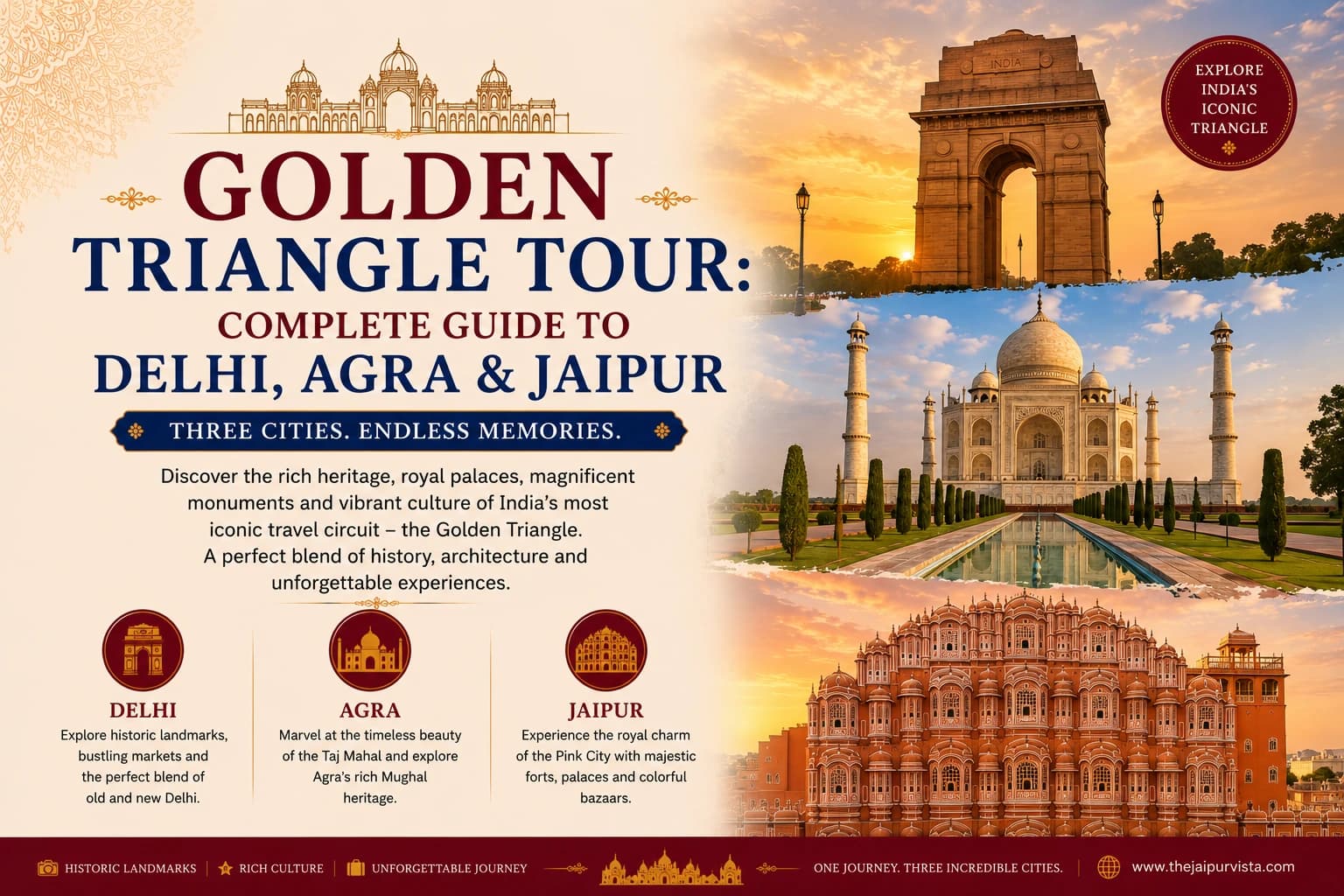
The Golden Triangle Tour is India's most iconic travel circuit, connecting three cities - Delhi, Agra, and Jaipur - whose locations on a map form a rough triangle. It's the single most-booked itinerary for first-time visitors to India, and for good reason: in one compact trip, you get a Mughal capital, the Taj Mahal, and a Rajput royal city, all within a few hours' drive of each other.
Delhi brings the history of empires and the energy of a modern capital. Agra holds the Taj Mahal, arguably the most recognisable monument on Earth. And Jaipur - the Pink City - delivers forts, palaces, bazaars, and the kind of living heritage that photographs can't quite capture. Together, they form a tour that consistently ranks among the top travel experiences in Asia.
If you're short on time but want to experience the essence of India's history, architecture, and culture, the Golden Triangle Tour is the most efficient - and most rewarding - way to do it.
The name comes from the geographic shape formed when you connect Delhi, Agra, and Jaipur on a map - an almost perfect triangle, with each city roughly 200–240 km from the next. The "golden" part reflects the cultural and historical wealth packed into this small stretch of northern India: three UNESCO World Heritage Sites (the Taj Mahal, Agra Fort, and Jaipur's Jantar Mantar), Mughal architecture, and one of the last living royal cities in the world.
Delhi is India's capital and the usual starting point for a Golden Triangle Tour, since most international flights land here. What makes Delhi worth a full day (or two) is the contrast between Old Delhi and New Delhi.
Old Delhi: Red Fort, Jama Masjid, and the chaotic, wonderful lanes of Chandni Chowk
New Delhi: India Gate, Humayun's Tomb, Qutub Minar, and the lotus-shaped Bahá'í Temple
Modern Delhi: Connaught Place, Akshardham Temple, and a genuinely excellent food scene
Agra served as the Mughal capital between the 16th and 17th centuries, and it shows. Beyond the Taj Mahal, the city has two other UNESCO sites worth your time.
Taj Mahal: Best visited at sunrise, both for the light and to avoid the crowds
Agra Fort: A red sandstone fortress that was the real seat of Mughal power
Fatehpur Sikri: A perfectly preserved abandoned Mughal city, about 40 km from Agra
Jaipur is where the Golden Triangle Tour shifts gears - from Mughal history to Rajput grandeur. Founded in 1727 by Maharaja Sawai Jai Singh II, it was one of India's first planned cities, and it still shows in its wide avenues and symmetrical pink-washed old quarter.
Amber Fort: A hilltop fort-palace with mirror-work halls and sweeping views over the Aravalli hills
City Palace: Still partly home to Jaipur's royal family, with museums of royal costumes and weapons
Hawa Mahal: The five-story "Palace of Winds," Jaipur's most photographed façade
Jantar Mantar: An 18th-century astronomical observatory and UNESCO World Heritage Site
Modern Jaipur: For travellers who want a break from monuments, spots like World Trade Park offer branded shopping, a multiplex, and a food court - a good half-day addition to a heritage-heavy itinerary
Most seasoned India travel writers will tell you the same thing: Delhi impresses you, Agra moves you, but Jaipur is the city people fall in love with - it's colourful, walkable, full of craft bazaars, and easy to extend by a day or two.
This is the standard itinerary followed by most tour operators, and it works well for a first trip:
Tip: If your schedule allows, add a 7th day in Jaipur. Most travellers regret rushing this city more than any other stop on the circuit - there's simply too much to see (and shop for) in one day.
Tour operators commonly offer extensions that build on the base itinerary:
Golden Triangle + Ranthambore - for a tiger safari between Agra and Jaipur
Golden Triangle + Pushkar & Udaipur - extends the Rajasthan leg with the lake city and holy town
Golden Triangle + Varanasi - adds India's spiritual capital on the Ganges
Golden Triangle by Train - using express trains like the Shatabdi between cities instead of road travel
Luxury Golden Triangle Tour - using heritage and 5-star properties across all three cities
October to March is, without question, the best time for a Golden Triangle Tour. Daytime temperatures sit comfortably between 15–28°C, which makes long days walking through Amber Fort or the Taj Mahal complex far more pleasant. December and January mornings can be foggy and cold, so pack layers if you're travelling then.
By car: The most flexible option. Delhi–Agra takes roughly 3–4 hours via the Yamuna Expressway; Agra–Jaipur takes about 5–6 hours via Fatehpur Sikri.
By train: The Gatimaan Express and Shatabdi Express connect Delhi and Agra in under 2 hours. Several daily trains also link Agra and Jaipur.
By luxury train: For a bucket-list experience, the Palace on Wheels and Maharajas' Express both run Golden Triangle-style routes with onboard stays.
By air: Jaipur and Delhi both have well-connected airports, useful if you want to skip the Jaipur–Delhi road leg on the return.
Costs vary widely depending on hotel category, but as a rough guide for a 5N/6D private tour (per person, twin-sharing, excluding international flights):
Budget tour: ₹20,000–35,000 (~$240–$420) - 3-star hotels, private car
Mid-range tour: ₹45,000–75,000 (~$540–$900) - 4-star hotels, private car, guided sightseeing
Luxury tour: ₹1,20,000+ (~$1,450+) - 5-star and heritage palace hotels, private guides, curated experiences
Same-day Agra trips from Delhi (without Jaipur) are also popular for travellers with limited time, and typically run $90–$110 per person by car or train.
Note: Prices fluctuate with season, hotel category, and fuel costs - always confirm current rates directly with your tour operator before booking.
Because this is a Jaipur-focused guide, it's worth saying plainly: most Golden Triangle itineraries under-allocate time to Jaipur. One day is enough to see the "big four" monuments, but it doesn't leave room for:
Shopping for block-printed textiles, blue pottery, and gemstones in Johari Bazaar and Bapu Bazaar
A proper Rajasthani thali dinner with a folk dance performance
A relaxed evening at a modern space like World Trade Park for shopping, dining, or a movie
A day trip to Nahargarh Fort for sunset views over the city
Exploring Jaipur's growing café and boutique-hotel scene beyond the walled city
If you're building your own itinerary rather than booking a fixed package, we'd recommend 2 full days in Jaipur over 1 - it's consistently the part of the trip travellers wish they'd extended.
The Golden Triangle Tour endures as India's most popular circuit because it genuinely delivers - three completely different cities, each with its own architectural language, food, and pace of life, all reachable within a single trip. Delhi sets the scene, Agra delivers the postcard moment, and Jaipur sends you home with the stories.
If Jaipur is your final stop on the Golden Triangle, give it the time it deserves. Explore our other guides on The Jaipur Vista for detailed coverage of Amber Fort, Hawa Mahal, City Palace, and modern Jaipur experiences like World Trade Park - everything you need to plan the Jaipur leg of your trip in depth.