Guest Contribution
Top 5 Places to Visit in Jaipur During Monsoon 2026
Author:Niharika
Published:August 11, 2026
Views:269
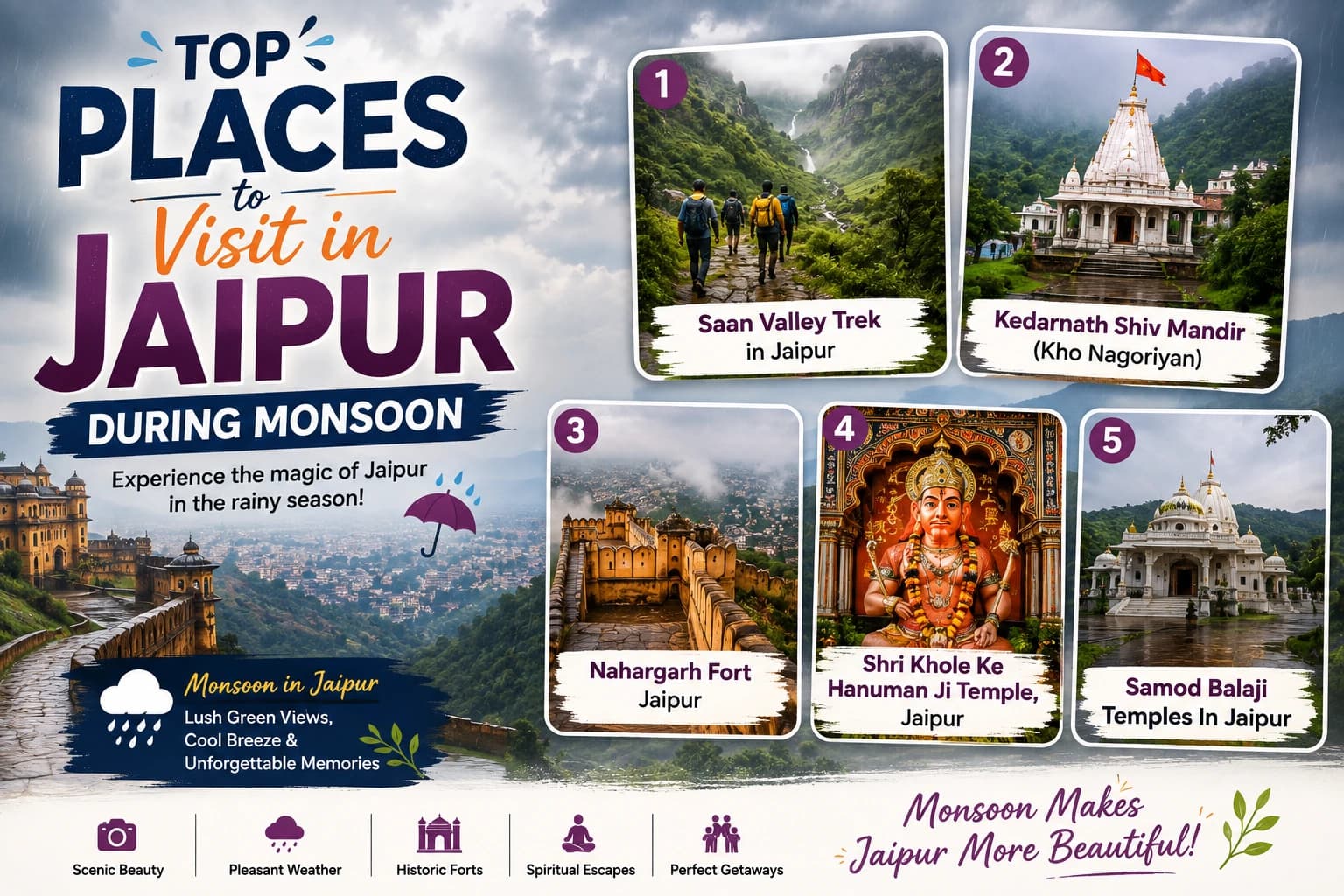
Jaipur wears a different face once the monsoon clouds roll over the Aravalli hills. The Pink City, usually associated with sun-baked forts and dusty bazaars, turns a deep, unexpected green between July and September. Waterfalls appear on hillsides that are bone-dry the rest of the year, the air smells of wet earth, and the forts on the ridgelines disappear and reappear through shifting mist.
If you are planning places to visit in Jaipur during monsoon, this guide covers the five spots that locals actually head to when the first showers hit - a mix of offbeat treks, hillside temples, and a monsoon-only fort experience. We've put this list together at The Jaipur Vista after visiting each of these places ourselves and talking to trekkers, priests, and regular monsoon visitors, so you're getting on-ground detail, not just a copy-paste list.
Jaipur's monsoon season, roughly July to September, is short but transformative. The Aravalli range that wraps around the city gets a burst of greenery, seasonal waterfalls start flowing near several temples and forts, and daytime temperatures drop from the punishing 40°C+ of summer to a far more walkable 28–32°C. It's also the least crowded time to visit Jaipur's outdoor and hillside spots, since most tourists plan their trip for winter. That means shorter queues, better light for photography, and a completely different, greener version of the city that most first-time visitors never see.
A quick word of caution before you head out: monsoon trails in the Aravallis get slippery, streams can flow unpredictably, and some hill routes are best avoided right after very heavy rain. Carry good grip shoes, avoid trekking alone on unfamiliar trails, and always check local weather updates before setting out.
Here are the five places in and around Jaipur that make the most of the monsoon season.
Location: Near Kukas, on the outskirts of Jaipur, close to Amer Road Best for: Trekkers, nature photographers, weekend adventurers
Saan Valley is one of Jaipur's best-kept outdoor secrets, tucked away in the Aravalli hills near Natata village close to Kukas. It's not a manicured picnic spot - it's a raw, largely untouched stretch of hill country that only really comes alive during monsoon.
This is roughly a 4-kilometre guided trek that typically starts early in the morning and takes you through green trails, butterfly-filled meadows, and rocky paths before reaching a summit with sweeping views of the Saan hills. There's also an old Hanuman temple at the top of the hill, which many trekkers visit before heading back down.
Monsoon (roughly July to September) is considered one of the two best windows to attempt this trek, since the rains bring out lush greenery and small seasonal waterfalls along the route, while winter offers clearer skies and cooler temperatures. Just keep in mind that while monsoon makes the valley look its greenest and most scenic, the trails also get slippery, so sturdy footwear with good grip is a must.
Good to know: The Saan Valley trek is rated as a moderate difficulty level, so it suits both first-time trekkers and experienced hikers, but a reasonable level of fitness helps. Several local trekking operators run guided group treks here on weekends, which is a good option if you're visiting Jaipur for the first time and don't want to navigate the trail solo.
Location: Kho Nagoriyan, near Ghat Ki Guni and Jhalana, Jaipur Best for: Short monsoon hikes, spiritual visits, easy family-friendly trekking
Don't confuse this with the Kedarnath in Uttarakhand - Jaipur has its own hillside Kedarnath Shiv Mandir, locally known by the name of its neighbourhood, Kho Nagoriyan. The temple sits atop a hill in Jagatpura, wrapped by the Aravalli range, and is visible from the base of the hill itself.
The trail up to the temple is a roughly 1.9-mile loop route near Jhalana, considered moderately challenging, and popular for birding, hiking, and walking.Most visitors describe it as an easy-to-moderate climb of about 1.5 km one way, taking roughly 30–45 minutes depending on fitness level, with the reward being lush greenery, rocky paths, and occasional wildlife sightings near Jhalana.
This makes it one of the more accessible monsoon trekking spots in Jaipur - short enough for a half-day outing, but scenic enough to feel like a proper escape from the city. Do note that the stone pathways get slippery in the rains, so caution is advised, and it's best to start early in the morning to enjoy cooler weather.The temple also draws large crowds of devotees every year around Maha Shivratri, when a mela-like atmosphere takes over the hill.</cite>
Location: Atop the Aravalli hills, overlooking Jaipur city Best for: Sunset views, photography, panoramic city views, history lovers
No monsoon list for Jaipur is complete without Nahargarh Fort. Built in the 18th century as part of the defensive ring around Jaipur (alongside Amer Fort and Jaigarh Fort), Nahargarh sits high on the Aravalli ridge and offers what is arguably the best panoramic view of the Pink City from any single point.
During the monsoon, the hills around Nahargarh turn a vivid green, and the fort's ramparts get wrapped in low clouds and mist on many evenings - a completely different look from its dusty, golden-brown appearance in summer. The famous view from the fort's cafés and terraces, overlooking the sprawl of Jaipur city below, is at its most dramatic right after a spell of rain, when the air is clear and the light softens toward sunset.
Nahargarh is also relatively easy to combine with a half-day trip that includes Jaigarh Fort, since both sit on the same ridge and are connected by a walkable fortified passage. If you're short on time in Jaipur but want one monsoon-friendly heritage stop, this is it - accessible by road, well-maintained for tourists, and rewarding even for travellers who aren't up for a full trek.
Tip: Plan your visit toward late afternoon so you can catch both the post-rain hills and the sunset over the city - this is when the fort is at its most photogenic.
Location: Laxman Dungri, Delhi Bypass Road, Jaipur Best for: Temple visits, monsoon picnics, families, photography
Khole Ke Hanuman Ji Temple is arguably the most-visited monsoon spot on this list among locals - and for good reason. Located on a hillock along the Delhi bypass, this historic temple is dedicated to Lord Hanuman, with an inner sanctum large enough to accommodate up to 500 devotees, and panoramic views of the green surroundings.
The temple's name comes from its origin story - the site was once a wild, forested valley where rainwater used to flow down through cave-like openings in the hills, described locally as "khole," which is where the temple takes its name from. That connection to rainwater and monsoon isn't just historical trivia - it's still true today.
Locals visit this temple in especially large numbers during the monsoon season for community picnics known locally as "Goth," and it's widely regarded as the most popular Hanuman temple in Jaipur.The temple complex spans five floors with plenty of stairs to climb (an elevator is available for those who need it), and visitors particularly highlight it as a must-visit during monsoon. A ropeway has also been added in recent years, offering panoramic views of both the temple complex and Jaipur city, which is especially striking against the monsoon-green backdrop.
The best time to visit is generally between the monsoon and winter months, from July through March, when the temple's gardens are in full bloom.
Location: Samod village, Chomu tehsil, roughly 30 km from Jaipur Best for: Half-day trips, spiritual seekers, hill treks, offbeat exploration
For travellers willing to venture slightly outside the city, Samod Balaji Temple (also known as Shri Veer Hanuman Dham) is one of the most rewarding monsoon detours near Jaipur. The temple sits atop Samod Parvat near Samod village in Chomu tehsil, roughly 30 km from Jaipur district headquarters.
There are two routes to reach the temple - the longer Samod Palace route, which covers three hillocks and a couple of valleys, and the shorter but steeper Khole-side route, which needs more stamina to climb its long stretch of stairs. Around 50 metres before the temple sits a kund, a water tank where devotees traditionally take a holy dip before climbing the final stretch to the shrine.
The temple itself sits on an elevated, open platform with pillared halls used for dance and cultural performances during festivals, and the main sanctum houses an idol of Lord Hanuman equipped with his traditional gada (mace). During monsoon, the surrounding Samod hills turn a rich green, making the climb up the stairs considerably more scenic - and considerably cooler - than in the peak summer months.
Nestled amidst the Aravalli hills, the temple attracts both pilgrims and tourists who come for its intricate carvings and tranquil surroundings, and it gets especially vibrant during festivals. If you're combining it with a heritage visit, the nearby Samod Palace, a 16th-century haveli-turned-heritage-hotel, makes for a good add-on stop on the same trip.
Check the weather before heading to any hill or trek route. Aravalli trails can turn slippery or flood-prone during heavy spells.
Wear proper grip shoes rather than regular sneakers or sandals for any of the trekking spots on this list.
Carry a light raincoat or poncho rather than an umbrella if you're doing any of the treks - it's easier to manage on uneven terrain.
Start early in the day, especially for Saan Valley and Kedarnath Shiv Mandir, to avoid both the midday heat spikes between showers and the afternoon crowd at temples.
Avoid trekking alone on the more offbeat routes like Saan Valley - go with a local guide or a group, especially if it's your first visit.
Combine nearby spots - Nahargarh and Jaigarh Fort, or Khole Ke Hanuman Ji and Galta Ji Temple, work well as a single half-day outing.
Monsoon is, without question, one of the most underrated times to explore Jaipur. Beyond the palaces and bazaars that dominate most travel itineraries, the rains unlock a side of the city that's genuinely green, quieter, and a little wilder - from the raw hill trails of Saan Valley to the mist-wrapped ramparts of Nahargarh Fort and the packed, festive courtyards of Khole Ke Hanuman Ji Temple.
Whether you're a trekker chasing waterfalls, a devotee looking for a peaceful hillside temple, or simply someone who wants to see Jaipur's forts without the summer heat or winter crowds, these five spots cover the best of what Jaipur's monsoon season has to offer
1. Is monsoon a good time to visit Jaipur?
Yes. Monsoon (July to September) brings cooler temperatures, lush green hills, and seasonal waterfalls to Jaipur's forts and hillside temples, along with far fewer crowds than the peak winter season.
2. Which is the best trekking spot in Jaipur during monsoon?
Saan Valley Trek is the most popular monsoon trekking spot in Jaipur, offering a scenic 4-km trail through green hills, butterfly trails, and rocky paths near Kukas on the outskirts of the city.
3. Is it safe to trek in Jaipur during the rainy season?
Trekking is generally safe if you take basic precautions - wear shoes with good grip, avoid trails right after heavy rainfall, start early in the day, and avoid trekking alone on offbeat routes like Saan Valley or Samod Balaji.
4. Which temples in Jaipur are worth visiting during monsoon?
Khole Ke Hanuman Ji Temple, Kedarnath Shiv Mandir (Kho Nagoriyan), and Samod Balaji Temple are the most popular monsoon temple visits in Jaipur, all set on green hillsides that come alive during the rains.
5. Is Nahargarh Fort open during monsoon season?
Yes, Nahargarh Fort stays open during monsoon and is one of the best times to visit - the surrounding hills turn green, and misty evenings offer a dramatic, less crowded view over Jaipur city.