Khole Ke Hanuman Ji Temple Jaipur: Timings, History, Aarti & Complete Visitor Guide (2026)
Author:Niharika
Published:May 29, 2026
Views:3029
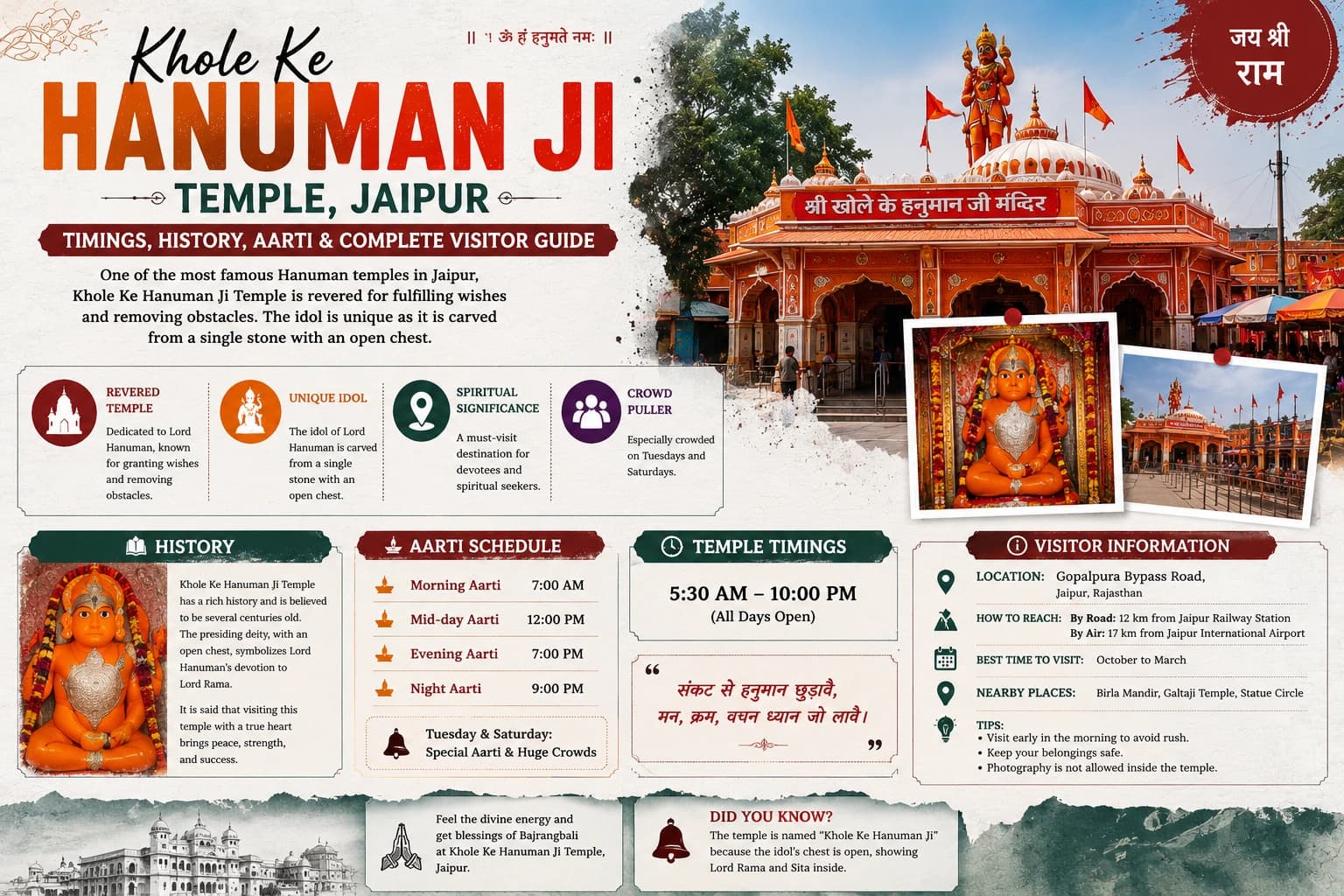
Tucked away in the Aravalli Hills along Jaipur's Delhi Highway, Khole Ke Hanuman Ji is not just a temple - it is a living, breathing sanctuary where the spirit of devotion never sleeps. For thousands of Jaipurites, no week is complete without a visit to this sacred Hanuman Ji mandir, especially on Tuesdays and Saturdays when the entire temple transforms into a sea of saffron and marigold.
Whether you are a devout pilgrim searching for Khole Ke Hanuman Ji timing today, a curious traveller wanting to understand the legend behind this magnificent shrine, or a first-time visitor to the Pink City planning your itinerary - this complete guide from The Jaipur Vista covers everything you need to know before stepping foot inside.
One of the most searched questions about this temple is: "What is the Khole Ke Hanuman Ji timing today?" Here is the complete weekly schedule:
Visitor Tip: On Tuesdays and Saturdays, the temple stays open until midnight to accommodate the large number of devotees. These are considered the most auspicious days for worshipping Lord Hanuman. Plan to arrive early in the morning or after 7:00 PM to avoid long queues. The daily aarti schedule at Khole Ke Hanuman Ji is one of the most spiritually uplifting experiences in all of Jaipur: Morning Aarti (Mangala Aarti): Around 5:30 AM – 6:00 AM Evening Aarti (Sandhya Aarti): Around 8:00 PM – 8:30 PM The evening aarti is considered the best time to visit this Hanuman Ji mandir, as the entire complex glows with diyas (oil lamps), the aroma of incense fills the air, and the sound of devotional bhajans echoes through the Aravalli hills. It is a profoundly moving experience that stays with visitors long after they return home. Khole Ke Hanuman Ji Temple is situated at Laxman Doongri, Natata Mode, on the Jaipur–Delhi National Highway (NH-48). The temple is set dramatically against a backdrop of Aravalli hills on three sides, making the landscape around it as memorable as the temple itself. Address: Laxman Dungri, Natata Mode, Delhi Road, Kunda, Jaipur, Rajasthan – 302028 From Jaipur Railway Station: Approximately 11 kilometres. A cab or auto-rickshaw ride takes 20–30 minutes. From Johari Bazar (Old City): About 7 kilometres, roughly 15–20 minutes by cab. From Jaipur International Airport: Around 22 kilometres via Delhi Road, approximately 35–40 minutes. By Bus: Several local city buses from Sindhi Camp (Central Bus Stand) stop near the temple entrance on Delhi Highway. By Auto-Rickshaw/Cab: Easily available from all major areas of Jaipur. Simply ask for "Khole Ke Hanuman Ji mandir" - every auto-driver in Jaipur knows this temple. Parking: The temple has a large, dedicated car parking area outside the complex. For those with mobility challenges, the temple committee provides complimentary battery-operated vehicles from the parking zone to the main temple gate - a thoughtful service that reflects the temple management's commitment to inclusivity. The story of Khole Ke Hanuman Ji is one of divine discovery, unwavering faith, and community devotion. In the early 1960s, Pandit Radhe Lal Choubey, a resident of Jamwa Ramgarh, was passing through the Laxman Doongri area when he came across a naturally occurring rock bearing an engraved image of Lord Hanuman. Deeply moved by this discovery, Pandit Choubey interpreted it as a divine sign and began offering his prayers at that very spot - long before any formal structure existed. Inspired by his devotion, he took it upon himself to commission a proper temple at the site in 1961. However, the spiritual roots of this location go far deeper. Ancient accounts suggest that a revered saint named Baba Nirmal Das had been worshipping Lord Hanuman at this very site several centuries prior. In those earlier times, the valley was known as "Narwar Dar Ki Khol" - and it is from the word "Khol" (meaning valley or hollow in the local dialect) that the temple derives its present name, Khole Ke Hanuman Ji. Pandit Choubey also established the Narwar Ashram Seva Samiti, a community organisation dedicated to the management and expansion of the temple. Under this Samiti's stewardship, the temple has grown from a modest 100-square-foot shrine into a sprawling multi-acre complex. When the temple was first established, it occupied just 100 square feet of land at the base of Laxman Doongri hill. As word of the temple's divine power spread and miracles were attributed to the deity, the footfall grew exponentially. Today, the temple complex spans several acres - roughly 300 times its original size - and includes the main sanctum, multiple smaller shrines, gardens, guest houses, 24 kitchens, and spacious dining halls. The architecture of Khole Ke Hanuman Ji Temple is a beautiful synthesis of Rajput and Mughal styles, drawing heavily from the visual language of Rajasthan's royal heritage. The temple's exterior is reminiscent of a grand Rajput palace - constructed primarily from Dholpur sandstone and white marble, with ornate domes, intricately carved columns, latticed jharokha windows, and decorative chhatris (umbrella-shaped pavilions) adorning every level. The interplay of stone and marble gives the structure a warm golden tone that catches the afternoon light magnificently. At the heart of the temple complex lies the garbhagriha (sanctum sanctorum), a relatively small chamber housed within a grand building. The idol of Lord Hanuman - believed to be the original naturally carved rock idol discovered by Pandit Choubey - is installed upon a single, unbroken slab of marble. The intimate scale of the inner chamber creates an intensely personal atmosphere for darshan, despite the thousands who visit each day. Beyond the main Hanuman shrine, the complex houses several other temples dedicated to: Goddess Durga – worshipped especially during Navratri Lord Ram – honouring the deep bond between Hanuman and Ram Lord Ganesha – the remover of obstacles Lord Shiva – with a special Shiva temple containing replicas of all 12 Jyotirlingas, making it a spiritually significant stop for Shiva devotees The temple grounds feature beautifully manicured lawns with seating areas shaded by chhatris, making it a peaceful place even outside prayer hours. A marble chhatri honouring Pandit Radhe Lal Choubey, the temple's founder, stands within the complex as a tribute to his vision. The dining halls within the campus are enormous - capable of seating and serving up to 5,000 people simultaneously. One of the most unique and heartwarming traditions at Khole Ke Hanuman Ji is the Sawamani Prashad ritual - a custom deeply embedded in Jaipur's religious culture. A Sawamani (also written as Swamani) is a community offering made by a devotee to Lord Hanuman. A single Sawamani typically consists of approximately 46 to 51 kilograms of raw food, flour, sugar, and sweets, which are donated to the temple kitchen and cooked into prasad. This prasad is then distributed freely to all pilgrims and visitors present at the temple on that day. Any individual, family, or organisation can host a Sawamani. It is an act of gratitude, fulfilment of a vow (mannat), or simply a gesture of devotion. The ritual is enormously popular among Jaipur families - many book a Sawamani months in advance for special occasions like marriages, business milestones, new home entries, or to fulfil a wish granted by Hanuman Ji. The temple complex has 24 separate kitchens, each of which can be booked by a devotee wishing to host a Sawamani. The rental cost for each kitchen varies depending on the menu, the number of people to be served, and the specific facilities offered. Some kitchens are more premium, offering larger spaces and more elaborate menus. To book a kitchen, devotees need to contact the temple management in advance, particularly during peak seasons like Navratri, Hanuman Jayanti, Diwali, and major Hindu festivals. Among the various prasads offered at Khole Ke Hanuman Ji, the Dal Baati Churma holds a special place. This iconic Rajasthani dish - a combination of lentil curry, baked wheat dumplings, and sweet crumbled wheat - is prepared in the temple kitchens and distributed as prasad. It is widely regarded as one of the most authentic Dal Baati Churma experiences in Jaipur and should not be missed by first-time visitors. Many visitors searching for Kale Hanuman Ji Jaipur timings land on information about this temple. It is worth clarifying the relationship between the two: Kale Hanuman Ji Mandir is a different, historically significant temple located near Sanganeri Gate in the old walled city of Jaipur - believed to be over 300 years old and said to have been visited by Maharaja Sawai Jai Singh II himself before founding the city. It is the oldest Hanuman temple in Jaipur city proper, while Khole Ke Hanuman Ji is the largest and most popular. Kale Hanuman Ji Temple Timings (General): The temple typically opens from 5:30 AM to 12:00 PM and then from 4:00 PM to 9:00 PM, though these may vary on festival days. It is best to verify directly before visiting. Both temples are must-visit spiritual landmarks in Jaipur, and many devout pilgrims complete a darshan of both temples on the same day. Weekday mornings at Khole Ke Hanuman Ji are peaceful and meditative. The temple opens at 5:00 AM, and the early hour brings a small but deeply devout crowd for the Mangala Aarti. Mid-morning (9 AM–12 PM) sees a moderate flow of pilgrims and tourists. Afternoons are relatively quiet - an excellent time for those who want a calm, unhurried darshan. Tuesdays and Saturdays are the most auspicious days for worshipping Lord Hanuman. Expect significantly larger crowds, especially between 6:00 PM and 10:00 PM. The atmosphere is electrifying - bhajans playing over loudspeakers, vendors selling marigold garlands, devotees queuing in disciplined rows, the smell of sindoor and ghee lamps, and an overwhelming sense of collective devotion. The temple stays open until midnight on these days. Hanuman Jayanti (celebrated in April/May) is the single biggest event at this temple. Hundreds of thousands of devotees visit over the course of the day. The entire stretch of Delhi Highway near the temple is decorated, and special arrangements are made for darshan, langar (community meals), and cultural programmes. Other major festivals celebrated with great fervour include: Ram Navami Navratri (both Chaitra and Sharad) Diwali Shravan Somwar (Mondays in the holy month of Shravan) True to the spirit of any Hanuman temple, the complex is home to a large number of langur monkeys that roam freely around the premises. They are considered sacred and are regularly fed by temple monks and devotees. While delightful to observe, visitors should be mindful of keeping food items secured, particularly in the open areas around the parking lot and outer gardens. There is no entry fee at Khole Ke Hanuman Ji Temple. The temple is completely free to visit. As with all Hindu temples, modest clothing is expected. It is respectful to cover shoulders and knees. Footwear must be removed before entering the main temple premises. Shoe-keeping stands are available near the entrance at a nominal charge. Photography is allowed within the temple complex, including the gardens and outer areas. However, photography inside the sanctum sanctorum (garbhagriha) during aarti is generally discouraged out of respect for the ceremony. The temple is fully accessible for senior citizens and differently-abled visitors. The temple committee operates complimentary battery-operated carts from the parking area to the main temple gate, running throughout the day. Comfortable footwear you can easily slip on and off A small cloth bag for your shoes Cash for parking, offerings, and prasad donations (digital payments may not be universally available at all stalls) Water bottle - the temple campus is large Since Khole Ke Hanuman Ji sits on the Jaipur–Delhi Highway in the northern fringe of the city, combine your visit with these nearby attractions: Amber Fort (Amer Qila) - 8 km away, one of Jaipur's most iconic UNESCO World Heritage Sites Jaigarh Fort - perched on the Aravalli hills above Amber, connected by a path from Amer Nahargarh Fort - the sunset viewpoint fort overlooking Jaipur city Galtaji Temple (Monkey Temple) - another temple complex nestled in an Aravalli gorge Sisodia Rani Ka Bagh - a peaceful Mughal-style garden with frescoes A suggested morning itinerary: Khole Ke Hanuman Ji (early morning darshan) → Amer Fort → Jaigarh Fort → return to city for lunch at Old Jaipur. Among all the Hanuman Ji mandirs in Jaipur, Khole Ke Hanuman Ji stands apart for several reasons: 1. Divine Power & Wish Fulfilment: There is a deeply ingrained belief among Jaipur locals that prayers offered here are never left unanswered. The temple's reputation for fulfilling wishes (mannat) has been passed down through generations, and thousands of Sawamani bookings each year are testimony to this faith. 2. Scale & Grandeur: From a 100 sq ft shrine in 1961 to a multi-acre campus today, the temple's physical growth mirrors the growth of devotion. No other Hanuman temple in Rajasthan matches this scale. 3. Community & Inclusivity: The temple welcomes people of all faiths, all backgrounds, and all ages. The free darshan, free battery carts for senior citizens, and the Sawamani tradition of community feeding make this a temple that gives back constantly. 4. Natural Beauty: Surrounded by the ancient Aravalli hills on three sides, the setting of Khole Ke Hanuman Ji is strikingly beautiful. Visiting at sunrise or during the evening aarti with the hills silhouetted against the sky is an experience that transcends pure religious pilgrimage. Khole Ke Hanuman Ji Temple is far more than a religious site - it is a living piece of Jaipur's cultural and spiritual identity. From its humble origins as a discovered rock carving in a quiet valley to its current status as one of Rajasthan's most visited places of worship, this temple embodies the power of faith and the strength of community. Whether you visit during the electric atmosphere of a Tuesday evening aarti, sit quietly in the manicured gardens at dawn watching the Aravalli hills turn golden, or experience the warmth of Sawamani prasad shared freely with strangers, Khole Ke Hanuman Ji leaves a mark that no other temple in Jaipur quite replicates. Next time you are in the Pink City, set your alarm early. Watch the sun rise over these ancient hills. And let the sound of "Jai Bajrangbali" guide you in. Q1. What are the Khole Ke Hanuman Ji timings today? Q2. Is there any entry fee for Khole Ke Hanuman Ji? Q3. What is the best time to visit Khole Ke Hanuman Ji? Q4. How far is Khole Ke Hanuman Ji from Jaipur city centre? Q5. What is a Sawamani at Khole Ke Hanuman Ji? Q6. Is Khole Ke Hanuman Ji the same as Kale Hanuman Ji? Q7. Can I click photos inside the temple? Q8. Is parking available at Khole Ke Hanuman Ji? Q9. What food is available at the temple? Khole Ke Hanuman Ji Aarti Timings
Where Is Khole Ke Hanuman Ji Temple Located?
How to Reach Khole Ke Hanuman Ji Temple
History and Legend of Khole Ke Hanuman Ji
The Founding Legend
From a Small Shrine to a Grand Temple
Architecture of Khole Ke Hanuman Temple
The Sanctum Sanctorum
Secondary Shrines Within the Complex
Gardens and Public Spaces
The Famous Sawamani Prashad - A Ritual Like No Other
What Is a Sawamani?
The 24 Kitchens of Khole Ke Hanuman Ji
The Dal Baati Churma Prasad
Kale Hanuman Ji Jaipur - Understanding the Connection
What to Expect on Your Visit to Khole Ke Hanuman Ji
On a Regular Weekday
On Tuesday and Saturday
During Major Festivals
The Monkeys of Khole Ke Hanuman Ji
Practical Visitor Information
Entry Fee
Dress Code
Photography
Accessibility
What to Carry
Nearby Attractions to Visit Alongside Khole Ke Hanuman Ji
Why Khole Ke Hanuman Ji Is Jaipur's Most-Visited Temple
Read Also: Hanuman Temples in Jaipur
Final Thoughts
Frequently Asked Questions (FAQ)
The temple opens at 5:00 AM every day. On Monday, Wednesday, Thursday, Friday, and Sunday it closes at 11:00 PM. On Tuesday and Saturday, it remains open until 12:00 AM midnight.
No. Entry to Khole Ke Hanuman Ji Temple is completely free of charge.
The best time is during the evening aarti (around 8:00–8:30 PM), which is a spiritually magnificent experience. For a quieter visit, early morning between 6:00 AM and 8:00 AM on weekdays is ideal.
The temple is approximately 11 km from Jaipur Railway Station and 7 km from Johari Bazar in the old city.
A Sawamani is a community offering of approximately 46–51 kg of raw food and sweets donated by a devotee to the temple kitchen, which is then cooked and distributed as free prasad to all visitors.
No. These are two different temples. Kale Hanuman Ji is an ancient temple near Sanganeri Gate in old Jaipur. Khole Ke Hanuman Ji is a larger, newer temple on Delhi Highway known as Jaipur's most popular Hanuman shrine.
Photography is permitted within the complex and in gardens. Inside the sanctum during aarti, it is advisable to refrain out of respect.
Yes, there is a large dedicated parking area. Free battery-operated vehicles ferry visitors from the parking to the main temple gate.
The most famous prasad is Dal Baati Churma, cooked in the temple's 24 kitchens and distributed during Sawamani events. There are also stalls outside offering prasad materials, snacks, and devotional items.
Tuesday and Saturday are the most auspicious and atmospherically vibrant days. For a quieter spiritual experience, any weekday morning is recommended.