12 Best Waterfalls Near Jaipur: Rajasthan's Most Beautiful Jharnas (2026)
Author:Niharika
Published:July 28, 2026
Views:1364
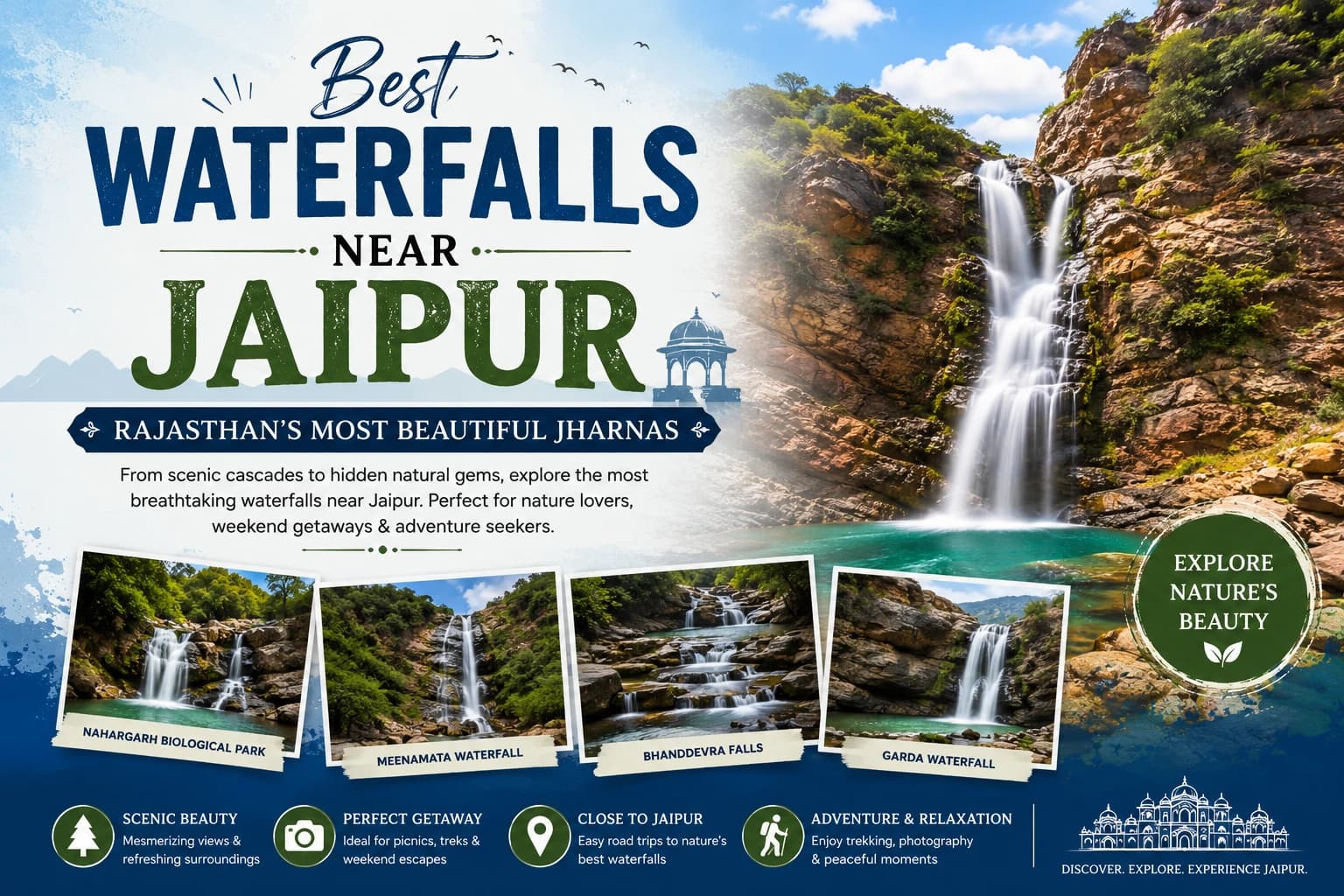
People do not think of Jaipur when they think of waterfalls. They think of Rajasthan and they see sand - the ochre-gold dunes of Jaisalmer, the fortress silhouettes of Jodhpur against a white sky, the flat salt plains of Sambhar Lake. Waterfalls, surely, belong to Coorg, Munnar, or Meghalaya.
And then the monsoon arrives in Rajasthan.
Between July and September, something extraordinary happens to the landscape around Jaipur. The Aravalli Hills - the world's oldest mountain range, ancient beyond geology's ability to fully measure - absorb millions of litres of monsoon rain, turn vivid green, and send the water rushing down their flanks in cascades and channels and falls that would look at home in any hill station in India. The semi-arid landscape transforms completely, and within driving distance of the Pink City, waterfalls that are invisible for nine months of the year come alive in a blaze of white water and green rock.
At The Jaipur Vista, we have spent years exploring these seasonal and perennial waterfalls near Jaipur - chasing them in the post-monsoon green, photographing them in the first light of October mornings, driving the back roads of Alwar, Bundi, Chittorgarh, and Sikar in search of Rajasthan's most underrated natural wonders. This is our definitive 2026 guide to the 12 best waterfalls near Jaipur - complete with honest descriptions, precise distances, photography guidance, and everything you need to plan the perfect waterfall trip from Jaipur.
Before we dive into the list, it is worth understanding the geography that makes waterfalls in Rajasthan possible - because once you understand the landscape, the locations and seasonality of each fall will make intuitive sense.
The Aravalli Mountain Range runs diagonally through Rajasthan from the northeast (near Delhi) to the southwest (into Gujarat), passing directly through the Jaipur region. These hills - rising to 1,722 metres at their highest point at Guru Shikhar in Mount Abu - create significant elevation variation across the state, and during the monsoon season (June-September), the orographic rainfall they generate is substantial.
The monsoon rains fill the Aravalli streams and rivers rapidly - and where those streams encounter rock outcrops, steep hillsides, or gorges, they form waterfalls (jharna) of varying sizes and seasonal duration. Some of these jharnas near Jaipur flow only during the peak monsoon; others persist through October and November on the strength of the monsoon runoff. A small number - fed by perennial springs or substantial river catchments - flow year-round.
Understanding which falls are perennial and which are seasonal will save you a wasted trip - which is why our guide specifies the best time to visit for each waterfall with precision.
Location: Near Bundi, Rajasthan
Distance from Jaipur: ~210 km (approximately 3.5–4 hours by road)
Height: Approximately 60 metres (196 feet)
Best Time to Visit: July to November
Entry Fee: None
Timings: Open all day (best visited 7:00 AM – 5:00 PM)
Nearest Railway Station: Bundi (~30 km)
Nearest City: Bundi
Why it ranks #1:
If you visit only one waterfall near Jaipur in your lifetime, make it Bhimlat. Tucked within the gorge country between Bundi and Chittorgarh - in a landscape of dramatic sandstone cliffs draped with monsoon greenery and framed by the ancient Chambal riverine ecosystem - Bhimlat Falls is the most visually magnificent and historically resonant waterfall in Rajasthan within reasonable driving distance of Jaipur.
The waterfall is formed by the Mej River plunging approximately 60 metres off a sheer sandstone escarpment into a pool below. At peak monsoon flow (August-September), the falls are a full, thundering curtain of white water that sends up a perpetual mist cloud - cool, refreshing, and extraordinary in the otherwise warm Rajasthani landscape.
The name Bhimlat derives from the Mahabharata - Bhim refers to the mighty Pandava warrior Bhima, and local legend holds that the waterfall was created when Bhima struck the earth with his legendary gada (mace) to draw water for his thirsty brothers during their wanderings in the forest. The pool at the base of the falls is called Bhimlat Kund, and a small temple to Bhima exists near the site.
The rock formation at the base of the falls is extraordinary - the centuries of water flow have carved the sandstone into smooth, curved formations that catch the light beautifully, and the pool is surrounded by vegetation that, during the monsoon, is an almost impossibly lush tropical green.
Photography notes: The falls face roughly westward, making them best photographed in the morning light (which falls on the rock face) and at golden hour (which illuminates the mist cloud). A wide-angle lens is essential for the full curtain shot. Drone photography is spectacular here - the gorge below the falls, with the green valley opening beyond, is one of the finest landscapes in south Rajasthan.
How to Reach: Drive from Jaipur via Tonk and Bundi on NH-52 and state highways. The last stretch to the falls from Bundi town involves approximately 30 km of reasonable state road. From Bundi, local taxis and autos can take you to the falls.
Nearby Attractions: Bundi town itself is one of Rajasthan's most charming and least-touristed heritage destinations - the Bundi Palace with its extraordinary frescoes, Taragarh Fort, and the famous step wells (baoris) of Bundi are all within a few kilometres and make Bhimlat an excellent two-day trip from Jaipur.
Location: Near Rajgarh, Alwar District
Distance from Jaipur: ~150 km (approximately 2.5–3 hours)
Height: Approximately 300 metres (in multiple tiers)
Best Time to Visit: July to October
Entry Fee: None
Timings: Dawn to Dusk
Nearest Railway Station: Alwar (~40 km)
The Garwaji Waterfall (also spelled Garbhaji, meaning "waterfall of the womb" - a reference to the cave-like depression at its base) is arguably the most spectacular waterfall in Rajasthan's Aravalli belt and one of the most underrated natural attractions in the entire northern region.
Situated within a dramatic Aravalli gorge near Rajgarh in Alwar district, the Garwaji Falls is actually a series of cascades descending through multiple tiers of the gorge - the total vertical descent across all tiers is substantial, with the main single drop estimated at approximately 300 metres (though the full flowing height varies significantly with rainfall).
What makes Garwaji exceptional is not just the falls themselves but the entire landscape surrounding them. The gorge is clothed in dense scrub forest - home to leopards, sambar deer, wild boar, and peacocks - and the road to the falls passes through some of the most beautiful Aravalli terrain in the Alwar district. The Aravalli Canal runs near the base of the gorge, adding to the water-rich atmosphere.
The falls are surrounded by beautiful hilly landscape that invokes photographers to capture some great pieces here. The most impressive views are from the top of the gorge looking down, and from a rocky promontory partway down that gives a clear view of the main curtain.
Getting there: The falls require a trek of approximately 2–3 km from the nearest road access point, through forest terrain. A guide from Rajgarh town is strongly recommended - the path is not well marked and the terrain can be slippery after rain.
Photography notes: The falls are best photographed in full monsoon (August) when the flow is maximum. The gorge walls reflected in the pool below the main falls create extraordinary mirror images in the calm morning light.
Location: Menal, Chittorgarh District
Distance from Jaipur: ~260 km (approximately 4–4.5 hours)
Height: Approximately 50 metres (150 feet)
Best Time to Visit: July to October
Entry Fee: None
Timings: Open all day
Nearest Railway Station: Chittorgarh (~65 km) or Bhilwara (~45 km)
Menal is one of those places where Rajasthan reveals layers that most travellers never see - a site where a spectacular natural waterfall in Rajasthan shares its geography with a remarkable complex of ancient Shiva temples from the 9th–11th century CE Pratihara and Chahamana periods.
The Menal Waterfall is formed by the Menal River (a tributary of the Banas) plunging off a sandstone escarpment in a series of cascades that, at peak monsoon flow, creates an impressive spectacle in the surrounding cliff landscape. The area around the falls is rich in vegetation - scrub forest, flowering seasonal plants, and the pale sandstone of the cliffs - and the water has carved out deep, curved channels in the rock below.
What makes Menal truly extraordinary is its companion: the Menal Temple Complex - a group of ancient Shaivite temples that stand directly above the waterfall gorge, their carved sandstone shikhars reflected in the river pools below. The temples date to approximately the 9th–11th century CE and contain some of the finest stone carvings in the region - including kama sutra panels reminiscent of Khajuraho (earning Menal the occasional description of "Chittorgarh's Khajuraho").
The combination of the ancient temples, the gorge landscape, and the monsoon waterfall makes Menal one of the most layered and rewarding day trips from Jaipur in the entire state.
How to Reach: Drive from Jaipur via Tonk, Bundi, and Bhilwara. The Menal temple and waterfall complex is well-signposted from the main road.
Nearby Attractions: The Badoli Temple Complex (30 km from Menal) is another extraordinary group of ancient Shaivite temples from the same period. Combining Menal and Badoli makes for a superlative day of historical and natural exploration.
Location: Dadhikar Forest Area, Alwar District
Distance from Jaipur: ~145 km (approximately 2.5 hours)
Height: ~100 feet
Best Time to Visit: July to October
Entry Fee: None
Timings: Throughout the day
Nearest Railway Station: Alwar (~25 km)
The Dadhikar Waterfall in the forest area near Alwar is one of the most accessible waterfalls near Jaipur and a popular monsoon day trip for families and groups from the Pink City.
The falls are situated within the dense forest landscape of the Sariska Tiger Reserve buffer zone - which means the drive to the falls passes through some of the most scenically rewarding terrain in the Alwar district. Wild animals including nilgai, langur monkeys, peacocks, and (occasionally) leopards are spotted on the forest roads in this area.
The waterfall itself - though not the tallest on our list - has a charm born of its setting: framed by ancient Aravalli rock formations, surrounded by monsoon-green forest, and accessible via a short, enjoyable walk through the forest from the road. The pool at the base of the falls is clear enough for wading in the early months of the monsoon season.
Practical tip: Carry your own food and water. Facilities at the falls are non-existent; the nearest town with services is Alwar.
Location: Amer (Amber), Jaipur
Distance from Jaipur City Centre: ~12 km
Best Time to Visit: July to September (monsoon only)
Entry Fee: ₹10 (park entry)
Nearest Landmark: Amer Fort
Strictly speaking, Panna Meena Ka Kund is not a waterfall - it is one of Jaipur's most photographed ancient step wells (baoris), located a short walk from Amer Fort. But during heavy monsoon rainfall, the surrounding hillsides feed water into the kund through natural channels and overflow points, creating temporary cascades that tumble down the geometric stone steps of the kund in a genuinely spectacular display.
We include it in our waterfalls in Jaipur list because it is the only location within the city limits that produces a waterfall-like experience - and because the combination of the ancient carved geometry of the kund with cascading monsoon water creates photographs of extraordinary beauty that are unlike anything else in Jaipur.
Beyond the monsoon effect, the Panna Meena Ka Kund is worth visiting in its own right year-round - its perfectly symmetrical inverted pyramid of carved stone steps, adorned with covered pavilions at each level, is one of the finest examples of the step well tradition in Rajasthan.
Photography notes: The best monsoon waterfall photographs here are taken from the top landing, looking down into the kund as water cascades down the steps. Come immediately after heavy rainfall for the most dramatic effect. Early morning light (7:00–9:00 AM) gives the best conditions before the tourist crowds arrive.
Location: Near Rajgarh, Alwar District
Distance from Jaipur: ~160 km (approximately 2.5–3 hours)
Height: ~750 feet (in cascades through a long valley)
Best Time to Visit: June to September
Entry Fee: None
Timings: Throughout the day
The Alewa Waterfall - also spelled Alewa Dham Waterfall - is an offbeat, genuinely unspoiled waterfall near Jaipur in the Alwar district that remains largely off the mainstream tourist radar. This is both its greatest strength (the site is pristine and uncluttered by the commercial infrastructure of more popular falls) and its main practical challenge (facilities are minimal and road access requires some navigation).
The waterfall flows through a long, narrow valley in the Aravalli Hills, with the water tumbling down in multiple cascades through a terrain of large boulders, forest scrub, and ancient Aravalli rock formations. The site is a local bathing spot - on weekend mornings during the monsoon, you will encounter families from the surrounding villages and small towns who come here for a refreshing soak.
Ideal for: Travellers who want an authentic, crowd-free experience of a Rajasthani monsoon jharna - and who are comfortable with basic facilities and some navigation uncertainty.
Location: Near Hathi Bhata Village, Dausa District
Distance from Jaipur: ~85 km (approximately 1.5–2 hours)
Best Time to Visit: July to October
Entry Fee: None
Timings: Dawn to Dusk
Nearest Town: Sikandra (Dausa)
The Hathi Bhata Waterfalls - named for the elephant-shaped rock formation (hathi = elephant, bhata = rock/stone) near the site - represent the closest reasonably impressive waterfall near Jaipur that a day-tripper can reach without a long drive.
Located in the Dausa district on the eastern Jaipur periphery, the Hathi Bhata area combines the waterfall with a fascinating landscape of unusual rock formations - the large, weathered granite boulders characteristic of this part of the Aravalli terrain take on extraordinary shapes that have inspired local naming traditions (hence the elephant rock).
The monsoon waterfall at Hathi Bhata flows through a series of small cascades over and between the giant boulders, creating a landscape that is particularly photogenic - the combination of smooth grey granite, cascading water, monsoon-green vegetation, and the occasional peacock perched on a boulder creates a scene quite unlike any other waterfall in Rajasthan's central belt.
Best for: Families with children, photography enthusiasts, and travellers who want a shorter drive for a satisfying waterfall near Jaipur experience.
Location: Near Rawatbhata, Chittorgarh District
Distance from Jaipur: ~295 km (approximately 4.5–5 hours)
Best Time to Visit: July to November
Entry Fee: None
Timings: Open all day
Nearest Railway Station: Baran (~80 km) or Kota (~65 km)
The Rawatbhata Falls - located near the nuclear research township of Rawatbhata on the Rajasthan-Madhya Pradesh border, where the Chambal River cuts through dramatic rock formations - is one of the largest and most powerful waterfalls in Rajasthan during the monsoon season.
Formed by a tributary of the Chambal River falling over a basalt outcrop, the falls at Rawatbhata are particularly impressive in August and September when the monsoon swells the river. The surrounding landscape - a dramatic, rugged terrain of black basalt, deep green forests, and the Chambal gorge system - is strikingly different from the sandstone Aravalli scenery of the falls near Jaipur and Alwar.
The nearby Chakreshwar Mahadev Temple on the river bank is an ancient Shiva temple that adds a spiritual dimension to the visit - the combination of the temple, the river, and the falls makes Rawatbhata a particularly atmospheric destination.
Note: The Rawatbhata Nuclear Power Plant is located in this area - visitors should stay on public roads and designated areas, and avoid approaching restricted zones.
Location: Near Kelwara, Baran District
Distance from Jaipur: ~305 km (approximately 5–5.5 hours)
Height: ~50 feet
Best Time to Visit: June to September
Entry Fee: None
Timings: 5:00 AM – 7:00 PM
Nearest Railway Station: Baran (~35 km) or Kota (~60 km)
The Gaipernath Waterfall near Kelwara in Baran district is distinguished from others on this list by its intimate connection with a sacred site - the Gaipernath Mahadev Temple, a Lord Shiva temple situated in a dramatic natural gorge where the waterfall flows past the temple walls during the monsoon.
The temple is ancient - carved into the natural rock of the gorge rather than built above it - and the combination of the cave shrine, the sheer rock walls of the gorge, the dense overhanging forest, and the monsoon waterfall creates one of the most atmospherically distinctive pilgrimage experiences in south Rajasthan.
Both the falls and the temple are accessible via a steep but manageable descent into the gorge from the car park above. The area is particularly busy on festival days - especially Maha Shivratri and Savan Somvar (Mondays of the holy month of Savan).
Nearby: The beautiful Shahabad Fort (approximately 30 km from Gaipernath) and the scenic Ramgarh Vishdhari Wildlife Sanctuary are excellent companions to a Gaipernath trip, making this an excellent 2-day excursion from Jaipur.
Location: Near Kelwara, Baran District
Distance from Jaipur: ~345 km (approximately 5.5–6 hours)
Best Time to Visit: July to September
Entry Fee: None
Nearest Railway Station: Baran (~45 km)
Sitabari is a remarkable pilgrimage site in the Baran district's forest belt where a natural spring-fed waterfall has been revered for centuries as the spot where Sita - wife of Lord Rama - took refuge and gave birth to the twins Lav and Kush during her exile in the forest (Valmiki's Ashram).
The site combines natural beauty (the waterfall, the sacred kunds, the ancient trees and forest) with profound mythological significance. Multiple sacred kunds - Sita Kund, Lav Kund, Kush Kund, Valmiki Kund - are associated with specific events from the Ramayana narrative. The waterfall that feeds these kunds flows year-round from natural springs, though it is most impressive during and after the monsoon.
A major fair is held at Sitabari in the month of Jyeshtha (May-June) that draws very large numbers of pilgrims from across the Hadoti region and beyond.
Ideal for: Pilgrims and travellers interested in the intersection of natural beauty and Ramayana mythology. The site has a contemplative, forest-hermitage atmosphere very different from the tourist feel of more accessible waterfalls.
Location: Near Neel Kanth, Alwar District
Distance from Jaipur: ~155 km (approximately 2.5–3 hours)
Best Time to Visit: July to October
Entry Fee: None
Timings: 6:00 AM – 8:00 PM
Nearest Railway Station: Alwar
The Neel Kanth Mahadev Waterfall is adjacent to the ancient Neelkanth Mahadev Temple - a complex of beautifully carved Shiva temples from the 6th–9th century CE that is one of Alwar district's most significant archaeological heritage sites - situated in the forest on the eastern slopes of the Aravalli range.
The temple complex contains an extraordinary wealth of sculptural art - carved panels depicting Shiva in multiple forms, celestial beings (apsaras and gandharvas), and mythological narratives - that would be a major tourist attraction if it were better known. During the monsoon, the stream that runs through the temple complex fills and creates a waterfall effect over the carved stone platforms and bathing ghats near the main shrine.
Visiting Neel Kanth combines the best of Rajasthan's archaeological heritage with the beauty of a monsoon waterfall in the Aravalli forest - a combination that is genuinely unique.
How to Reach: From Jaipur, take the NH-148 towards Alwar, then proceed via Rajgarh. The last section to the temple involves a forest road that is accessible by car but can be challenging in wet conditions. Local guides from Alwar city are recommended.
Location: Near Khandela/Uchhalda, Sikar District
Distance from Jaipur: ~95 km (approximately 1.5–2 hours)
Best Time to Visit: July to September
Entry Fee: None
Timings: Dawn to Dusk
The Uchhalda Waterfall in the Sikar district is the closest falls to Jaipur on our list that involves a genuine mountain-descent waterfall - formed by the seasonal streams of the Aravalli foothills near Khandela flowing over a rocky escarpment during the monsoon.
The area around Khandela is rich in historical associations - the town has an ancient fort and several old temples - and the waterfall trip can easily be combined with a historical exploration of the Khandela area for a satisfying half-day excursion from Jaipur.
The falls are modest compared to the grandeur of Bhimlat or Garwaji, but their proximity to Jaipur - and the fact that they can be reached quickly when the mood for a monsoon waterfall strikes - makes them a practical and enjoyable option for Jaipur residents and visitors who cannot commit to a longer drive.
Understanding the seasonal pattern of waterfalls in Rajasthan is essential for planning a successful trip.
The single best month for waterfall visits near Jaipur: September - the monsoon has done its work filling the rivers, the sky has begun to clear, the temperatures are lower, the roads are better than in July-August, and the landscape is still brilliantly green. September is when The Jaipur Vista most recommends visiting the waterfalls near Jaipur. For Jaipur residents planning weekend waterfall trips through the monsoon season, here is a practical weekly planner: July (Early Monsoon): Focus on the closer falls - Hathi Bhata (85 km) and Uchhalda (95 km) - as the rains are beginning but heavy monsoon rains may make longer drives challenging. July–August (Peak Monsoon): All falls are flowing at maximum. Best time for Garwaji, Dadhikar, and Alewa in Alwar district (150–160 km). Check road conditions before setting out. August–September (Peak to Post-Monsoon): The best window for the longer drives - Bhimlat (210 km), Menal (260 km). All major falls on our list are active. September–October (Post-Monsoon Peak): Ideal conditions overall. Drive to Bhimlat + Bundi for a two-day trip. Combine with Menal Temples if driving towards Chittorgarh. October–November: Bhimlat and Rawatbhata are still worth visiting. Most others will be reduced or dry. For photographers, the waterfalls near Jaipur offer some of the most rewarding and original subject matter available in Rajasthan - because they are unexpected, and unexpected beauty always makes for the most compelling images. Wide-angle lens (14–24mm): Essential for capturing both the full height of larger falls like Bhimlat and the surrounding landscape context. Telephoto (70–200mm): Useful for detail shots of the rock formations, birds in the mist, and distant sections of cascading water. Circular Polarising Filter: Cuts the glare from wet rocks and water surfaces, makes the green of the surrounding vegetation richer, and deepens the blue of the sky behind the falls. More useful at Rajasthan waterfalls than in most other contexts because the surrounding landscape is lighter and reflective. Neutral Density (ND) Filter (6-stop or 10-stop): Allows long exposures in daylight - essential for the silky-smooth water effect that transforms falling water from a frozen splash into a flowing curtain. For shots of Bhimlat and Garwaji especially, an ND filter will give you waterfall photographs that look professional rather than amateur. Tripod: Required for all ND filter and long-exposure work. Also useful in the low light of the gorge at Gaipernath and Neel Kanth. Long Exposure (Silky Water): Set your camera to Aperture Priority mode (f/11–f/16), ISO 100, and use your ND filter to reduce light entering the lens. Shutter speeds of 1–5 seconds will give you the silky waterfall effect. Use a remote shutter or timer to avoid camera shake. Short Exposure (Frozen Motion): For the power and drama of a full-flow monsoon waterfall, use a fast shutter speed (1/500s – 1/1000s) to freeze individual droplets and capture the spray. This works particularly well at Bhimlat during peak monsoon. Environmental Context: The falls themselves are only part of the story. Include the gorge walls, the surrounding forest, the carved rock formations, or a human figure for scale. The green Aravalli landscape framing a white cascade is specifically Rajasthani - do not crop it out. Sunrise and Golden Hour: Arrive at the falls before sunrise. In the golden hour following sunrise, the light in gorges and valleys is warm and directional - it picks out the texture of wet rock and illuminates the spray beautifully. By midday, the light is harsh and unflattering. Monsoon Sky: Do not wait for clear skies at a waterfall. The dramatic cloud formations of the monsoon - towering cumulonimbus, layered stratus, the occasional dramatic shaft of light through cloud gaps - are part of the visual vocabulary of monsoon Rajasthan and should be used compositionally. This is not a section to skip. Every year, accidents occur at waterfalls across India - including Rajasthan - often because visitors underestimate the power of monsoon water, the slipperiness of wet rock, or the speed with which river levels can rise. The most important rule: Never enter the water directly under or near a waterfall during or immediately after heavy rain. The current generated by the falls can be very strong and entirely invisible from the surface. Sudden upstream rain - which you cannot see or predict - can cause instant flooding. Footwear: Wear closed-toe shoes with good grip - specifically trail shoes or trekking sandals. Never attempt to approach falls barefoot or in flip-flops on wet rock. This is the single most common cause of falls and injuries at waterfall sites. Rock surfaces: Even the flattest-looking wet rock near a waterfall is likely to be extremely slippery. Approach with exaggerated caution - lean into the rock, move slowly, and test each footstep before committing your weight. Children: Keep children within arm's reach at all times near waterfall edges. The excitement of the environment can override their natural caution. Swimming: Many waterfalls near Jaipur have pools at their base. Swimming in these pools can be enjoyable but should be approached with caution - check the current, the depth, and the underwater terrain before entering. Never dive headfirst into a waterfall pool. Monsoon flooding: If it has rained heavily upstream in the past 24 hours - even if it is not raining at the waterfall site - the water level and current in rivers near waterfalls can increase dramatically without warning. Always be aware of the upstream weather situation. Mobile connectivity: Many waterfall sites in the Aravalli Hills have poor or no mobile connectivity. Inform someone of your intended route and expected return time before setting out. For Hathi Bhata: Depart Jaipur at 7:00 AM, arrive by 9:00 AM, spend 2–3 hours at the falls and exploring the rock formations, return to Jaipur by afternoon. Total distance: ~170 km round trip. For Garwaji or Dadhikar (Alwar): Depart 6:00 AM, reach falls by 9:00 AM, spend 3–4 hours, return via Alwar city (stop for Alwar ka milkcake - a local delicacy), back in Jaipur by evening. Total: ~300 km round trip. Day 1: Jaipur → Bundi → Bhimlat Waterfall (afternoon visit) → Overnight in Bundi (stay at one of Bundi's excellent heritage guesthouses). Day 1: Jaipur → Dadhikar Falls (Alwar) → Neel Kanth Temple & Waterfall → Overnight in Alwar. Closed-toe shoes with grip (trail shoes or sturdy sandals - never flip-flops) Quick-dry clothing (you will get wet; synthetic fabrics dry much faster than cotton) Extra change of clothes (sealed in a plastic bag in your backpack) Rain jacket or poncho (monsoon rains are unpredictable) Sufficient water (2 litres per person minimum - facilities at waterfalls are limited) Packed food or snacks (restaurants and dhabas may not be near the falls) Sealed waterproof bag or dry bag for electronics First aid kit (basic - plasters, antiseptic, crepe bandage) Fully charged phone with offline maps downloaded (Google Maps offline area download recommended before departure) Camera gear in waterproof protection Sunscreen and sunglasses (for the drive and any exposed sections) Most travellers come to Rajasthan in winter - when the forts are golden and the sky is blue and the heritage circuit unfolds in perfect photogenic clarity. They see a magnificent landscape but they miss something essential: Rajasthan in the rain. The monsoon transforms this landscape in ways that are genuinely hard to believe if you have only seen it in winter or summer. The ancient Aravalli Hills turn green. The seasonal rivers fill and run fast. And in a state that most people associate exclusively with desert, waterfalls appear - in gorges and valleys and over sandstone escarpments - as if the land is reminding you that it was never simply what it appeared to be. The waterfalls near Jaipur are that reminder. The best waterfall in Jaipur's reach - Bhimlat, with its 60-metre curtain of white water and its Mahabharata mythology and its ancient sandstone gorge - is not just a scenic attraction. It is Rajasthan showing you a side of itself that most visitors never see, and that those who do see never forget. Pack your rain jacket, charge your camera, and go. Q. What are the best waterfalls near Jaipur? Q. Jharna kahan hai Jaipur ke paas? (Where is a waterfall near Jaipur?) Q. Is there any waterfall in Jaipur city itself? Q. What is the best time to visit waterfalls near Jaipur? Q. Which waterfall near Jaipur is closest to the city? Q. Are there any waterfalls in Rajasthan that flow year-round? Q. Are waterfalls near Jaipur safe to visit? Q. Can I visit Bhimlat Waterfall as a day trip from Jaipur? Jharna in Jaipur: The Monsoon Weekend Waterfall Calendar
Photography Guide: Capturing Rajasthan's Waterfalls
Essential Equipment
Shooting Techniques
Safety at Rajasthan Waterfalls: What You Must Know
How to Plan the Perfect Waterfall Day Trip from Jaipur
Day Trip (Single Waterfall)
Weekend Trip (Multiple Waterfalls)
Day 2: Morning at Bundi's heritage sights (Palace, step wells) → Drive to Menal Waterfall and Temples (1.5 hours from Bundi) → Return to Jaipur via Tonk.The Alwar Waterfall Circuit (Two Days)
Day 2: Garwaji/Garbhaji Falls → Alewa Falls → Return to Jaipur.What to Carry for a Waterfall Trip Near Jaipur
Final Word: Rajasthan's Hidden Monsoon Soul
Frequently Asked Questions: Waterfalls Near Jaipur
The best waterfalls near Jaipur are Bhimlat Waterfall (Bundi, 210 km), Garwaji/Garbhaji Waterfall (Alwar, 150 km), Menal Waterfall (Chittorgarh, 260 km), and Dadhikar Waterfall (Alwar, 145 km). Bhimlat is considered the most spectacular waterfall in Rajasthan within driving distance of Jaipur.
Jaipur ke paas sabse prasiddh jharna Bhimlat Waterfall (Bundi, 210 km), Garwaji Waterfall (Alwar, 150 km), aur Hathi Bhata Waterfall (Dausa, 85 km) hain. (The most famous waterfalls near Jaipur are Bhimlat, Garwaji, and Hathi Bhata.)
There is no permanent waterfall in Jaipur city. However, during heavy monsoon rainfall, the hillsides around Nahargarh Fort and the Panna Meena Ka Kund step well in Amer create impressive seasonal cascades. These are the closest thing to a waterfall in Jaipur proper.
September to October is the best time - the monsoon has fully charged the falls but the weather is more manageable than during peak monsoon (July-August). The falls are at excellent flow and the landscape is brilliantly green.
The closest waterfall near Jaipur is Hathi Bhata Waterfall in Dausa district at approximately 85 km. For something within the Jaipur area itself, the seasonal monsoon cascades at Panna Meena Ka Kund, Amer (12 km) are the nearest waterfall-like experience.
Yes - Sitabari Waterfall (Baran district) and Neel Kanth Mahadev (Alwar district) are fed by perennial springs and flow throughout the year, though they are most impressive during and after the monsoon. Most other waterfalls near Jaipur are seasonal.
Yes, with appropriate precautions. Wear proper footwear, never enter the water during active rainfall or if you see the water level rising, keep children supervised near the water's edge, and avoid standing directly under the falls during peak monsoon flow. September and October are safer months than July-August for visiting most waterfalls near Jaipur.
Yes - Bhimlat Waterfall is 210 km from Jaipur, approximately 3.5–4 hours by road. Departing by 6:00 AM allows you to reach by 10:00 AM, spend 2–3 hours at the falls, and return to Jaipur by evening. However, an overnight stay in Bundi is highly recommended to fully appreciate both the waterfall and the town.