Sambhar Lake, Rajasthan: Complete Guide to India's Largest Salt Lake (2026)
Author:Niharika
Published:June 30, 2026
Views:2128
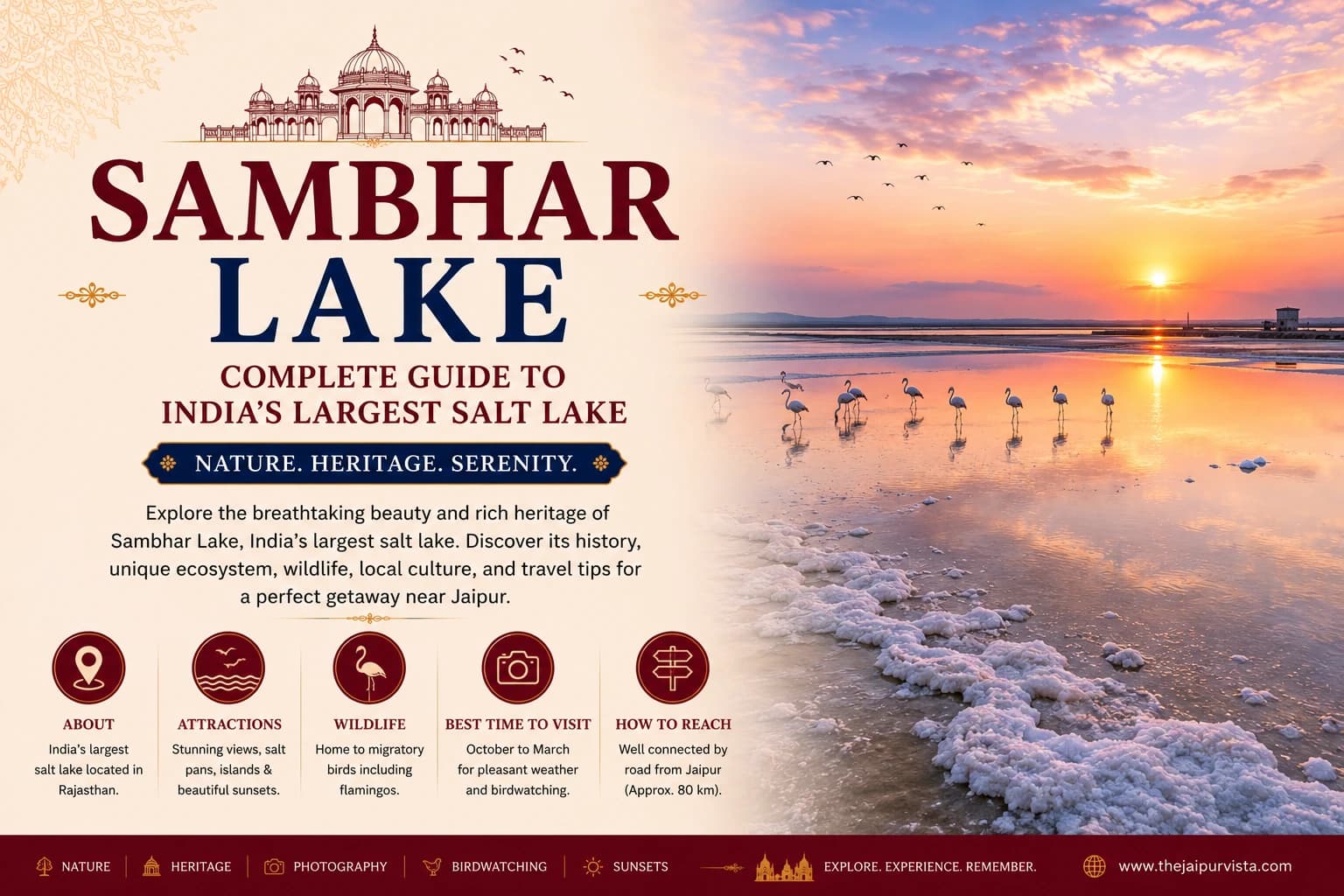
If you've typed "sambhar lake is located in which state" into Google, here's your one-line answer: Sambhar Lake is located in Rajasthan, India, roughly 80 kilometres southwest of Jaipur city, spread across the Jaipur, Nagaur, and Ajmer districts. But that's just the opening line of a much bigger story - one that involves a goddess, a vanished kingdom, thousands of migratory flamingos, and nearly 200,000 tonnes of salt produced every single year.
This guide covers everything a real traveler - not just a search engine - needs to know before visiting Sambhar Lake, Rajasthan: where exactly it is, the legend behind its name, when to go, what to see, and how to plan the trip from Jaipur.
Sambhar Salt Lake is located in the state of Rajasthan, India. It is India's largest inland saltwater lake, stretching across three districts - Jaipur, Nagaur, and Ajmer - though the town of Sambhar Lake itself, and the main access point for most tourists, falls within Jaipur district, about 65–80 km from Jaipur city.
So if you're searching "Sambhar Lake in which district," the most accurate answer is: it primarily lies in Jaipur district, with parts of the lake basin extending into Nagaur and Ajmer districts as well. This is why you'll often see it referred to interchangeably as "Sambhar Lake Jaipur" in travel content - it's the nearest major city and the most common base for visiting.
Quick facts at a glance:
Country: India
State: Rajasthan
Districts: Jaipur (primary), Nagaur, Ajmer
Nearest City: Jaipur (approx. 65–80 km)
Length: Approximately 35.5 km
Width: Varies between 3 km and 11 km
Type: Inland saline (salt water) lake
Status: India's largest inland salt lake
Long before it was a salt lake, this land carries a story rooted in devotion. The name Sambhar is believed to be derived from Maa Shakambari Devi, the tutelary goddess of the Chauhan Rajput dynasty - which is why locals and pilgrims often refer to it as Shakambari Jheel (Shakambari Lake).
Local legend says that around the 6th century, this area was a dense forest. Goddess Shakambari, an incarnation of Durga, is said to have blessed the land, turning it into a plain glittering with jewels. But the local inhabitants feared the greed and conflict such wealth would invite, so they prayed for a different blessing - and the goddess transformed the silver-jeweled plain into a tranquil lake instead. That lake became Sambhar.
There's also a Mahabharata-era reference: the region is believed to have once been part of the kingdom ruled by the demon king Vrishaparva, adding another layer of mythology to this already storied landscape.
Whether you come for the geography or the folklore, Sambhar Lake - or Shakambari Jheel, as devotees call it - carries a sense of sacred history that few salt lakes in the world can match.
Geologically, Sambhar Lake sits in a natural depression between the Aravalli hills. It's fed by several seasonal rivers - including the Mendha, Rupangarh, Khari, and Khandela - none of which have an outlet. This means water flows in but has no way to flow out, so over thousands of years, evaporation has left behind a thick, mineral-rich layer of salt across the lakebed.
This is also why the lake's appearance changes dramatically with the seasons:
Monsoon (July–September): The lake fills with water and takes on a shallow, mirror-like appearance.
Post-monsoon to winter (October–February): Water levels drop, salt crystallizes, and the lake becomes a stunning expanse of white salt flats - often compared to a smaller version of the Rann of Kutch.
Summer (March–June): The lake is almost entirely dry, with cracked salt-crusted earth stretching to the horizon.
Sambhar Lake isn't just a scenic stop - it's an economic powerhouse for Rajasthan. The lake produces approximately 196,000 tonnes of salt annually, accounting for nearly 9% of India's total salt production. Salt harvesting here has been documented for centuries, and the Sambhar Salts Ltd. facility (a joint venture historically linked to Hindustan Salts) continues operations that supply salt across northern India.
Walking along the embankments near the salt pans, you'll see workers raking crystallized salt into mounds - a visual that's become iconic in Rajasthan travel photography.
Come winter, Sambhar Lake transforms into one of India's most important wetland habitats for migratory birds. Thousands of flamingos - both greater and lesser flamingo species - arrive from as far as Siberia, Mongolia, and parts of Europe, turning the shallow saline waters a soft shade of pink.
Alongside flamingos, the lake attracts:
Pelicans
Ruddy shelducks
Sandpipers
Avocets
Various species of plovers and ducks
The high salinity of the water supports brine shrimp and algae, which form the primary food source drawing these birds in such large numbers - making Sambhar one of the most significant Ramsar-recognized wetlands in India for migratory bird conservation.
If you only remember one practical tip from this guide, make it this: timing your visit makes or breaks the experience.
This is, without question, the best time to visit Sambhar Lake. Daytime temperatures hover between 15–25°C, making it pleasant for sightseeing. More importantly, this is flamingo season - the lake fills with thousands of migratory birds, and the cooler air makes the white salt flats glisten beautifully under the winter sun.
The lake fills with rainwater and offers a completely different, almost surreal visual - vast sheets of shallow water reflecting the sky. Bird activity is lower during this period, but the landscape photography opportunities are unique.
Daytime temperatures can soar past 40°C, and the lake is mostly dry. Not recommended for a comfortable visit, though early morning or sunset visits are still possible for those chasing dramatic, stark desert-salt photography.
Best time of day: Regardless of season, visit during sunrise or sunset. The way light reflects off the salt crust creates a mirror-like, almost otherworldly glow that's become Sambhar Lake's signature photographic moment.
Since most travelers approach via Sambhar Lake Jaipur routes, here's the breakdown:
By Road: Sambhar Lake town is approximately 65–80 km from Jaipur city via NH 48 and connecting state highways - roughly a 1.5 to 2-hour drive. Private taxis and self-drive are the most convenient options.
By Rail: Sambhar Lake has its own railway station (Sambhar Lake Railway Station), connected to Jaipur Junction. It's a scenic, budget-friendly way to reach the lake.
By Air: The nearest airport is Jaipur International Airport (JAI), about 70–85 km away, with Kishangarh Airport (near Ajmer) as a secondary option.
A trip to Sambhar Lake pairs well with a few nearby spiritual and historical sites:
Devyani Kund (Chota Pushkar): A sacred water tank associated with goddess Ganga, considered a smaller, more peaceful alternative to Pushkar.
Devyani Temple: Located beside the kund, dedicated to the goddess and frequented by local pilgrims.
Baba Jageshwar Temple: An ancient Shiva temple near Devyani Kund, reflecting the region's deep spiritual roots.
Naliasar Archaeological Site: Ancient ruins near Sambhar believed to date back over a thousand years, of interest to history enthusiasts.
Entry & Timings: The lake is open from sunrise to sunset; there's generally no entry fee for the open salt flat areas, though guided tours of working salt pans may have separate access rules.
What to Carry: Sunglasses and sunscreen (the salt glare is intense), comfortable walking shoes, water, and a camera with a polarizing filter if you're serious about photography.
Caution: Avoid walking too far onto soft or wet salt patches, especially post-monsoon - some areas can be marshy and unstable.
Photography: Early morning and late afternoon offer the best light. Drone photography may require local permissions, so check ahead.
Duration: A half-day trip from Jaipur is sufficient, though birdwatchers may want to allocate a full day during winter.
Few destinations near Jaipur offer the sheer contrast that Sambhar Lake does - a place that's mythological in origin, industrial in function, and breathtakingly scenic in appearance, often within the same square kilometre. Whether you're chasing flamingo season, hunting for the perfect salt-flat sunset photo, or simply curious why a desert state has India's largest salt lake, Sambhar deserves a spot on your Rajasthan itinerary.
Planning more day trips around Jaipur? Explore our other Rajasthan travel guides on The Jaipur Vista for itineraries, hidden gems, and seasonal travel tips.
Q1. Sambhar Lake is located in which state?
Sambhar Lake is located in the state of Rajasthan, India.
Q2. Sambhar Lake is in which district?
The lake primarily lies in Jaipur district, with its basin also extending into Nagaur and Ajmer districts.
Q3. How far is Sambhar Lake from Jaipur?
Sambhar Lake is approximately 65–80 km from Jaipur city, about a 1.5–2 hour drive.
Q4. What is Sambhar Lake also known as?
It is also referred to as Shakambari Jheel, named after the goddess Shakambari Devi, the tutelary deity of the Chauhan Rajput dynasty.
Q5. What is the best time to visit Sambhar Lake?
The best time to visit Sambhar Lake is between November and February, during winter, when flamingos migrate to the lake and temperatures are pleasant.
Q6. Is Sambhar Lake a saltwater or freshwater lake?
Sambhar Lake is India's largest inland saltwater lake.
Q7. Why is Sambhar Lake famous?
It's famous for being India's largest inland salt lake, contributing about 9% of India's total salt production, and for hosting thousands of migratory flamingos every winter.