Panna Meena ka Kund Jaipur – The Hidden Stepwell You Must Visit in 2026
Author:Nidhi
Published:May 30, 2026
Views:1207
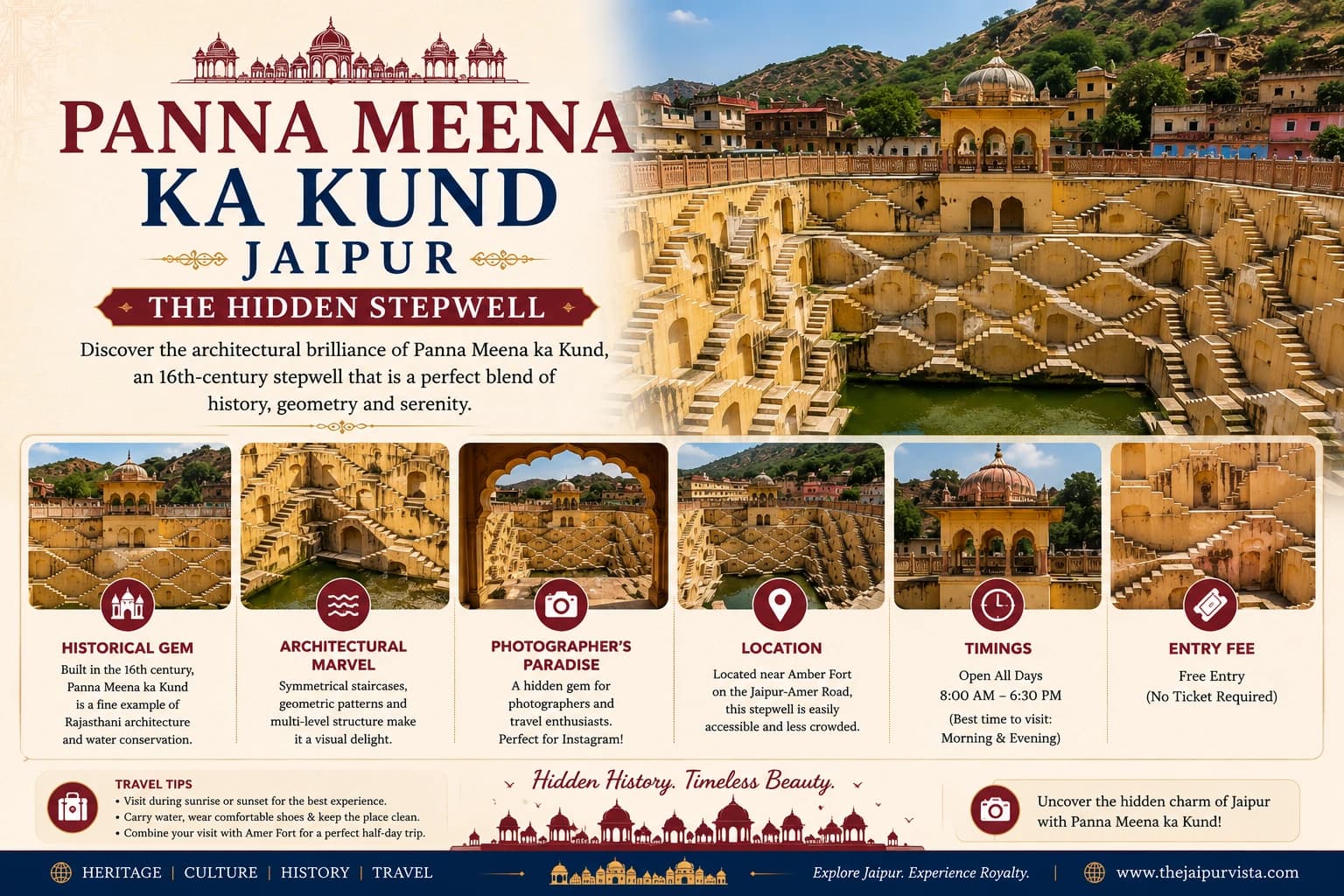
Jaipur is famous for its forts, palaces, and bazaars — but tucked away in the ancient town of Amer lies one of the city's most breathtaking and underrated secrets: Panna Meena ka Kund. This centuries-old stepwell is a geometric masterpiece that most tourists walk right past on their way to Amber Fort, completely unaware of the marvel hiding just around the corner. Whether you're a history buff, a photographer chasing Instagram-worthy symmetry, or simply a curious traveler who loves going off the beaten path, Panna Meena Kund deserves a dedicated spot on your Jaipur itinerary. In this complete guide, we cover everything you need to know — from the fascinating legends behind its name to practical tips on timings, entry fee, and the best time to visit. Panna Meena ka Kund is a historic stepwell — locally called a baori or bawdi — situated in the heart of Amer town in Jaipur, Rajasthan. It is considered one of the finest and best-preserved stepwells in the entire state, which itself is home to nearly 100 of India's estimated 2,000-plus stepwells. The word kund refers to a tank or reservoir, and this particular one is far more than just a water storage structure. It is an eight-storey architectural wonder featuring crisscrossing staircases, four ornamental pavilions called chhatris, and a design so precise that it has captivated architects, historians, and travelers alike for centuries. Panna Meena Kund holds the unique distinction of being Jaipur's only fully restored and functional stepwell. Unlike many ancient water structures across India that have fallen into disrepair, this baori has been meticulously preserved and continues to hold water throughout the year — a living relic of Rajasthan's genius approach to water conservation and rainwater harvesting. The exact history of Panna Meena ka Kund is shrouded in mystery, largely because no official historical records document its origins. What we do know with reasonable certainty is that the Meena community — the indigenous tribe that ruled Amer before the arrival of the Rajputs — controlled this region prior to the 11th century. This has led to widespread belief that the stepwell is closely linked to Meena heritage. Over generations, four popular legends have emerged to explain both the name and origin of this remarkable structure: One of the most commonly repeated stories credits a eunuch named Panna Miah, who served in the royal court of Amber Fort during the reign of Maharaja Jai Singh. According to local lore, he commissioned or supervised the construction of this stepwell as a service to the community. Some accounts date the stepwell to the 16th century CE, placing its construction within the broader period of Rajput dominance in the region, when large-scale water management projects were commonly undertaken. A widely held belief among the local community is that the Meena tribe constructed this baori between the 10th and 11th centuries — well before the Rajputs arrived in Amer. In this version, "Panna Meena" refers to a valiant Meena warrior, and the kund was built in his honour. A fourth legend connects the stepwell to the political transition of power in Amer. It suggests that the Rajputs took control of the town by overpowering the Meena chiefs, and the kund stands as a symbol of that earlier Meena dominance — a monument to the community that once ruled this land. None of these stories can be verified with certainty. The absence of documented records has allowed myth and history to interweave, making Panna Meena ka Kund as culturally rich in story as it is architecturally stunning. If there is one thing that makes Panna Meena ka Kund truly extraordinary, it is its architecture. The stepwell is a textbook example of Indian vernacular architecture at its most functional and most beautiful — proving that utility and artistry need not be in conflict. The defining feature of Panna Meena Kund is its interlocking, crisscross pattern of staircases. Unlike conventional stepwells where stairs descend in a single linear direction, these steps interweave in a complex grid that creates a mesmerizing visual effect when viewed from above. The geometry is so precise and so striking that it has become one of the most photographed architectural details in all of Jaipur — and rightly so. Interestingly, one of the quirks of this design is that certain staircases are one-directional: the steps used to descend cannot always be used to ascend. Local residents are well accustomed to this peculiarity, but first-time visitors often find themselves momentarily puzzled by the logic of the layout. Panna Meena Kund descends eight storeys below ground level. At each storey, a series of steps provides access to the water below, ensuring that regardless of the season — or the water level — people could always reach the water. This was a critical feature in an era before piped water infrastructure, particularly during droughts or dry seasons when water levels dropped significantly. Positioned at each of the four corners of the kund are four octagonal pavilions known as chhatris — a signature element of Rajput architecture. These elegant structures serve both a decorative and functional purpose: they provided shade for those who gathered at the stepwell, and their elevated position also served as ideal viewpoints overlooking the stepwell's geometry. Unlike many stepwells that are purely utilitarian in design, Panna Meena ka Kund features broad terraces and open platforms alongside the staircases. Three sides of the kund are lined with steps, while the fourth side provides an open space for sitting, conversing, or simply enjoying the atmosphere. This design reflects the stepwell's role as a social hub, not merely a water source. The Panna Meena Kund is a remarkable example of ancient water management and rainwater harvesting. The structure is engineered to capture and store rainwater, and it remains full of water throughout the year — a testament to the sophistication of its design. This has gained renewed attention in modern times as water conservation becomes an increasingly pressing global concern. Panna Meena was not simply a place to collect water. It was a cornerstone of community life in Amer for centuries. Women would gather here daily to fill their clay pots, and in doing so, the stepwell became a space for conversation, gossip, social bonding, and the exchange of news. It was, in many ways, the social media of its time — the place where community narratives were formed and shared. The Meena Panna Kund also held religious and ceremonial significance. Water, in Hindu culture, is deeply sacred, and stepwells were often associated with purification rituals, festivals, and prayers. The space around the kund would have been alive with activity during festivals and auspicious occasions. Today, while the stepwell no longer serves as the community's primary water source, it continues to be used by local youth for swimming and diving competitions — a reminder that the space retains its social character even in modern times. One reason Panna Meena ka Kund has gained significant popularity in recent years is its appearance in several Bollywood film productions and fashion photo shoots. The dramatic geometry of the crisscrossing staircases, the depth of the well, and the play of light and shadow at different times of day make it an extraordinarily photogenic location. Filmmakers and photographers have recognized what architects have always known: the Panna Meena Kund is genuinely cinematic. This Bollywood connection has drawn younger, urban travelers to this site who might otherwise have overlooked a historic stepwell in favour of more conventional sightseeing. One of the most traveler-friendly facts about Panna Meena ka Kund is that it is completely free to visit. There is no entry fee, no ticketing counter, and no prior booking required. This makes it an easy and rewarding add-on to any Jaipur itinerary, especially for budget travelers. Opening Hours: The stepwell is accessible every day of the week from 7:00 AM to 6:00 PM. It is open on all public holidays and national holidays as well. Important Tip: Avoid visiting in the very late afternoon when the light begins to fade and the area becomes quieter. As with any heritage site off the main tourist circuit, it is advisable to visit during daylight hours when other visitors are present. Jaipur's climate plays a significant role in determining when you'll enjoy the Panna Meena Kund the most. October to March is unquestionably the best time to visit. The weather during these months is pleasant and cool, making it comfortable to explore outdoor heritage sites without the discomfort of Rajasthan's scorching summer heat. The stepwell is particularly beautiful during the post-monsoon period (October–November) when the water levels are high and the surrounding greenery is at its most vibrant. April to June brings intense heat to Jaipur, with temperatures regularly exceeding 40°C. While the stepwell remains open, visiting during peak summer is not recommended unless you go very early in the morning. July to September (Monsoon Season) has its own unique charm. The rains fill the kund to impressive levels, and the dramatic cloud formations above the stepwell make for extraordinary photographs. However, do exercise caution during heavy rains, as the wet stone steps can be slippery. Panna Meena Kund is located in Amer town, approximately 11 kilometres north of central Jaipur. The precise address is: Near Amber Fort, Amer Town, Jaipur, Rajasthan 302028 The stepwell sits close to the Ambikeshwar Mahadev Temple and the famous Anokhi Cafe in Amer. It is also within easy walking distance of the Anokhi Museum of Hand Printing. The Kheri Gate in Amer serves as a useful local landmark for finding the kund. The most scenic and recommended way to reach Panna Meena ka Kund is on foot from Amber Fort, which is approximately 1 kilometre away. After exploring the fort, simply walk downhill into Amer town — locals will happily point you in the right direction. The Panna Meena Kund is approximately 11 kilometres from Jaipur Railway Station. Take a taxi, auto-rickshaw, or cab (via apps like Ola or Uber) for a journey that typically takes 25–35 minutes depending on traffic. The stepwell is roughly 21 kilometres from Jaipur International Airport (Sanganer Airport). A taxi or cab will take approximately 40–50 minutes. The distance from the main city bus terminal at Sindhi Camp to Panna Meena Kund is approximately 12 kilometres, easily covered by auto-rickshaw or cab in around 30 minutes. RSRTC and city buses run regularly between Jaipur and Amer. Board a bus headed to Amer from MI Road or Sindhi Camp. Alight at the Amer stop and walk or take an auto-rickshaw the remaining short distance to the kund. Hiring a private cab for the day is the most convenient option for families and groups, especially if you plan to combine Panna Meena ka Kund with Amber Fort, Jaigarh Fort, and other sights in the Amer area. Photography & Videography: The geometric perfection of the crisscross staircases is a photographer's dream. Visit in the morning (7–9 AM) when the light is softer and the stepwell is less crowded. The interplay of light and shadow across the steps is particularly dramatic. Architecture Appreciation: Take your time to study the engineering of the eight-storey structure. Walk down to the lowest accessible level to truly appreciate the scale of this ancient construction. Spot the Chhatris: Look for the four corner pavilions and climb up to enjoy a panoramic view of both the stepwell and the distant Amber Fort on the hillside. Soak in the Views: The terrace area of the kund offers a peaceful, unhurried space to sit, reflect, and absorb the atmosphere of historic Amer — a welcome contrast to the crowds at nearby Amber Fort. Since Panna Meena Kund is located in Amer, it pairs beautifully with several other significant attractions in the area: Amber Fort — The UNESCO World Heritage Site and Jaipur's most iconic landmark is just 1 km away. This should be your primary destination in Amer, with the kund as a wonderful addition. Jaigarh Fort — Sitting high on the Aravalli hills above Amber Fort, Jaigarh Fort houses the world's largest wheeled cannon. It is connected to Amber Fort via an underground passage. Anokhi Museum of Hand Printing — A beautifully curated museum housed in a restored haveli, dedicated to Rajasthan's traditional block-printing textile heritage. Ambikeshwar Mahadev Temple — A revered Shiva temple located very close to the kund, significant to local worshippers and worth a brief visit. Anokhi Cafe — A charming café in Amer that serves excellent food in a serene heritage setting — perfect for a refreshment break after exploring the kund. Nahargarh Fort — A short drive from Amer, Nahargarh Fort offers sweeping panoramic views of Jaipur city and is particularly beautiful at sunset. Best Angle: The most striking shots are taken from the top of the kund looking straight down — this reveals the full symmetry of the crisscross staircases. Find a vantage point at one of the corner chhatris for a slightly elevated perspective. Best Lighting: Early morning (7–9 AM) offers the softest, most flattering light. Late afternoon creates long shadows that add dramatic depth to the geometry. Monsoon Magic: If you visit during or just after the monsoon, the water level will be high, adding a beautiful reflective element to your photographs. Include People: A human figure on the staircases adds scale and life to photos, dramatically emphasising the depth and complexity of the architecture. Drone Photography: Please note that drone photography at heritage sites in India requires prior permission from the Archaeological Survey of India (ASI). Always check the current regulations before flying a drone at this location. Wear comfortable, flat shoes with good grip. The ancient stone steps can be uneven and may be slippery, especially near the water's edge. Carry water — while the entry is free, there are limited facilities at the site itself. Stay hydrated, especially if visiting in warmer months. The site has no formal guides stationed here, so hiring a local guide from Amber Fort or booking a guided tour through a reputable Jaipur tour operator is a great idea if you'd like deeper historical context. Respect the site: This is a heritage structure. Do not litter, deface the walls, or attempt to swim in the kund. Visit early — the stepwell gets busier as the day progresses and tour buses arrive at Amber Fort. An early morning visit offers a more intimate, serene experience. Combine it with Amber Fort — since you'll already be in Amer, it makes perfect sense to visit both on the same day. Jaipur's most famous attractions — Hawa Mahal, City Palace, Amber Fort, Jantar Mantar — draw hundreds of thousands of visitors every year, and rightly so. But Panna Meena ka Kund offers something increasingly rare in the world of mass tourism: genuine discovery. Here, you can stand at the edge of a perfectly preserved ancient stepwell, listen to the sound of water below, trace the geometry of staircases that have stood for centuries, and feel a real connection to the communities that built and depended on this structure long before any modern city existed here. The Panna Meena Kund is free. It is beautiful. It is historically significant. And it is criminally undervisited. That is exactly what makes it the kind of place that genuine travelers — the ones who seek meaning alongside sightseeing — treasure most. Every great city has its official highlights and its hidden depths. For Jaipur, the Panna Meena ka Kund represents the latter — a place of quiet, profound beauty that rewards those who look beyond the well-trodden tourist trail. The Meena Panna Kund tells the story of Rajasthan's ingenious relationship with water, its ancient communities, its architectural brilliance, and its layered history. It costs you nothing to visit, takes less than an hour to explore, and will leave you with some of the most memorable photographs and experiences of your entire Jaipur trip. When you're planning your next visit to the Pink City, let The Jaipur Vista be your guide. And make sure Panna Meena ka Kund is firmly on your list. Q1. What is the entry fee for Panna Meena ka Kund? Q2. What are the timings for Panna Meena Kund? Q3. How far is Panna Meena ka Kund from Amber Fort? Q4. Is Panna Meena ka Kund safe to visit? Q5. Why is it called Panna Meena ka Kund? Q6. Who built Panna Meena Kund? Q7. Is photography allowed at Panna Meena ka Kund? Q8. What is the best time to visit Panna Meena ka Kund? Q9. Can I visit Panna Meena ka Kund without a guide? Quick Reference: Panna Meena ka Kund at a Glance
What Is Panna Meena ka Kund?
The History of Panna Meena ka Kund
Legend 1 — The Royal Eunuch
Legend 2 — A 16th-Century Construction
Legend 3 — Built by the Meenas in the 10th or 11th Century
Legend 4 — A Symbol of Meena Sovereignty
Architecture of Panna Meena Kund — A Geometric Marvel
The Crisscross Staircase Design
The Eight Storeys
The Four Chhatris
Space for Community Gathering
Water Management Excellence
Cultural Significance of Panna Meena ka Kund
Panna Meena ka Kund and Bollywood
Entry Fee and Timings of Panna Meena ka Kund
Best Time to Visit Panna Meena ka Kund
Where Is Panna Meena ka Kund Located?
How to Reach Panna Meena ka Kund
From Amber Fort (Walking)
From Jaipur Railway Station
From Jaipur International Airport
From Sindhi Camp Bus Stand
By Public Bus
By Private Cab or Taxi
Things to Do at Panna Meena ka Kund
Nearby Attractions to Combine with Your Visit
Photography Tips for Panna Meena ka Kund
Practical Tips for Visiting Panna Meena ka Kund
Why Panna Meena ka Kund Is the Best Hidden Gem in Jaipur
Final Thoughts: Add Panna Meena ka Kund to Your Jaipur Bucket List
Frequently Asked Questions (FAQs) About Panna Meena ka Kund
There is no entry fee for Panna Meena ka Kund. It is free to visit.
The stepwell is open every day from 7:00 AM to 6:00 PM, including weekends and public holidays.
The Panna Meena Kund is approximately 1 kilometre from Amber Fort. You can easily walk from the fort to the kund in 10–15 minutes.
Yes, it is safe to visit during daylight hours. Avoid going very late in the evening as there is limited footfall after sunset. The stone steps can be slippery, so wear appropriate footwear.
The exact origin of the name is disputed. Various legends attribute it to a eunuch named Panna Miah from the Amber Fort court, or to the Meena community that controlled Amer before the Rajputs, or to a brave Meena warrior named Panna. No definitive historical record confirms the origin.
The builder is not definitively known. Popular legends suggest it was built either during the Meena reign of Amer (possibly in the 10th–11th century) or later during the Rajput era in the 16th century. Official historical records are absent.
Yes, photography is allowed. It is an excellent location for photography, particularly for architectural and travel shots.
October to March is the best time to visit, when the weather in Jaipur is cool and pleasant. The post-monsoon months of October and November are especially good, as water levels are high.
Yes, you can visit independently. However, hiring a local guide enriches the experience by providing historical context and local stories about the stepwell.
No, they are different stepwells. Chand Baori is located in Abhaneri, about 95 km from Jaipur, and is perhaps India's most famous stepwell. Panna Meena ka Kund is located in Amer town, approximately 11 km from central Jaipur.