Teej Festival Jaipur 2026: History, Rituals, Procession & Everything You Need to Know
Author:Niharika
Published:June 29, 2026
Views:2706
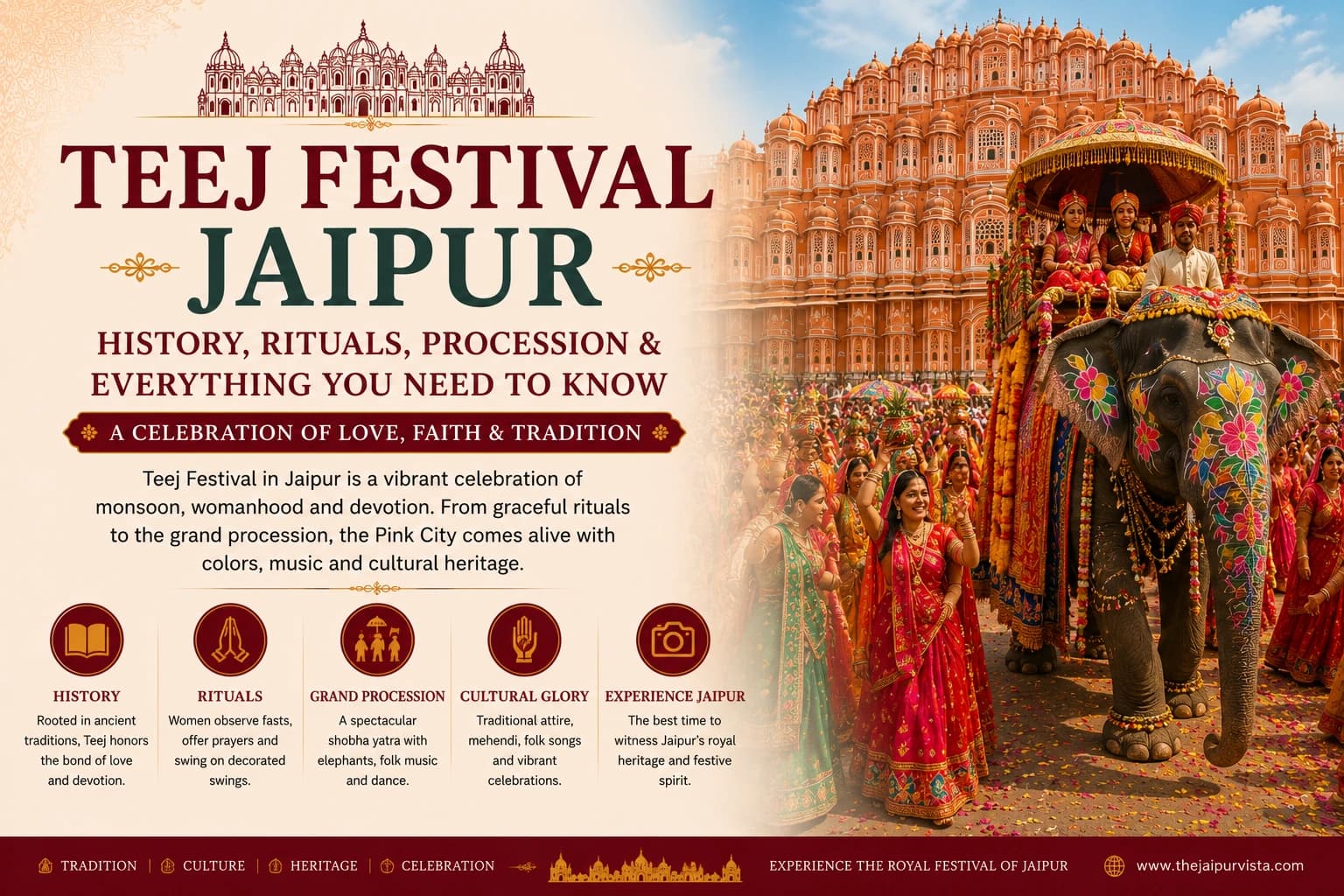
The Pink City has a thousand shades, but once a year, in the heart of the monsoon, it turns gloriously green. Bangles clink in every alley, the fragrance of marigolds fills the air, the beat of the dhol echoes off ancient sandstone walls, and a golden palanquin carrying Teej Mata winds its royal way through the walled city - this is the Teej Festival of Jaipur, and there is truly nothing else like it in India.
Whether you are a first-time visitor trying to understand what all the colour is about, a student researching what is Teej festival, or a traveller timing your Rajasthan trip around one of the most immersive cultural experiences on the subcontinent, this is your complete guide to Teej in Rajasthan - from its mythological origins to the exact procession route, festive foods, shopping, and insider travel tips.
Teej festival is one of the most beloved monsoon celebrations in northern and western India, observed primarily by women to honour the sacred union of Goddess Parvati (also called Teej Mata) and Lord Shiva. The word "Teej" refers to the third day of the lunar fortnight - specifically the third day of the bright half (Shukla Paksha) of the Hindu month of Shravana, which falls between July and August on the calendar.
At its core, Teej is a celebration of devotion, love, and marital bliss. Married women fast and pray for the long life and well-being of their husbands, while unmarried girls observe the rituals praying for a loving, devoted partner. But Teej is also far more than a personal prayer - it is a communal, joyful, rain-soaked explosion of Rajasthani culture that draws thousands of tourists, photographers, and travellers from across the world every year.
The spiritual heart of Teej lies in one of Hinduism's most beautiful love stories. According to ancient belief, Goddess Parvati was so devoted to Lord Shiva that she chose to be reborn life after life, each time performing intense penance to win him as her husband. It was not until her 107th rebirth that Lord Shiva, moved by the depth of her unwavering devotion, finally accepted her love and agreed to marry her. Their divine reunion is said to have taken place on the third day of Shravana - the day we now celebrate as Teej.
Goddess Parvati, deeply moved by this blessing, declared that any woman who invokes her on this auspicious day with sincerity and devotion would be blessed with a happy, loving marriage. This mythology is not just religious backstory - it is the living soul of every ritual performed during Teej, from the fasting to the procession to the all-night vigil that women keep in her honour.
While Teej is celebrated across Rajasthan, Uttar Pradesh, Bihar, Haryana, and even Nepal, Jaipur's Teej celebration stands in a league of its own. The city's deep royal heritage transforms what is a personal and domestic festival in other regions into a grand, public, civic spectacle rooted in centuries of Rajput tradition.
The historical roots of Jaipur's royal Teej procession run deep. As far back as 1875 AD, the Maharaja of Gwalior, Jiyaji Rao Scindia, attended the Teej celebrations in Jaipur at the invitation of Sawai Ram Singh Bahadur, describing it as one of the most magnificent festivals he had witnessed. That legacy of grandeur continues to this day, making Teej Festival Jaipur one of the most visited cultural events in all of Rajasthan - and one of the most photographed festivals in India.
Not all Teej celebrations are the same. There are three distinct forms of this festival observed across India:
Hariyali Teej - The most widely celebrated form, observed on the third day of Shravana's bright fortnight. "Hariyali" means greenery, and this version of Teej marks the fullness of the monsoon with lush, rain-fed landscapes. In Jaipur, Hariyali Teej is the grand occasion - the one with the royal procession, the decorated elephants, and the street celebrations.
Kajari Teej - Observed a fortnight after Hariyali Teej, during the dark fortnight (Krishna Paksha) of Shravana. This form is popular in the Braj region, Madhya Pradesh, and parts of Rajasthan, and is marked by the singing of Kajari folk songs celebrating the rains.
Hartalika Teej - Celebrated on the third day of the bright fortnight of the month of Bhadrapada (just after Shravana), this is widely observed in Maharashtra, Jharkhand, and Chhattisgarh, and is particularly significant for unmarried girls.
In Jaipur, Hariyali Teej is the star of the festival calendar, though Kajari Teej is also observed with devotion.
The jewel of the Teej Festival in Jaipur is without question the Teej Mahotsav procession - a royal parade that transforms the Old City's narrow bazaars into a river of colour, sound, and devotion. Here is everything you need to know about it:
The celebrations formally begin at the Jenani Dyodhi of the City Palace, where the ornately decorated idol of Goddess Teej Mata is ceremonially dressed in a richly coloured sari and adorned with jewellery. She is then placed in a magnificent golden palanquin and the procession sets off into the walled city.
The Teej Mata procession winds its way through some of Jaipur's most iconic streets:
City Palace → Tripolia Gate → Choti Chaupad → Gangauri Bazaar → Choughan Stadium (or Kanak Vrindavan)
Along the entire route, the streets are lined with locals and tourists. Women lean from the latticed windows of haveli balconies. Devotees shower the palanquin with flowers. The air is thick with the sound of shehnai, dhol, and women singing ancient folk songs dedicated to Teej Mata.
The Teej procession in Jaipur is a visual feast, featuring:
Decorated elephants and camels draped in embroidered cloth and painted with folk motifs
Royal chariots and bullock carts from the City Palace treasury
Traditional musicians playing shehnai, nagada, and dhol in royal style
Folk dancers performing Ghoomar, Kalbeliya, and Bhavai
Military bands in period costume, adding a regal martial note
Women in leheriya and bandhej sarees chanting devotional songs (bhajans)
The procession takes place over two consecutive evenings, beginning around 6 PM - the golden hour of Jaipur, when the sandstone walls glow amber and the evening light is extraordinary
The day before Hariyali Teej is called Sinjara. On this day, married daughters receive festive gifts - known as the sinjara - from their parents. These typically include colourful sarees or lehengas, bangles (chudi), mehndi (henna) cones, sweets, and cosmetics. It is a beautiful expression of parental love and continues to be one of the most emotionally significant parts of the Teej calendar.
Married women observe a strict fast throughout Teej, abstaining from food and often from water as well for the entire day. This fast, called the Teej Vrat, mirrors the intense penance that Goddess Parvati is believed to have performed to win Lord Shiva's devotion. Some women keep this fast without a drop of water from sunrise until the moonrise.
During the festival, women traditionally do not sleep for three nights - a practice symbolising the depth of Parvati's spiritual endurance. While in modern celebrations this is observed selectively, many devout women still maintain this tradition.
Two of the most joyful rituals of Teej are the application of mehndi (henna) on hands and feet, and the playing on jhoolas (decorated swings). Swings are hung from trees and draped with marigolds, jasmine, and mango leaves. Women sit on these swings, singing songs about the rain and about love - a ritual that is as photogenic as it is sacred.
No festival in Jaipur is complete without its food, and Teej has a delicious culinary tradition of its own. Here are the must-try dishes during Teej in Rajasthan:
Ghewar - The undisputed queen of Teej sweets. A disc-shaped, honeycomb-textured dessert made from refined flour and soaked in sugar syrup, then topped with cream (rabri), saffron, and dry fruits. Ghewar is so synonymous with Teej that the two are nearly inseparable in Rajasthani culture.
Fenia (Pheniya) - Thin, crisp vermicelli-like sweet threads, often served with milk and sugar. A traditional Teej morning preparation.
Malpua - Fluffy, deep-fried sweet pancakes soaked in sugar syrup and served with rabri. A Rajasthani monsoon classic.
Balushahi - Flaky, deep-fried rounds with a glazed sugar finish, similar to a doughnut but far more indulgent.
Kachori and Mirchi Vada - After the fast breaks, savoury snacks are equally eagerly awaited. Jaipur's spicy, flaky kachoris paired with tangy chutney are the perfect post-vrat treat.
Kulhad Lassi and Jaljeera - Cooling, clay-pot lassi and spiced jaljeera are refreshing lifesavers during the warm, humid monsoon afternoons
Teej transforms Jaipur's markets into a shopper's paradise. The streets come alive well before the festival, and the bargaining, browsing, and buying is itself an experience. Here is where to shop and what to look for:
Johari Bazaar - The go-to destination for traditional jewellery, lac bangles, and silver accessories for Teej.
Bapu Bazaar - Stock up on leheriya and bandhej textiles, the tie-dyed fabrics that are the signature look of Teej.
Tripolia Bazaar - Right along the procession route, this market is perfect for mehndi cones, festive dupattas, footwear (jootis), and Rajasthani handicrafts.
Look for: Lac bangles in red and green, mirrorwork accessories, bandhej dupattas, block-print sarees, traditional Rajasthani jootis, handmade Ghewar boxes as gifts, and wooden or clay folk art items.
Jaipur is home to some of India's most spectacular festivals - the Jaipur Literature Festival, the Elephant Festival, the Kite Festival (Makar Sankranti), and the Desert Festival (in nearby Jaisalmer). But Teej Festival holds a very special place because it is not a tourism product or a curated event - it is a living, breathing cultural tradition that the people of Jaipur have celebrated for centuries and continue to celebrate with the same authenticity and fervour.
Teej is the festival that shows you the real Jaipur - not the city of tourist sites and heritage hotels, but the city of faith, family, colour, and community. If you visit only once, visit during Teej.
Hariyali Teej typically falls in late July or early August (the exact date changes each year based on the Hindu lunar calendar). The main procession runs for two evenings. Arrive at least a day early.
Tripolia Gate and Tripolia Bazaar - Right at the heart of the route; arrive 90 minutes early for a good spot
Iswari Minar Swarga Sal - A rooftop minaret offering aerial views of the procession below
Gangauri Bazaar - Less crowded than Tripolia, equally vibrant
Choughan Stadium - Where the procession concludes; folk performances happen here
Book accommodation in or near the Old City (Walled City) to be within walking distance of the procession route, bazaars, and temples. Many heritage havelis and boutique guesthouses are clustered around Johari Bazaar and the City Palace area.
Wear modest, traditional-style clothing - a kurta or salwar kameez is appreciated and helps you blend in respectfully
Carry a raincoat or compact umbrella - it is monsoon season, and showers are common
Stay hydrated; July in Jaipur is humid as well as warm
Always ask before photographing women during rituals - most are welcoming, but asking first is respectful and culturally appropriate
Arrive at the procession route well before 6 PM to secure a comfortable vantage point
Support local artisans by buying directly from small vendors at the market stalls
The Teej Festival of Rajasthan is many things at once: a spiritual act of devotion, a seasonal celebration of the monsoon's arrival, a living art show of Rajasthani craft and tradition, and an unforgettable community experience that pulls together faith, family, colour, and song. In Jaipur, it becomes all of this and more - wrapped in royal ceremony, ancient mythology, and the irresistible energy of a city that knows how to celebrate.
If you are planning to visit Jaipur, plan around Teej. You won't just witness a festival - you will feel, for a few extraordinary days, like a full and welcome part of the Pink City's living culture.
Q1. What is Teej festival and why is it celebrated?
Teej is a Hindu monsoon festival primarily observed by women to celebrate the divine union of Lord Shiva and Goddess Parvati. Women fast, pray, apply mehndi, and participate in processions and swing rituals to seek blessings for a happy married life and the wellbeing of their families.
Q2. When is Teej celebrated in Jaipur?
Teej in Jaipur is celebrated during the Hindu month of Shravana, which falls between July and August. The exact date shifts each year with the lunar calendar. Hariyali Teej and Kajari Teej are the two main observances in Rajasthan.
Q3. What is Teej Mahotsav?
Teej Mahotsav is the grand public festival event organised in Jaipur during Teej, featuring the royal procession of Teej Mata, folk performances, cultural programmes, and traditional fairs. It is the centrepiece of the city's Teej celebrations, drawing thousands of visitors every year.
Q4. What is the route of the Teej procession in Jaipur?
The royal procession begins at the City Palace (Jenani Dyodhi), passes through Tripolia Gate, Choti Chaupad, and Gangauri Bazaar, and concludes at Choughan Stadium or Kanak Vrindavan Garden.
Q5. Is Teej festival open to tourists?
Absolutely. The Teej procession and street celebrations are open to everyone. Tourists are warmly welcomed to watch, photograph, shop in the bazaars, and enjoy the food and cultural performances.
Q6. What are the three types of Teej?
The three types of Teej are: Hariyali Teej (celebrated in Shravana's bright fortnight, most prominent in Jaipur), Kajari Teej (celebrated a fortnight later), and Hartalika Teej (observed in Bhadrapada, prominent in Maharashtra and Jharkhand).
Q7. What sweet is most associated with Teej?
Ghewar is the most iconic sweet of Teej in Rajasthan - a honeycomb-textured disc dessert soaked in sugar syrup and topped with rabri and dry fruits. It is so closely associated with the festival that it is sometimes called "the Teej sweet."
Q8. What is Sinjara in the Teej Festival?
Sinjara is the day before Hariyali Teej, when the parents of married daughters send a festive gift package including sarees, bangles, sweets, and mehndi. It is one of the most emotionally significant pre-festival traditions of Teej in Rajasthan.
Q9. Why is Teej especially grand in Jaipur compared to other cities?
Jaipur's Teej celebration draws on centuries of royal Rajput tradition. The Teej Mata procession, which originates from the City Palace with decorated elephants, camels, royal palanquins, and military bands, gives the festival a scale and grandeur that is unique to Jaipur and unmatched anywhere else in India.