Salasar Balaji Temple: History, Story, Darshan, Timings & Travel (2026)
Author:Niharika
Published:June 24, 2026
Views:3713
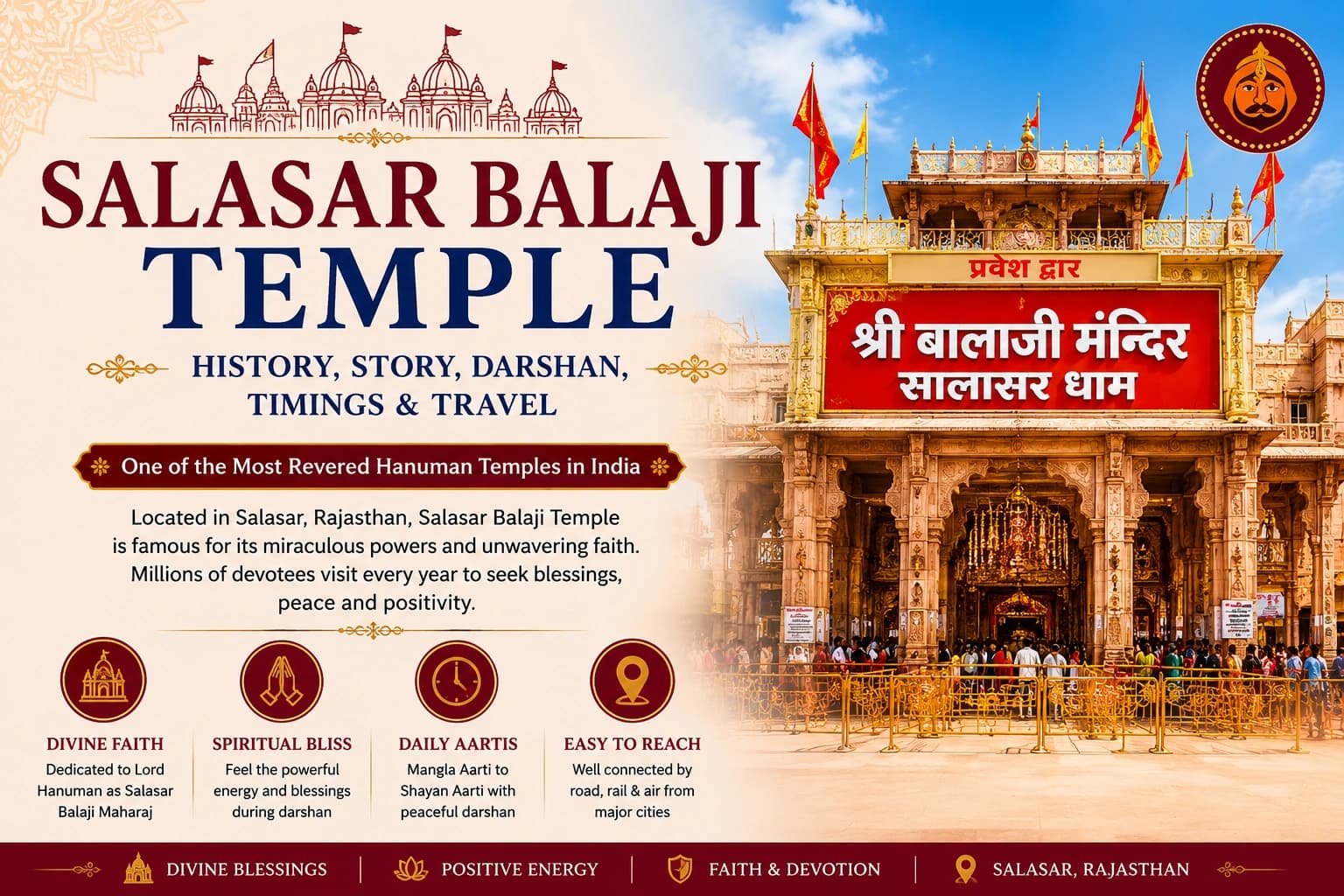
Salasar Balaji belongs to the second kind. Devotees who have stood before the extraordinary idol of Hanumanji at Salasar Dham - watched by a Hanuman unlike any other, one who appears with a beard and moustache, whose eyes seem to look into you with a warmth that no description can adequately convey - consistently describe the experience not as a visit to a religious site but as a homecoming. As if they were drawn there by something beyond their own planning. As if Balaji himself had sent the invitation.
Every year, millions of devotees from across India - but especially from Rajasthan, Haryana, Delhi, Punjab, and Uttar Pradesh - make the journey to this small, luminous town in the Churu district of Rajasthan. They come in buses and cars and trains, on foot and on horseback, by motorcycle convoys that stretch for kilometres along the National Highway. They come for the ailing, for the new-born, for the examination student and the businessman, for the newly married and the newly bereaved. They come because the Salasar Balaji story - of a self-manifested idol, a devoted priest, and a divine promise of three centuries' standing - is one of the most extraordinary stories in the entire devotional landscape of northern India.
At The Jaipur Vista, we consider Salasar Balaji one of the most important and spiritually resonant pilgrimage destinations in Rajasthan. This is our complete 2026 guide to everything you need to know - the history, the miraculous story, the unique iconography, the temple architecture, darshan timings, the full pilgrim experience, how to reach Salasar from Jaipur and Delhi, accommodation options, and a detailed visitor guide.
Before diving into the depth of this extraordinary place, here is a concise overview:
One of the most frequently searched questions is: Salasar Balaji kis district mein hai? (In which district is Salasar Balaji?)
The answer: Salasar Balaji is located in the Churu district of Rajasthan, in the town of Salasar, within the Sujangarh tehsil. The temple sits directly on NH-52 (the Jaipur–Bikaner National Highway), making it highly accessible from both directions.
Precise Location:
Shri Salasar Balaji Mandir
Salasar, Sujangarh Tehsil
Churu District, Rajasthan - 331506
Salasar is a small but significant town that exists almost entirely in service of the temple - its economy, its culture, and its identity are completely shaped by the millions of devotees who flow through it every year. The town itself is part of the Shekhawati region of Rajasthan - the same culturally rich belt of painted havelis, temple towns, and ancient trade routes that includes Jhunjhunu, Fatehpur, Mandawa, and Nawalgarh.
The Salasar Balaji story is one of the most beautifully documented miraculous narratives in Rajasthani religious tradition - a story involving a farmer, a devoted priest, a self-manifested idol, and a supernatural journey of 40 kilometres. Here is the complete account.
The story begins not in Salasar but in a village near Nagaur, a city approximately 80–90 km from Salasar, around the year 1754 CE.
A farmer was ploughing his field when his plough suddenly struck something hard beneath the surface. Expecting a stone or a root, he dug down - and found instead a piece of stone unlike any he had ever seen. As he cleared away the soil, the stone revealed itself to be a carved image of extraordinary beauty and spiritual power. It was an idol of Lord Hanuman - but unlike any conventional depiction of Hanuman. This Hanuman was depicted with a distinctive beard and moustache, giving the deity a form of mature, warrior-like dignity that is almost unique in Hanuman iconography across India.
The farmer immediately understood that this was no ordinary finding. He covered the idol with respect and went to inform the village elders and the local priest. As the news spread, it became clear that this was a swayambhu (self-manifested) idol - a deity who had chosen to reveal himself from the earth, not crafted by human hands but present in the stone by divine will.
At almost exactly the same time, in the village of Salasar in present-day Churu district, lived a devoted priest and farmer named Mohan Das - a man of extraordinary personal piety who had dedicated his life to the worship and service of Lord Hanuman. Mohan Das is the central human figure in the Salasar Balaji story, the man through whose devotion an entire pilgrimage tradition was born.
According to the most widely accepted historical account, Mohan Das received a divine dream in which Lord Hanuman appeared and instructed him that a self-manifested idol of his form would be brought to Salasar, and that Mohan Das should prepare a proper shrine to receive and install it. The dream carried such clarity and divine authority that Mohan Das immediately began preparing.
When the local leaders in the Nagaur area had recovered the self-manifested idol and were deliberating over its installation - in Nagaur or elsewhere - a message arrived from Mohan Das in Salasar, describing his divine dream and requesting that the idol be sent to Salasar. The leaders of the Nagaur village, recognising the divine order implicit in the coincidence of the discovery and the dream, agreed.
The idol was loaded onto an ox-cart and the journey to Salasar began - a distance of approximately 40 kilometres through the semi-arid Shekhawati landscape.
What happened on that journey is the most miraculous element of the Salasar Balaji story. According to the account passed down through the generations:
The ox-cart proceeded along the route to Salasar without incident - until it reached a crossroads, where the two oxen stopped and refused to move forward in any direction. Despite the efforts of those accompanying the cart, the animals would not budge. The bullock drivers and accompanying devotees were at a loss.
It was then that Mohan Das - who had been informed of the cart's progress and had walked out to meet it - arrived at the crossroads. The moment Mohan Das appeared and addressed the deity with prayers and greetings, the oxen immediately resumed walking - and proceeded directly to Salasar Town without further delay.
The community interpreted this stopping of the cart as the deity's own expression of patience, waiting for his chosen devotee-priest to arrive and personally escort him to his new home.
The idol was installed in 1754 CE (Samvat 1811, in the Shravan month) in Salasar by Mohan Das, who became the first priest-devotee of what would become one of Rajasthan's most celebrated pilgrimage shrines. The installation was accompanied by appropriate Vedic rituals and pran pratishtha (consecration ceremony), establishing the divine presence formally in the new shrine.
Mohan Das is venerated to this day as the founder-devotee of Salasar Dham, and his samadhi (memorial) within the temple complex remains a site of deep reverence for pilgrims.
From this singular beginning in 1754 - a small shrine established by one devoted priest around a miraculous self-manifested idol - Salasar Balaji Mandir has grown over 270 years into one of the most visited temples in all of India. The current massive temple complex bears no resemblance to the modest original structure, but the devotional energy that Mohan Das brought to this place is considered by devotees to be as present today as it was on the day of installation.
The temple has historically been managed by the Chahar family - descendants of Mohan Das - who have served as the primary priests and administrators of Salasar Balaji Mandir across multiple generations. The tradition of family-based temple administration (pujari parampara) is common in significant Hindu temples, and at Salasar it has given the shrine a continuity of devotional practice that spans nearly three centuries.
Over the generations, as the Salasar Balaji temple's fame spread - first through Rajasthan, then into Haryana and Delhi, then across northern India - the temple has expanded dramatically. The current temple complex is a vast structure built primarily in the 20th and 21st centuries, with significant additions made as the volume of pilgrims grew.
The expansion of Salasar Dham through the 20th century parallels the growth of road connectivity and railway access in this part of Rajasthan. As the Jaipur–Bikaner road improved and the railway network reached nearby Sujangarh and Churu, pilgrims from increasingly distant origins could make the journey to Salasar.
The temple became particularly associated with the Marwari business community, who spread its fame across their extensive commercial networks - from Rajasthan into Bombay, Calcutta, Delhi, and beyond. Today, the Salasar Balaji is one of the most recognisable devotional names across the Marwari diaspora globally.
The single most distinctive feature of the Salasar Balaji idol - and the one that immediately strikes every visitor who stands before it - is that this form of Hanumanji has a beard and moustache.
This is extraordinary. In the vast iconographic tradition of Lord Hanuman across India, the standard depiction is of a young, powerful, clean-faced divine warrior - the veera (heroic) form of Hanumanji that is universally familiar. The bearded and moustached form at Salasar Balaji is found at very few temples across the entire subcontinent and is one of the rarest and most distinctive forms of Hanuman in Hindu religious art.
The beard and moustache on the Salasar Balaji idol are understood by the temple's devotional tradition to represent Hanumanji in his fully matured, grihastha (householder) aspect - a divine form that combines the energy of the warrior (veera) with the wisdom and compassion of an elder (vriddha). It is a form that emphasises Lord Hanuman's role as protector, provider, and nurturer - qualities that the householder-devotee, facing the trials of worldly life, seeks most urgently.
The bearded form is also associated with the tamsik (power) aspect of Lord Hanuman - the form invoked for the removal of malevolent influences, the protection of the family, and the resolution of deeply entrenched difficulties that require the full force of divine power rather than simple blessing.
Many devotees describe an emotional quality to their encounter with the Salasar Balaji idol that is particularly intense compared to other Hanuman temples - a sense of being seen and understood by the deity in a way that cuts through the transactional nature of typical temple visits.
The Salasar Balaji idol is a swayambhu (self-manifested) form - not carved by human hands but present naturally in the stone in which it was discovered. The idol is of modest size but is elaborately adorned with gold ornaments, silk garments, and fresh flowers in the tradition of Rajasthani deity adornment.
The idol depicts Lord Hanuman in a seated or slightly inclined posture (as opposed to the standing form common in many Hanuman temples), which gives the image a quality of approachability and rest - as if Hanumanji is seated and receptive to the prayers of his devotees.
The current Salasar Balaji Mandir complex is a large, well-maintained, actively expanding temple campus that has grown enormously from its modest 1754 origins. Here is what you will see when you visit:
The heart of Salasar Dham is the main temple building - a traditional Rajasthani-style temple structure with a prominent shikhara (spire) that is visible from a considerable distance as you approach Salasar on the highway. The exterior walls are painted in warm ochre and cream tones, with ornamental work typical of the Shekhawati architectural tradition.
The main temple has an outer prayer hall (mandapa) leading to the inner sanctum (garbhagriha) where the Salasar Balaji idol is enshrined. The sanctum is richly decorated with silver panels, gold ornamental work, floral decorations, and the rich textiles that are offered by devotees. The idol itself is adorned with fresh flower garlands, golden ornaments, and fine silks - the elaborate shringar (adornment) that is performed fresh at each major aarti. Within the temple complex, the samadhi (memorial) of the founding devotee-priest Mohan Das is maintained with deep reverence. Mohan Das is venerated as a saintly figure - a man whose extraordinary devotion brought the miraculous idol to Salasar and established the pilgrimage tradition. Devotees pay their respects at his samadhi as part of their temple circuit. Salasar Dham has a sacred kund (water tank) within or adjacent to the temple complex. In Hindu temple tradition, a sacred kund associated with a major temple is considered spiritually charged - devotees touch the water, offer flowers and lamps, and perform simple ritual ablutions as part of their visit. The Salasar Balaji temple trust operates extensive dharmshalas (pilgrim rest houses) that provide accommodation for the thousands of pilgrims who arrive every day. The facilities are basic but clean and well-managed - reflecting the trust's commitment to ensuring that the most economically modest devotees can complete their pilgrimage with dignity. Beyond the main Hanuman shrine, the broader Salasar Dham complex includes: A Shiva Temple - for devotees who wish to offer prayers to Lord Shiva as part of their visit A Gau Shala (cow sanctuary) - in keeping with the sacred tradition of cow protection A Prasad Distribution Centre - where the official temple prasad (typically ladoos and other sweets) can be received Extensive food serving facilities - the temple serves free meals (langar or bhandara) to a large number of pilgrims daily, a tradition of community service that has been maintained since the temple's early years Shri Salasar Balaji Mandir is open every day of the year. The darshan schedule broadly follows this pattern: Important Notes on Timings: Timings are approximate and can change during festivals, major melas, and special occasions - the temple may open earlier and remain open later during the Hanuman Jayanti mela, the Ashwin Purnima mela, and the Chaitra Purnima mela On Tuesdays and Saturdays (the days most auspicious for Hanuman worship), the temple is significantly busier; arrive at least 60–90 minutes before your preferred darshan time During major festival periods, the temple may operate on continuous darshan hours without the midday break, to manage the extremely high volume of pilgrims Always confirm current timings locally or via the temple trust's official information channels before your visit Entry Fee: The Salasar Balaji temple is completely free of entry charge for all devotees. Photography: Photography is generally not permitted inside the main sanctum. Respect this rule out of consideration for fellow worshippers and the sanctity of the space. Two major fairs (melas) are held at Salasar Dham every year - on the Purnima (full moon) of Chaitra (March-April) and the Purnima of Ashwin (September-October). Both dates correspond to major auspicious occasions in the Hindu calendar and draw enormous numbers of pilgrims. The Ashwin Purnima mela is held on the full moon of the Hindu month of Ashwin (typically September-October), which coincides with Sharad Purnima - considered one of the most auspicious full moon nights in the Hindu calendar. At Salasar Balaji, the Ashwin Purnima mela is the larger of the two annual fairs, drawing an estimated 10–20 lakh devotees (1–2 million people) over the mela period. During the mela, Salasar transforms completely - the town, the surrounding roads, and the open land around the temple fill with tents, temporary shops, food stalls, bhajan mandalis (devotional singing groups), and an extraordinary diversity of devotees from across northern India. The atmosphere is one of collective devotion at a scale that must be experienced to be understood. The Chaitra Purnima mela coincides with Hanuman Jayanti - the birth anniversary of Lord Hanuman, celebrated on the full moon of Chaitra. This is the most auspicious occasion for Hanuman devotees worldwide, and at Salasar Balaji it is a particularly charged event. The mela draws similar numbers to the Ashwin mela and is characterised by an especially intense devotional atmosphere. Beyond the two principal melas, Hanuman Jayanti itself (which may coincide with the Chaitra Purnima mela or fall separately, depending on the calendar year) is the single most important religious occasion at Salasar Dham. The temple is elaborately decorated, special pujas and abhishekams (ritual bathing of the idol) are performed, and the darshan lines extend for several kilometres outside the temple. Even outside the major melas, Tuesdays (Mangalwar) and Saturdays (Shaniwar) are considered especially auspicious days for Hanuman worship throughout India. At Salasar Balaji, the crowd on these days is consistently several times the weekday average. If you wish to experience the temple in a more contemplative manner, plan a weekday visit from Monday to Friday. A pilgrimage to Salasar Dham encompasses far more than the darshan itself. Here is a complete guide to the meaningful activities available during your visit: For the most profound spiritual experience at Salasar Balaji, attend the pre-dawn Mangla Aarti. The temple at this hour - before the main crowds arrive - has an atmosphere of extraordinary intimacy and power. The fragrance of incense, the sound of bells and Sanskrit mantras, the glow of oil lamps reflected in the adorned idol, and the absolute darkness of the surrounding pre-dawn sky create conditions for a genuinely transformative experience. The official prasad of Salasar Balaji - typically offered in the form of ladoos, boondi, and other sweets that have been offered before the deity - is considered highly auspicious. Receiving and sharing the prasad is an essential part of the pilgrimage. The Salasar Balaji temple trust runs one of the most generous community feeding programmes (bhandara) of any temple in Rajasthan. Free meals are served to pilgrims daily. Participating in this collective meal - sitting alongside devotees from every walk of life - is a genuinely equalising and moving experience that reflects the egalitarian spirit of Hanuman worship. The traditional offering at Salasar Balaji is a whole coconut and a piece of red cloth - the colour red is deeply associated with Lord Hanuman, and the coconut represents the offering of the devotee's ego (the hard outer shell) and inner essence. These offering items are available from vendors throughout the market area surrounding the temple. Paying respects at the samadhi of the founding devotee Mohan Das is an important part of the complete pilgrimage at Salasar Dham. His example of pure, selfless devotion is considered an inspiration for all who come to the temple he established. The market lanes surrounding the Salasar Balaji temple are fascinating in their own right - an intensely crowded, colourful collection of shops selling religious items (malas, idols, pictures of Balaji, lamps, incense), traditional Rajasthani food (the local kachoris and sweets are excellent), and the distinctive red-thread bracelets associated with Hanuman blessings that you will see on the wrists of almost every devotee who has been to Salasar. Distance: ~180 km Route: Take NH-52 (Jaipur–Bikaner Highway) northward through Chomu, Sikar, Fatehpur, and Sujangarh, then turn onto the state highway to Salasar Town. The route is well-signposted and entirely on good-quality national and state highways. By Car/Taxi: The most comfortable and flexible option. Self-drive or hired taxi from Jaipur to Salasar and back can comfortably be done as a day trip, leaving Jaipur by 5:00–6:00 AM for an early morning darshan. One-way taxi fare from Jaipur to Salasar is approximately ₹2,000–2,800 for a sedan; round trip with waiting approximately ₹4,000–5,500. By Bus: Regular Rajasthan State Road Transport Corporation (RSRTC) and private buses operate from Jaipur's Sindhi Camp Bus Stand to Sujangarh (the nearest large town to Salasar) and to Salasar directly. Journey time is approximately 4–5 hours. Several private operators run air-conditioned overnight and morning bus services on this route. By Train: The nearest railway stations to Salasar Balaji are: Sujangarh Railway Station (~12 km from Salasar) - served by trains on the Jaipur–Bikaner line Ratangarh Junction (~45 km from Salasar) - a major junction on the Delhi–Bikaner line From Jaipur, trains to Sujangarh depart from Jaipur Junction. The journey takes approximately 3–4 hours. From Sujangarh station, auto-rickshaws and shared jeeps run frequently to Salasar (approximately 20–30 minutes). Distance: ~490 km Route: Take NH-48 (Delhi–Jaipur Expressway) to Jaipur, then continue on NH-52 (Jaipur–Bikaner Highway) through Chomu, Sikar, Fatehpur, and Sujangarh to Salasar. Alternatively, take the route via Rewari, Narnaul, Jhunjhunu, and Sujangarh for a more scenic but slightly longer journey. By Car: Best departed from Delhi the night before, stopping overnight in Jaipur or Sikar, and completing the journey to Salasar the next morning. By Train from Delhi: Multiple trains operate on the Delhi–Bikaner route, stopping at Ratangarh Junction (approximately 45 km from Salasar). The Intercity Express and the Bikaner Express are both popular options. From Delhi, the train journey to Ratangarh takes approximately 6–7 hours. A taxi or shared jeep from Ratangarh to Salasar takes about an hour. Special Pilgrimage Buses from Delhi: During the Ashwin and Chaitra Purnima melas, multiple private bus operators run direct pilgrim buses from Delhi, Gurugram, Faridabad, and other NCR cities to Salasar Balaji. These are a popular and economical option for large groups. Auto-rickshaws and cycle-rickshaws are the primary local transport within Salasar Town. The town is small enough that the railway station, bus stand, and main dharamshalas are all within reasonable walking or rickshaw distance of the temple. Salasar has developed a comprehensive range of pilgrim accommodation to serve the millions of visitors it receives annually: The Salasar Balaji Temple Trust operates several large dharamshalas (pilgrim rest houses) within and around the temple complex, offering basic but clean rooms at very affordable rates (typically ₹200–500 per room, per night). These fill up rapidly during festivals and weekends - arrive early or book through the trust's contact channels in advance. A growing number of private guesthouses, budget hotels, and small hotels have developed in Salasar Town, offering more facilities than the dharamshalas at correspondingly higher prices (typically ₹500–1,500 per night for clean, comfortable rooms). For those who prefer more comfortable accommodation, the nearby towns of Sujangarh (~12 km) and Ratangarh (~45 km) offer better-quality hotels and guesthouses at reasonable prices. During the two annual melas, temporary tent accommodations and ground sleeping facilities are available throughout the area surrounding the temple. Many pilgrims also simply sleep in the temple courtyards or in their vehicles during the mela nights. The food culture around Salasar Balaji is entirely sattvic (pure vegetarian) - no meat, no eggs, and no alcohol are served or permitted in the temple town. Here is what to look for: Temple Langar/Bhandara: Free meals served by the temple trust - simple, nourishing dal, rice, roti, and sabzi. Participating in the langar is recommended for the experience of collective pilgrimage feeding. Local Halwai Shops: Salasar's sweet shops produce excellent traditional Rajasthani sweets - particularly the besan ladoos and churma that are popular prasad items. The local kachoris and jalebis served in the market area are excellent. Dhabas: Multiple simple roadside dhabas around the temple market serve standard north Indian vegetarian thali meals - dal, roti, sabzi, rice - at very affordable prices. Chai Stalls: Tea stalls are everywhere around the temple complex - the sweet, milky, ginger-infused Rajasthani chai is excellent and essential on cold winter mornings. Many devotees visit Salasar Balaji as part of a broader Shekhawati pilgrimage circuit that includes several important temples in the region. Here are the most commonly combined stops: The famous temple of Shri Khatu Shyam Ji (Barbarika) in Khatu, Sikar district, is one of the most visited temples in Rajasthan and pairs naturally with Salasar Balaji on a two-day pilgrimage from Jaipur. Devotees typically visit Khatu Shyam Ji on Day 1 and Salasar Balaji on Day 2, or combine both in a long single day with a very early start. The Jeen Mata Temple - one of the most powerful Shakti peethas in Rajasthan, situated on a hill near Sikar - is another natural companion stop on the Shekhawati temple circuit. The revered Rani Sati Dadi temple in Jhunjhunu, dedicated to a legendary regional goddess particularly venerated by the Marwari community, is another significant stop on the Shekhawati pilgrimage circuit. The ancient pilgrimage site of Lohargal - where the Pandavas are said to have bathed in a sacred kund to cleanse themselves of the karma of the Kurukshetra war - is within range of a Salasar trip, though visiting both in a single day requires an early start. Beyond its religious significance, Salasar Balaji sits in the heart of the Shekhawati region - one of the most culturally distinctive and historically rich areas of Rajasthan. Visitors who combine their pilgrimage to Salasar with a broader exploration of the region will encounter: Painted Havelis: The towns of Fatehpur (40 km from Salasar), Mandawa, Nawalgarh, and Ramgarh contain some of the finest fresco-painted havelis in all of India. The Shekhawati havelis - built by wealthy Marwari merchant families in the 19th and early 20th centuries - are covered in vibrant painted murals depicting mythological scenes, historical events, and even early automobiles and European fashions. Tal Chhapar Sanctuary: Located approximately 80 km from Salasar, the Tal Chhapar Wildlife Sanctuary in Churu district is famous as one of the finest habitats for the Indian Blackbuck antelope in Rajasthan, as well as a major congregation ground for demoiselle cranes during the winter months. The Unique Bearded Hanuman: The Salasar Balaji idol is one of only a handful of temples in India where Hanumanji is depicted with a beard and moustache - a form found at Salasar and at a very small number of other shrines. This iconographic rarity is one of the temple's most distinctive features. Founded in 1754: The temple was established approximately 271 years ago (as of 2026), making it a relatively modern shrine by Indian temple standards - yet it has attracted devotees in numbers that most ancient temples cannot match, a testament to the intensity of the devotional tradition Mohan Das established. Three Districts' Devotees: Although located in Churu district, the Salasar Balaji temple draws the majority of its devotees from three Rajasthan districts - Churu, Jhunjhunu, and Sikar - as well as from the neighbouring state of Haryana and from Delhi-NCR, making it a genuinely trans-regional pilgrimage site. Hanuman Worship Across Castes: Unlike some temples that are associated primarily with specific caste communities, Salasar Balaji draws devotees from across caste lines, economic backgrounds, and regional cultures. The universally accessible energy of Hanuman worship - requiring no elaborate ritual knowledge, no significant expense, and no caste qualification - makes Salasar Dham one of the most genuinely egalitarian pilgrimage sites in northern India. Associated with the Marwari Community: The Salasar Balaji temple has a particularly strong association with the Marwari business community, who have historically been among the most devoted and most generous donors to the temple. Major Marwari business families from across India maintain a connection to Salasar, and many attribute their business success to the blessings of Salasar Balaji. Red Thread of Salasar: The distinctive red thread bracelet (mouli) offered at Salasar Balaji - tied around the wrist as a token of Hanumanji's protection - is one of the most recognisable symbols of the temple's devotional community. You will see it on the wrists of devotees across northern India, wherever the influence of the Salasar pilgrimage tradition has reached. Dress modestly: Cover shoulders and legs. Traditional Indian clothing (kurta, salwar kameez) is appropriate and welcome; Western casual clothing should be clean and modest. Head covering is respectful but not strictly required. Remove footwear: Shoes must be removed before entering the temple complex. Secure footwear storage is available near the temple entrance. Carry cash: The immediate area around Salasar Balaji is heavily cash-dependent - prasad vendors, dharmashala fees, food stalls, and local transport all primarily operate in cash. ATMs are available in Salasar Town and in Sujangarh. Plan for crowds: Even on ordinary weekdays, Salasar Balaji receives very large numbers of devotees. On Tuesdays, Saturdays, and festival days, the crowds are extraordinary. Factor significant waiting time into your plans. Arrive early for the best darshan: The Mangla Aarti at 4:30 AM and the early morning hours up to about 9:00 AM offer the most peaceful and intimate darshan experience. By mid-morning the temple is extremely busy. Carry your own water: While water is generally available, carrying your own water bottle is advisable for the journey and for waiting in long darshan queues. Security of belongings: As at all major pilgrimage sites with large crowds, be attentive to your belongings, particularly in the crowded darshan queues. There are sacred places in India that you visit as a tourist and leave as something different. Standing before the bearded, moustached face of Salasar Balaji - in a room full of people who have travelled hundreds of kilometres to be there, some weeping, some singing, some simply standing in silence with their hands folded - you feel something that is difficult to articulate but impossible to miss. It is the weight of three centuries of faith, concentrated in a single point of space. It is the accumulated longing of millions of ordinary people, who came to this small town in the Churu district with their most desperate needs and their most private hopes, and placed them before this extraordinarily rare form of Hanumanji. The bearded face of Salasar Balaji looks back at you with an expression that seems - to devotees and to many sceptical visitors alike - to contain something that resembles recognition. As if he knows you were coming. As if the invitation was sent long before you decided to accept it. Q. Salasar Balaji kis district mein hai? (In which district is Salasar Balaji?) Q. What is the Salasar Balaji story? Q. Why does Salasar Balaji have a beard and moustache? Q. What are the Salasar Balaji darshan timings? Q. How far is Salasar Balaji from Jaipur? Q. How far is Salasar Balaji from Delhi? Q. Is there an entry fee at Salasar Balaji? Q. When is the best time to visit Salasar Balaji? Q. What is Salasar Balaji famous for? Q. Can I combine a Salasar Balaji visit with Khatu Shyam Ji? Samadhi of Mohan Das
The Kund (Sacred Tank)
Dharamshalas and Pilgrim Facilities
Surrounding Temple Complex
Salasar Balaji Darshan Timings 2026
The Salasar Balaji Melas: The Great Pilgrim Fairs
Ashwin Purnima Mela (October)
Chaitra Purnima Mela (March-April)
Hanuman Jayanti (Annual)
Every Tuesday and Saturday
Things to Do at Salasar Balaji Temple
1. Attend the Mangla Aarti (4:30 AM)
2. Receive the Sacred Prasad
3. Participate in the Bhandara (Community Meal)
4. Offer a Coconut and Red Cloth
5. Visit the Samadhi of Mohan Das
6. Explore the Salasar Temple Market
How to Reach Salasar Balaji: Complete Transport Guide
Salasar Balaji from Jaipur
Travel Time: Approximately 3 to 3.5 hours by roadSalasar Balaji from Delhi
Travel Time: Approximately 7–8 hours by roadSalasar Balaji from Other Key Cities
Local Transport in Salasar
Where to Stay at Salasar Balaji
Temple Dharamshalas (Most Economical)
Private Guesthouses and Hotels
Premium Options: Sujangarh and Ratangarh
Camping During Melas
What to Eat at Salasar Dham
The Salasar Balaji Pilgrimage Circuit: Combining with Nearby Temples
Khatu Shyam Ji Temple (~90 km from Salasar)
Jeen Mata Temple, Revasa (~80 km from Salasar)
Rani Sati Dadi Temple, Jhunjhunu (~80 km from Salasar)
Lohargal (~60 km from Salasar)
Salasar Balaji and the Shekhawati Heritage Experience
Interesting Facts About Salasar Balaji
Visitor Tips for Salasar Balaji
Final Word: Why Salasar Balaji Stays With You
Frequently Asked Questions: Salasar Balaji
Salasar Balaji is located in Churu district, Rajasthan - specifically in Salasar town, Sujangarh Tehsil. It is situated on NH-52 (Jaipur–Bikaner Highway).
In 1754 CE, a farmer near Nagaur discovered a self-manifested idol of Lord Hanuman - uniquely depicted with a beard and moustache - while ploughing his field. Simultaneously, a devoted priest named Mohan Das in Salasar received a divine dream instructing him to prepare a shrine for the idol. The idol was transported by ox-cart to Salasar, and Mohan Das installed it in what became Salasar Dham - now one of India's most visited Hanuman temples.
The Salasar Balaji idol is a swayambhu (self-manifested) form found naturally in stone - and in this divine form, Hanumanji appears with a beard and moustache, representing his mature, protector aspect. This form is extremely rare in Hanuman iconography and is one of the defining features of Salasar Balaji's devotional identity.
The temple is open approximately from 4:30 AM to 10:30 PM daily, with a midday break from approximately 12:00 PM to 1:30 PM. Major aartis are held at 4:30 AM (Mangla), 7:00 PM (Sandhya), and 9:30 PM (Shayan). Timings may vary during festivals.
Salasar Balaji is approximately 180 km from Jaipur via NH-52 - a drive of approximately 3 to 3.5 hours.
Salasar Balaji is approximately 490 km from Delhi via the Jaipur–Bikaner highway - a drive of approximately 7–8 hours.
No. Entry to Salasar Balaji Mandir is completely free for all devotees.
October to March is the best season. The Ashwin Purnima (September-October) and Chaitra Purnima / Hanuman Jayanti (March-April) melas are the most auspicious but also the most crowded times. Weekday mornings during the winter months offer the most comfortable and contemplative visit.
Salasar Balaji is famous for its miraculous origin story (the self-manifested idol discovered in 1754), its unique iconography (Hanumanji depicted with beard and moustache), its extraordinary capacity to fulfil the prayers of devotees, and the annual melas that draw millions of pilgrims. It is considered one of the most powerful Hanuman shrines in India.
Yes - visiting both Salasar Balaji (Churu district) and Khatu Shyam Ji (Sikar district) is a very popular two-day pilgrimage from Jaipur. They are approximately 90 km apart on the Shekhawati highway network
Have you visited Salasar Balaji and experienced the divine darshan? Share your experience, your miraculous stories, and your visitor tips in the comments below - we would love to hear from the Salasar devotee community!
Looking for more Rajasthan pilgrimage inspiration? Read our complete guides to [Khatu Shyam Ji Temple], [Jeen Mata Temple], [Sambhar Lake], and [places to visit near Khatu Shyam], right here on The Jaipur Vista.