15 Best Places to Visit Near Khatu Shyam, Rajasthan (2026 Complete Guide)
Author:Niharika
Published:May 31, 2026
Views:4992
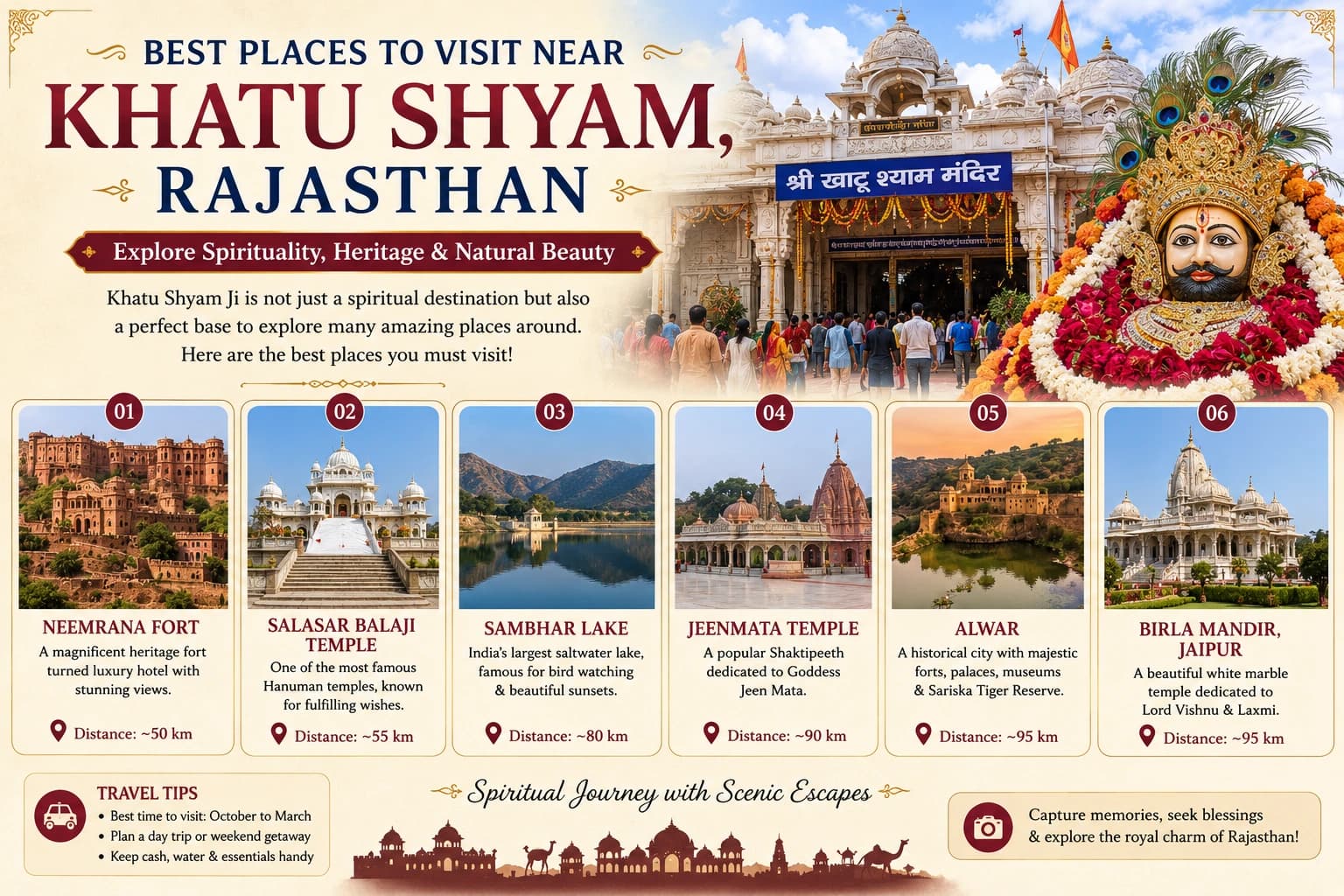
Every year, millions of devotees make their way to a small, sacred town in the Sikar district of Rajasthan, drawn by the divine pull of Khatu Shyam Ji — the beloved deity revered as the "Haare ka Sahara" (the support of those who have lost). The chants of "Shyam Bolo, Jai Shyam" fill the air, and an indescribable energy wraps around every visitor who arrives at this holy dhaam.
But here's what most travel guides miss: the journey to Khatu Shyam is just the beginning. The surrounding region — stretching across the ancient Shekti belt of Rajasthan — is home to some of the most spiritually significant temples, architecturally stunning forts, pristine holy kunds, and culturally rich towns you will find anywhere in northern India. Whether you are a devoted pilgrim, a curious traveller, or a family planning a weekend getaway from Jaipur, the places to visit near Khatu Shyam will leave you with memories that last a lifetime.
In this guide, The Jaipur Vista brings you a comprehensive, well-researched list of the 15 best places to visit near Khatu Shyam, Rajasthan — complete with distances, timings, travel tips, and things to do at each stop.
Khatu Shyam Ji is located in Khatu village, roughly 80 km north of Jaipur, in the Sikar district of Rajasthan. The surrounding Shekhawati region is known for its extraordinary concentration of ancient havelis, step wells (baoris), temples, and small towns that have retained their medieval character over centuries.
While most pilgrims visit only the Khatu Shyam Ji Temple and return the same day, those who linger discover a world of spiritual and cultural richness. The things to do in Khatoo, Rajasthan are far more varied than a single darshan visit — you can explore holy bathing ghats, walk through fresco-painted havelis, climb ancient Shiva temples, and drive through the golden sands of the Aravalli foothills.
Best time to visit: October to March is the ideal season. The weather is pleasant, and the major melas (fairs) including the famous Phalgun Mela (held during February-March) draw lakhs of devotees and create a once-in-a-lifetime festive atmosphere.
Before exploring the surrounding region, make sure you experience everything Khatu Shyam places to visit has to offer within the town itself.
Distance from Khatu Shyam Town Centre: 0 km (within town)
Timings: 5:30 AM – 1:00 PM and 5:00 PM – 9:00 PM
Entry: Free
No visit to Khatu is complete without spending meaningful time at the Shri Khatu Shyam Ji Temple — the spiritual heart of the entire region. This magnificent temple is dedicated to Barbarika, the courageous grandson of Bhima (son of Pandava fame) and grandson of Ghatotkacha, who was blessed by Lord Krishna himself to be worshipped in the Kali Yuga under the name "Shyam."
According to Hindu mythology, Barbarika possessed an extraordinary power — just three divine arrows could decide the outcome of any battle. Before the Kurukshetra war, Lord Krishna sought Barbarika's head as a daanveer offering. Moved by Barbarika's selfless sacrifice, Krishna blessed him and declared that in the Kali Yuga, Barbarika would be worshipped as Shyam and would fulfil the wishes of his devotees.
The temple complex is built in traditional Rajasthani style with intricate marble carvings, towering shikhars (spires), and silver-plated doors. The idol of Shyam Ji — adorned with fresh flowers, jewels, and silken garments — radiates a divine glow that devotees describe as deeply moving.
Travel Tips:
Arrive before 6:00 AM for a peaceful darshan; the temple gets extremely crowded after 8:00 AM, especially on weekends and ekadashi days.
The Phalgun Mela (February-March) is the most sacred time to visit but also the most crowded — book accommodation well in advance.
Photography is allowed in the outer courtyard; check with temple authorities before photographing inside.
Distance from Khatu Shyam Temple: Adjacent (100 meters)
Timings: Open all day
Entry: Free
Adjacent to the main temple lies the sacred Shyam Kund, a holy water tank of immense religious significance. According to legend, this is the very spot where the severed head of Barbarika was discovered. It is believed that the head had been resting in this kund for thousands of years before a local king was divinely guided to retrieve it and install it in the temple.
Devotees consider a ritual bath in Shyam Kund before entering the temple to be spiritually purifying and deeply auspicious. The kund is lined with beautifully carved marble steps (ghats), and devotees of all ages can be seen offering flowers, lighting lamps, and quietly praying at the water's edge.
During the Phalgun Mela, the Shyam Kund becomes an extraordinary sight — thousands of devotees in saffron and yellow attire taking a ritual dip in the illuminated waters while bhajans echo around them.
Insider Tip: The kund is most serene in the early morning hours, especially during sunrise when soft golden light reflects off the still water. This is also the best time for photography.
Distance from Temple: 300 meters
Timings: Daytime hours
Entry: Free
The town of Khatu has a well-managed Gaushala (cow shelter) run by the temple trust where you can feed and interact with sacred cows. Many devotees consider offering fodder to the cows as part of their religious offering to Shyam Ji. Near the temple complex, the official Prasad distribution centre also operates, where you can purchase or receive mahaprasad — sweets and other offerings that have been offered to the deity.
Now, let us journey outward. The following are the best places to visit near Khatu Shyam, Rajasthan, covering a radius of approximately 100 km — all easily accessible by road.
Distance from Khatu Shyam: 26 km
Timings: 5:00 AM – 9:00 PM
Entry: Free
Best Time to Visit: During Navratri (October and March-April)
Perched dramatically atop a hill amidst the Aravalli foothills, the Jeen Mata Temple at Revasa is one of the most powerful shakti peethas in Rajasthan and an essential stop on any Khatu Shyam pilgrimage circuit. The temple is dedicated to Goddess Jeen Mata, believed to be an incarnation of Goddess Durga, and is considered highly auspicious for seekers of divine feminine energy.
The approach to the temple requires a short but scenic trek through rocky pathways and dense scrub forest. The views of the surrounding countryside from the hilltop are spectacular, especially during the cooler months. The temple is known for its ancient stone architecture, vibrant prayer flags, and the continuously burning sacred flame (akhanda jyoti) that is believed to have been burning for centuries.
During Navratri, the Jeen Mata Temple transforms into a carnival of devotion — folk music, aarti performances, and the sight of thousands of devotees ascending the hill with flowers and coconuts is a deeply moving experience.
Things to do at Jeen Mata Temple:
Attend the morning and evening aarti
Trek to the hilltop and take in panoramic views of the Aravalli range
Explore the ancient stone carvings on the temple walls
Buy local handicrafts and religious items at the market near the base of the hill
Distance from Khatu Shyam: 30 km
Timings: Sunrise to Sunset
Entry: Free
Nearest City: Sikar (14 km from Sikar town)
If you are looking for places that combine spiritual depth with historical grandeur and natural beauty, the Harshnath Temple near Sikar is an absolute must-visit. Situated atop a ridge of the Aravalli Hills at an altitude of approximately 914 metres above sea level, this ancient Shaivite temple complex dates back to the 10th century CE and is associated with the royal legacy of the Chahamana (Chauhan) dynasty.
The temple is dedicated to Lord Shiva in his form as Harshnath (the Lord of Joy) and was constructed by the Chahamana king Vigrahraja around 973 CE, as evidenced by a Sanskrit inscription found at the site. The temple complex includes the main Shiva shrine, several smaller ancillary temples, a beautiful step well, and a large number of exquisitely carved stone panels depicting scenes from Hindu mythology and the life of the Chauhan kings.
What makes Harshnath especially magical is its setting — the hilltop location offers sweeping 360-degree views of the Shekhawati plains, and the surrounding forests provide a serene, almost meditative atmosphere. The site is less visited than the major pilgrimage temples, which means you can explore at your own pace in relative peace.
Things to do at Harshnath Temple:
Explore the ruins of the ancient temple complex and admire the intricate stone carvings
Climb to the highest point for panoramic views of Sikar district
Look for the historic Sanskrit inscription tablet preserved on the temple premises
Carry a picnic — the hilltop meadow is a perfect spot for a quiet meal surrounded by nature
Practical Note: The road to Harshnath Temple is narrow and hilly in the final stretch. A robust vehicle (SUV or Jeep) is recommended, especially during or after the monsoon season.
Distance from Khatu Shyam: 17 km
Best Time to Visit: October to March
The district headquarters of Sikar is the closest major city to Khatu Shyam Ji and serves as an excellent base for exploring the broader Shekhawati region. Sikar itself is a historically significant city with several notable attractions.
Places to visit in Sikar:
Sikar Fort: A 19th-century fort built by the Shekhawat thakurs, now partially converted into government offices. The fort exterior features some fine examples of Rajput architecture.
Baba Mohan Ram Mandir: An important local temple dedicated to a regional deity worshipped widely in the Sikar and Jhunjhunu districts.
Gopinath Ji Temple: A beautifully decorated temple within the old city of Sikar, known for its fine frescoes.
Sikar Bazaar: The main market of Sikar is a good place to buy local Rajasthani textiles, silver jewellery, and traditional snacks like ghevar and mawa kachori.
Distance from Khatu Shyam: 90 km
Timings: 5:00 AM – 12:00 PM and 4:00 PM – 10:00 PM
Entry: Free
Location: Salasar, Churu district
Salasar Balaji is arguably the most famous Hanuman temple in Rajasthan and one of the most visited pilgrimage sites in all of northern India. The temple is dedicated to Lord Hanuman and uniquely depicts him with a beard and moustache — a form not commonly seen elsewhere.
The story behind Salasar Balaji is deeply moving: in 1754 CE, a farmer ploughing his field in a village near Nagaur found a self-manifested idol of Hanuman. The idol was miraculously transported to Salasar and installed by the devoted priest Mohan Das. Since then, the temple has grown into a sprawling complex that draws millions of devotees annually — particularly on Saturdays, Sundays, and during Hanuman Jayanti.
Visiting Salasar Balaji in combination with Khatu Shyam Ji and Jeen Mata Temple is a well-established pilgrimage circuit in Rajasthan, often completed over 2-3 days.
Things to do at Salasar:
Attend the morning or evening aarti (the evening aarti is particularly spectacular)
Explore the colourful market selling prasad, religious items, and traditional Rajasthani food
Walk through the lanes of the temple town and interact with local craftspeople
Try local food at one of the dhabas — the dal baati churma and ladoos near the temple are excellent
Distance from Khatu Shyam: 65 km
Timings: 5:00 AM – 9:00 PM
Entry: Free
The Rani Sati Dadi Temple in Jhunjhunu is one of the most revered temples in the Shekhawati region and draws large numbers of devotees — particularly from the Marwari business community — throughout the year.
The temple is dedicated to Rani Sati, a legendary Rajasthani woman who performed sati in the 17th century and was subsequently deified by her followers. What makes this temple architecturally distinctive is its pure white marble construction and the complete absence of any idol — the primary object of worship is a sacred trishul (trident), symbolising the strength, sacrifice, and divine femininity of Rani Sati Dadi.
The temple complex is beautifully maintained, with intricate silver work on the inner sanctum walls, spacious courtyards, and a series of smaller shrines dedicated to associated deities. The main fair at the temple, held on Bhadra Amavasya (a moonless night in August-September), attracts hundreds of thousands of visitors from across India.
Jhunjhunu — A Shekhawati Treasure:
While in Jhunjhunu, also visit:
Khetri Mahal: A stunning 18th-century palace built on a cliff, featuring unique architecture with no supporting pillars in the verandahs.
Tibrewal ki Haveli: One of the finest fresco-painted havelis in Jhunjhunu.
Mertani Baori: A beautifully constructed step well that reflects the ingenious water conservation traditions of Rajasthan.
Distance from Khatu Shyam: 40 km
Timings: Open all day
Entry: Free
Lohargal is one of the most fascinating and spiritually powerful sites in the Shekhawati region — and one that remains surprisingly little-known outside the local pilgrim community. The name Lohargal literally translates to "where iron dissolves," referring to the legendary account in the Mahabharata where the Pandavas, burdened by the sin of the war, took a bath in the sacred kund here and their iron weapons dissolved instantly, cleansing them of their karmic debt.
The site features a series of sacred kunds (holy water tanks) nestled within a narrow, forested valley in the Aravalli Hills. The most significant of these is the Surya Kund, believed to be the spot where the Pandavas bathed. Surrounding the kund are ancient temples dedicated to Surya (the Sun God), Hanuman, Shiva, and other deities.
Lohargal also hosts a major pilgrim fair every year during the Shravan month (July-August), particularly on Shravan Somvar (Monday of the holy month), when thousands of devotees arrive to take a dip in the holy waters.
Things to do at Lohargal:
Take a ritual bath in Surya Kund
Trek through the valley and explore the surrounding temples
Visit the ancient Shiva temple at the head of the valley
Spot migratory birds near the kund (especially during winter months)
Distance from Khatu Shyam: 55 km
Best Time to Visit: October to February
If you have even a passing interest in history, art, or architecture, Fatehpur Shekhawati is a place that will genuinely astonish you. This small but historically significant town, located in the Sikar district, is home to an extraordinary concentration of painted havelis — grand merchants' mansions whose facades and interiors are covered floor-to-ceiling with vibrant frescoes depicting mythological scenes, historical narratives, and daily life in the 19th and early 20th centuries.
Fatehpur was one of the great trading towns of the Shekhawati region, and its wealthy merchant families (mainly Marwari traders) expressed their affluence by commissioning elaborate painted havelis. Today, these havelis represent the finest examples of Rajasthani fresco art in existence.
Must-visit havelis in Fatehpur:
Nadine Le Prince Cultural Centre (Haveli): A beautifully restored French-owned haveli that now functions as a cultural centre and gallery — a stunning example of East-meets-West restoration.
Devra Haveli: Featuring some of the most intricate and well-preserved frescoes in the region.
Singhania Haveli: Notable for its detailed paintings of mythological scenes and European-influenced imagery.
Practical Tip: Hire a local guide in Fatehpur — many of the havelis are within private compounds or down unmarked lanes, and a knowledgeable guide will significantly enrich your experience.
Distance from Khatu Shyam: 55 km
Best Time to Visit: October to March
Mandawa is perhaps the most photogenic town in the Shekhawati region and one that has been featured in numerous Bollywood films and international travel documentaries. Centred around a magnificent 18th-century fort (now converted into a heritage hotel), Mandawa's lanes are lined with beautifully preserved havelis adorned with frescoes that blend Rajput, Mughal, and even European artistic styles.
Unlike some other heritage towns in Shekhawati, Mandawa has invested significantly in tourism infrastructure — you will find good hotels (including the fort itself), clean restaurants, and reliable guides.
Things to do in Mandawa:
Walk the heritage circuit through the old town lanes (best done in the early morning) Visit Hanuman Prasad Goenka Haveli and Gulab Rai Ladia Haveli for superb frescoes Stay overnight in Mandawa Fort for an immersive Rajasthani heritage experience Browse local craft shops for block-printed textiles and silver jewellery Distance from Khatu Shyam: 75 km Ramgarh is considered to have some of the finest and most intact painted havelis in all of Shekhawati — perhaps even superior to those of Mandawa and Fatehpur in terms of artistic quality and preservation. Founded in 1791 by the Poddar merchant family, Ramgarh became one of the wealthiest trading towns in Rajasthan during the 19th century. The frescoes here are notable for their unusual subject matter — alongside traditional Hindu mythological scenes, you will find paintings depicting early automobiles, steam trains, telegraph wires, and European fashions — a fascinating record of how the Marwari trading community absorbed and depicted the modern world as it came to them through trade. Must-visit sites in Ramgarh: Poddar Haveli: The finest haveli in Ramgarh, with an extraordinary double courtyard and extraordinarily detailed frescoes. Shani Temple: An important temple complex at the centre of the town. Ram Gopal Poddar Chhatri: A beautiful memorial pavilion on the outskirts of town featuring paintings in excellent condition. Distance from Khatu Shyam: 45 km Nawalgarh is often described as the cultural heart of the Shekhawati region — a town where you will find the highest concentration of traditional arts, crafts, and cultural activities, alongside a remarkable collection of painted havelis. The town was founded in 1737 by Nawal Singh, a local chief, and flourished as a trading centre for centuries. Today, it is home to numerous havelis (some estimate as many as 5,000 painted buildings in and around Nawalgarh), museums, and active craft workshops where you can watch artisans at work. Things to do in Nawalgarh: Visit the Roop Niwas Kothi — a heritage hotel that also runs excellent cultural tours Explore the Aath Haveli complex (eight connected havelis) Visit the Dr. Ramnath Podar Haveli Museum — probably the best-maintained haveli museum in the Shekhawati region with informative displays Take a folk painting workshop (available at several local arts centres) Stroll through the old bazaar and sample local sweets Distance from Khatu Shyam: 30 km Ringas is a small town on the railway line between Jaipur and Sikar, and it is home to a significant regional temple — Shree Kalyanji Ka Thaan, dedicated to a local folk deity revered across the Sikar and Jhunjhunu districts. The temple is particularly important for devotees who follow the Shyamji-Kalyanji circuit — many pilgrims visit both Khatu Shyam Ji and this temple on the same trip. Ringas is also important as a transit hub — it is the nearest railway station to Khatu Shyam Ji (about 17 km away), and many pilgrims arriving by train from Jaipur pass through here. Distance from Khatu Shyam: Various Beyond fixed attractions, one of the most authentic things to do in Khatoo, Rajasthan is to experience the living cultural fabric of the region through its weekly haats (village markets) and seasonal fairs. The Jeen Mata Fair held twice yearly during Navratri (March-April and October-November) is the largest such fair in the Sikar district. The Khatu Shyam Mela (Phalgun Mela), held on the Ekadashi of the Phalgun month (usually February-March), transforms the entire town of Khatu into a festival of devotion — with hundreds of bhajan mandalis (devotional singing groups) arriving from across north India, streets decorated with lights and flowers, and a carnival atmosphere that continues day and night for several days. From Jaipur (80 km): The most common route. Take NH-11 (Jaipur-Bikaner Highway) up to Ringas and then follow the state highway to Khatu. The drive takes approximately 1.5 to 2 hours by car. Buses are also available from Sindhi Camp Bus Stand in Jaipur and run frequently throughout the day. From Delhi (310 km): Take NH-48 to Jaipur and then follow the Jaipur-Khatu route, or take NH-58 through Alwar, Ringas, and then to Khatu. The total drive from Delhi takes approximately 5-6 hours. By Train: The nearest railway station is Ringas Junction (17 km from Khatu), which is well-connected to Jaipur, Delhi, and other major cities. From Ringas, take an auto-rickshaw or shared tempo to Khatu. By Bus: Direct buses operate from Jaipur (Sindhi Camp), Delhi (Bikaner House / ISBT), and Sikar to Khatu Shyam. State buses are available but private operators offer more comfortable services. In Khatu Town: The temple trust manages basic dharamshalas (pilgrim rest houses) offering affordable accommodation near the temple. Several budget and mid-range hotels have come up in and around Khatu in recent years, with decent facilities. In Sikar City (17 km): Sikar offers a much wider range of hotels, from budget guesthouses to comfortable business hotels, and is an excellent base for exploring the entire Sikar district. In Jaipur (80 km): For travellers who want high-quality accommodation, Jaipur offers everything from heritage havelis to luxury hotels, and the 80 km drive to Khatu can be comfortably completed in under 2 hours. The food scene around Khatu Shyam is primarily oriented around pilgrim-friendly, sattvic (pure vegetarian) cuisine. Here are some options: Temple Prasad: The most authentic "meal" in Khatu — the mahaprasad distributed at the temple is delicious and considered highly auspicious. Local Dhabas on Khatu Main Road: Serve simple, hearty Rajasthani thali meals including dal baati churma, gatte ki sabzi, and bajre ki roti. Mithai Shops: Khatu's local sweet shops are excellent — look for besan ladoo, mawa kachori, and jalebi. Sikar's Famous Kachori: If you are passing through Sikar on your way back to Jaipur, a stop at one of the town's famous kachori shops is a must. One Day (Khatu Shyam Darshan Only): 5:30 AM: Morning aarti at Khatu Shyam Ji Temple 7:00 AM: Bath and prayer at Shyam Kund 8:00 AM: Breakfast at a local dhaba 9:00 AM: Visit Jeen Mata Temple (26 km drive) 12:00 PM: Lunch and return to Jaipur Two Days (Spiritual Circuit): Day 1: Khatu Shyam Ji Temple + Shyam Kund + Jeen Mata Temple + Lohargal Day 2: Salasar Balaji + Rani Sati Dadi Temple Jhunjhunu + return via Harshnath Temple Three Days (Complete Shekhawati Circuit): Day 1: Khatu Shyam Ji + Jeen Mata + Harshnath Temple (base in Sikar) Day 2: Salasar Balaji + Rani Sati Dadi + Mandawa (base in Mandawa/Nawalgarh) Day 3: Nawalgarh + Fatehpur Shekhawati + Ramgarh + return to Jaipur Read Also: Birla Mandir Jaipur Dress Code: Modest clothing is appreciated at all temples. Avoid sleeveless tops and shorts. Carry a dupatta or shawl that can be used as a head covering when entering temple sanctums. Footwear: You will need to remove your shoes at all temple entrances. Carrying a small shoe bag is recommended, especially during busy pilgrimage seasons. Crowds: Khatu Shyam Ji Temple can get extremely crowded on weekends, Ekadashi days, and during the Phalgun Mela. Visit on weekdays for a more peaceful darshan experience. Health and Hygiene: Carry your own drinking water and light snacks, especially if you are undertaking longer excursions to Lohargal or Harshnath Temple. Photography: Always seek permission before photographing inside temple sanctums. The outer courtyards and kunds are generally accessible for photography. Language: Hindi and Rajasthani (Marwari/Shekhawati dialect) are spoken throughout the region. English is understood in Jaipur and at some of the larger hotels. Khatu Shyam Ji is not just a temple — it is an experience, a feeling, and for millions of devotees, a homecoming. The sacred energy of the Shyam darshan, combined with the rich cultural and historical tapestry of the surrounding Shekhawati region, makes this one of the most rewarding travel destinations in Rajasthan. Whether you are planning a same-day pilgrimage from Jaipur, a weekend spiritual retreat, or a full Shekhawati heritage circuit, the places to visit near Khatu Shyam, Rajasthan offer something extraordinary for every kind of traveller. At The Jaipur Vista, we are committed to helping you plan meaningful, well-informed journeys across Rajasthan. Bookmark this guide, share it with your travel companions, and step into the divine world that waits beyond the Khatu Shyam Ji temple gates. Q. How far is Khatu Shyam from Jaipur? Q. Which is the best time to visit Khatu Shyam Ji? Q. What are the must-visit places near Khatu Shyam? Q. Can I cover Khatu Shyam and Salasar Balaji in one day? Q. What is the Phalgun Mela at Khatu Shyam?12. Ramgarh Shekhawati
Best Time to Visit: October to March13. Nawalgarh — The Cultural Capital of Shekhawati
Best Time to Visit: October to March14. Shree Kalyanji Ka Thaan, Ringas
Timings: 6:00 AM – 8:00 PM
Entry: Free15. Jeenmata Mata Fair & Local Haats (Weekly Markets)
Best Time: Navratri, Phalgun Mela seasonPractical Travel Guide: Khatu Shyam Rajasthan
How to Reach Khatu Shyam Ji
Where to Stay Near Khatu Shyam Ji
Best Places to Eat Near Khatu Shyam
Suggested Itineraries
Tips for Visiting Khatu Shyam Ji and Nearby Places
Final Word: Plan Your Khatu Shyam Trip with The Jaipur Vista
Frequently Asked Questions: Places to Visit Near Khatu Shyam
Khatu Shyam Ji is approximately 80 km from Jaipur. The drive takes 1.5 to 2 hours by car or taxi.
October to March is the best time to visit. The Phalgun Mela (February-March) is the most auspicious but also the most crowded period.
Jeen Mata Temple, Harshnath Temple, Salasar Balaji, Rani Sati Dadi Temple Jhunjhunu, Lohargal, and the Shekhawati haveli towns of Mandawa, Nawalgarh, and Fatehpur are the top recommendations.
Yes, it is possible on a long day trip, especially from Jaipur. Start very early (by 5:00 AM) to get morning darshan at Khatu Shyam Ji, then drive to Salasar Balaji (90 km from Khatu) for afternoon darshan and return to Jaipur by evening.
The Phalgun Mela is the annual fair held at Khatu Shyam Ji during the Ekadashi of the Phalgun month (February-March). It is the most important event in Khatu's religious calendar and draws lakhs of devotees from across India. The fair features bhajan programmes, processions, and a deeply devotional atmosphere.
While Khatu Shyam Ji is primarily a religious site, the broader Shekhawati region surrounding it offers extraordinary attractions for history buffs, art lovers, nature enthusiasts, and photographers. The haveli towns of Mandawa, Nawalgarh, and Fatehpur, the ancient temple complex at Harshnath, and the natural beauty of Lohargal appeal to travellers regardless of religious inclination.