Laal Maas – Rajasthan's Most Legendary Meat Curry (History, Recipe & Where to Eat)
Author:Niharika
Published:June 1, 2026
Views:1144
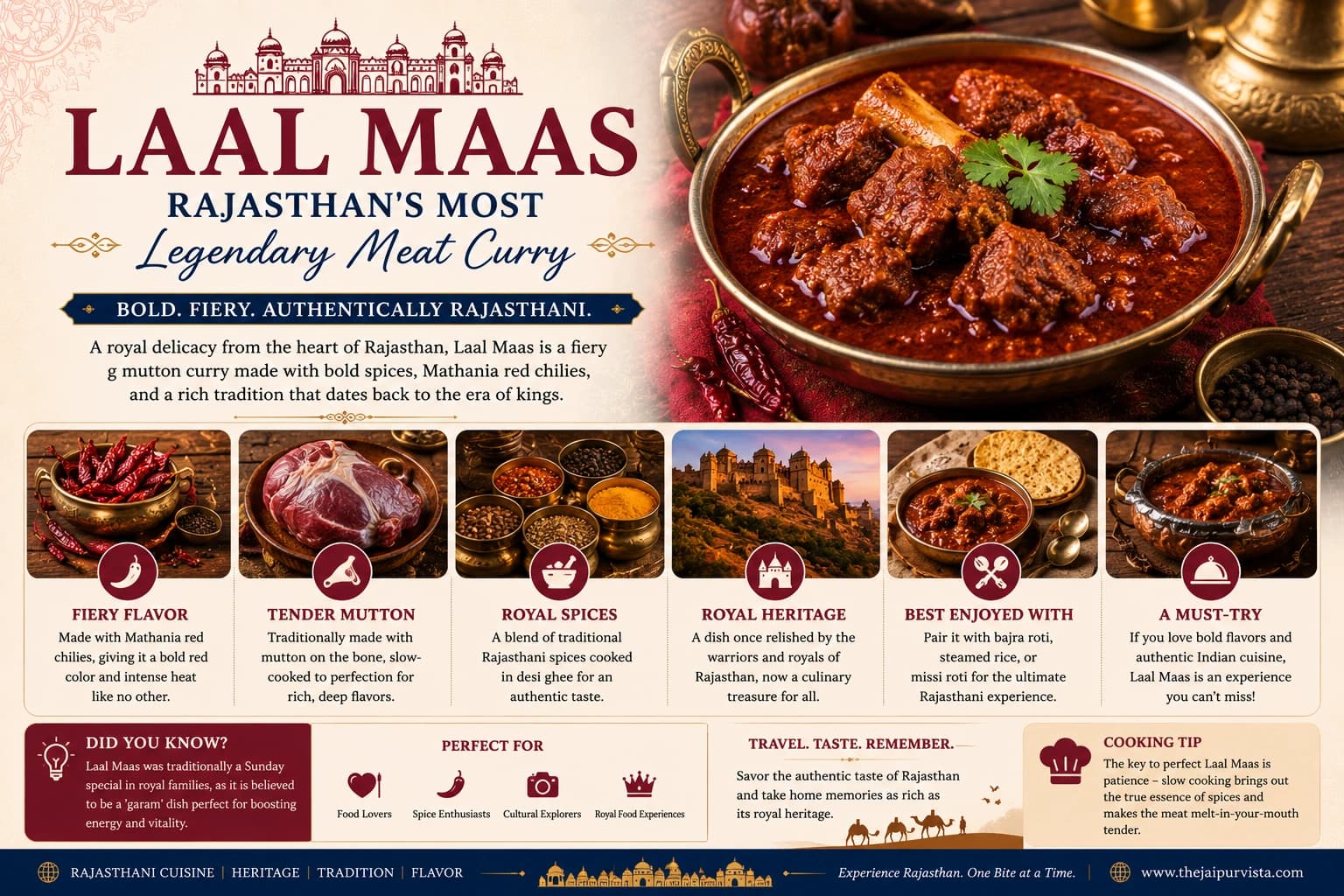
There are dishes that feed you, and then there are dishes that tell you a story. Laal Maas does both - with heat, depth, and a fiery confidence that refuses to be ignored.
If you have ever sat down at a dhaba in Rajasthan and watched a clay pot of deep red curry arrive at your table, trailing a fragrant cloud of chilli and ghee and whole spices, you already know what we mean. And if you haven't yet had the privilege of tasting authentic Rajasthani Laal Maas, then this guide is the beginning of something wonderful.
At The Jaipur Vista, food is never just about eating. It is about understanding the land, the people, and the history behind every recipe. And the history of Laal Maas is as rich, complex, and deeply satisfying as the dish itself.
Laal Maas - also written as Laal Maans - is a slow-cooked meat curry from Rajasthan, India. The name comes from two Hindi words: laal, meaning red, and maas (or maans) meaning meat. Together, they give you its most direct translation: Red Meat.
The name is not merely descriptive. It is a declaration. The magnificent, blazing crimson colour of this curry - achieved through a generous use of dried red Mathania chillies, rich ghee, and slow cooking - is as much a part of its identity as its taste. When a bowl of Laal Maas is placed in front of you, there is no mistaking what you are about to experience.
Traditionally, Laal Maas is made with bone-in mutton - goat meat - simmered slowly in a gravy built on curd (yoghurt), whole spices, garlic, and above all, the distinctive Mathania red chilli. The result is a curry that is intensely aromatic, deeply flavoured, and honestly, uncompromisingly spicy - exactly as it should be.
This is the meat curry from Rajasthan that has made food lovers travel hundreds of kilometres just for a single, unforgettable meal.
Read Also: Best Street Food in Jaipur
To truly understand Rajasthani Laal Maas, you need to travel back several centuries to the forests and hunting grounds of royal Rajputana.
The Rajputs - the warrior aristocracy that ruled much of Rajasthan for over a thousand years - were passionate hunters. The shikar (royal hunt) was not merely a sport; it was a statement of power, a demonstration of courage, and an important ritual in the life of every Rajput nobleman and king. Maharajas would set out with elaborate retinues - soldiers, attendants, cooks, and of course, their hunting weapons - for expeditions that could last days or weeks in the deep forests of the Aravalli hills and the scrublands of the Thar Desert.
During these hunts, the catch of the day - wild boar (jungli suar), deer (hiran), and other game - would be cooked on the spot over open fires. This is where Laal Maas, in its earliest form, was born.
Game meat - boar, deer, and other wild animals - has a strong, distinctive odour that most domestic meats do not. The Rajput cooks who travelled with hunting parties discovered that an abundance of hot red chillies, combined with strong garlic and whole spices, effectively masked this gaminess while simultaneously creating a gravy of extraordinary depth and complexity.
The chillies served a dual purpose: flavour and preservation. In the heat of Rajasthan's climate, the antimicrobial properties of chillies helped keep the cooked meat from spoiling too quickly in the absence of refrigeration - a critical practical consideration for hunting parties far from their kitchens.
As the celebrated chef Bulai Swain has noted, Laal Maas was originally a jungli maas - wild meat curry - and its exaggerated heat was a functional choice before it became a culinary philosophy.
Over time, the dish evolved from its rough, open-fire origins into a refined preparation of the royal Rajput kitchens. The game meat was gradually replaced by tender, well-raised domestic mutton. The spice profile was refined, the technique became more sophisticated, and the dish acquired the status it holds today: the flagship meat preparation of Rajasthani cuisine and the most celebrated Rajasthani mutton curry in India.
The royalty of Jaipur, Udaipur, Jodhpur, and the other princely states of Rajputana all had their own versions of Laal Maas - each kitchen adding its own touches, jealously guarding its masalas, and taking pride in its interpretation of this iconic dish.
What separates a genuinely authentic Rajasthani Laal Maas from an ordinary red meat curry is a specific set of ingredients and the respect with which they are handled. Here is what matters most:
Ask any serious Rajasthani cook what makes Laal Maas different, and they will answer without hesitation: Mathania chilli. Named after the village of Mathania, near Jodhpur, from which they originate, these medium-length dried red chillies have a very particular character. They are moderately hot - significantly less fiery than a Bhut Jolokia but more complex than a Kashmiri chilli - and they impart a deep, rich red colour along with a subtle, slightly fruity flavour that no other chilli quite replicates.
A proper Mutton Laal Maas uses Mathania chillies both whole (for early-stage tempering) and as a paste (for building the gravy's body and colour). Substituting Kashmiri chilli will give you the colour but not the heat or the exact flavour character. Substituting regular red chilli will give you heat but not the colour. Mathania is both.
Authentic Laal Maas is always made with bone-in mutton - typically from the shoulder, ribs, and leg - cut into medium-sized pieces. The bones are non-negotiable. The slow braising process draws collagen and marrow out of the bones into the gravy, creating a body and richness that boneless meat simply cannot achieve. If you see a Laal Maans made with boneless meat, it is a compromise.
Traditional Rajasthani Laal Maas is cooked in either pure desi ghee (clarified butter) or mustard oil - or a combination of both. Ghee adds a nutty, deeply satisfying richness that is inseparable from the authentic taste profile. Some recipes use mustard oil for its pungent, slightly bitter quality that cuts through the fat of the mutton. The modern trend of cooking it in refined vegetable oil produces a competent but ultimately inferior dish.
A proper Laal Maas recipe begins with the tempering of whole spices in hot ghee: dried red chillies, black cardamom, green cardamom, cinnamon sticks, cloves, bay leaves, and black peppercorns. These aromatics release their essential oils into the cooking fat in the first few minutes and form the flavour foundation upon which the entire dish is built.
Laal Maas is famously heavy on garlic. We are not talking about two or three cloves. A traditional recipe for one kilogram of mutton typically calls for an entire head of garlic - sometimes more. The garlic is added both as crushed paste (for depth) and as whole cloves (for texture). This is not subtle. It is not meant to be.
Thick, full-fat curd is beaten into the cooking base after the meat has been seared, where it performs two functions: it tenderises the mutton by breaking down tough protein fibres, and it provides a gentle acidity that balances the intense heat of the chillies. The curd must be added gradually, off the heat or on very low heat, to prevent splitting.
A word that cannot be said loudly enough: authentic Laal Maas contains no tomatoes and no cream. The temptation to add tomatoes for extra body or cream to soften the heat is understandable from a modern restaurant perspective - but it produces a fundamentally different dish. The true character of Rajasthani Laal Maas - its uncompromising heat, its clean red colour, its yogurt-based depth - depends on resisting these shortcuts.
This is the authentic home-style Laal Maas recipe as it has been made in Rajasthani households for generations. It demands patience, good ingredients, and honest heat.
For the Meat:
1 kg bone-in mutton (shoulder + ribs, medium-sized pieces)
200 g full-fat curd (yogurt), beaten smooth
Salt to taste
For the Masala Base:
8–10 whole Mathania dried red chillies (or substitute 6 Mathania + 4 Kashmiri chilli for milder colour without full heat)
2–3 tablespoons Mathania red chilli paste (made by soaking and grinding dried chillies)
1 full head of garlic (10–12 large cloves), roughly crushed
1 teaspoon turmeric powder
2 teaspoons coriander powder
For Tempering (Tadka):
4 tablespoons pure desi ghee (plus 1 tbsp extra for finishing)
2 tablespoons mustard oil (optional, but traditional)
4 whole dried red chillies
2 black cardamom pods, cracked
4 green cardamom pods
1 inch cinnamon stick
4 cloves
2 bay leaves
1 teaspoon black peppercorns
For Garnish:
Fresh coriander (dhania), roughly chopped
A knob of ghee drizzled at serving
Step 1 - Prepare the Chilli Paste (1 hour before cooking) Soak 10–12 Mathania dried red chillies in warm water for 45 minutes to 1 hour until fully softened. Drain and grind to a smooth, thick paste. This paste is the heart of your Laal Maas - it must be made from soaked whole chillies, not from chilli powder. Set aside.
Step 2 - Temper the Whole Spices Heat ghee (and mustard oil if using) in a heavy-bottomed kadai or Dutch oven on medium-high heat until the oil/ghee shimmers and begins to smoke lightly. Add whole dried red chillies first - they will puff and darken within seconds. Then add black cardamom, cinnamon, cloves, bay leaves, green cardamom, and black peppercorns. Stir constantly for 30–45 seconds until the whole spices are fragrant and the oil is richly perfumed.
Step 3 - Add Garlic Add the crushed garlic to the hot spiced ghee. Lower the heat slightly. Fry the garlic, stirring frequently, for 4–6 minutes until it turns golden brown and fragrant. Do not let it burn - bitter garlic is unforgiving and cannot be fixed.
Step 4 - Sear the Mutton Increase heat to high. Add the mutton pieces in a single layer (work in batches if needed). Sear for 3–4 minutes per side without moving - you want a proper brown crust, not a steam. This step builds the fond at the bottom of the pan that becomes the base of your gravy. Season generously with salt.
Step 5 - Add the Chilli Paste Reduce heat to medium. Add the Mathania red chilli paste to the seared mutton. Stir vigorously to coat every piece of meat thoroughly. Cook the paste with the meat for 8–10 minutes, stirring regularly, until the oil begins to separate from the masala at the edges of the pan. This bhunoing (stir-frying the masala until it cooks out) is one of the most important steps - undercooked chilli paste produces a raw, harsh flavour that no amount of slow cooking will fix.
Step 6 - Add Turmeric and Coriander Powder Add turmeric and coriander powder. Stir well and cook for another 2 minutes.
Step 7 - Add the Beaten Curd Remove the pan from the heat or reduce to the lowest possible flame. Add the beaten curd one tablespoon at a time, stirring continuously after each addition to prevent it from splitting. Once all the curd is incorporated, return to medium heat and cook, stirring, for 5 minutes until the curd has been fully absorbed into the masala and the mixture is thick and fragrant.
Step 8 - Slow Cook to Perfection Add enough hot water to just cover the meat (approximately 1 to 1.5 cups). Stir well, scraping up any fond from the bottom of the pan. Cover tightly and reduce heat to the lowest possible setting. Cook covered for 60–75 minutes, checking and stirring every 15–20 minutes. The mutton is ready when it is completely tender and falls slightly from the bone when pressed.
Step 9 - Adjust Consistency and Final Seasoning Uncover and assess the gravy. Traditional Laal Maas can be served with a thick, coating gravy or a slightly looser consistency - both are correct depending on preference. If the gravy is too thin, cook uncovered on medium heat for 10–15 minutes to reduce. If it is too thick, add a splash of hot water and stir. Taste and adjust salt.
Step 10 - Finish and Serve Turn off the heat. Add a generous knob of ghee and let it melt into the curry. Garnish with roughly chopped fresh coriander. Serve immediately - Laal Maas is at its absolute best piping hot, straight from the fire.
Authentic Rajasthani Laal Maas is traditionally served with:
Bajra Roti - Thick, unleavened flatbread made from pearl millet flour, the winter staple of Rajasthan. Its slightly earthy, nutty flavour is the most traditional pairing and the one that ties the dish most firmly to its land.
Wheat Chapati or Phulka - The summer alternative to bajra roti. Lighter and thinner, it works beautifully with a slightly looser Laal Maas gravy.
Tandoori Roti or Naan - A popular restaurant pairing that works well, though slightly less traditional.
Steamed Basmati Rice - Not strictly traditional, but increasingly popular, especially for those who prefer a milder experience (the rice absorbs and moderates the heat).
Dal Baati Churma - Some Rajasthani thali presentations pair Laal Maas alongside dal baati as a grand feast combination. This is the full Rajasthani experience on a single plate.
Laal Maas is not the only meat preparation in Rajasthani cuisine, but it is undoubtedly the most famous. Here is how it compares to some of its neighbours on the Rajasthani food map:
Safed Maas (White Meat Curry) - The yin to Laal Maas's yang. Safed Maas is a mutton curry cooked in a pale, creamy gravy of white poppy seeds, cashews, cream, and mild spices. Where Laal Maas is fire and passion, Safed Maas is elegance and restraint. Both are considered royal Rajput preparations and are typically served together at grand Rajasthani feasts and thalis.
Jungli Maas - The ancestor of Laal Maas, jungli maas is a stripped-back hunting-camp recipe made with only three core ingredients: meat, ghee, and red chillies. No yogurt, no onions, no other masalas. It is a raw, elemental dish that speaks directly to the origins of Rajasthani mutton curry culture.
Khad Gosht - A dramatic preparation where marinated mutton is sealed inside a clay pot, buried underground, and slow-cooked over a wood fire for several hours. The result is extraordinarily tender meat that falls off the bone. This is traditionally associated with the Rajput hunting tradition, just as Laal Maas is.
India has hundreds of regional meat curry traditions, each with its own character. So what specifically sets Laal Maas apart?
The Heat Profile: Most Indian meat curries moderate their heat with tomatoes, onions, coconut, or cream. Laal Maas does not moderate. The Mathania chilli dominates, and the dish's identity depends on this dominance. This is not heat for the sake of shock - it is heat as flavour, heat as tradition, heat as geography.
The Absence of Onion: Many versions of authentic Rajasthani Laal Maas contain no onion at all in the base gravy - an unusual feature for an Indian curry. The Rajput warrior class, particularly on hunting expeditions, traditionally avoided onion and garlic on certain occasions, and some versions of the dish reflect this heritage. However, many contemporary recipes do include onion, and both approaches have genuine traditional backing.
The Yogurt Base: While yogurt-based curries exist across North India (rogan josh from Kashmir, for example), the specific combination of Mathania chilli paste and heavy curd in Laal Maas creates a flavour profile that is distinctly its own - simultaneously fiery and tangy, robust yet complex.
The Cooking Vessel: Traditionally, Laal Maas is cooked in a heavy kadai over a wood or coal fire, and many old-school Rajasthani cooks insist this cooking method is irreplaceable. The slight smokiness imparted by wood fire, combined with the dry Rajasthani air, creates nuances that a domestic gas burner cannot fully replicate. Many acclaimed restaurants in Jaipur still use wood-fired chulhas (traditional stoves) specifically for their Laal Maas.
Jaipur is the spiritual home of Laal Maas, and the city takes enormous pride in the quality of this dish. Here are the most celebrated places where you can eat authentic Rajasthani Laal Maas in the Pink City:
One of Jaipur's most beloved institutions for non-vegetarian Rajasthani cuisine. Their Laal Maas is slow-cooked in the traditional manner over a moderate flame, and the consistency is thick, coating, and intensely flavoured. A Jaipur institution that has been serving visitors and locals alike for decades.
Spice Court is specifically celebrated for its Rajasthani cuisine, and their Mutton Laal Maas is considered by many local food critics to be among the finest in the city. The open kitchen lets you watch the preparation - a bonus for food enthusiasts who want to learn from observation.
A Jaipur landmark since 1949, Niros has been welcoming generations of visitors and serves a refined, somewhat gentler version of Laal Maas that is accessible to those who love the flavour but worry about the heat. An excellent choice for first-timers.
For those who want to eat Rajasthani Laal Maas in the most atmospherically appropriate setting imaginable - a former maharaja's palace - the Suvarna Mahal restaurant at the Rambagh Palace hotel offers a beautifully plated, heritage-inspired version of the dish. The experience is significantly more expensive, but worth it at least once for the sense of occasion.
While primarily famous for its sweets and vegetarian Rajasthani fare, LMB's non-vegetarian section serves a creditable Laal Maas that is popular with locals. A great option if you are already exploring the old city.
A more casual setting near Amber Fort, Anokhi Café serves a thoughtfully prepared, quality Laal Maas that is particularly popular with travellers who have spent the morning at the fort and want a proper Rajasthani lunch before continuing their exploration.
For the most honest, unpretentious, and sometimes most delicious Laal Maans experience in Jaipur, venture to any of the local dhabas (roadside eateries) along the city's main roads. These places cook in large handis (clay pots) on wood fires, serve on metal plates, and charge a fraction of what a restaurant would. The heat will be genuine, the portions will be generous, and the experience will be authentically Rajasthani.
Source the Right Chilli: The single most important thing you can do to improve your Laal Maas recipe is find genuine Mathania dried red chillies. They are increasingly available through Indian grocery stores and online spice retailers. If you cannot find them, a combination of Kashmiri chilli (for colour) and regular dried red chilli (for heat) is the best substitute.
Do Not Rush the Bhuno: The step where you cook the chilli paste into the meat over medium heat - bhunoing - takes patience. 8–10 minutes of continuous stirring until the oil separates is the minimum. Rushing this step produces a raw, harsh, one-dimensional heat. Taking the time produces depth and complexity.
Use Bone-In Meat: We said it in the ingredients section and we will say it again. Bone-in mutton is non-negotiable for authentic flavour. The bones make the gravy.
Cook Low and Slow: The final braising stage - covered, on low heat, for 60–75 minutes - is what transforms tough mutton into the meltingly tender, deeply flavoured meat that Laal Maas is famous for. Do not try to speed this up by raising the heat.
Finish with Ghee: The knob of fresh ghee added at the end of cooking does something magical to the flavour of the finished dish - it adds a round, nutty richness and a silkiness to the gravy that is deeply satisfying. Do not skip it.
Rest Before Serving: Like all slow-cooked meat dishes, Laal Maas improves significantly if rested for 10–15 minutes off the heat before serving. The flavours settle and deepen. The gravy becomes more cohesive.
The Next Day Rule: Every experienced Rajasthani cook will tell you the same thing: Laal Maas tastes better the next day. As it rests overnight, the spices, meat, and gravy fully integrate. Reheat gently on low heat, adding a splash of water if the gravy has thickened too much. It will be extraordinary.
The authentic version of Rajasthani Laal Maas is genuinely and unapologetically spicy. If you or your guests have a lower spice tolerance, here are ways to enjoy the dish without losing its essential character:
Reduce, Don't Eliminate: Use fewer whole chillies and less chilli paste. A version made with half the quantity of Mathania chilli still tastes unmistakably like Laal Maas - the flavour profile is preserved even if the heat is moderated.
Deseeded Chillies: Much of the heat in dried chillies resides in the seeds and the white pith. Soaking and then deseeding the Mathania chillies before grinding reduces heat significantly while preserving colour and flavour.
Balance with Accompaniments: Serving Laal Maas with plain steamed rice rather than bread allows the rice to absorb and dilute the heat. A side of plain yogurt (raita) on the table is the most traditional way to cool the palate between bites.
Do Not Add Cream or Coconut Milk: The temptation when cooking a hot curry is to add cream or coconut milk to reduce heat. For Laal Maas, please resist. These additions fundamentally alter the character of the dish - it ceases to be Rajasthani Laal Maas and becomes something else entirely. Modulate the spice quantity instead.
In a state whose cuisine is more often associated with its extraordinary vegetarian traditions - dal baati churma, gatte ki sabzi, ker sangri, churma ladoo - Laal Maas stands as a powerful counterpoint. It reminds us that Rajasthan's food story is not a single narrative but a multitude: the royal Rajput warrior, the desert farmer, the nomadic herder, the merchant family of the old trading city.
Rajasthani Laal Maas is also, increasingly, a story of pride. In a country where regional cuisines often struggle for recognition against the dominant narratives of Mughal and South Indian cooking, Laal Maas has broken through. It appears on menus in Delhi and Mumbai, in Indian restaurants in London and New York, on food television programmes and in respected culinary publications. It has become an ambassador for the depth and complexity of Rajasthani cooking in a way that few other dishes have managed.
And yet - as every Jaipur local will tell you - the best version is always the one made in a Rajasthani kitchen, in a heavy iron kadai, with Mathania chillies soaked overnight, bone-in mutton from the morning market, and ghee that smells exactly as it should.
Laal Maas is not for the faint-hearted. It does not apologise for its heat, its richness, or its intensity. It is a dish that was born in the forests of royal Rajputana, refined in the kitchens of maharajas, and carried down through generations of Rajasthani families who understand that sometimes, the most honest expression of love - for your land, your history, and the person you are cooking for - is a bowl of fiery red meat curry and a piece of bajra roti.
At The Jaipur Vista, we believe that eating Rajasthani Laal Maas in Jaipur is not just a meal. It is an experience of this city's character - bold, generous, unapologetically itself, and utterly unforgettable.
Come hungry. Bring your appetite and your courage. The Laal Maas will do the rest.
Read more: Best Restaurants in Jaipur
Q1. What is Laal Maas?
Laal Maas is a traditional Rajasthani meat curry made from bone-in mutton slow-cooked in a gravy of yogurt, Mathania dried red chillies, garlic, ghee, and whole spices. The name means "red meat" in Hindi, referring to the dish's characteristic deep red colour. It is the most famous meat curry from Rajasthan and considered the signature dish of Rajasthani non-vegetarian cuisine.
Q2. What makes Laal Maas red?
The intense red colour of Laal Maas comes primarily from Mathania dried red chillies - a variety native to the Mathania village near Jodhpur, Rajasthan. These chillies have a naturally deep red pigment that, when soaked and ground into a paste and cooked in ghee, produces the dish's iconic colour.
Q3. Is Laal Maas very spicy?
Yes - authentic Rajasthani Laal Maas is genuinely and significantly spicy. It is not the kind of curry where heat is implied or decorative; it is central to the dish's identity. However, the spice level can be moderated at home by reducing the quantity of chillies used.
Q4. What is the difference between Laal Maas and Rogan Josh?
Both are red mutton curries from North India, but they are distinct dishes. Laal Maas is from Rajasthan, uses Mathania red chillies as its primary heat and colour source, and is cooked without tomatoes. Rogan Josh is from Kashmir, gets its red colour primarily from Kashmiri chilli and dried cockscomb flower (mawal), and has a more aromatic, slightly sweeter flavour profile. The heat levels and gravy textures are quite different.
Q5. Can Laal Maas be made with chicken or beef?
Traditionally, Laal Maas is made exclusively with mutton (goat meat). Some modern recipes adapt the preparation for chicken - resulting in a dish that shares the spice profile but lacks the depth and richness that bone-in mutton provides. In India, the dish is never made with beef, as beef is not consumed by Hindus, who form the majority of Rajasthan's population.
Q6. What is Mathania chilli and where can I buy it?
Mathania chilli is a variety of dried red chilli native to Mathania village near Jodhpur, Rajasthan. It is prized for its medium heat, deep red colour, and complex flavour. It is available in spice markets across Rajasthan and Jaipur, in Indian grocery stores, and from various online spice retailers. It is the essential ingredient for authentic Laal Maas.
Q7. Does Laal Maas contain onions?
This varies by recipe and tradition. Some completely authentic versions of Laal Maas contain no onion - a reflection of certain Rajput culinary traditions. Others use browned onions as part of the base. Both approaches have legitimate traditional standing.
Q8. What is the best bread to eat with Laal Maas?
Bajra roti (pearl millet flatbread) is the most traditional pairing and the one most deeply rooted in Rajasthani food culture. Wheat chapati works beautifully in summer. Tandoori roti and naan are popular restaurant pairings. All are excellent.
Q9. Where is the best place to eat Laal Maas in Jaipur?
Among the most celebrated options are Handi Restaurant (C-Scheme), Spice Court (Civil Lines), Niros (MI Road), and Suvarna Mahal at Rambagh Palace for a luxury experience. Local dhabas on the city's main roads offer the most authentic, unpretentious versions.
Q10. Can Laal Maas be frozen?
Yes. Laal Maas freezes very well - better than most curries, in fact, because the robust spice profile survives freezing without significant degradation. Cool completely before storing in airtight containers. Reheat from frozen on low heat with a splash of water, and it will taste almost as good as fresh.