Best Street Food in Jaipur: 20 Famous Foods You Must Try in the Pink City
Author:Niharika
Published:May 21, 2026
Views:425
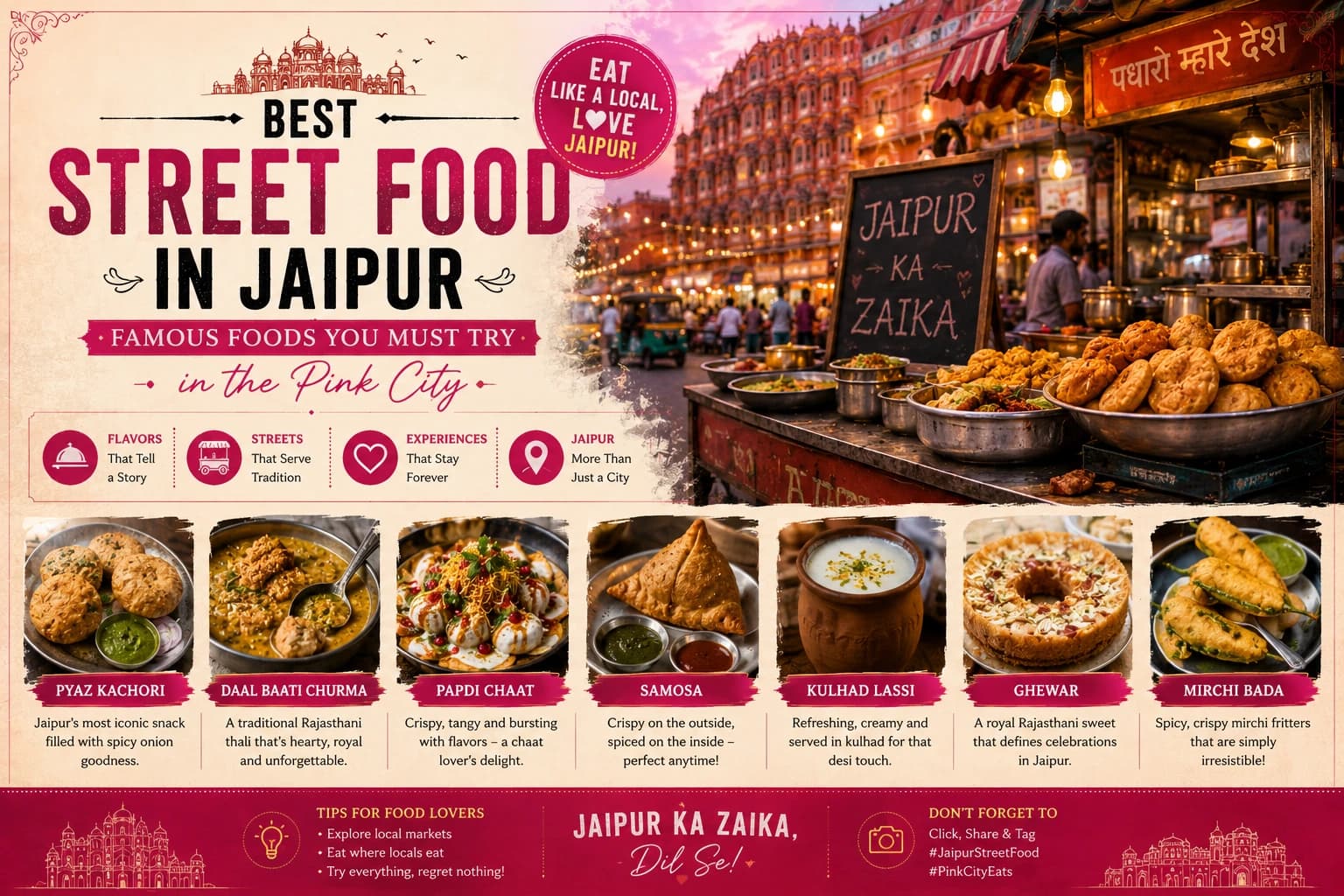
Jaipur is not just India's Pink City - it is one of the most vibrant street food destinations in the entire country. The lanes of the old walled city buzz with the sizzle of deep frying, the aroma of fresh jalebis dunked in warm syrup, and the earthy scent of kulhad chai. If you visit Jaipur and only eat at hotel restaurants, you have missed the soul of this city entirely.
As a local Jaipur-based travel guide, The Jaipur Vista takes you through the very best street food in Jaipur - the iconic stalls, the legendary dishes, the hidden gems, and everything in between. Whether you are a first-time visitor or a seasoned traveller returning for another round, this is the most comprehensive street food guide to Jaipur you will find.
The most famous street foods in Jaipur are Pyaz Kachori, Dal Baati Churma, Mirchi Bada, Ghevar, Lassi, Mawa Kachori, Golgappa (Pani Puri), Kulfi, Dal Cheela, and Jalebi. The top areas to eat street food in Jaipur are MI Road, Johari Bazaar, Bapu Bazaar, Tripolia Bazaar, and Sindhi Camp.
Rajasthan has always had a cuisine shaped by its landscape - a dry, hot desert land where fresh ingredients were scarce, and preservation was essential. Over centuries, Jaipur's street food evolved with bold spices, deep frying, clarified butter (ghee), dried lentils, and dairy-rich preparations like curd and milk.
The result is a street food culture that is intensely flavourful, unabashedly indulgent, and deeply rooted in tradition. Unlike the tangy chaats of Delhi or the seafood snacks of Mumbai, famous street food in Jaipur leans towards the rich, the spicy, and the sweet - often all in the same bite.
The city's position as a major royal centre for centuries also influenced its food. Many of Jaipur famous food items you eat on the street today were once associated with specific communities, craftsmen, and traders who settled in the walled city. Rawat Mishthan Bhandar, Lassiwala, and several other iconic establishments carry decades - sometimes over a century - of culinary heritage.
Read Also: Best Restaurants in Jaipur
Here is a full rundown of the best street food in Jaipur, covering savoury snacks, sweet treats, beverages, and everything in between. Each entry includes what the dish is, where to find it, and why it belongs on your plate.
If there is one single dish that defines street food in Jaipur, it is the Pyaz Kachori. This deep-fried, crispy, golden pastry is stuffed with a spiced filling of sweet onions (pyaz), peanut oil, red chilli, garlic, and fennel. The onion filling is cooked down so slowly and thoroughly that the kachori stays moist and flavourful long after it is fried - no chutney required, though a tamarind or green chutney on the side does no harm.
Unlike the flatter, drier kachoris found elsewhere in Rajasthan, Jaipur's Pyaz Kachori is puffy, generous in size, and almost bursting with filling. The crust is light and shatteringly crisp. Each bite releases a rush of sweet onion, warmth from the spices, and a gentle kick of chilli.
Where to eat Pyaz Kachori in Jaipur:
Rawat Mishthan Bhandar (Sindhi Camp, near the railway station) - the most famous destination for Pyaz Kachori in Jaipur, possibly in all of Rajasthan
Samrat Restaurant (Chaura Rasta, walled city)
Sodhani Sweets (Main Tonk Road, near Rambagh Circle)
Various roadside vendors near Johari Bazaar and Badi Chopad in the old city
Best time to eat: Mornings from 7 am to 11 am, when the kachoris are freshest and the queue at Rawat is at its most energetic.
Pro tip from The Jaipur Vista: At Rawat, arrive before 9 am on weekends to avoid a long wait. The kachoris sell out quickly, and the early batches are always the crispiest.
A close cousin of the Pyaz Kachori, the Mawa Kachori is one of the most distinctive and beloved examples of famous food in Jaipur. Where the Pyaz Kachori is savoury and spiced, the Mawa Kachori is decadent and sweet. The filling is made from mawa (khoya - reduced, solidified milk), mixed with chopped dry fruits such as almonds, cashews, and pistachios, fragrant with cardamom and saffron. This mixture is stuffed inside the pastry, deep fried until golden, and then dunked into warm sugar syrup.
The result is a dessert kachori that sits at the intersection of Indian mithai and street food - syrup-soaked, richly nutty, and unmistakably Jaipur. It is unique to the region and something you simply cannot find anywhere else in India with the same level of craft.
Where to eat Mawa Kachori in Jaipur:
Rawat Mishthan Bhandar - the definitive address for Mawa Kachori
LMB (Laxmi Misthan Bhandar) on Johari Bazaar - another institution worth visiting
No guide to famous street food in Jaipur would be complete without Dal Baati Churma. This is not just street food - it is the soul dish of Rajasthan. Traditionally a celebration meal, it has crossed over into the street food and casual dining space, and you will find it served at dhabas and food stalls across Jaipur.
Dal is a thick, spiced lentil curry (typically five-lentil panch mel dal) cooked with ghee, turmeric, coriander, and dried red chillies. Baati are hard, baked wheat dough balls that are first baked in a traditional clay oven or over cow-dung fire, then cracked open and drenched with generous amounts of ghee. Churma is the sweet element - coarsely ground wheat flour fried in ghee and mixed with jaggery or sugar and cardamom, sometimes with coconut or dry fruits.
Together, the three form a meal that is deeply satisfying, intensely flavourful, and quintessentially Rajasthani.
Where to eat Dal Baati Churma in Jaipur:
Chokhi Dhani (outside Jaipur on Tonk Road) - a village-style cultural resort where Dal Baati Churma is served the traditional way
Handi Restaurant on MI Road - a reliable mid-range option
Laxmi Misthan Bhandar (LMB) - offers a very good version as part of the Rajasthani Thali
Mirchi Bada (also called Mirchi Vada) is one of the most popular and widely eaten pieces of street food in Jaipur. Large, thick wax chilli peppers (the long green variety used specifically for frying, not for raw eating) are deseeded and stuffed with a filling of spiced mashed potatoes flavoured with dried coriander powder, black pepper, and sometimes fennel. The stuffed chilli is then coated in a thick batter of seasoned gram flour and deep fried until it turns golden and crisp.
The result is a beautiful contrast - the mild, slightly smoky chilli on the outside, and the soft, spiced potato filling within. A squeeze of lemon and a side of tamarind chutney makes this one of the most satisfying snacks in the city.
Where to eat Mirchi Bada in Jaipur:
Sodhani Sweets on Main Tonk Road - considered one of the best in the city
Rawat Mishthan Bhandar - also serves an excellent Mirchi Bada
Street carts along Johari Bazaar, particularly in the evenings
Ghevar is perhaps the most visually striking of all the famous food in Jaipur. A traditional Rajasthani sweet particularly associated with the Teej and Raksha Bandhan festivals, Ghevar is a disc-shaped, latticed sweet made from a batter of refined flour, ghee, and water, deep fried in a special process that creates its characteristic honeycomb-like structure, then soaked in sugar syrup.
It comes in several variants: plain (sada), mawa (topped with reduced milk), malai (topped with fresh cream), and the most indulgent version, paneer ghevar. Good Ghevar is light, airy, and subtly sweet - not cloying - with a beautiful textural contrast between its crisp outer lattice and the syrup-soaked interior.
While Ghevar is technically a mithai (sweet), it is so prominently featured in the streets of Jaipur during festival seasons that it absolutely belongs in any guide to best street food in Jaipur.
Where to eat Ghevar in Jaipur:
Rawat Mishthan Bhandar - famous for their Ghevar all year round
LMB (Laxmi Misthan Bhandar) on Johari Bazaar
Seasonal stalls in the old walled city during Teej (July–August)
If there is one drink that defines the street food experience in Jaipur, it is the thick, creamy lassi served at the original Lassiwala on MI Road. This humble stall, located just past the Paanch Batti crossing on the left side of MI Road, has been serving one thing - and one thing only - for decades: fresh, thick, pure curd lassi.
No water, no ice, no artificial flavouring. The lassi is made from pure homemade curd, lightly flavoured with kewra water (a fragrant extract from pandanus flowers), and topped generously with a thick layer of malai (cream). It is served in traditional clay kulhads (earthen cups), which add their own subtle earthy note to the drink.
A large lassi here is a meal in itself. It is cold, rich, slightly tangy, and completely addictive. The shop opens early in the morning and closes by mid-afternoon once the day's supply is exhausted.
Insider tip from The Jaipur Vista: Do not be fooled by the several shops next door that have adopted similar names and branding. The original Lassiwala has the longest queue and the most patina. Go for the large kulhad and take your time - this is one of the most authentic flavours of Jaipur.
Location: MI Road, near Paanch Batti crossing, Jaipur
Known as Golgappa in Jaipur and Rajasthan (called Pani Puri in other parts of India), this is the great democratiser of Indian street food - loved equally by children, college students, working professionals, and grandparents. In Jaipur, the Golgappa takes on a distinctly Rajasthani character.
The crisp, hollow puris are filled with a mixture of boiled, mashed potatoes and spiced chickpeas, and then dunked into flavoured water. What makes Jaipur's Golgappa distinctive is the range of pani (flavoured water) options available - from the classic spicy-sour jaljeera to sweet imli (tamarind) water to the fiery green chilli variety. Many stalls also offer a Rajasthani twist with the addition of hing (asafoetida) and dried mango powder.
Where to eat Golgappa in Jaipur:
Street vendors around Bapu Bazaar and Johari Bazaar
Stalls near the Hawa Mahal area
Evening food markets in Vaishali Nagar and Mansarovar
The Jalebi is not unique to Jaipur, but the city's version deserves special mention because of how it is made and served. Freshly batter-fried in large, spiralling loops of fermented flour, plunged immediately into hot sugar syrup, and served while still warm - a Jaipur Jalebi is an experience rather than just a snack.
The best jalebis in Jaipur are thin-battered, lacy in texture, and soaked through with syrup without becoming soggy. They have a slight tang from the fermented batter, balanced by the sweetness of the syrup. Paired with rabri (reduced sweetened milk) or simply eaten on their own, they are one of the great pleasures of eating street food in Jaipur.
Where to eat Jalebi in Jaipur:
Samrat on Chaura Rasta - famous for crispy, freshly fried jalebis paired with bread pakoda and chai
Rawat Mishthan Bhandar - also excellent
Early morning vendors near Badi Chopad in the walled city
Dal Cheela is a thick, savoury pancake made from ground lentil batter - typically moong dal with skin, which gives it a characteristic earthiness and texture you will not find in versions made with husked dal. The batter is poured onto a hot griddle, spread thin, and cooked until the edges crisp up while the centre remains soft.
Jaipur's most celebrated Dal Cheela stall is the modest Kalkatta Chaat Bhandar on Vaniki Marg, behind the High Court. The stall serves its Dal Cheela topped with paneer and accompanied by multiple chutneys - a tangy tamarind-ginger sonth chutney, a spiced yoghurt mix, a chilli-garlic chutney, and fresh mint chutney. It is a remarkable and uniquely Rajasthani breakfast that not many visitors know about.
The same stall is also known for its Dahi Wada - large, soft lentil dumplings doused in thick yoghurt, sprinkled with roasted cumin, and topped with a medley of chutneys and spiced dal. A bowl of Dahi Wada here is one of the finest examples of this dish anywhere in North India.
Location: Kalkatta Chaat Bhandar, Vaniki Marg, near High Court, Jaipur
Long before modern ice cream arrived in India, there was Kulfi - a dense, rich frozen dairy dessert made by slowly simmering milk until it reduces to a thick, creamy consistency, then flavouring it with cardamom, saffron, rose water, and pistachios. Unlike commercial ice cream, kulfi is not aerated; it is solid, dense, and intensely flavoured. It melts slowly and rewards patience.
In Jaipur, the most famous address for kulfi is Pandit Ki Kulfi, a small shop located just ahead of Hawa Mahal on the main bazaar road. Their kulfi is made the traditional way - full-fat milk slow-cooked to the right consistency, flavoured with real saffron and cardamom, packed into traditional matka (clay pot) moulds, and frozen. The result is rich, creamy, and deeply satisfying, without the granular texture that lesser kulfis develop.
Available on the stick, in a matka, or in a cup; flavours typically include malai, kesar-pista, mango (seasonal), and rose.
Location: Pandit Ki Kulfi, near Hawa Mahal, Jaipur
Dahi Vada (also called Dahi Bhalla) is a chaat-style dish that combines soft, pillowy lentil dumplings soaked in water to remove excess oil, then generously topped with thick fresh yoghurt, sweet tamarind chutney, green coriander-mint chutney, roasted cumin powder, red chilli powder, and chaat masala.
The beauty of good Dahi Vada lies in its layering of textures and flavours - the soft, yielding dumpling; the cool, tangy yoghurt; the warm sweetness of the tamarind; the heat of the chilli. Jaipur's Dahi Vada often has a Rajasthani slant with the addition of hing (asafoetida) and sometimes a sprinkling of fine sev.
Where to eat: Kalkatta Chaat Bhandar (Vaniki Marg), and numerous chaat stalls in Johari Bazaar and near Badi Chopad.
No street food guide to Jaipur would be complete without mentioning the humble but deeply satisfying Bread Pakoda and Samosa. These are the workhorses of Jaipur's street food culture - found on every corner, consumed at every time of day, and judged mercilessly by locals who can tell a great one from a mediocre one in a single bite.
Bread Pakoda in Jaipur is made with thick slices of white bread sandwiched around a spiced potato filling, coated in gram flour batter, and deep fried. The best versions are crispy outside, fluffy inside, and served with green chutney and a small pool of tomato ketchup.
Samosa here is the North Indian classic - a crispy, triangular pastry filled with spiced boiled potatoes and peas, deep fried. The Jaipur samosa tends to be smaller and crispier than the Delhi variety, with a more heavily spiced, drier filling.
Where to eat: Samrat (Chaura Rasta), Rawat Mishthan Bhandar, and countless neighbourhood sweet shops (mithai walas) throughout the city.
Falooda is one of those rare preparations that sits perfectly between a drink and a dessert. It is built in a tall glass, starting with rose sherbet (or other flavoured syrups), followed by cooked vermicelli noodles (falooda sev), sweet basil seeds (sabja/tukhmalanga) that have been soaked in water until they develop a jelly-like coating, chilled milk, a generous scoop of rabri (reduced sweetened milk), and a dollop of homemade kulfi-style ice cream on top.
In Jaipur, the finest Falooda is found at Indian Ice Cream on Bapu Bazaar - a tiny, easy-to-miss shop that has built a devoted following over the years. The ice cream and rabri are house-made, the noodles are fresh, and the entire preparation is assembled with care. It is the ideal way to end a long street food walk through the bazaars.
Location: Indian Ice Cream, Bapu Bazaar, Jaipur
Malpua is a traditional Indian sweet pancake - a thick batter of flour, milk, and fennel is poured into hot ghee and fried until the edges are golden and lacy, then soaked in saffron-flavoured sugar syrup. It is served hot with a generous ladleful of cold, thick Rabri (milk that has been simmered for hours until it reduces to a creamy, condensed state, flavoured with cardamom and rose water).
The combination of the hot, ghee-rich Malpua with cold, dense Rabri is a classic Rajasthani dessert pairing and one of the most comforting things you can eat on a cool Jaipur evening.
Where to eat: LMB (Laxmi Misthan Bhandar) on Johari Bazaar, and speciality sweet shops in the walled city.
Aloo Tikki is a pan-fried potato patty, seasoned with cumin, coriander, and green chilli. But in Jaipur's chaat culture, the Aloo Tikki is rarely eaten plain - it is served as Aloo Tikki Chaat, which layers the crispy tikki with a spoonful of spiced chickpea curry, a drizzle of tamarind chutney, green chutney, yoghurt, and chaat masala.
A popular variant found in Jaipur is the Laccha Aloo Tikki - a tikki made with grated or shredded potato rather than mashed, which creates a different texture: crispy on the outside like a rosti, with a somewhat denser interior. The version served at Samrat on Chaura Rasta has developed a loyal following.
Kadhi Kachori is a comforting and very local breakfast dish in Jaipur that rarely makes it into tourist guides. A crispy, lentil-stuffed kachori is broken open and served submerged in a bowl of warm Rajasthani kadhi - a tangy, spiced yoghurt and gram flour gravy tempered with mustard seeds, dried red chillies, curry leaves, and asafoetida. It is thicker, slightly sourer, and more pungent than the Punjabi version of kadhi.
This dish is particularly popular in the older residential neighbourhoods of Jaipur and at small neighbourhood eateries (dhabas) that open early for the breakfast crowd.
No exploration of street food in Jaipur is complete without a cup of chai, and no chai compares to that served at Gulab Ji Ki Chai on MI Road. Located at the corner near Ganpati Plaza, this tiny tea stall opens before dawn - as early as 4 or 5 am - and serves what many Jaipuris consider the finest cup of tea in the city.
The chai is perfectly balanced - milky but not cloying, sweet but not overpowering, with a well-measured hit of ginger and cardamom. It is brewed in the traditional way, slowly simmered on a low flame. Paired with a Bun Makhan Samosa (a soft bun slathered in butter, served alongside a small samosa), it is one of the most pleasurable breakfasts you can have in Jaipur, and it will cost you less than a cup of hotel coffee.
The shop owner is also known in the local community for regularly distributing chai and bread-butter to those in need - a long-standing act of generosity that has become part of the stall's legend.
Location: MI Road, near Ganpati Plaza, Jaipur
Pakodas - deep-fried fritters made from seasonal vegetables coated in spiced gram flour batter - are a beloved snack throughout India, but Jaipur has its own champion in this category: Jagannath Sharma Pakodi Wale, located next to Badi Chopad in the old walled city. This shop has been operating for over seven decades and is famous for the complexity of its spiced batter, which includes asafoetida, cumin, fennel seeds, black pepper, cloves, dried ginger, and green chilli.
Vegetables used change seasonally - spinach, potato, onion, cauliflower, green chilli - and each type has its own particular charm. The pakodas here are fried to order, and eating them hot, directly from the pan, is the only way to truly appreciate them.
Paan - a betel leaf preparation eaten after meals as a mouth freshener and digestive - is a deep-rooted tradition across India, but Jaipur's paan culture has evolved into something theatrical. The most memorable of these is the Fire Paan, served at Annu Mobile near Panchvati Circle in Raja Park.
The paan is loaded with a customised filling - rose petal jam, fennel seeds, coconut shavings, cardamom, cloves, and various sweet pastes - and then, just before it is handed to you, it is briefly flambéed. The paan guy lights it, blows out the flame, and then places it in your mouth whole. It sounds alarming but is entirely safe and utterly theatrical. The flavour is a burst of sweetness, fragrance, and warmth.
The stall reportedly offers nearly 100 varieties of paan, ranging from humble meetha paan and chocolate paan to medicinal varieties. Whether or not you believe the medicinal claims, the experience is unforgettable.
Location: Annu Mobile Paan, Panchvati Circle, Raja Park, Jaipur
Understanding the geography of street food in Jaipur helps you plan your food walk more effectively. Here are the key zones:
MI Road (Mirza Ismail Road) The spine of modern Jaipur, MI Road hosts Lassiwala, Gulab Ji Ki Chai, Prem Paan, and several trusted mithai shops and snack stalls. Best visited in the mornings and evenings.
Johari Bazaar & the Walled City The old city is the heart of traditional Jaipur famous food. This area - encompassing Johari Bazaar, Tripolia Bazaar, Badi Chopad, and Choti Chopad - is where you find kachori carts, Dahi Vada stalls, pakoda shops, and the concentrated energy of street food culture at its most authentic.
Sindhi Camp & Railway Station Area The area around the main bus stand and railway station is where Rawat Mishthan Bhandar is located. Busy from early morning, this zone caters to travellers and locals alike with kachori, samosa, and mithai.
Bapu Bazaar A shopping street by day, Bapu Bazaar is also home to the Indian Ice Cream Falooda stall and several chaat and snack vendors. Good for an evening street food walk.
Chaura Rasta, located inside the walled city, this is where you find Samrat and its excellent jalebis, bread pakodas, and chai. Also, a gateway into the dense food culture of the old bazaars.
Vaishali Nagar, Mansarovar & C-Scheme The modern residential neighbourhoods of Jaipur have developed their own thriving street food scenes, particularly in the evenings. These areas are less touristy but very popular with locals.
Morning (7 am – 11 am): The prime time for Jaipur street food. Kachori stalls, Gulab Ji's chai, Lassiwala, and pakoda shops are all at their best and freshest. Many stalls sell out of their signature items by late morning.
Evening (5 pm – 9 pm): The second great window for street food in Jaipur. Chaat stalls, golgappa carts, Falooda vendors, and paan shops come alive. The walled city bazaars take on a festive energy in the evenings, especially around Johari Bazaar and Bapu Bazaar.
Monsoon season (July–September): Pakodas and Mirchi Bada are particularly popular during Jaipur's monsoon season. The rains also coincide with the Teej festival, when fresh Ghevar floods the sweet shops of the city.
Festival seasons: During Diwali, Holi, and Teej, Jaipur's street food culture reaches a celebratory peak. New seasonal items appear, the bazaars are decorated, and the food energy is extraordinary.
Eat where the locals eat. Busy stalls with high turnover have fresher food and less opportunity for contamination. The most popular stalls in Jaipur - Rawat, Lassiwala, Samrat - are trusted precisely because they have served thousands of people over decades.
Stick to freshly fried and cooked food. Deep-fried items like kachori and pakoda are safer than pre-cut fruit or items sitting in open containers. The high heat of frying eliminates most pathogens.
Carry a bottle of water for hand-washing. Many street stalls in the old city do not have handwashing facilities nearby.
Go easy on the chutney initially. If you have a sensitive stomach, ask for less chutney on your chaat dishes. The raw chutneys (especially mint-coriander) can sometimes cause issues for first-time visitors.
Visit the famous stalls in the mornings. Items like kachori and lassi are best eaten fresh, and the morning batches at places like Rawat are consistently the highest quality.
Carry small change. Most street food stalls in Jaipur are cash-only, and exact change is appreciated.
Jaipur's street food is not just food - it is a living connection to the city's history, its communities, and its way of life. The men frying kachoris at Rawat have been doing so for generations. The Lassiwala has stirred his earthen pots on the same stretch of MI Road for decades. The pakoda stall near Badi Chopad has outlasted empires.
When you eat street food in Jaipur, you are not just feeding yourself. You are participating in something far larger - a culinary tradition that has fed kings and craftsmen, artists and architects, travellers and residents, for hundreds of years.
Come hungry. Eat well. And let the lanes of Jaipur take you somewhere extraordinary.
The Jaipur Vista is your local guide to the Pink City - written by people who live here, eat here, and love this city deeply. For more on what to do, where to stay, and where to eat in Jaipur, explore our full travel guide at thejaipurvista.com.
Q. What is the most famous food in Jaipur?
The most famous food in Jaipur is undoubtedly the Pyaz Kachori - a crispy, deep-fried pastry stuffed with spiced onion filling. Mawa Kachori, Lassiwala Lassi, and Dal Baati Churma are close runners-up among the most iconic Jaipur famous foods.
Q. What is the best street food in Jaipur?
The best street food in Jaipur includes Pyaz Kachori at Rawat Mishthan Bhandar, Lassi at Lassiwala, Dal Cheela at Kalkatta Chaat Bhandar, Jalebi at Samrat, Kulfi at Pandit Ki Kulfi, Mirchi Bada at Sodhani Sweets, and Falooda at Indian Ice Cream on Bapu Bazaar.
Q. Where should I eat street food in Jaipur?
The top areas for street food in Jaipur are MI Road, Johari Bazaar, Bapu Bazaar, Chaura Rasta (inside the walled city), and Sindhi Camp near the railway station.
Q. Is street food in Jaipur safe to eat?
Yes - when you eat at established, high-footfall stalls and choose freshly cooked items. Jaipur's most famous street food addresses have served thousands of customers over decades and maintain strong reputations. Start with places like Rawat, Lassiwala, and Samrat, which are trusted by locals and visitors alike.
Q. What is the famous sweet of Jaipur?
Ghevar is the most iconic sweet of Jaipur, particularly during the Teej festival season. Mawa Kachori, Jalebi, and Malpua with Rabri are also widely considered the most famous sweets in Jaipur.
Q. What is Jaipur food known for?
Jaipur food is known for its bold use of spices, generous amounts of ghee, rich dairy preparations, deep-fried snacks, and the distinctive flavours of dried mango powder (amchur), asafoetida, and fennel. The cuisine reflects Rajasthan's desert heritage - hearty, intensely spiced, and built to be filling.
Q. Can vegetarians find good street food in Jaipur?
Absolutely. The vast majority of street food in Jaipur is completely vegetarian, reflecting the city's dominant Hindu culture and Jain community. You will not struggle in the slightest - virtually every item on this list is vegetarian.
Q. What is the best time to visit Jaipur for street food?
October to March (winter) is the most comfortable time to explore street food in Jaipur, when the weather is pleasant for outdoor eating. However, the monsoon season (July–September) brings festive energy and is the best time to try seasonal specialities like Ghevar and hot pakodas.