Rambagh Palace Jaipur: History, Rooms, Dining, Prices & Visitor Guide (2026)
Author:Namrata
Published:May 22, 2026
Views:1809
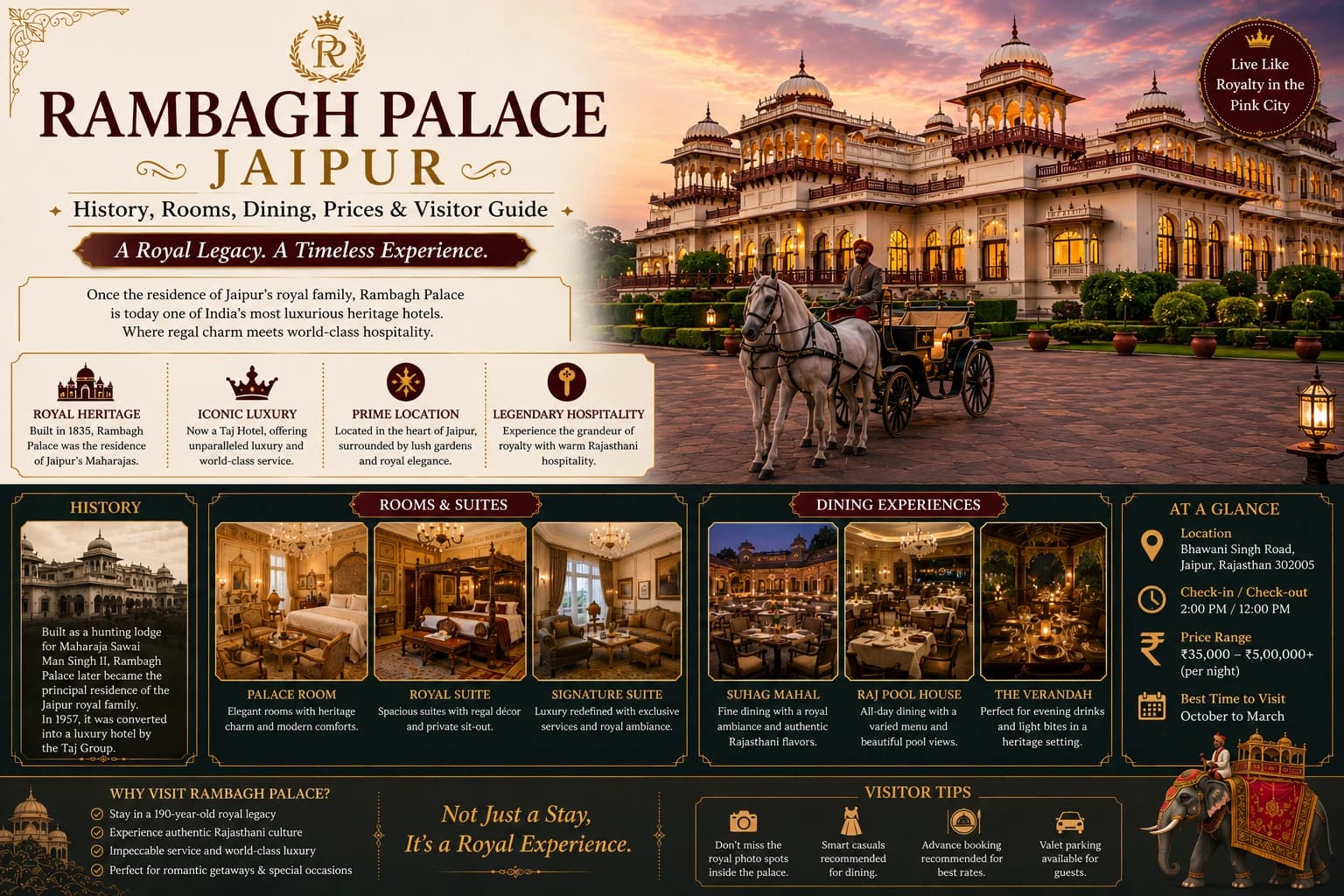
There are grand hotels, there are heritage properties, and then there is Rambagh Palace Jaipur - a place in an entirely different category of its own. Known reverently as the "Jewel of Jaipur," Rambagh Palace is not simply a place to stay; it is a living monument to Rajputana royalty, a sanctuary where 19th-century grandeur meets contemporary luxury without losing a single thread of its royal soul.
Whether you are planning to stay at Rambagh Palace, dreaming of a royal Jaipur wedding, looking to experience its legendary restaurants, or simply hoping to visit and absorb its extraordinary atmosphere, this complete guide by The Jaipur Vista tells you everything you need to know. We cover the palace's remarkable history, its architecture, rooms and suites, dining experiences, room prices, how to visit even if you are not a guest, and much more.
This is the most comprehensive guide to Rambagh Palace Jaipur, you will find anywhere - written for the curious traveller who wants to experience Jaipur's royal heritage deeply, not just scratch its surface.
Rambagh Palace is a spectacular 5-star luxury palace hotel in Jaipur, managed by Taj Hotels (part of the Indian Hotels Company Limited - IHCL). Spread across 47 acres of manicured Mughal gardens and royal grounds, the palace is widely considered one of the finest and most romantic heritage hotels in the world.
But Ram Bagh Palace is far more than a luxury hotel. It is a building with nearly 200 years of living history - a place that has witnessed royal births and grand durbars, hosted global dignitaries and film legends, and made the transition from a private Maharaja's residence to a world-class destination that welcomes guests from every corner of the globe.
When international publications rank the best palace hotels in the world, Rambagh Palace Jaipur is almost always in the top three. It has appeared on Condé Nast Traveller's Gold List, Travel + Leisure's World's Best Hotels list, and countless other prestigious rankings. The reason is simple: few places on Earth give you the feeling - the genuine, unperformed feeling - of living like royalty quite the way Rambagh does.
The story of Rambagh Palace is one of the most fascinating in Jaipur's rich history. It begins not as a palace at all, but as a modest garden house.
Rambagh was originally built in 1835 as a small garden house and guesthouse for the royal family's handmaiden, Kesar Badaran. It sat within a formal garden - Rambagh literally means "Garden of Lord Ram" - on the outskirts of what was then Jaipur city. The structure at this stage was modest and entirely unpretentious, distinguished mainly by its lovely setting.
In 1887, the property was expanded and converted into a royal hunting lodge for Maharaja Ram Singh II. The surrounding gardens and grounds were developed to support the hunting expeditions of the royal court. This period marks the beginning of Rambagh's association with active royal life.
The transformation of Rambagh from a hunting lodge into a grand royal palace is almost entirely the work of one man: Maharaja Sawai Man Singh II, who ascended the throne of Jaipur in 1922 at the age of just eleven.
As Man Singh II grew into his role, he undertook an extensive programme of expansion and renovation at Rambagh between 1925 and 1940, transforming it into his primary royal residence. Under his direction, the property was redesigned with elaborate Mughal-style gardens, hand-carved marble latticework, ornate sandstone balustrades, royal suites, a polo ground, a swimming pool, and a full retinue of courtly spaces. Rambagh became the social and cultural heart of Jaipur's royal court during this era.
It was during this period that the famous Suvarna Mahal (the palace ballroom, now the landmark restaurant) was built in the 18th-century architectural style - a space designed explicitly to host the grandest of royal entertainments.
Maharaja Sawai Man Singh II was one of India's most celebrated polo players - arguably the greatest the subcontinent has produced. He played for England's national polo team (as well as India's), won numerous international championships, and is credited with popularising the sport globally. Rambagh Palace was the headquarters of his polo obsession: he maintained his stables here, trained on the palace grounds, and the polo connection is so deep that the Polo Bar inside the palace remains one of the most evocative spaces in Jaipur to this day.
After Indian Independence and the integration of princely states, the maintenance of a full royal household at Rambagh became impractical. In 1957, Maharaja Sawai Man Singh II made the historic decision to convert Rambagh Palace into a luxury hotel, handing its management to the Taj Hotels group. It was one of the first palace hotels in India - and it set a template for palace hotel conversions that the entire hospitality industry would follow for decades.
The royal family retained emotional and cultural connections to the property, while Taj Hotels undertook the careful task of preserving its heritage character while adapting it for contemporary guests.
Today, Rambagh Palace Jaipur operates as a premier property under Taj Hotels, consistently ranked among the finest hotels in Asia and the world. Its 47 acres of grounds, its 78 rooms and suites, its multiple award-winning restaurants, its legendary polo heritage, and its unbroken connection to Jaipur's royal family make it genuinely unlike any other hotel in India.
The architecture of Rambagh Palace defies easy categorisation. It draws from multiple traditions - Mughal garden design, Rajput ornamentation, colonial influences - and weaves them into something that feels entirely coherent and uniquely Jaipur.
The palace's exterior is built in pale yellow and cream-toned sandstone, with extensive use of white Makrana marble for ornamental elements. The facade is defined by hand-carved marble latticework (jali screens), decorative chhatris (umbrella-shaped pavilions), carved sandstone balustrades, and deeply recessed arched windows - a visual vocabulary borrowed from the finest Mughal and Rajput palace architecture.
Approaching Rambagh through its main gate, along the curving driveway lined with manicured lawns, the sight of the palace's facade against a blue Rajasthan sky is one of those images that stays with you permanently.
The Mughal Gardens of Rambagh Palace are among the finest surviving examples of formal Mughal garden design in North India. Stretching across the property's 47 acres, the gardens are laid out in the classic charbagh (four-quadrant) pattern, with geometric flower beds, water channels, fountains, ancient trees, and carefully sculpted hedgerows. The rose gardens are particularly spectacular during the winter months.
These gardens are not merely decorative - they are central to the Rambagh experience. Many guests spend hours simply walking through the grounds, watching the light change across the lawns and fountains as the day progresses.
Inside, Rambagh Palace Jaipur is a feast of craftsmanship. The corridors and public spaces are adorned with:
Original royal paintings and miniature art
Antique Rajasthani furnishings and fabrics
Intricate mirror-and-fresco work in the Rajput tradition
Belgian crystal chandeliers in the grand dining halls
Mughal-style arched doorways and window screens
Hand-knotted carpets from the finest Rajasthani weavers
Teak and rosewood furniture sourced from the original palace interiors
The overall effect is one of layered, lived-in luxury - the feel of a real palace that has been inhabited and loved by generations, rather than a hotel designed to look like one.
Rambagh Palace offers 78 rooms and suites, each one individually designed and carrying its own distinct character. No two rooms are identical - a reflection of the palace's organic growth over nearly two centuries.
The entry-level rooms at Rambagh Hotel Jaipur (if such a term can be applied to a property of this calibre) are spacious, elegantly furnished, and open onto views of the gardens or the palace courtyard. Even the standard rooms feature high ceilings, period-appropriate furnishings, and the quiet, unhurried atmosphere of genuine royal hospitality.
Approximate Price: ₹35,000 – ₹50,000 per night (rates vary by season and availability)
A step above the standard rooms, the luxury suites offer larger living spaces, dedicated sitting areas, more elaborate décor, and often private balconies or terraces overlooking the Mughal Gardens. These are the rooms most often booked by travellers celebrating anniversaries, honeymoons, or milestone occasions.
Approximate Price: ₹60,000 – ₹1,20,000 per night
The grand luxury suites occupy prime positions within the palace and represent a significant step up in space, décor, and exclusivity. Original artworks, four-poster beds, marble bathrooms with soaking tubs, and dedicated butler service define this category.
Approximate Price: ₹1,20,000 – ₹2,50,000 per night
The Royal Suites at Rambagh Palace are among the most sought-after rooms in all of India. These are the actual apartments that were used by the Maharaja, his family, and visiting royalty - and they have been preserved and furnished to reflect that heritage. Stepping into a Royal Suite at Ram Bagh Palace is as close as most of us will ever come to understanding what it genuinely felt like to live as Indian royalty.
Approximate Price: ₹2,50,000 – ₹5,00,000+ per night
The pinnacle of the Rambagh Palace experience is the Maharaja Suite - the legendary accommodation that was once the personal chambers of Maharaja Sawai Man Singh II himself. This is one of the most famous hotel rooms in the world: an extraordinary ensemble of original furnishings, royal artefacts, a private turret offering panoramic views of the gardens, a private plunge pool, and butler service available around the clock. Guests who have stayed here include international heads of state, royalty from other nations, and global celebrities.
Approximate Price: On request (typically ₹5,00,000+ per night)
Every stay at Rambagh Palace Jaipur includes access to:
Heritage walk of the palace and its grounds
Complimentary use of the outdoor swimming pool
Access to the Mughal Gardens
Dedicated butler service (suites and above)
Priority reservations at all palace restaurants
Curated local experiences arranged by the concierge team
Complimentary WiFi throughout the property
If you are in Jaipur and cannot stay at Rambagh Palace, dining here is the next best way to experience its magic. The palace's restaurants are legendary - some of the finest dining experiences in all of Rajasthan - and they are open to non-resident guests (reservations essential).
Suvarna Mahal is the flagship restaurant of Rambagh Palace Jaipur and one of the most celebrated dining rooms in India. Housed in the former royal ballroom, the restaurant's interior is breathtaking: a soaring painted ceiling, Belgian crystal chandeliers, original frescoes, gilded columns, and walls lined with royal miniature paintings create an atmosphere of pure theatrical grandeur.
The cuisine focuses on authentic Royal Indian cooking - dishes drawn from the traditions of the Rajput court, from Mughal banquet menus, and from the rich culinary heritage of Rajasthan. Expect game preparations, rich dal-meat dishes, slow-cooked kormas, royal kebab platters, and desserts that draw on centuries of royal confectionery tradition. Dining at Suvarna Mahal is not just a meal; it is an immersive encounter with India's royal culinary legacy.
Best for: Romantic dinners, special occasions, cultural dining experiences
Dress Code: Smart casual to formal (avoid shorts or casual sportswear)
Reservation: Essential - book well in advance, especially October–March
The Polo Bar at Rambagh is one of the most atmospheric watering holes in India. The walls are lined with polo memorabilia - vintage photographs, riding equipment, trophies, and portraits of Maharaja Sawai Man Singh II in his polo prime - creating an intimate, club-like atmosphere that feels authentically connected to the golden age of Indian royalty.
The Polo Bar serves an excellent selection of cocktails, single malts, wines, and spirits. It is a perfect pre-dinner destination and one of the finest spots in Jaipur for a quiet evening drink in genuinely historic surroundings.
Best for: Pre-dinner drinks, history enthusiasts, polo aficionados, a quiet evening in historic surroundings
The Rajput Room is the more relaxed of Rambagh's main dining venues, offering an extensive multi-cuisine menu that spans Indian regional specialities, continental preparations, Asian options, and an elaborate buffet breakfast service. The setting remains palatial - carved pillars, arched doorways, and the constant hum of discreet, attentive service - but the atmosphere is slightly less formal than Suvarna Mahal, making it suitable for families and travellers looking for a broader menu.
Best for: Breakfast, family dining, multi-cuisine preferences
For those who want to dine al fresco in one of the most beautiful garden settings in Rajasthan, the Verandah offers exactly that. Situated on a terrace overlooking the palace gardens, it serves light meals, afternoon teas, and casual lunches in a setting that feels almost impossibly scenic, especially during Jaipur's cool winter months.
Best for: Lunch, afternoon tea, light meals, romantic garden dining
Perhaps the most whimsical of all Rambagh's dining experiences, the Steam Bar is a fully restored vintage train car - complete with working steam engine aesthetics - transformed into a unique cocktail lounge. It is a conversation piece in itself: utterly unexpected inside a royal palace, but somehow perfectly Jaipur in its celebration of the theatrical and the historic.
Best for: Cocktails, unique experience, after-dinner drinks, conversations
Here is a practical price reference for planning your stay at Rambagh Palace Jaipur. Note that palace hotels of this category price dynamically - rates vary significantly by season, demand, and booking window.
Peak Season (October – March): Prices at the higher end of each range; book 3–6 months in advance.
Off-Season (April – September): More competitive rates available; excellent value during July–September monsoon, when the gardens are at their greenest.
Where to Book:
Direct via the Taj Hotels website (often best rates + loyalty benefits)
Via IHCL's Taj InnerCircle loyalty programme for member benefits
Through luxury travel agents for curated packages with added inclusions
The J Wellness Circle at Rambagh Palace is the palace's luxury spa and wellness facility, offering a deeply considered programme of treatments rooted in ancient Indian healing traditions.
Named for Jamsetji Tata (the founder of Tata Group, which owns IHCL/Taj Hotels), the J Wellness Circle at Rambagh offers:
Signature Royal Treatments: Therapies developed from Ayurvedic texts and traditional Rajasthani healing practices, adapted for contemporary wellness needs. These include full-body Abhyanga (warm oil massage), Shirodhara (warm oil pouring on the forehead), and royal herbal wrap treatments.
Wellness Rituals: Multi-day wellness programmes combining treatments, yoga, meditation, and dietary consultations - designed for guests looking for genuine rejuvenation rather than simply relaxation.
Fitness Facilities: A well-equipped gymnasium with modern equipment, supplemented by garden yoga sessions available at sunrise on the palace lawns - one of the most extraordinary yoga settings imaginable.
Swimming Pool: The outdoor pool at Rambagh Palace Jaipur is set within the palace gardens and is one of the most beautiful hotel pools in India. Its colonial-era pool house, the manicured garden surroundings, and the quiet, unhurried atmosphere make it a genuine highlight of a stay.
For non-resident guests, spa treatments at J Wellness Circle can be booked directly - though availability is prioritised for hotel guests.
If you are considering a destination wedding in Jaipur, Rambagh Palace is, quite simply, the most magnificent option in the city - and one of the finest wedding venues in all of India.
The palace offers several event venues for weddings and celebrations:
The Lawns: Sprawling gardens capable of hosting large-format outdoor weddings under the stars, with the illuminated palace façade as a backdrop that no purpose-built wedding venue can replicate.
Suvarna Mahal Ballroom: The grand ballroom setting for intimate indoor receptions and wedding dinners of extraordinary elegance.
The Courtyards: For smaller, more intimate gatherings, the palace's historic courtyards provide an atmospheric backdrop that is both ancient and deeply personal.
Rambagh Palace weddings have hosted some of India's most celebrated families and international royalty. The Taj Hotels events team handles every detail - décor, catering, entertainment, accommodation, guest experiences - with the seamless precision and warmth that has defined Rambagh Hotel Jaipur's reputation for decades.
This is one of the most common questions The Jaipur Vista receives about Rambagh Palace Jaipur, and the answer is: yes, with caveats.
The palace is a private luxury hotel, not a public monument - so you cannot simply walk in off the street and explore. However, there are several ways to experience Ram Bagh Palace without booking a room:
Dining: All of Rambagh's restaurants are accessible to non-resident guests with reservations. Booking dinner at Suvarna Mahal or drinks at the Polo Bar gives you legitimate access to the palace interior and grounds.
Spa Treatments: Non-resident bookings at J Wellness Circle are available subject to availability. A spa session is an excellent way to spend half a day at the palace.
Afternoon Tea: The Verandah offers afternoon tea service that is accessible to day visitors - a lovely, relatively affordable way to spend a couple of hours in the palace gardens.
Heritage Walk: Occasionally, guided heritage walks of the palace grounds are available for non-residents. Check with the concierge team directly for current availability.
The Etiquette: If you are visiting as a non-resident, dress smartly (no shorts, no flip-flops, no casual sportswear), make your reservation in advance, and be respectful of the hotel guests. Rambagh Palace is a working luxury hotel, and the experience is best enjoyed by those who approach it with the appropriate level of regard.
Rambagh Palace is conveniently located on Bhawani Singh Road in central-south Jaipur, making it easily accessible from all major transit points.
The palace is approximately 11 km from Jaipur International Airport - roughly 25–35 minutes by road depending on traffic. The hotel arranges dedicated airport transfers for guests; alternatively, taxis and app-based cabs are readily available at the airport.
Jaipur Junction is approximately 5 km from Rambagh Palace, about 15–20 minutes by cab. Auto-rickshaws are available but taxis are more comfortable for this journey.
The palace is about 3–4 km from MI Road and the main Hawa Mahal area - around 10–15 minutes by car. This proximity makes it very convenient to combine a day of sightseeing in central Jaipur with an evening experience at Rambagh.
The most practical option for visitors. The main entrance on Bhawani Singh Road has ample parking for restaurant guests and day visitors.
This is the best time to visit Rambagh Palace Jaipur and, indeed, all of Jaipur. The weather is beautifully temperate (8°C–25°C), the gardens are in full bloom, outdoor dining is magical, and the palace is at its most socially vibrant. This is also the season of major Jaipur events - the Jaipur Literature Festival (January), Jaipur Heritage International Film Festival, and the city's polo season, which carries particular resonance at Rambagh.
Book well in advance - 3–6 months ahead for peak December–January weekends.
Jaipur summers are fierce (up to 45°C), and outdoor activities become limited. However, Rambagh Palace's air-conditioned interiors, spa, and pool make it a genuinely comfortable base even in the heat. Rates are lower, the property is less crowded, and the quality of service and attention is arguably even higher.
The monsoon transforms Rambagh's 47-acre gardens into extraordinary lush greenery - a dramatic and beautiful contrast to the usual Rajasthan palette. Rates are at their lowest, and the palace in the monsoon has a romantic, slightly melancholy quality that many travellers find deeply appealing. Light rain showers during outdoor dining are part of the charm.
Jaipur has a remarkable collection of luxury and heritage hotels - Samode Haveli, Jai Mahal Palace, Fairmont, Trident, and others - and travellers sometimes wonder what specifically sets Rambagh Palace apart. The answer lies in several qualities that are genuinely difficult to replicate:
Authentic Royal Provenance: Most heritage hotels in India are converted havelis or lesser royal properties. Rambagh was the personal palace of a reigning Maharaja - Jaipur's primary royal residence for nearly three decades. The connection to living royal history is not cosmetic here.
Scale and Grounds: The 47-acre garden estate is extraordinary in a city where land is precious. The Mughal Gardens alone distinguish Rambagh from any other city hotel in Rajasthan.
The Polo Legacy: Maharaja Sawai Man Singh II's status as one of the greatest polo players in history gives Rambagh a sporting and cultural heritage that no hotel in India can match. The Polo Bar is living history.
Continuity of Management: Taj Hotels has managed Rambagh since 1957 - nearly 70 years of accumulated expertise in preserving and presenting one of India's most important heritage properties.
The Feeling: Ultimately, what separates Rambagh Palace Jaipur from every other luxury property is ineffable - the feeling you get walking those corridors, sitting in the gardens at dusk, hearing the clink of crystal in the Polo Bar. It is the feeling of a place that has held centuries of human stories and has no need to perform its history because its history is simply present, in the air and the stone and the light.
Over its decades as one of the world's premier palace hotels, Rambagh Palace Jaipur has hosted an extraordinary roll call of global visitors:
Queen Elizabeth II and members of the British royal family
Jacqueline Kennedy (whose 1962 visit is one of the most famous in the palace's history)
Prince Charles (now King Charles III)
Multiple heads of state and prime ministers from around the world
Leading figures from global entertainment, fashion, and culture
The palace's discreet, professional approach to privacy means that full guest records are never disclosed - but the walls of Ram Bagh Palace hold memories of some of the 20th and 21st centuries' most consequential figures.
From The Jaipur Vista's local knowledge and extensive research, here are the tips that will make your Rambagh Palace experience truly exceptional:
1. Even One Night is Transformative If the room prices feel daunting, consider booking the least expensive room for a single night rather than skipping the experience entirely. Even one night at Rambagh Palace in the most modest room is an experience that most travellers describe as genuinely life-changing.
2. Book Suvarna Mahal Well in Advance Dinner at Suvarna Mahal fills up fast - sometimes weeks in advance during peak season. Even if you are not a hotel guest, email the restaurant directly to make a reservation as far ahead as possible.
3. Walk the Gardens at Sunrise The Mughal Gardens at Rambagh in the early morning, before most guests are awake, is one of the most peaceful and beautiful experiences Jaipur offers. If you are staying at the palace, set your alarm for 6:30 AM.
4. Ask About the Heritage Walk The in-house heritage walk of the palace - offered to all guests - covers parts of the property that are not otherwise accessible. The stories the guides share about Maharaja Sawai Man Singh II, his polo career, and the palace's transformation from royal residence to hotel are genuinely fascinating.
5. Visit During Polo Season The Jaipur Polo Season (typically October to March) gives a Rambagh Palace stay an added layer of authenticity. The sight of polo ponies exercising on the grounds in the early morning is one of those quintessentially Jaipur images that stays with you forever.
6. Afternoon Tea at the Verandah is the Best Value For non-resident visitors on a tighter budget, afternoon tea at the Verandah - approximately ₹2,500–₹4,000 per person - offers excellent value for spending a couple of hours in one of the world's great palace hotels, in a beautiful garden setting.
7. Dress the Part This applies to both hotel guests and day visitors. Rambagh Palace is a place that rewards a degree of effort in presentation. Smart casual at minimum; smart-elegant for Suvarna Mahal. Dressing well is a mark of respect for the palace's heritage and significantly enhances your own experience.
For the traveller who wants the definitive Jaipur royal experience, Rambagh Palace stands in a class of its own.
Rambagh Palace is centrally located, making it an excellent base for exploring Jaipur's major attractions:
Albert Hall Museum (2 km): Jaipur's oldest museum, set in a stunning Indo-Saracenic building - a 10-minute walk or 5-minute drive from the palace.
Hawa Mahal (4 km): Jaipur's iconic Wind Palace and one of India's most photographed façades - about 15 minutes by car from Rambagh.
City Palace Jaipur (4 km): The stunning royal complex at the heart of the Pink City, still partly inhabited by the royal family - 15 minutes from Rambagh.
Jantar Mantar (4 km): UNESCO-listed astronomical observatory - easily combined with a City Palace visit.
Amer Fort (14 km): The magnificent hilltop fortress - about 30 minutes from Rambagh by taxi.
Nahargarh Fort (10 km): Best sunset viewpoint in Jaipur - 20–25 minutes by car.
Bapu Bazaar / Johari Bazaar (3 km): Jaipur's famous gem, textile, and souvenir markets - 10–15 minutes from the palace.
There are moments in travel that become reference points - the experiences against which everything else is measured. A stay at Rambagh Palace Jaipur, or even a single evening in its restaurants or gardens, tends to become exactly that kind of moment.
It is a place that makes the grandeur of India's royal heritage feel not like a museum exhibit, but like something breathing and alive. The stone corridors carry the memory of kings. The gardens have been tended through monsoons and droughts and the upheavals of history. The Polo Bar holds photographs of a man who played his sport before presidents and princes and brought a kingdom's pride with every stroke of his mallet.
Rambagh Palace is not the most affordable destination in Jaipur. It is, without question, among the most extraordinary. Whether you stay for a night, dine for an evening, or simply take afternoon tea in those incomparable gardens, the experience of Ram Bagh Palace will follow you home - and will probably bring you back to Jaipur again.
That, ultimately, is what the finest places do.
Read Also: Jai Mahal Palace Jaipur
Q1. What is Rambagh Palace famous for?
Rambagh Palace is famous as the former royal residence of Maharaja Sawai Man Singh II, its extraordinary Mughal Gardens, the legendary Suvarna Mahal restaurant, the Polo Bar, and its status as one of the world's finest and most authentic palace hotels.
Q2. Who owns Rambagh Palace Jaipur?
Rambagh Palace is managed by Taj Hotels (Indian Hotels Company Limited - IHCL), which has operated it since 1957. The original property was built for and by the royal family of Jaipur.
Q3. When was Rambagh Palace built?
The original structure at Rambagh was built in 1835, initially as a garden guesthouse. It was transformed into a grand royal palace primarily between 1925 and 1940 by Maharaja Sawai Man Singh II.
Q4. What is the room price at Rambagh Palace in 2026?
Room prices at Rambagh Palace Jaipur range from approximately ₹35,000 per night for a luxury room to ₹5,00,000 or more for the legendary Maharaja Suite. Prices vary significantly by season and availability.
Q5. Can non-guests visit Rambagh Palace?
Yes. While you cannot simply walk in and explore, non-resident guests can access Rambagh Palace through dining reservations (Suvarna Mahal, Polo Bar, Verandah), spa bookings at J Wellness Circle, or afternoon tea service at the Verandah.
Q6. What is the best restaurant at Rambagh Palace?
Suvarna Mahal is widely considered the signature restaurant - a landmark dining experience housed in the former royal ballroom, serving Royal Indian cuisine in extraordinary surroundings. The Polo Bar is equally famous for its atmosphere and heritage significance.
Q7. Is Rambagh Palace worth the price?
For travellers who appreciate heritage, royal history, architecture, and exceptional hospitality, Rambagh Palace Jaipur consistently delivers an experience that guests describe as worth every rupee - often citing it as the best hotel stay of their lives.
Q8. What is the best time to visit Rambagh Palace?
October to March is the best time, when Jaipur's weather is ideal, the gardens are in bloom, and the city's cultural calendar is at its richest. For lower rates and a more intimate experience, consider the monsoon months of July–September.
Q9. How far is Rambagh Palace from Jaipur Airport?
Rambagh Palace is approximately 11 km from Jaipur International Airport, about 25–35 minutes by road. The hotel arranges dedicated airport transfers for guests.
Q10. What is the difference between Rambagh Palace and Ram Bagh Palace?
They are the same property. Ram Bagh Palace and Rambagh Palace are simply alternative spellings of the same name - the Taj Hotels property on Bhawani Singh Road in Jaipur.