Sheesh Mahal Jaipur: History, Architecture, Timings & Photography Tips 2026
Author:Nidhi
Published:June 9, 2026
Views:1116
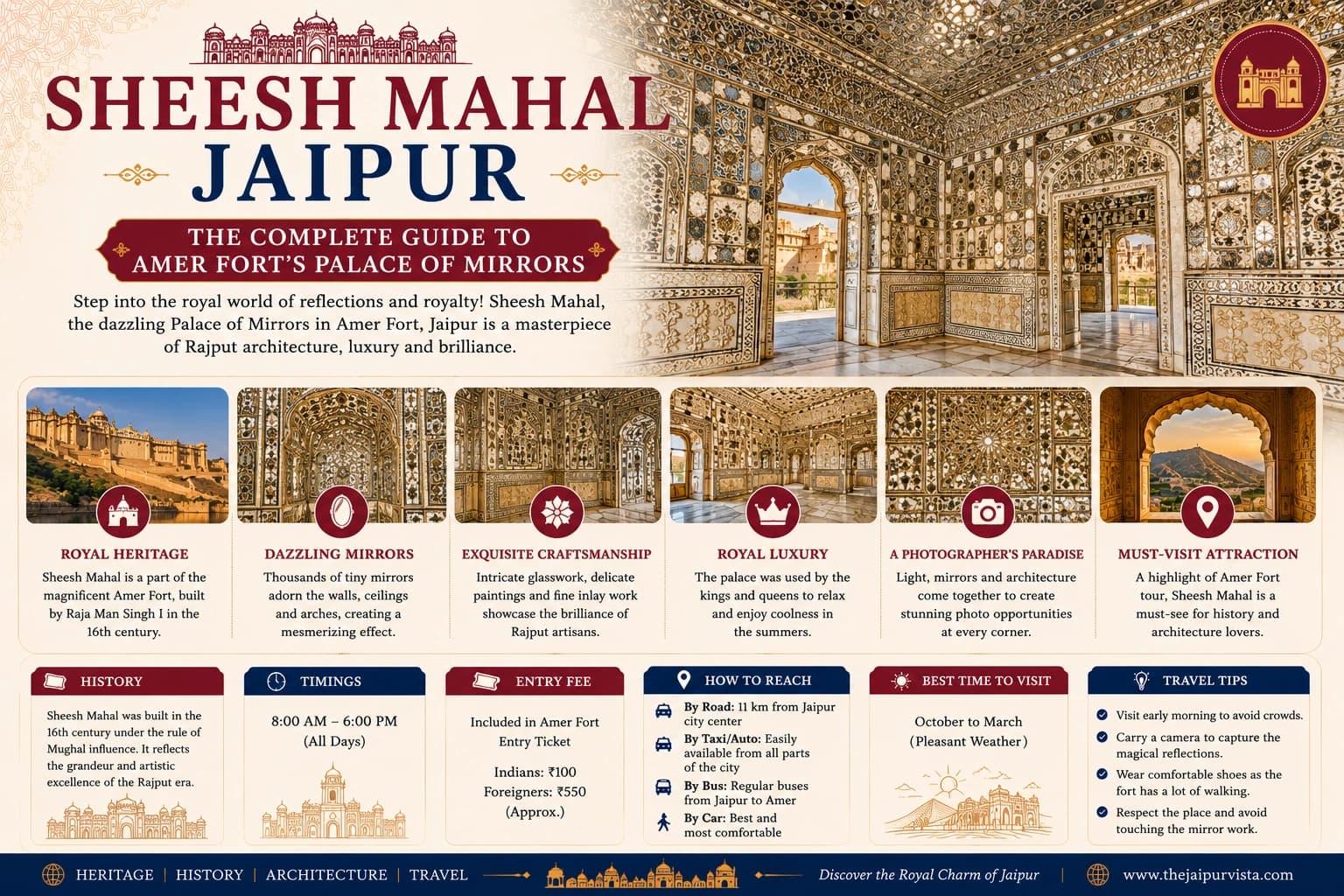
Light a single candle inside the Sheesh Mahal Jaipur and watch what happens.
That one flame -modest, quiet, no larger than a fingertip -multiplies. It catches in one mirror, leaps to another, fractures into a dozen, then a hundred, then a thousand. Within seconds the entire chamber is alive with reflected fire: a private galaxy of tiny stars conjured from a single point of light, flickering across a ceiling of glass mosaic that cost the artisans of the 17th century years of painstaking labour to create.
This is the moment that has reduced visitors to awed silence for over three centuries. This is why Maharaja Sawai Jai Singh I built the Sheesh Mahal inside Amer Fort. This is why it remains, without serious competition, the most breathtaking room in Rajasthan -and arguably in all of India.
Welcome to the Palace of Mirrors. At The Jaipur Vista, we have spent years exploring the heritage of the Pink City, and the Sheesh Mahal Jaipur never loses its power to astonish. In this complete guide, we bring you the full story of this extraordinary monument -its history, the legends woven into its creation, a detailed study of its architectural craftsmanship, the Belgian glass that makes it shine, practical visitor information for 2025, and an expert photography guide to help you capture it at its most magnificent. Sheesh Mahal -the name translates directly from Persian and Hindi as "Palace of Mirrors" or "Mirror Hall" -is a spectacular mirrored chamber located within the Jai Mandir complex on the upper level of Amer Fort (also spelled Amber Fort), situated 11 kilometres north of Jaipur city on the Delhi–Jaipur Highway in the Aravalli Hills. The Sheesh Mahal is widely regarded as the crown jewel of Amer Fort -itself a UNESCO World Heritage Site and one of the finest examples of Rajput military and palace architecture in India. While the fort contains numerous remarkable spaces -the Diwan-e-Aam, the Ganesh Pol gateway, the Sukh Niwas -none generates the visceral, immediate impact of stepping into the Sheesh Mahal for the first time. Every surface of the chamber -walls, ceiling, arches, pilasters, recessed niches -is encrusted with thousands of tiny convex mirror pieces set into intricate plaster patterns, alongside coloured glass inlay work, semi-precious stone floral motifs, and gilded stucco decoration. The effect is overwhelming: a room that appears, in candlelight or torchlight, to contain the entire night sky within its walls. The Sheesh Mahal Jaipur is not merely a decorative flourish. It represents the pinnacle of a specific and extraordinarily refined architectural and craft tradition -the confluence of Mughal decorative sophistication and Rajput artistic sensibility -that flourished in northern India during the 16th and 17th centuries and found its most perfect expression right here, in this room, in this fort, above the ancient town of Amer.What Is Sheesh Mahal Jaipur? An Introduction
Read Also: Birla Mandir Jaipur: Timings, Aarti Schedule, History & Complete Visitor Guide
To understand the Sheesh Mahal history, you must first understand the broader context of Amer Fort and the Kachhwaha dynasty that built it.
The Kachhwaha Rajputs established themselves in the Amer region around the 10th century CE, making Amer their capital for several centuries before Maharaja Sawai Jai Singh II moved the capital to newly built Jaipur in 1727. The fort complex at Amer was developed over multiple generations, with different rulers adding palaces, temples, gardens, and defensive works.
The principal construction of the Amer Fort palace complex as we see it today was carried out by Maharaja Man Singh I (r. 1589–1614 CE), a powerful general in the court of the Mughal Emperor Akbar, who used the considerable wealth and patronage flowing from his close relationship with the Mughal court to commission a palace complex of extraordinary scale and sophistication.
Man Singh I began the tradition of commissioning craftsmen trained in both Rajput and Mughal artistic traditions -a creative fusion that would define Amer's architectural character for generations. He built the original Shila Devi Temple within the fort and laid the foundations for much of the northern palace complex. The Sheesh Mahal specifically was built by Maharaja Jai Singh I (also known as Mirza Raja Jai Singh I, r. 1621–1667 CE) -a ruler of extraordinary political skill and cultural refinement who navigated the complex politics of the Mughal court under three emperors (Jahangir, Shah Jahan, and Aurangzeb) while simultaneously transforming Amer into one of the most architecturally distinguished capitals in Rajputana. Maharaja Jai Singh I is the ruler most closely associated with the grand residential palace complex of Amer Fort -including the Diwan-e-Khas (Hall of Private Audience), the Jai Mandir (Temple of Victory), the Sukh Niwas (Hall of Pleasure), and most magnificently, the Sheesh Mahal within the Jai Mandir. Construction of the Sheesh Mahal Jaipur is generally dated to around 1621–1627 CE, during the early years of Jai Singh I's reign, though embellishment and refinement of the interior continued for several decades. The chamber was conceived as the private sleeping and meditation chamber of the Maharaja and his queens -a supremely intimate space in which the royal household could retreat from the public functions of the fort. The completion of the broader Amer Fort complex, of which the Sheesh Mahal forms the centrepiece, is generally considered to have concluded around 1727 CE -coincidentally (or perhaps symbolically) the same year that Maharaja Sawai Jai Singh II founded Jaipur city and the Kachhwaha capital moved permanently to the new city. No account of the Sheesh Mahal history is complete without the legend that has been passed down through generations of Rajasthani oral tradition. The story goes that the queens of Amer Fort were bound by the purdah system -the tradition of seclusion that required royal women to remain within the private apartments of the palace and refrain from venturing outside after nightfall. As a result, the queens were unable to sleep in the open courtyards or on the terraces of the fort, which would have allowed them to see the night sky. One of the queens expressed a deep longing to Maharaja Jai Singh I -she wished to see the stars and the moon as she fell asleep each night. She wished to feel the night sky above her even within the walls of her chamber. The Maharaja, moved by her request, summoned his master craftsmen and commanded them to create a ceiling that would bring the night sky inside the royal bedchamber. The craftsmen responded with a creation that exceeded all expectation: the Sheesh Mahal -a chamber whose ceiling and walls, covered in thousands of tiny convex mirrors and coloured glass pieces, would reflect the light of a single lamp into the likeness of a star-filled sky. Whether the legend is historically literal or metaphorically true, it captures something essential about the Sheesh Mahal -this is a space created by a king, for love, to bring the infinite inside four walls. The Sheesh Mahal is, first and foremost, a triumph of architectural craft -a room where the intellectual traditions of Indo-Islamic decorative art, the emotional intensity of Rajput aesthetic sensibility, and the technical mastery of some of the finest artisans of the 17th century converge in a single space. The Sheesh Mahal is located within the Jai Mandir (Temple of Victory) complex on the western side of the fort's third courtyard -the private residential level of the palace. This is the most elevated and most protected section of the entire fort, accessible only through the ceremonial Ganesh Pol gateway and reserved in historical times exclusively for the royal family and their most intimate courtiers. The Jai Mandir itself is a raised hall opening onto a large, flat terrace with sweeping views of the Maota Lake below and the Aravalli Hills beyond. The Sheesh Mahal occupies the primary inner chamber of the Jai Mandir -a rectangular room approximately 20 metres long and 6 metres wide, with a ceiling height of approximately 5 metres at the highest point of the vaulted arches. The defining element of the Sheesh Mahal -and the source of its enduring fame -is the extraordinary mirror mosaic work that covers virtually every surface. This decorative technique is known in the Indo-Persian architectural tradition as aīna kārī (mirror work) and represents one of the most labour-intensive and technically demanding forms of decorative craftsmanship ever developed. The Belgian Glass Connection One of the most fascinating facts about the Sheesh Mahal Jaipur is that the mirrors embedded in its walls and ceiling are not of Indian origin. They are imported Belgian glass mirrors -brought from Europe to Rajasthan in the 17th century, a testament to both the extraordinary wealth of the Kachhwaha rulers and the well-established trade networks that connected Mughal India to Europe during this period. Belgian glass was prized across the Mughal and Rajput courts for its exceptional clarity, uniformity, and reflective quality -far superior to the glass mirrors that could be produced locally in India at the time. The Maharaja's craftsmen took these imported Belgian glass sheets and cut them into the thousands of small convex pieces -typically circular, oval, hexagonal, and floral in shape -that were then individually set into the plaster surface of the walls and ceiling. Each convex mirror piece was positioned at a very slightly different angle to its neighbours -a technically precise arrangement that maximises the scatter and multiplication of reflected light, ensuring that a single light source produces the maximum possible number of reflections throughout the chamber. The Plasterwork Setting The mirrors are set within an elaborate framework of lime plaster arabesques -intricate geometric and floral patterns executed in the traditional gachwork (fine lime plaster) technique that was the standard medium for high-quality decorative work in Mughal-Rajput palace interiors. The plasterwork patterns between the mirror pieces are themselves works of great refinement: flowing vine patterns, stylised lotus blooms, geometric star forms, and Persian arabesque scrollwork, all executed with extraordinary precision in fine white and tinted plaster. Many sections incorporate additional ornamentation in the form of semi-precious stone inlay (a technique known as pietra dura in the Mughal tradition, adopted enthusiastically by Rajput craftsmen) -with floral bouquets and birds rendered in carnelian, lapis lazuli, jade, and other stones embedded directly into the plaster surface. The Coloured Glass Work Alongside the mirror mosaic, several sections of the Sheesh Mahal walls feature coloured glass inlay in deep blues, greens, yellows, and reds -creating stained-glass-like panels within the overall mirror composition. When light passes through these coloured glass sections, it casts coloured reflections across the chamber interior, adding to the kaleidoscopic effect. Among the many remarkable details of Sheesh Mahal Amer Fort, one in particular has been famous for centuries and is invariably cited by local guides and scholars: a carved stone pillar near the entrance to the chamber that features, at its base, a sculpted flower blossom -apparently a single bloom, executed in multiple-coloured stone -that appears to change colour as you shift your viewing angle. This colour-changing flower pillar is an extraordinary demonstration of the Rajput craftsmen's mastery of both carving technique and material knowledge: the flower was carved across multiple layers of differently coloured stone so that different facets of the carved surface expose different mineral layers, producing the illusion of colour transformation with changing angles of light. The ceiling of the Sheesh Mahal Jaipur is widely regarded as its single most spectacular element. The vault is divided into a series of decorated bays by arched ribs, and every surface between and across these ribs is completely covered in the convex mirror mosaic. When the chamber is lit -traditionally by oil lamps or candles, and now, for demonstration purposes, by a single torchlight held by the guide -the ceiling creates the effect that inspired the legend of the queen and the stars. The thousands of slightly differently angled mirror surfaces scatter the single point of light in thousands of distinct directions, simultaneously, creating the unmistakable impression of being beneath a starlit sky. The geometry of the vault is also carefully calculated to maximise the acoustic properties of the space -whispers spoken at one end of the chamber can be heard clearly at the other end, a feature that would have had obvious practical and intimate appeal in a royal bedchamber. The Sheesh Mahal is a perfect physical embodiment of the cultural synthesis that made Amer Fort's architecture so distinctive. The structural planning and the overall layout of the Jai Mandir complex follow Mughal palace planning conventions -the sequenced progression from public to private space, the flat terraced rooflines, the use of red sandstone for structural elements and white marble for the most refined interiors. But the ornamental vocabulary -the mirror work, the indigenous floral imagery, the use of local stone, the intensity of the decorative programme -is deeply Rajput in character, rooted in the Rajasthani aesthetic traditions that valued surface richness, colour, and the play of light. The Sheesh Mahal took the mirror work traditions that had already appeared in Mughal interiors (notably at the Agra Fort and at Lahore) and transformed them into something more complete, more immersive, and more overwhelming than anything the Mughals had attempted. This was a Rajput response to Mughal influence -taking an imported idea and surpassing its originators. The Sheesh Mahal is located inside Amer Fort, and entry to the Sheesh Mahal is covered by the Amer Fort entry ticket. There is no separate standalone ticket for the Sheesh Mahal. Note: Ticket prices are set by the Archaeological Survey of India (ASI) and the Rajasthan government, and are subject to periodic revision. We recommend confirming current prices at the official Amer Fort ticket counter or via the ASI website before your visit. Additional Charges: Camera/Photography fee: A still camera fee may be applicable inside certain areas of the fort -confirm at the ticket window. Smartphones are generally allowed for photography throughout. Audio guide: Available in multiple languages at an additional charge. Highly recommended for the Sheesh Mahal and the broader Amer Fort complex. Light and Sound Show: A separate ticketed event held in the evenings at Amer Fort. This is one of the best ways to experience the fort's grandeur after dark. The Sheesh Mahal is open every day of the week. Amer Fort does not observe a weekly closure. Important Note on Access: As of the most recent visitor reports, direct entry into the Sheesh Mahal chamber itself may be restricted to viewing through the doorway -the interior is not always fully open for visitors to walk through, in order to preserve the delicate mirror work. Confirm the current access policy with fort guides or the ASI office at the entrance, as this can change. By Season: October to March (Strongly Recommended): This is the best time to visit Amer Fort and the Sheesh Mahal Jaipur by a considerable margin. The weather is cool and pleasant -daytime temperatures range from 10°C to 25°C -making the walk up to the fort comfortable and the extended exploration of the palace apartments enjoyable. The winter light in Jaipur is exceptionally clear, making the mirror reflections in the Sheesh Mahal particularly vivid. April to June (Challenging): The Rajasthani summer is intense, with temperatures regularly exceeding 40°C. The fort, built largely of stone, absorbs and radiates heat significantly. Visiting is possible but should be restricted to the very early morning (opening at 7:00 AM) for comfort. The light at this time of year can also be very harsh. July to September (Monsoon): The monsoon transforms the Aravalli Hills around Amer into lush green landscapes that are genuinely beautiful. Humidity is high but temperatures are more moderate than summer. The fort and the Sheesh Mahal are open as normal, though some exterior paths can be slippery after rain. By Time of Day: Early Morning (7:00 AM – 9:30 AM): The ideal time. The fort is quiet, the light is gentle and directional, and the mirror reflections have a warm, golden character. Tour groups and large crowds typically do not arrive until after 9:30 AM. Late Afternoon and Evening (4:00 PM – 6:00 PM): Another excellent window. The afternoon light coming from the west creates a different quality of illumination in the Sheesh Mahal, casting long shadows through the arched doorways and creating dramatic contrasts. The fort is also quieter in the last two hours before closing. Midday (11:00 AM – 3:00 PM): The busiest and least pleasant time. Large tour groups, intense heat (in most months), and flat overhead light combine to make this the least rewarding window for a Sheesh Mahal visit. The Sheesh Mahal is located inside Amer Fort, which is situated 11 km north of Jaipur city centre on the Delhi–Jaipur Highway (NH-48). The most common starting point for tourists. By taxi or Ola/Uber: approximately 25-35 minutes depending on traffic. The route takes you through the old city and then north along the Amer Road, passing Jal Mahal on the way. Approximately 10-12 km by road. By taxi: 25-35 minutes. By auto-rickshaw: possible but the journey is long and can be uncomfortable; taxis are recommended. Approximately 22 km by road. By taxi: approximately 45-60 minutes depending on traffic. Regular city buses run from various points in central Jaipur to Amer. Bus No. 10 operates from Chandpol to Amber and is a popular option for budget travellers. Journey time is approximately 45-60 minutes. Auto-rickshaws can take you to Amer from central Jaipur but are best suited for the one-way journey. The return from Amer by auto can sometimes be difficult as fewer autos wait at the fort. Book a return taxi or cab through an app to avoid being stranded. Once inside the Amer Fort complex, reaching the Sheesh Mahal Jaipur requires navigating through the fort's sequential courtyard structure. Here is the step-by-step route: Step 1 -Enter through Suraj Pol (Sun Gate): The main entrance to the fort, on the eastern side. After buying your ticket and entering, you enter Jaleb Chowk (the outer courtyard), where elephant rides are available. Step 2 -Ascend to the upper level: From Jaleb Chowk, climb the broad stone ramp or stairway to reach the second courtyard level. Step 3 -Pass through Ganesh Pol: The breathtakingly painted ceremonial gateway of the fort -itself a masterwork of decorated architecture -leads you from the second courtyard into the third courtyard, which is the private residential level. Step 4 -Locate the Jai Mandir: On the left (western) side of the third courtyard is the Jai Mandir -the Temple of Victory. The Sheesh Mahal is the inner chamber of the Jai Mandir. The walk from the entrance to the Sheesh Mahal typically takes 15-20 minutes at a comfortable pace, including climbing the stone ramps between levels. Accessibility Note: The route to the Sheesh Mahal involves significant climbing on stone ramps and staircases. The surface is uneven in places. This may be challenging for visitors with mobility difficulties or young children in prams. The Sheesh Mahal is one of the most challenging -and most rewarding -interior photography subjects in India. Here is how to approach it. The Sheesh Mahal is an interior space with relatively low ambient light and extraordinarily complex, multi-reflective surfaces. Modern cameras and smartphones have made remarkable advances in low-light performance, but the Sheesh Mahal still requires some preparation. What makes it difficult: The mirror surfaces reflect light sources (windows, cameras, lamp guides) directly back into your lens, creating bright spots and blown highlights The room is dark enough that standard phone cameras will default to their "Night Mode" or increase ISO dramatically, potentially introducing noise The sheer complexity of the mirror surface makes it difficult for autofocus systems to find a clean focal point What makes it extraordinary: The candlelight / torchlight demonstration by the guide (ask specifically for this if your guide does not automatically perform it) creates the single most photogenic moment in the entire fort The quality of reflected light in the mirrors is unlike anything else in Indian architectural photography The architectural details of the plasterwork, columns, and stone carving are magnificent in close-up The Doorway Frame Shot: Standing outside the Sheesh Mahal and framing the interior through the decorated archway of the entrance creates an excellent architectural composition that works even in challenging light conditions. The Ceiling Upward Shot: Lie on your back or hold your camera directly overhead (smartphone portrait mode, portrait orientation) and photograph the mirrored ceiling. This is the most iconic Sheesh Mahal photo and the one that most dramatically conveys the scale of the mirror work. Use the widest lens angle available. The Candlelight Reflection Shot: When the guide lights a candle or torch in the darkened chamber, switch to Night Mode on your smartphone or set a longer exposure on a camera (ISO 1600-3200, shutter speed 1/15 – 1/4 second for a camera; Night Mode automatic for most smartphones). The image you capture of a thousand reflected flames across the mirrored ceiling is the defining Sheesh Mahal Jaipur photo. The Column Floral Detail Shot: Find the famous colour-changing flower column near the entrance and photograph it from multiple angles, noting how the apparent colour of the carved flower changes. A macro shot of this detail rewards close inspection. The Arch Plasterwork Shot: The decorated archways leading into the Sheesh Mahal feature intricate plasterwork and mirror inlay that make excellent close-up detail photographs. Smartphone: Modern flagship phones (iPhone 15/16, Samsung Galaxy S24/S25, Pixel 8/9) perform excellently in the Sheesh Mahal using their Night Mode features. Enable Night Mode proactively before entering. DSLR/Mirrorless Camera: A wide-angle lens (14-24mm range) is ideal. Bring a fast lens (f/1.8 or f/2.8) to maximise light capture. A small portable tripod or beanbag support will help for the ceiling shots and candlelight exposure. Tripods: Full-size tripods may not be permitted inside the fort -check at the entrance. Small, flexible mini-tripods are usually uncontested. Flash: Do not use flash photography inside the Sheesh Mahal. It destroys the atmosphere, reflects harshly off the mirrors, and is disrespectful to other visitors. While the Sheesh Mahal is the centrepiece, Amer Fort contains numerous other remarkable spaces that deserve your time: The ceremonial gateway between the second and third courtyards of the fort, Ganesh Pol is one of the finest painted gateways in all of Rajput architecture. Every surface -including the exterior, the jaali (lattice screen) windows of the queens' gallery above, and the passages through the gate -is covered in vivid fresco paintings of flowers, elephants, divine figures, and geometric patterns. The gate takes its name from a Ganesha image above the central arch. It is an essential photo stop. Directly opposite the Jai Mandir across the private courtyard, the Sukh Niwas (Palace of Comfort) was the summer retreat of the Maharaja. Its most famous feature is an ingenious ancient air-conditioning system: channels cut through the walls and floor carried water pumped from Maota Lake below, over a khas grass (vetiver) screen, so that air passing into the rooms was naturally cooled and pleasantly scented. The sandal-wood doors with ivory inlay are particularly magnificent. The Diwan-e-Khas is where the Maharaja held confidential meetings with his most trusted ministers and high-ranking nobles. The hall features elaborate mirror work, pietra dura stone inlay panels, and finely carved sandstone columns -a more austere but equally refined expression of the same craft tradition visible in the Sheesh Mahal. On the second level of the fort, the Diwan-e-Aam is the great public hall where the Maharaja received petitions and conducted open court. A double row of columns with elephant-head capitals supports the covered hall, which opens onto the main courtyard. The proportions are magnificent. Located in the ground level of the first courtyard (Jaleb Chowk), the Shila Devi Temple is dedicated to Goddess Shila Devi (a manifestation of Durga) and is one of the most important religious sites within Amer Fort. The temple houses a black stone idol brought from Bengal by Maharaja Man Singh I. The temple is particularly busy during Navratri when thousands of devotees visit. The fort's ramparts offer spectacular views of Maota Lake below -the artificially constructed lake that supplied the fort's water and whose reflective surface creates the iconic postcard image of Amer Fort. The surrounding gardens in the Maota Lake area, including the Dilaram Bagh, are worth exploring. The term Sheesh Mahal (Palace of Mirrors) is used for several mirrored halls in Rajasthan, and visitors sometimes wonder how the Sheesh Mahal Jaipur at Amer compares with its counterparts. Sheesh Mahal, City Palace Jaipur: Located within the City Palace complex in central Jaipur, this is a separate Sheesh Mahal that is sometimes confused with the Amer Fort version. The City Palace Sheesh Mahal is part of the Chandra Mahal (the seven-storey palace still used by the Jaipur royal family). It is generally not open to regular visitors. Sheesh Mahal, Agra Fort: The Agra Fort also contains a mirrored hall built by Shah Jahan, and it is frequently cited as an influence on -and comparison point for -the Sheesh Mahal Jaipur at Amer. The Amer version is generally considered more elaborate and more complete in its mirror coverage. Sheesh Mahal, Lahore Fort (Pakistan): Shah Jahan also built a Shish Mahal (alternative spelling) at Lahore Fort, which is considered one of the finest surviving examples of Mughal mirror-work architecture. The comparison between the Lahore and Amer Sheesh Mahal is a fascinating study in the parallel development of this decorative tradition across the Mughal empire. Sheesh Mahal, Amber Palace vs. Others: Among all the Sheesh Mahals of Rajasthan and northern India, the Sheesh Mahal at Amer Fort Jaipur is most frequently ranked by scholars and architectural historians as the finest example -combining the greatest surface coverage, the most sophisticated plasterwork setting, the highest quality of imported Belgian glass, and the most complete integration with its architectural context. One of the most recommended experiences related to the Sheesh Mahal Jaipur is the Amer Fort Light and Sound Show held in the evenings in the Jaleb Chowk (outer courtyard) of the fort. The show narrates the history of the Kachhwaha dynasty and the Amer Fort complex -including the story of the Sheesh Mahal and its legendary creation -through dramatic lighting, projected imagery, and a narrated soundtrack in Hindi and English. Light and Sound Show Timings: Hindi show: Generally at 7:30 PM English show: Generally at 8:30 PM (Times may vary seasonally -confirm at the fort ticket office or with your hotel concierge before visiting) Why it is Worth Attending: The show illuminates the exterior of the fort in dramatic colours and uses the architecture itself as a canvas for the light projections. The narration provides historical context that enriches your understanding of what you saw during the daytime visit to the Sheesh Mahal and the rest of the fort. The entire experience takes approximately 50 minutes. Here are some of the most fascinating and lesser-known facts about the Sheesh Mahal that most general guides do not mention: The Mirrors are Convex, Not Flat: Unlike modern flat mirrors, the mirror pieces set into the Sheesh Mahal walls and ceiling are convex -slightly curved outward. This is a deliberate choice: convex mirrors scatter light in a wider arc than flat mirrors, producing a more diffuse and star-like pattern of reflections rather than the sharp, directional reflections of flat glass. Hundreds of Artisans Over Decades: According to architectural historians, the creation of the Sheesh Mahal likely employed hundreds of master craftsmen and their assistants over a period of several decades. The aīna kārī (mirror work) technique requires the individual hand-setting of each mirror piece into wet plaster at a precisely calibrated angle -a process that cannot be rushed or mechanised. The Room Has Natural Acoustic Properties: The vaulted ceiling and the reflective surface of the mirrors give the Sheesh Mahal remarkable acoustic properties -sounds made at one end of the chamber can be heard clearly at the other end, even when spoken softly. This whisper-gallery effect was another source of wonder for royal residents and their guests. The Light Demonstration Uses Only One Source: The guide's demonstration of the candle/torch effect in the darkened Sheesh Mahal uses a single light source. The thousands of apparent lights you see are all reflections of that one source -multiplied by the mathematical arrangement of the mirror surfaces. This single fact conveys the extraordinary intelligence of the craftsmen who designed the room. The Plasterwork Contains Natural Pigments: The coloured sections of the plasterwork in the Sheesh Mahal were made using natural mineral pigments -lapis lazuli for blue, malachite for green, vermillion for red, turmeric for yellow -in the same tradition as the frescoes found in other Rajput palace interiors. These pigments have remarkable longevity, which is why the colours remain vivid after nearly four centuries. Belgian Glass in 17th-Century Rajasthan: The fact that the Sheesh Mahal was built using imported Belgian glass mirrors in the early 17th century is a striking testament to the global trade connections of the Mughal empire. Belgian glass workshops were known across Europe and the Middle East for the quality of their products, and the Mughal court's extensive maritime and overland trade networks made importing such materials from Europe entirely feasible. Beyond the pure experience of the Sheesh Mahal itself, here are the most rewarding activities during your visit to Amer Fort: Take the Guided Tour: A knowledgeable local guide will significantly enrich your experience of the Sheesh Mahal. They will know which pillars have the famous colour-changing flower, which sections of the fresco programme are most significant, and -most importantly -they will perform the candle/torch light demonstration that transforms the room into a galaxy of reflections. Always hire a government-certified guide from the main entrance. Explore the Full Fort Circuit: Most visitors spend 2-3 hours at Amer Fort but could easily fill a half day. Give yourself time to explore the lower temples, the outer ramparts, the Maota Lake gardens, and the various galleries and exhibitions within the fort complex. Attend the Light and Sound Show: As described above -an excellent complement to the daytime fort visit, and a particularly evocative way to hear the story of the Sheesh Mahal and the Kachhwaha dynasty. Walk the Rampart Trail to Jaigarh Fort: For the physically adventurous, a walking path along the Aravalli ridge connects Amer Fort to Jaigarh Fort above it -a walk of approximately 1.5 km with spectacular views. Jaigarh contains the world's largest wheeled cannon (Jaivana) and is architecturally fascinating in its own right. Photograph the Fort from Maota Lake: Some of the best exterior photographs of Amer Fort are taken from the road level, looking across Maota Lake at the fort's southern facade reflected in the water. This is the quintessential Amer Fort image and is best captured in the early morning when the lake is still. Q. What is Sheesh Mahal in Jaipur? Q. Who built Sheesh Mahal in Jaipur? Q. What is the entry fee for Sheesh Mahal Jaipur? Q. What are the timings of Sheesh Mahal Jaipur? Q. Why is it called Sheesh Mahal? Q. What are the mirrors in Sheesh Mahal made of? Q. What is the best time to visit Sheesh Mahal Jaipur? Q. Is the Sheesh Mahal inside Amer Fort? Q. Can I take photos inside Sheesh Mahal Jaipur? Q. How do I get from Sheesh Mahal to City Palace Jaipur? There are monuments you visit and forget within a week. There are monuments that stay with you for years. The Sheesh Mahal Jaipur belongs to the second category -but it earns its place there in a way that is remarkably personal, almost intimate. Because the moment that defines your experience of the Sheesh Mahal is not a sweeping panorama or a grand architectural vista. It is a small, quiet moment: a guide lights a single candle in a darkened room, and suddenly you are standing beneath a sky of a thousand stars that were not there a second ago, and you understand -in your body as much as your mind -what it meant for a king to have tried to bring the infinite inside four walls, for love.Maharaja Jai Singh I and the Creation of Sheesh Mahal
The Legend of the Queen and the Stars
Sheesh Mahal Architecture: A Master Class in Craftsmanship
Location Within Amer Fort
The Mirror Work: Belgium, Rajasthan, and the Art of Aīna Kārī
The Pillars and Their Extraordinary Flower
The Vaulted Ceiling: A Sky of Glass
Mughal Meets Rajput: The Architectural Synthesis
Sheesh Mahal Entry Fee and Timings 2025
Entry Fee for Sheesh Mahal Jaipur
Sheesh Mahal Timings
Best Time to Visit Sheesh Mahal Jaipur
How to Reach Sheesh Mahal, Amer Fort, Jaipur
From Jaipur City Centre (City Palace / Hawa Mahal)
From Jaipur Railway Station
From Jaipur International Airport
By Bus (RSRTC)
By Auto-Rickshaw
Getting to Sheesh Mahal From Within Amer Fort
Sheesh Mahal Photos: The Complete Photography Guide
The Core Challenge: Low Light, High Contrast
Best Photography Positions in Sheesh Mahal
Equipment Tips
What to See Near Sheesh Mahal in Amer Fort
Ganesh Pol (Elephant Gate)
Sukh Niwas (Hall of Pleasure)
Diwan-e-Khas (Hall of Private Audience)
Diwan-e-Aam (Hall of Public Audience)
Shila Devi Temple
Maota Lake and the View from the Ramparts
Other Sheesh Mahals in Rajasthan: A Comparison
The Amer Fort Light and Sound Show: Experiencing Sheesh Mahal After Dark
Interesting Facts About Sheesh Mahal Jaipur
Things to Do at Sheesh Mahal and Amer Fort
Frequently Asked Questions: Sheesh Mahal Jaipur
The Sheesh Mahal Jaipur is a mirrored palace chamber located inside Amer Fort (Amber Fort), 11 km from Jaipur city. Also known as the Palace of Mirrors, it is covered entirely in thousands of convex mirror pieces and coloured glass set into intricate plaster patterns -creating a room that reflects a single candle flame into thousands of starlike points of light.
The Sheesh Mahal at Amer Fort was built by Maharaja Jai Singh I (Mirza Raja Jai Singh I, r. 1621–1667 CE) of the Kachhwaha dynasty, during the early to mid-17th century. The broader Amer Fort complex was developed by multiple rulers over several generations, with Maharaja Man Singh I beginning the major palace construction in the late 16th century.
Entry to the Sheesh Mahal is included with the Amer Fort entry ticket: ₹100 for Indian nationals and ₹500 for foreign tourists (subject to revision -confirm at the ticket counter before visiting).
The Sheesh Mahal is accessible during Amer Fort's opening hours: 7:00 AM to 9:00 PM, seven days a week.
Sheesh is a Persian and Hindi word for mirror or glass, and Mahal means palace. The name "Sheesh Mahal" -Palace of Mirrors or Mirror Hall -refers to the extraordinary mirror-encrusted walls and ceiling that are the chamber's defining feature.
The mirrors in the Sheesh Mahal Jaipur are made from imported Belgian glass -brought from Europe to Rajasthan in the 17th century. They are small, individually hand-set convex pieces, mounted at calculated angles to maximise light reflection.
The best season is October to March, when weather is pleasantly cool. The best time of day is early morning (7:00 AM – 9:30 AM) for minimal crowds and beautiful light.
Yes. The Sheesh Mahal is located within the Jai Mandir (Temple of Victory) complex on the upper residential level of Amer Fort (Amber Fort), Jaipur. You need to purchase an Amer Fort ticket to access it.
Smartphone photography is generally permitted. A camera fee may apply for professional cameras. Flash photography is not permitted inside the Sheesh Mahal. Ask your guide to perform the candle/torch light demonstration for the most memorable photographs.
From Amer Fort (where the Sheesh Mahal is located), the City Palace is approximately 11 km south by the Amer Road. By taxi or Ola/Uber, the journey takes approximately 25-35 minutes through the city.Final Word: The Palace of Mirrors and the Memory It Creates
That is what Rajasthan does better than anywhere else on earth: it builds beauty that you do not merely see but feel. And nowhere in Rajasthan is that truth more fully demonstrated than in the Sheesh Mahal.